Btw, a fun fact about ML and contex mixing - all the time at the end of school and the beginning of university, I was fascinated by data compression and algorithmic codecs. This is essentially how I started my career as a C developer. There's one fun fact about compression that just occurred to me: the legendary Matt Mahoney, who created the most powerful algorithmic coder and founded the PAQ family, variations of which constantly won the Hutter Prize for data compression, essentially laid the foundation for the concept of ML through data compression, since algorithmic codecs are built on predictive models and sigmoid functions for constructing frequency context models based on the data type. So, what I'm getting at is that in our "narrow" circle of those involved in this topic, there was a clear justification for what AGI is expressed through data compression. As you know - you can't bypass the Shannon limit, that's a hard math law. However, the Shannon limit is bound to a specific predictive model. If an algorithmic codec can build such a profound, context aware model of the world that its 'guessing' pushes the practical compression down to the data's absolute, intrinsic complexity, that might just be the key to unlocking AGI.
If you want to start approaching AGI, you need to pay attention to data compression, bc if a context codec model can "decompress" and predict and compress the full context of Wikipedia (which in a compressed format has entropy practically within the limits of Shannon), then this may mean that one of the most important steps towards AGI has been made.
PVAC-HFHE uses our own version of algorithmic mixing to compress public keys for the HFHE engine. You can see it here: https://t.co/saI0ADcdXF
Now that we're head over heels in working on circles in @octra with the goal of bringing interesting use cases, this has made sense again and we've developed a passion for trying out new hypotheses. So yes, one of the new directions for octra is ML and contextual transformation, because the treechain structure and data model are perfectly compatible with the goals of ML inference. We'll continue working on this (I think every day now) and will report if we find anything interesting.
hello everyone, a new mini-announcement regarding circles and the private web services protocol on octra
as you've probably seen more than once, we've always referred to octra as being more than just a treechain, but a full fledged network, and so on
well, that is indeed true, today i'd like to give a brief introduction to the concept of circles, circles are a substrate with their own runtime and mem for programs and resources in the octra network, but they're not just a single tx point where the entire state considers your contract and operates on separate functions, circles are about something else: they're a truly first of its kind private substrate, where addressing, program runtime, publishing, sealed delivery, and wallet access all live in the same space. this can be compared, in part, to .onion resources: you can deploy anything in a circle, from a simple website, forum, web form, or checkout store with specific products, and anything else, to full fledged ml inference, complex apps, or entire program stacks
this is our attempt to reimagine the hidden internet (we're working on this concept from a security perspective), much faster than our beloved @torproject (160 kilo bytes per sec are a thing of the past), but here you won't find single exit nodes that could get you in trouble, we propose a new concept - disposable nodes for specific tasks that operate as unikernels without a full operating sys and are not touched by anyone or anything, an example of such a unikernel will be published separately with a full flow for your convenience
currently, circles are available as an alpha ver and a night build for a narrow scope of tasks, we are testing the flow and verifying network behavior
next week, additional tools for developing and comfortably deploying your circles will be available for everyone
among other things, webcli has been updated to give you access to these features, in addition, webcli security has been improved, several network connection issues have been fixed, and unlock flow issues have been resolved, including cases where an unresponsive rpc endpoint could block wallet unlock
please make sure to recompile your webcli (setup sh file if you're using linux or macos, setup.bat if, G-d forbid, you're using win)
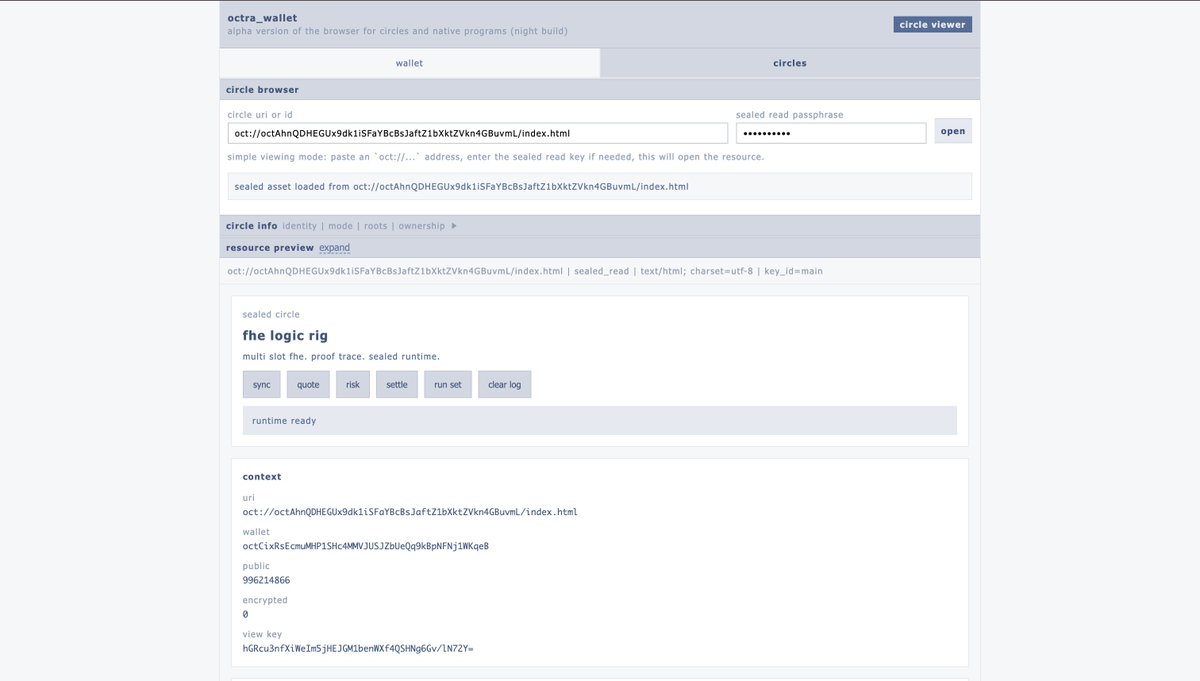
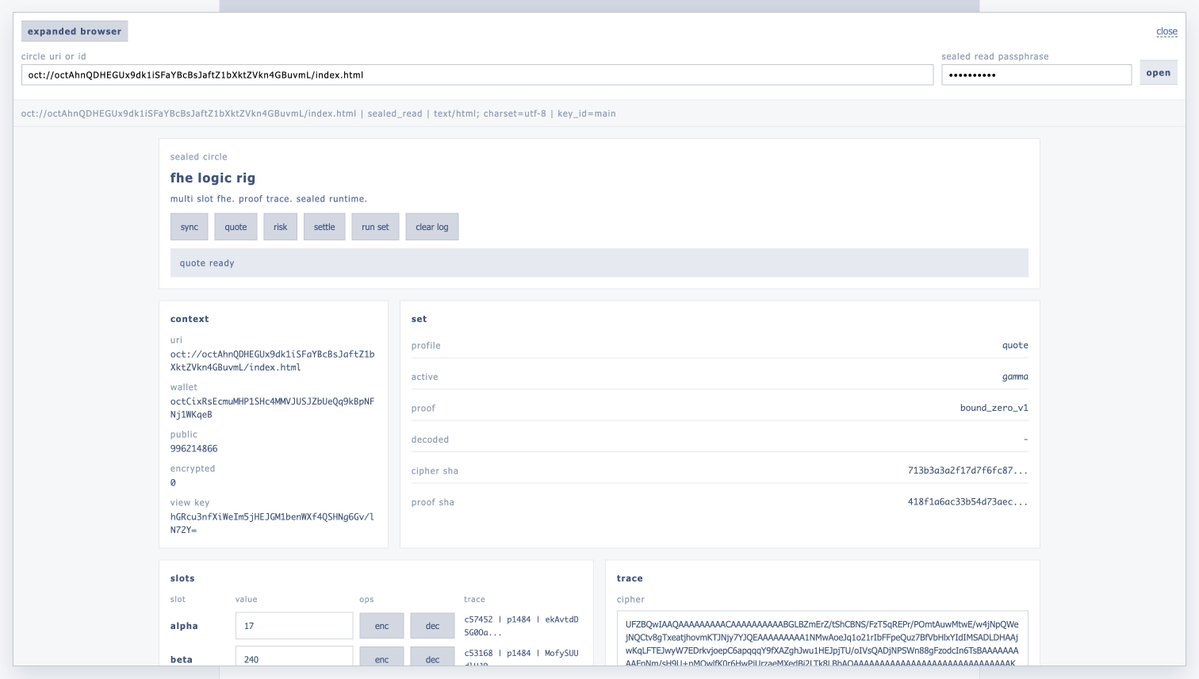
after building and running, you'll find a new menu item at the top: "circles" when you open it, you'll see a browser and an input field for entering the circle address, as well as a password field if the circle uses sealed delivery
for your convenience, we've deployed an example of such an application with an end to end fhe flow, you can explore it, next week will also be packed with nice mini-updates
thanks, everyone
refs:
- demo circle
https://t.co/XqW2vteD50
in circle browser pls use this entry:
oct://octAhnQDHEGUx9dk1iSFaYBcBsJaftZ1bXktZVkn4GBuvmL/index.html
pwd: circlepass
- webcli
https://t.co/UthSMTzPAI
mini-update: stealth withdrawals coming to the bridge, which will be available for @ethereum and @octra
anonymous bridging between the eth and octra networks will be added, BridgeVault program (octra side) will allow stealth txs to be sent without specifying the recipient (no one will be able to identify the recipient)
you will be able to bridge wOCT to the octra main network from Ethereum
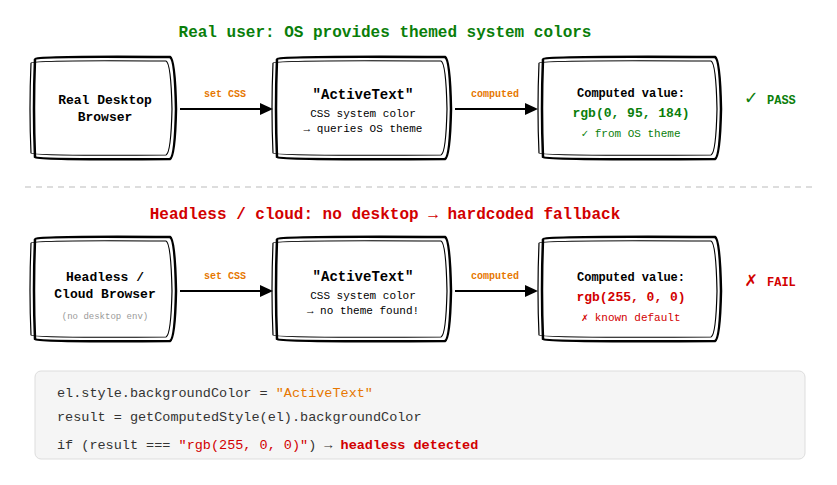
Your "stealth" browser gets detected by 3 lines of JavaScript.
Set background-color: ActiveText on a div. Read getComputedStyle().
ActiveText is a CSS system color, it pulls from your OS theme.
Real desktop? Unique themed color.
Headless cloud machine? Chromium returns its hardcoded default: rgb(255, 0, 0).
simple private transfers were solved a decade ago
octra devnet performs the full stealth transfer cycle in under 20 seconds, already faster than mainstream privacy solutions
the goal remains general-purpose encrypted compute, on all types of data, at scale
Seeing lots of similarities to the post FTX era;
- A potential technology ending crisis (i.e. quantum, files, etc...)
- Crypto native people pivoting to other industries in droves
- Several retail investors entering the market right before the crash (although much less than prev cycle)
@goodalexander i feel the need to point out that, with respect to number 6, we have been doubling q/q revenue for the past year working directly with frontier AI labs. the issue is more about apathy within the crypto circle itself & a focus on imaginary stories instead of what’s already there
it is sort of odd yet incredibly flattering that a lot of the crypto world believed our commercial success “too good to be true”. in either case, they have 3rd party validation now. congrats to the folks at @EV3ventures and @MessariCrypto for such a great report!
I asked clawdbot to scrape canada goose prices
it grabbed an unblocked browser, bypassed kasada antibot, scrolled to load everything, and handed me clean json in 47 seconds
skill is live on clawdhub if anyone wants it: https://t.co/KYcQSrXW2m
@steipete@openclaw@aibrowsers
"You mentioned you’re using "hypergraphs" to make this encrypted FHE stuff actually run fast instead of taking forever. How does it fix that?"
"It’s the abstraction layer Joe. We moved away from traditional DAGs because they can't handle the multidimensionality of ciphertexts in an FHE environment. By utilizing hypergraphs, we can perform parallel gate evaluations within the IEE (Isolated Execution Environment). We map the logic gates to hyperedges, allowing us to process complex WASM binaries across the network without decrypting a single bit. It’s... uh... high-dimensional concurrency."
"So it’s basically just doing a bunch of math at the same time? And you guys call it "Proof-of-Useful-Work"?"
"Right. PoUW. We don't waste cycles on SHA-256 hashing. The nodes provide computational power to perform bootstrapping on the ciphertexts. We use an ABFT (Asynchronous Byzantine Fault Tolerance) consensus to ensure state finality across the hypergraph. We also implement Circles which is a isolated sub-networks to localize the data load and prevent global congestion. It makes the overhead of FHE manageable for real-time applications. It’s just... math."