The difference between a good student and a great one is that a good student is concerned more about the outcome while a great one is fascinated by the process of learning.
-Dr. Richard P. Feynman
The difference between a good student and a great one is that a good student is concerned more about the outcome while a great one is fascinated by the process of learning.
-Richard P. Feynman
NEW: Mike Leach made the Hall of Fame ballot after criteria changes — but if he's getting in, John Majors should already be there 👀
Majors won 3 SEC titles and a natty. Leach never came close.
Read: https://t.co/7ooHA3Z8jF
The problem is not people being uneducated.
The problem is that people are educated just enough to believe what they have been taught, and not educated enough to question anything from what they have been taught.
—Professor Richard Feynman (must watch)
“AND YOU STILL DARE TO OPEN YOUR MOUTH…”
Sasha Legerman: This is too accurate not to share.
This Australian’s response to Trump’s rant that “NATO does nothing for America” is absolutely devastating:
“Mate. You run a country where 600,000 homeless people will sleep on the streets tonight.
A country where 40% of adults can’t cover a $400 emergency without borrowing money.
A country where insulin costs more than a car payment, and people ration it just to stay alive.
A country where medical debt is the number one cause of bankruptcy.
A country where women die in hospital parking lots because doctors are too afraid of abortion laws to treat miscarriages.
You imprison more of your own citizens than any country on Earth.
More than China. More than Russia. More than North Korea.
In the land of the free, 2 million people sit in cages, and a quarter of them haven’t even been convicted of anything.
They’re simply too poor to afford bail.
Your life expectancy is declining. You’re the only developed nation where that’s happening.
Your infant mortality rate is worse than Cuba’s.
Your children practice active shooter drills between math and English classes while you sell defense stocks to your friends.
Your minimum wage hasn’t changed in 15 years.
Your teachers work two jobs, your veterans sleep under bridges, and you just spent a trillion dollars flattening a country that never attacked you.
And now a convicted criminal — found liable for sexual abuse, defending a pedophile, sleeping with a porn star, and running the biggest dumpster-fire campaign since the Taliban — is thanking you for yet another disaster.
And you call Greenland badly governed?
Greenland has universal healthcare. Free education. One of the lowest incarceration rates in the world.
Nobody there goes bankrupt because they got sick. Nobody dies in a waiting room because insurance refused treatment.
‘NATO wasn’t there when we needed them.’
When exactly was that, champ?
September 11?
Because NATO invoked Article 5 for the first and only time in history FOR YOU.
Soldiers from dozens of countries deployed, fought, bled, and died in Afghanistan FOR YOU.
Australia wasn’t even in NATO, and we still showed up. For twenty years.
And then you left at 2 a.m. without telling anyone and left everybody else to clean up the mess.
You don’t care that a great nation is being terrorized by your friend, and you haven’t shown it a single ounce of sympathy.
So maybe before calling other countries badly governed, take a look at your own backyard, you aluminum siding salesman with a spray tan.
The only thing badly managed in this picture is your damn mouth.
And you still dare to lecture the rest of the world?”
Thousands of generations of humans lived and died never knowing what a sunset looked like anywhere but Earth.
You're in the first generation that doesn't have to.
This is a sunset on Mars.
140 million miles away from us.
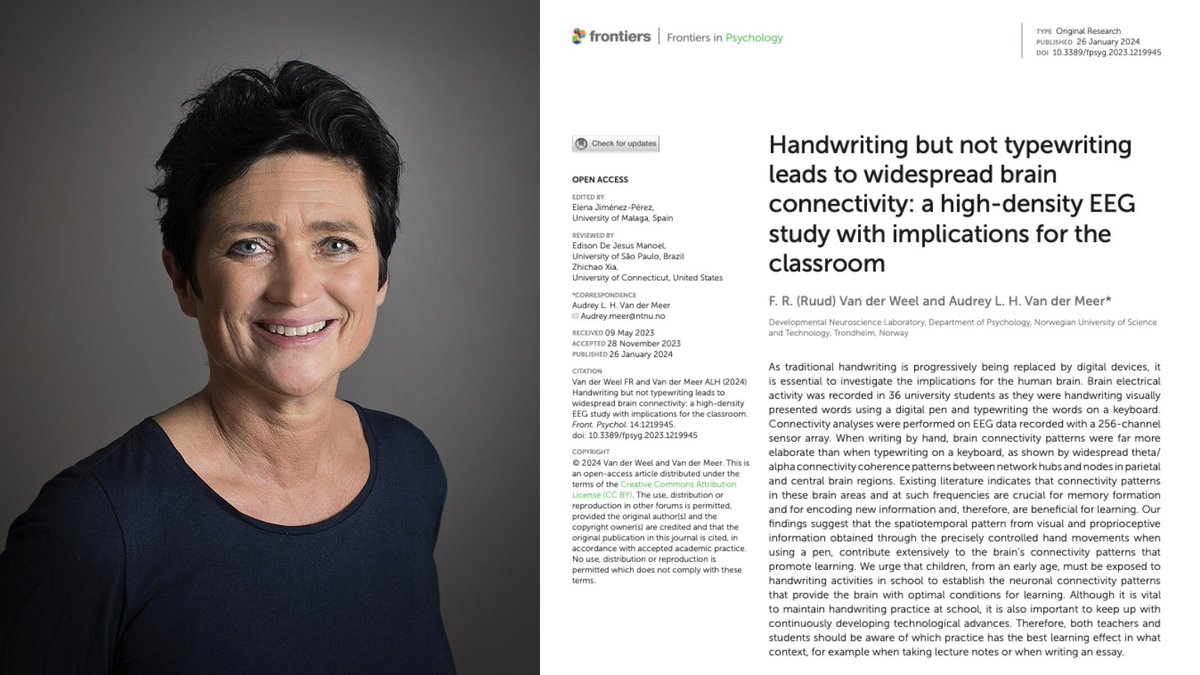
A Norwegian neuroscientist spent 20 years proving that the act of writing by hand changes the human brain in ways typing physically cannot, and almost nobody outside her field has read the paper.
Her name is Audrey van der Meer.
She runs a brain research lab in Trondheim, and the paper that closed the argument was published in 2024 in a journal called Frontiers in Psychology. The finding is brutal enough that it should have changed every classroom on Earth.
The experiment was simple. She recruited 36 university students and put each one in a cap with 256 sensors pressed against their scalp to record brain activity. Words flashed on a screen one at a time.
Sometimes the students wrote the word by hand on a touchscreen using a digital pen, and sometimes they typed the same word on a keyboard. Every neural response was recorded for the full five seconds the word stayed on screen.
Then her team looked at the part of the data most researchers had ignored for years, which is how different parts of the brain were communicating with each other during the task.
When the students wrote by hand, the brain lit up everywhere at once.
The regions responsible for memory, sensory integration, and the encoding of new information were all firing together in a coordinated pattern that spread across the entire cortex. The whole network was awake and connected.
When the same students typed the same word, that pattern collapsed almost completely.
Most of the brain went quiet, and the connections between regions that had been alive seconds earlier were nowhere to be found on the EEG.
Same word, same brain, same person, and two completely different neurological events.
The reason turned out to be something nobody had really paid attention to before her work. Writing by hand is not one motion but a sequence of thousands of tiny micro-movements coordinated with your eyes in real time, where each letter is a different shape that requires the brain to solve a slightly different spatial problem.
Your fingers, wrist, vision, and the parts of your brain that track position in space are all working together to produce one letter, then the next, then the next.
Typing throws all of that away. Every key on a keyboard requires the exact same finger motion regardless of which letter you are pressing, which means the brain has almost nothing to integrate and almost no problem to solve.
Van der Meer said it plainly in her interviews.
Pressing the same key with the same finger over and over does not stimulate the brain in any meaningful way, and she pointed out something that should scare every parent who handed their kid an iPad.
Children who learn to read and write on tablets often cannot tell letters like b and d apart, because they have never physically felt with their bodies what it takes to actually produce those letters on a page.
A decade before her, two researchers at Princeton ran the same fight using a completely different method and ended up at the same answer. Pam Mueller and Daniel Oppenheimer tested 327 students across three experiments, where half took notes on laptops with the internet disabled and half took notes by hand, before testing everyone on what they actually understood from the lectures they had watched.
The handwriting group won by a wide margin on every question that required real understanding rather than surface recall.
The reason was hiding in the transcripts of what the two groups had actually written down.
The laptop students typed almost word for word, capturing more total content but processing almost none of it as they went, while the handwriting students physically could not write fast enough to transcribe a lecture in real time, which forced them to listen carefully, decide what actually mattered, and put it in their own words on the page.
That single act of choosing what to keep was the learning itself, and the keyboard had quietly skipped the choosing and skipped the learning along with it.
Two studies. Two countries. Same answer.
Handwriting makes the brain work. Typing lets it coast.
Every note you have ever typed instead of written went into your brain through a thinner pipe. Every meeting, every book highlight, every idea you captured on your phone instead of on paper was processed at half depth.
You did not forget those things because your memory is bad. You forgot them because typing never woke the part of the brain that would have made them stick.
The fix is the thing your grandmother already knew.
Pick up a pen. Write the thing down. The slower road is the faster one.
A visual modeling of the Earth from the beginning of time to the present day.
A ma is a unit of time corresponding to 1 million years. The plate tectonics reconstruction is based on paleomagnetic data, although it may be imprecise. The temperature, atmospheric composition, and length of day that might have existed at that time are also shown.
The James Webb Space Telescope has done it again: revealing a breathtaking structure now dubbed the “Cosmic Vine”: a string of 20 galaxies stretching across a staggering 13 million light-years!
What makes this discovery so shocking? This colossal formation dates back nearly 11 billion years, forming just 3 billion years after the Big Bang, a time when galaxies were thought to still be forming in isolated clumps. Instead, JWST captured a massive, organized structure linking galaxies together much earlier than expected.
[image: artist's impression]
Richard Feynman ganó el Nobel de Física y dijo algo que dejó huella:
"La mayoría de personas saben muchas cosas. Pero no saben pensar."
Feynman dio una clase magistral de 1 hora sobre física e imaginación.
Sus 12 lecciones de vida:
1. La imaginación le gana al conocimiento
“The effort to understand the universe is one of the very few things that lifts human life a little above the level of farce and gives it some of the grace of tragedy.”
- Steven Weinberg
The First Three Minutes: A Modern View of the Origin of the Universe (1977).
A community college professor named Marty Lobdell taught the same study skills lecture for 30 years. The video quietly became one of the most watched educational recordings online, with over 10 million views.
He spent his career watching students fail not because they were lazy, but because no one had taught them how their brain actually works when learning something difficult.
The lecture, “Study Less Study Smart,” contains a powerful framework.
Your brain cannot sustain focus the way most people believe. Studies show the average learner hits a wall between 25 and 30 minutes. After that, efficiency collapses. You’re still sitting there, but almost nothing is being absorbed.
Lobdell told the story of a student who planned to study 6 hours a night, 5 nights a week. Thirty hours total. She failed every class. She was not lacking effort. She was confusing time near books with actual learning. The fix is simple: when focus drops, stop, take a 5 minute rewarding break, then return. That reset makes a massive difference.
He also destroyed the myth of highlighting and re reading. Recognition is not the same as recall. To prove it, he read 13 random letters. Almost no one remembered them. Then he turned them into “Happy Thursday.” The entire room recalled them instantly. The brain stores meaning, not repetition.
This is why elaborative encoding works so well.
Finally, he shared the most important principle: 80 percent of study time should be active recitation. Close the book and explain the material in your own words. Teach it to someone else or an empty chair. Retrieval is where real learning happens.
His closing line stuck with me: If this information does not change your
behaviour, you have not actually learned it.
The best students do not study more hours. They stop confusing the feeling of studying with the reality of learning.







![Rainmaker1973's tweet photo. The James Webb Space Telescope has done it again: revealing a breathtaking structure now dubbed the “Cosmic Vine”: a string of 20 galaxies stretching across a staggering 13 million light-years!
What makes this discovery so shocking? This colossal formation dates back nearly 11 billion years, forming just 3 billion years after the Big Bang, a time when galaxies were thought to still be forming in isolated clumps. Instead, JWST captured a massive, organized structure linking galaxies together much earlier than expected.
[image: artist's impression]](https://pbs.twimg.com/media/HI2nEAJXkAAeFcl.jpg)


