Dearest gentle reader, we are delighted to announce a new story from our lab published in @Nature describing how a meal's systemic metabolic changes are interpreted by your immune system to enhance adaptive immunity. A thread 1/ https://t.co/zACqCLxDMU
This trial is of an oncolytic virus that encodes a novel TGFbeta receptor inhibitor that we developed in the lab. Super excited to see it change the lives of cancer patients!
See the preclinical paper here: https://t.co/tY4SX7pHhc
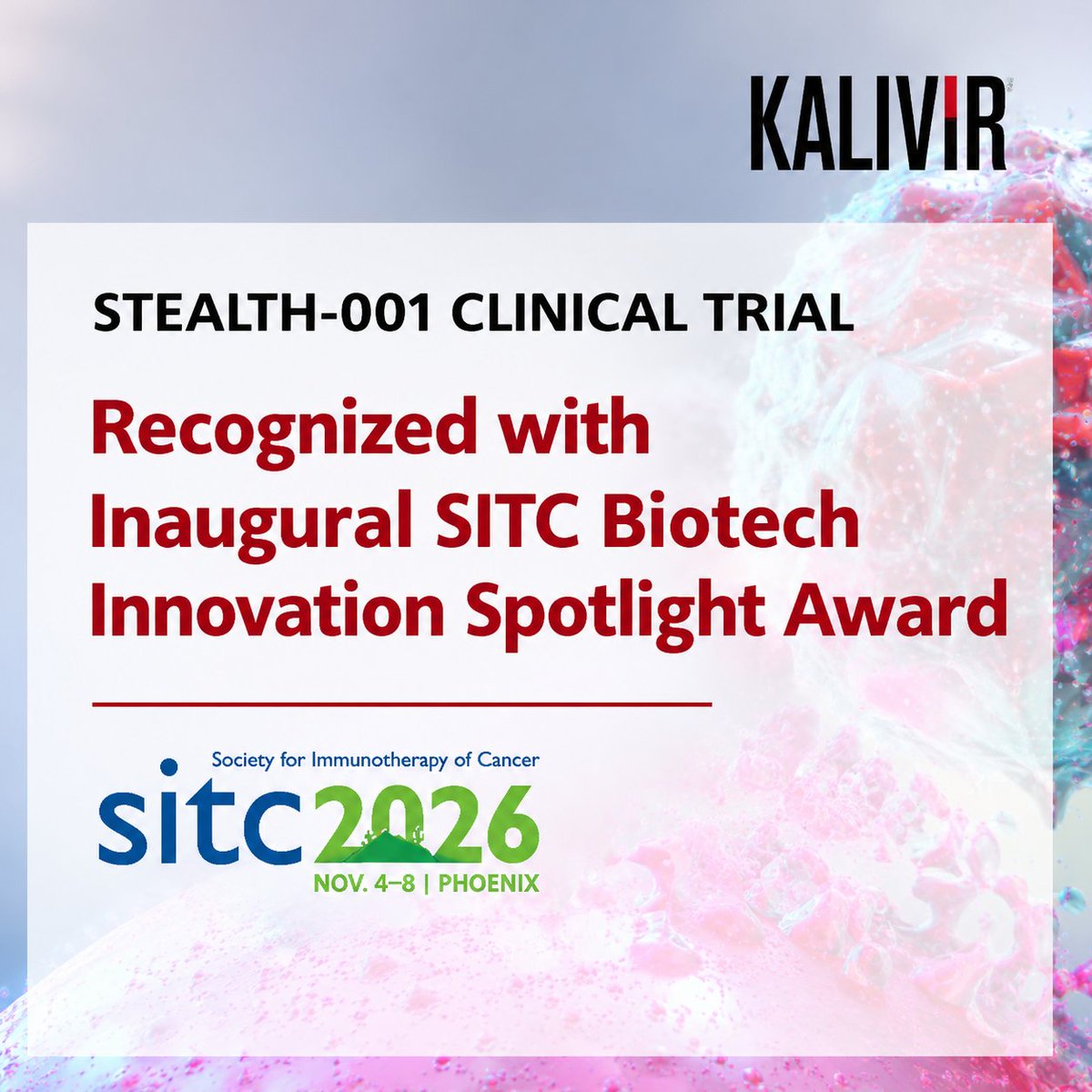
We're pleased to share that our STEALTH-001 clinical trial abstract was one of just two selected for the inaugural SITC Biotech Innovation Spotlight Award!
Thank you to Dr. Yana Najjar, our investigators, collaborators and patients.
#SITC2026#CancerImmunotherapy
So many presentations/posters uncovering beautiful biology that by some decree must end with "and then we added anti-PD1". For a field that was out of the limelight for so many years, I feel like we can do better.
#SITC26 was a great event!
However, my hot take is we we'll never improve/solve cancer immunotherapy without deep understanding of cancer immunology. We must promote and highlight basic understanding of the cancer:immunity problem without needing to immediately move to therapy.
Had an awesome time presenting our postprandial data on immunology and immunotherapy at #SITC26, and moderating a stellar and entertaining debate on time-of-day and immunotherapy. Tomorrow I'll be at the Prez Sesh discussing two of our 4 SITC Presidential Talks!
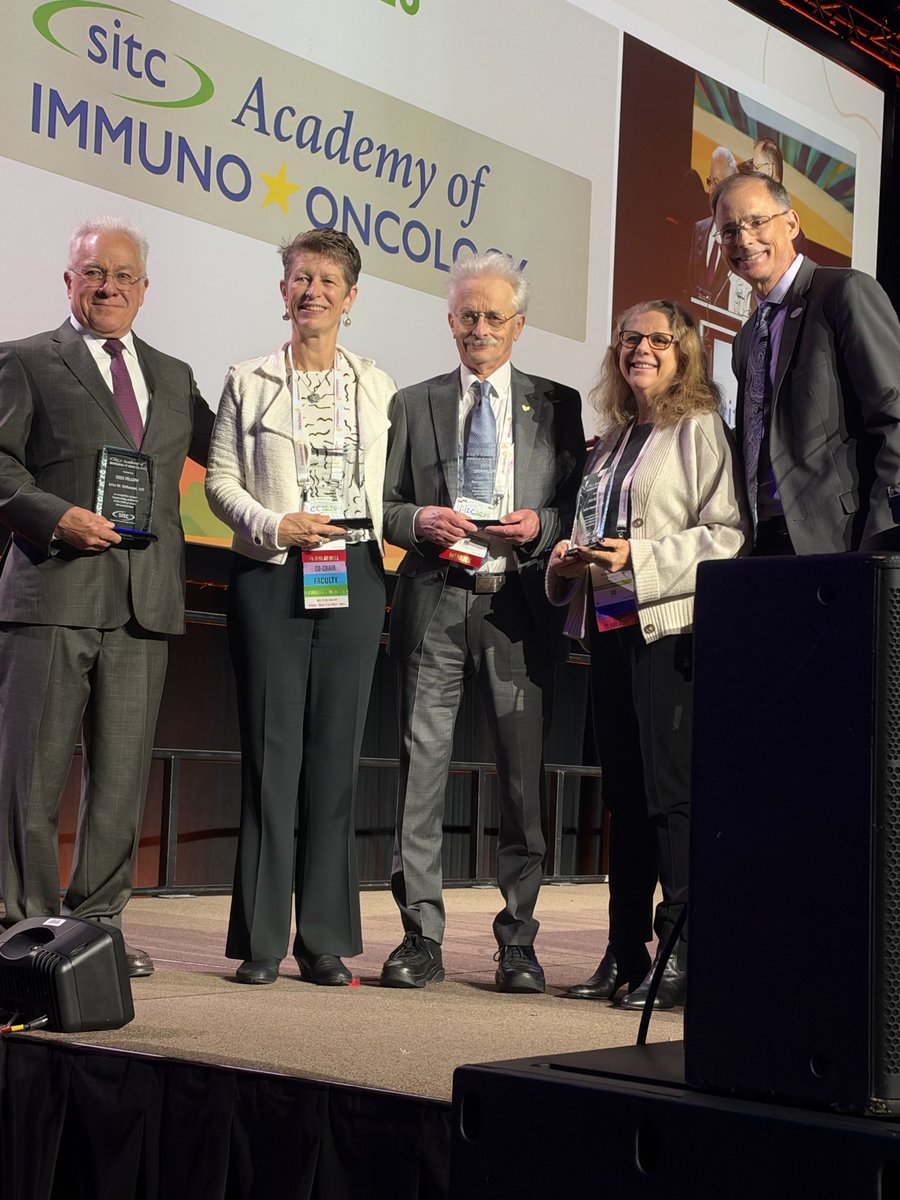
Congratulations to Dr John Kirkwood ( @jmkirkwood ) inducted today as a 2026 Fellow of the Academy of Immunology-Oncology @sitcancer for his pioneering research in the field of #melanoma as well as his leadership. @UPMCnews@PittHealthSci
How the diet & microbiome may lead to immune adverse effects. Join immunologist, Dr. Abby Overacre (@OveracreLab ) later today at #SITC2026. Session 106d | Mechanisms of irAEs | 1:45-3:25 pm | North Building | 300 Level | Hall A
@UPMCnews@PittHealthSci@PittDeptofMed
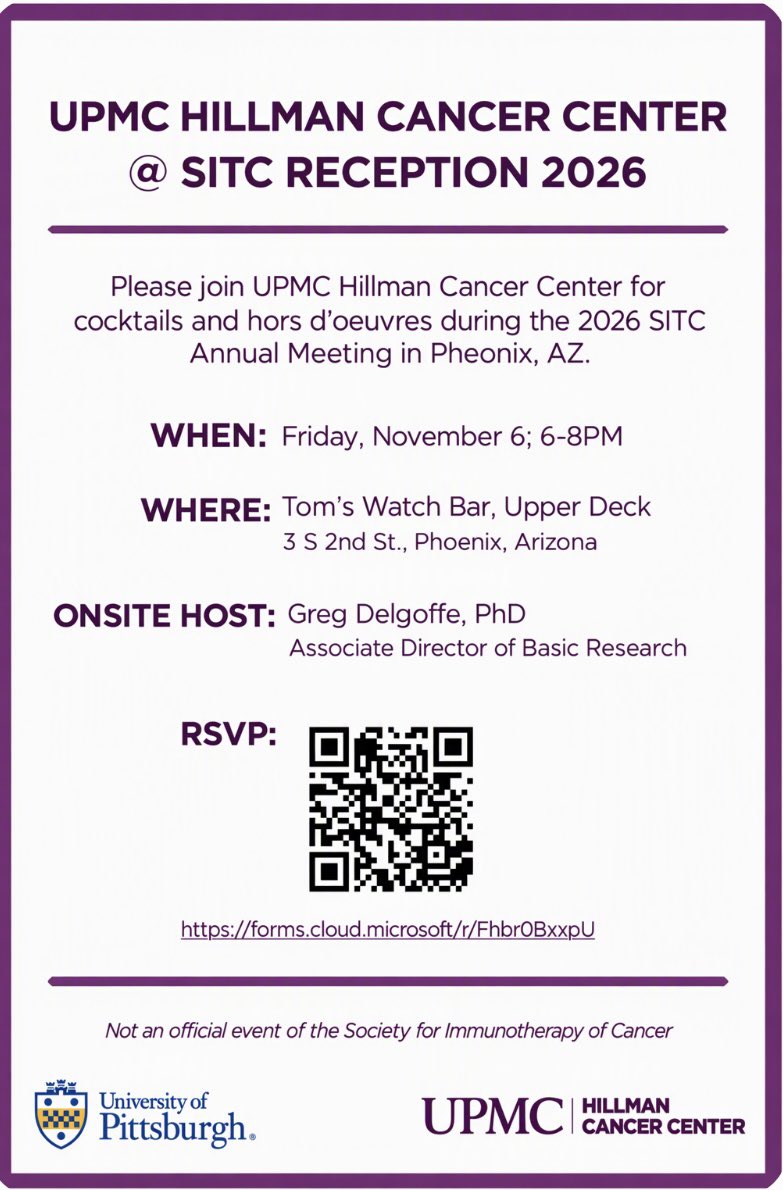
If you’re attending the #SITC2026 conference in Phoenix this week be sure to stop by and meet up with our team of immunologists for a casual get together on Friday, Nov. 6th. Please register using the QR code below! See you there! @gmdelgoffe@UPMCnews@PittHealthSci
CRI STARs take the stage at #SITC26 today!
🔹 @j_eyquem (@UCSF): In vivo and Solid Tumor CAR-T Cell Therapies | 3:10 PM
🔹 @gmdelgoffe (@PittTweet): Funding Your Research Through Industry Collaboration | 3:15 PM
Explore the sessions: https://t.co/m3tNph2dtl
@joerees75395391 As a Chair, I [or anyone on my SRGs] can tell you I'm pushing the discussion. Most SROs can't judge: they'd have to read 3x80 critiques. The issue now is a 2,3,5 grant never even makes it to study section, and it's harder for revs to rescue an application if it's in the C/ND pile
This is an important issue. Streamlining the bottom 70% instead of 50% removes the grants that actually NEED discussion! A grant that got all 2s needs no discussion; it’s good. But a 2,3,5 (which prob would be discussed at top 50% triage) actually needs expert discussion more.
NIH study sections are in poor shape right now. Reviewing only the top third of preliminary scores lets a single reviewer eliminate a grant with no chance of recovery. This favors conservative, incremental ideas from established PIs and summarily cuts down new entrants at the preliminary stage. Far from “gold standard science,” the process has worsened under this regime even though Congress did not cut the NIH budget. A thorough investigation is needed into the political interference behind these changes and fund allocation. The prior system was imperfect and needed reform, but the outcome from the last 20 months has been wholesale destruction by imbeciles.
@SGrivennikov@bimald@JacobAllenPhD The thing is, Sergei, in overburdened study sections and restricted 15 min discussion times, rescues (at least in many SRGs I’ve been involved in) are exceedingly rare. Further, many study sections now prevent non-primary viewers from trying to rescue. We need to go back to 50%.
@VaActiveAngels@NIH Disease has no political party, and scientific innovation from the NIH is a massive return on investment. Traditionally NIH has enjoyed bipartisan support: I hope this new Congress can continue this trajectory.
What an incredible night! 🌊
Now, how about a bipartisan bill to double (protect?) the @NIH budget? Let's promote and retain our leadership in global science!
@sciencey274807@NIH I am a US Citizen and as stated in my profile, these views are my own. I support NIH as an engine of scientific excellence, both now and in the future. Grants flow to Republican, Democratic, and Independent faculty across the US: thus I mentioned BIPARTISAN support for NIH.