On the blessed occasion of your birthday, we offer you our heartfelt gratitude
Thank you for your watchful care, your forgiving heart, and your loving guidance on our journey of faith.
May our Good God grant you many more blessed and fruitful years in Christ!
@FChristopher77
In the Egyptian Paterikon two elders lived together for years and never quarreled. One day one of them said:
“Brother, let us quarrel just once, the way all people do.”
The other answered: “I don’t know how a quarrel is made.”
“Look: we put a brick between us. I say, ‘It’s mine.’ You say, ‘No, it’s mine.’ That’s how a quarrel begins.”
They put the brick down.
The first said: “It’s mine.”
The second: “No, it’s mine.”
The first said: “If it’s yours, take it and go.”
And they could no longer quarrel.
This is the secret of peace: the one who yields.
The strongest does not win.
The one who no longer needs to be right wins.
Christ did not say, “Win the argument.”
He said: “Blessed are the peacemakers, for they shall be called sons of God.” (Matthew 5:9)
The Apostle Paul is even clearer:
“Avoid foolish and ignorant disputes, knowing that they generate strife. And a servant of the Lord must not quarrel but be gentle to all.” (2 Timothy 2:23–24)
And St. Seraphim of Sarov left the word that should be taped to the mirror:
“Acquire the Spirit of peace, and a thousand souls around you will be saved.”
Not “win the argument.”
Not “teach him a lesson.”
Not “make sure he sees that you were right.”
Acquire peace.
St. John Climacus says something that stings and heals:
“If a bitter word arises between you and another and he denies it, do not provoke him. Let the word go, and great peace is made. For peace is four times greater than justice.”
Four times greater.
Not twice. Four.
Better to lose an argument than to lose your heart.
St. Isaac the Syrian adds:
“If you cannot be a peacemaker, at least be one who does not love disturbance.”
And: “Let yourself be wronged and do not wrong. Let yourself be slandered and do not slander.”
Peace does not mean you are weak.
Peace means you are so strong in Christ that you no longer need to defend yourself at every provocation.
In daily life the “brick” looks like this:
— the sharp message in the group chat
— the cutting remark at the table
— “just let me explain why you’re wrong”
— the need to have the last word
— the comment that “has to” be posted so injustice doesn’t hang in the air
Every time you feel that fire in the chest - “I have to answer” - remember the two elders.
One said: “If it’s yours, take it.”
Not because he had no right.
But because he had something more precious: peace.
“A soft answer turns away wrath, but a harsh word stirs up anger.” (Proverbs 15:1)
“If it is possible, as much as depends on you, live peaceably with all men.” (Romans 12:18)
As much as depends on you.
Not as much as depends on the other.
Peace is not made by two people who are right.
It is made by one who is silent out of love.
Today, before you answer:
1. Ask yourself: do I want the truth, or do I want to win?
2. Remember that the devil loves a quarrel more than a mistake.
3. Say in secret: “Lord Jesus Christ, give me Your peace, not my being right.”
4. If you can, yield the brick.
5. If you cannot yet, be silent. Silence is also a form of victory.
The strongest person in the room is not the one who shouts.
It is the one who can say: “Take it. It isn’t worth losing my peace over a brick.”
The brick passes.
The quarrel stays in the heart.
Peace, once lost, is hard to regain.
Acquire peace.
Not because the world deserves it.
But because Christ deserves a clean place in you.
And perhaps, without your knowing, someone around you will be saved simply because you did not answer.
Lord, teach us to yield the brick - and keep heaven.
If this spoke to your heart, pass it on. Someone may be about to enter a quarrel they do not need.
This is from this morning at Proskomedia, the preparation for the Divine Liturgy.
In the Orthodox Church, the Proscomidia is far more than a practical preparation of the bread and wine. It is a profound, silent liturgy of its own - a mystical representation of the entire economy of salvation, from the Incarnation to the Second Coming, and of the unity of the whole Church, both living and departed, around Christ.
The central symbolism
On the holy diskos (the silver plate you see) the priest places the Lamb - the square portion of prosphora stamped with the seal
IC XC
NI KA
(“Jesus Christ conquers”).
This Lamb is Christ Himself, the “Lamb of God who takes away the sin of the world.” When the priest cuts it out with the liturgical lance and pierces its side, he re-enacts the soldier’s spear on Golgotha. From that wound flow the blood and water that will later fill the chalice - the very life of the Church.
Around the Lamb the priest arranges smaller triangular particles and particles of pure white bread:
• To the right of the Lamb: the large triangular particle in honour of the Theotokos (the Mother of God), the one who gave flesh to the Word.
• To the left and above: particles for the ranks of angels and all the saints (prophets, apostles, martyrs, hierarchs, monastics…).
• Below the Lamb: two groups of particles - one for the living (the names of the faithful who asked to be remembered) and one for the departed.
These particles are not “crumbs.” They are the Church itself: the triumphant Church in heaven and the militant Church on earth, all gathered around the one Sacrifice. When the priest later places them into the chalice after Communion with the words “Wash away, O Lord, the sins of those who are remembered here…,” every name is united to the Blood of Christ.
The vessels and coverings
• The diskos itself is both the manger of Bethlehem and the Tomb of the Resurrection.
• The asterisk (the star-shaped cover) is the Star of Bethlehem that rested over the Infant.
• The veils are the swaddling clothes and the burial shroud.
• The mixed wine and water in the chalice recall the blood and water that flowed from Christ’s side.
Everything is done quietly, behind the closed Royal Doors, while the faithful outside still hear only the reader. Yet in that hidden act the whole cosmos is being prepared: the Sacrifice is already present, the Church of all ages is already assembled, and the Divine Liturgy that follows is simply the public manifestation of what has already taken place in mystery.
So when you look at this diskos, you are not looking at “bread on a plate.” You are looking at the entire Orthodox vision of salvation in miniature: Christ in the midst of His Mother, His saints, His living people and His departed servants - one Body, one Offering, one eternal Liturgy.
"Mark the blameless man, and observe the upright; For the future of that man is peace.
But the transgressors shall be destroyed together; The future of the wicked shall be cut off.
But the salvation of the righteous is from the LORD; He is their strength in the time of trouble.
And the LORD shall help them and deliver them; He shall deliver them from the wicked, And save them, Because they trust in Him."
Psalm 37.
The Russian Orthodox Church in Cyprus, with impressive paintings from the lives of russian saints.
Through the prayers of our holy fathers, Lord Jesus Christ, Son of God, have mercy on us!
THE LARGEST ORTHODOX CHURCH IN THE WORLD🇷🇴
In Romania, the largest active Eastern Orthodox Church in the world is officially finished and consecrated for use.
There is NO OTHER FAITH in the world that shows their love for God like Orthodoxy☦️🙏
An old monk, tired of hearing all sorts of excuses from those who don’t go to church and refuse to confess, wrote the following on the door of his cell:
SOME REASONS WHY I DON'T WASH:
Because I was forced to wash as a child.
Because I wasn’t taught to wash from childhood.
Those who wash are hypocrites who think they’re cleaner than others.
I can’t decide which soap is the best.
I used to wash, but I got tired of it.
I only wash on major holidays - Christmas and Easter.
I don’t have any friends who wash.
I’ll start washing when I’m old and dirty.
I don’t have time to wash.
In winter, the water is too cold, and in summer, it’s too hot.
I don’t want soap manufacturers to profit off me.
I wash in my soul.
Soap was invented by tricksters because there’s no such thing as dirt or cleanliness.
All wars in the world are because of soap.
Every type of soap has its flaws.
I wash with three kinds of soap at once because that’s the only right way.
Science has proven that no soap completely removes dirt.
Therefore, washing is pure deception and opium for the filthy.
All soaps contain toxic substances that harm health.
A child shouldn’t be taught to wash from a young age. When they grow up, they should decide for themselves whether to wash or not, and with which soap.
In 1967, a committee of scientists (forensic experts) went to investigate the relics of Saint Gerasimus of Kefalonia and to provide a "scientific" solution (if they could) to the problem of the incorruptibility of the holy relics.
They examined the relics for several days. In the end, they drew up a report in which, among other things, they acknowledged that the incorruptibility of the Holy Relics lies beyond the scope of science.
But the most surprising thing was that their leader, cold and indifferent toward faith, afterward shut himself away in his house for twenty days. When asked later why he had done this, he confessed that while examining the holy relics, at one point he felt a pulse in the saint's hand!
Hello everyone!
I’ve been waiting in line for 4 hours to venerate the relics of Saint Parascheva in Iași, and I just received this small icon of the Virgin Mary, discovered at the Savior’s Tomb in Jerusalem during its restoration.
May the Mother of God and Saint Parascheva protect you all!
In a remote village nestled between hills, where the sky seemed to conceal the secrets of the saints, there lived an elderly hermit named John, whose humility drew many wandering souls.
A young man named Arsenius set out to him, seeking the path to salvation. On the way, he had spotted a drunken man collapsed in a ditch, and thought with disdain: "What shame, to sink so deeply into sin, while I toil to live in purity!"
Upon reaching the hermit's cell, Arsenius recounted the scene, convinced that Father John would share his indignation. But the elder, his face illuminated by a profound peace, replied: "My son, take heed: judging your neighbor is like a stone that crushes the heart. The man in the ditch may have found repentance in his final moment, and you, by condemning him, have clouded your soul with pride.
Saint Isaac the Syrian says: 'He who judges his brother drives away grace.' Look first to your own sins, not those of others." Ashamed, Arsenius realized that his judgment was pride in disguise. He departed, seeking forgiveness from God and the man in the ditch, learning that mercy is greater than judgment.
Saint John Cassian says: "Judging our neighbor separates us from Christ, but humility unites us with Him."
I asked the iron: Are you the strongest?
And it replied: No, fire can break me!
Then I asked the fire: Are you the strongest?
The fire replied: No, water can quench me!
Then I asked the water: Are you, perhaps, the strongest?
The water replied: No, the sun can evaporate me!
Then I asked the sun: So, you are the strongest, aren’t you?
The sun replied: No, for the clouds can cover me!
I went to the clouds: Are you the strongest?
The clouds laughed and said: Go to the wind, it can scatter us!
I asked the wind: Are you, perhaps, the strongest?
The wind replied: No, the mountains can stop me!
I climbed a mountain and asked: So, you are the strongest?
The mountain replied: No, man has conquered me!
Meeting a man with great power and many under his command, I asked: Man, are you the strongest?
But the man replied: No, for death can take everything from me.
I asked death: So, you are the strongest?
And death, sorrowfully, replied: No, for Christ has conquered me.
So I said to Jesus: Lord, then You are the strongest…
And He replied with a gentle and humble voice:
Yes… But I let Myself be conquered by the prayer that comes from a repentant and humble heart.
Mother of God, quick helper, cover us with your holy omophorion!
O, Most Holy Theotokos, Mother of Light and Source of Mercy, look upon us, who often wander in the darkness of our thoughts, and illuminate our hearts with the gentle rays of your love! You, who carried the Savior of the world in your arms, be today the support of the powerless, the consolation of the sorrowful, and the hope of those without hope.
Do not leave us, Most Pure One, in the waves of this turbulent life, but stretch out your protective hand over us and our home. Sweeten the tears of those who weep, raise up the fallen, strengthen the weak, and kindle in our souls the pure love of God.
Under your protection we take shelter, Theotokos, and we pray: do not abandon us in the hour of trouble, but be always near, like a loving Mother, like a guiding Star on the path of salvation.
Amen.
In the Egyptian desert, a young monk named John, gripped by fear of death, ran to Saint Anthony the Great, crying, “Father, persecutions threaten us, brothers are dying - what’s the point of our struggle?”
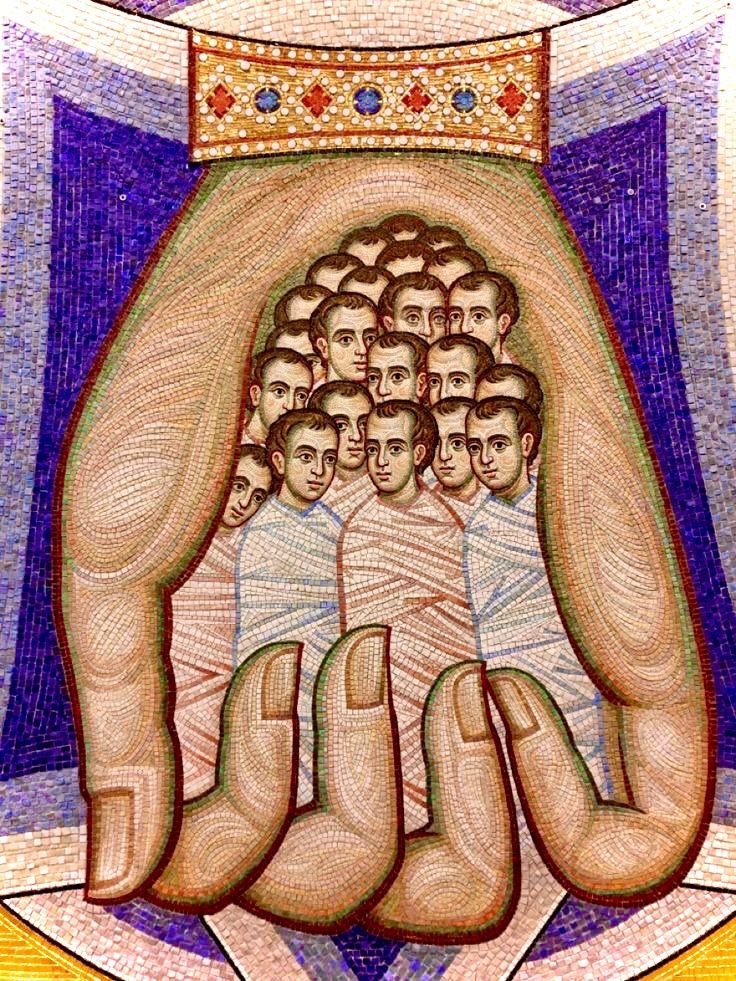
His heart trembled, like many today mourning the loss of a righteous man like Charlie Kirk. With eyes shining with the Spirit’s light, Anthony replied, “Son, look at the sky! God, Who created the stars, holds your soul in His palm. Death is not a thief but a door to Christ!”
He shared of a martyr who, singing psalms before death, led pagans to faith, his face radiant with peace. “Fear is the devil’s trap,” Anthony said, “but Christ is victory!” He urged him to pray, “Lord, into Your hands I commend my spirit!” (Matthew 10:28). John left strengthened, becoming a pillar of hope for others.
O Christian, you who grieve the loss of a faithful warrior, do not be overcome! Death is but a step to eternal glory. Pray, seek Christ’s peace, and be a light, for “our life is hidden in Him” (Colossians 3:3)!