We're launching Oodle Agent Observability on Product Hunt today.
Unlike our logs product, DenaliDB for agent traces, the database that powers our Agent Observability, did not start from ClickHouse. It was built on a cloud architecture of object storage and serverless functions from day 1. It was the right decision. Many scaling issues we encountered in our logs product with ClickHouse Cloud (see my ClickHouse series), and also discussed by Langfuse, do not apply to DenaliDB, such as isolating reads from ingestion and actively tuning merges. It is by design.
As an engineer and data infra enthusiast, what fascinates me is that agent traces bring a new set of challenges that are different from APM traces and logs:
- A single span can be tens of megabytes, because every LLM call resends the whole conversation so far.
- A single trace can pass three gigabytes over a long session.
- When you debug, you often need one tool output from hundreds of turns back, so truncating or sampling doesn't work.
If you have agent trace use cases that might run into scale and size issues, check us out at https://t.co/6yRBpkPsZo
I'm really excited to share our first public benchmarks of Oodle (powered by DenaliDB) vs. ClickHouse for metrics observability!
ClickHouse conquered real-time analytics. But observability? Not so fast.
Huge respect for what the ClickHouse team has built. But I don't buy the argument that winning analytics means winning observability.
Especially when AI agents are becoming the primary users.
At Oodle, 93% of queries now come from AI agents. They're not clicking through dashboards. Their queries are unpredictable, and they can fire off 100-1000x more concurrent queries than humans.
That's a very different workload. And it needs a different database architecture.
My co-founder @mvijaykarthik put Oodle against ClickHouse, testing concurrency and price-performance for metrics observability.
The results? Oodle comes out significantly ahead.
It's why we built DenaliDB from the ground up as a truly serverless, purpose-built database for observability.
ClickHouse has done amazing things for analytics. But I'm not convinced it's the future of observability.
Benchmarks and code are public. Would love a healthy technical debate.
https://t.co/qIaLuJzpcv
It’s easy to prompt a Slack bot into existence. Making one that people love takes secret ingredients.
Our internal coding agent is resilient, multiplayer & knows when to shut up.
On Thu, @sujeetgholap will show how we built it. Join us: https://t.co/s7CFKxfsVq
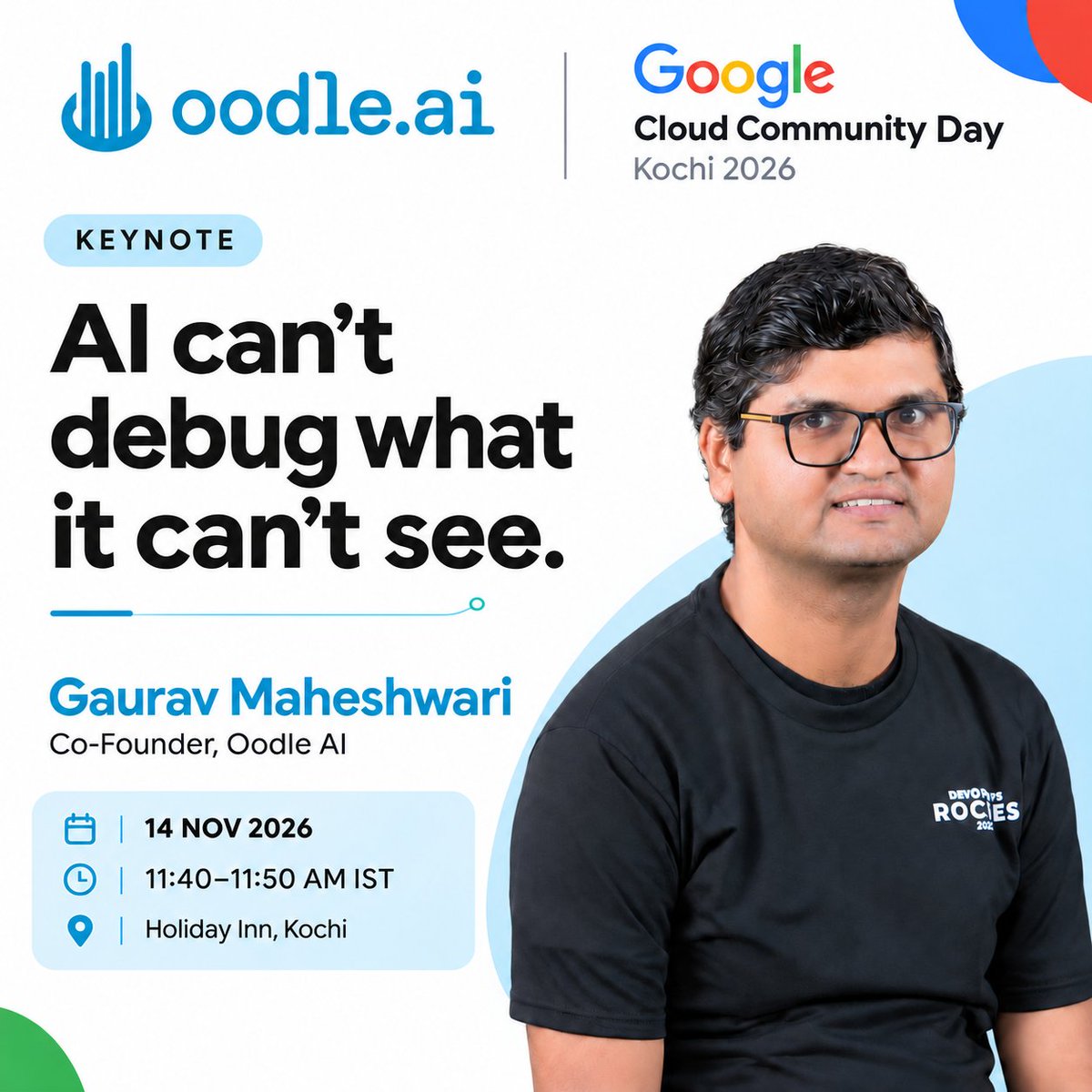
Today, I’ll be delivering the Keynote at Google Cloud Community Day Kochi 2026, followed by a talk on Building Self-improving Loops for AI Agents.
Keynote: 11:40–11:50 AM, Main Hall
Technical session: 2:00–2:30 PM, Hall 1
📍 November 14, Holiday Inn, Kochi
I’ll also be at the Oodle booth. If you’re building AI agents, come say hello.. let’s talk observability and what it takes to keep improving your agents.
In the field:
- Agent observability companies are part of the agent dev cycle
- Support teams use agent traces to triage customer issues
- We give customers visibility into BYOC deployments
- We help customers turn OSS users into enterprise
A podcast guest argued that observability is a proxy for infrastructure and application reliability. It’s insurance.
At Oodle, we have a different vision. Observability is not insurance for reliability, but an enabler and multiplier for business.
AI Agents are debugging most incidents now and it can only debug what it can see. Premature cost optimizations in Datadog might shrink your bill but it is actually hurting you.
Wrote about it: https://t.co/APtxYNEHoH
Agree or disagree?
@xanderai Hey Opus 4.6, move us off ClickHouse.
Nine months later, Opus 4.6 woke up and found his little brother, Opus 5.5, had gotten the job done.
https://t.co/jIDwXKlss9
Don't wait for your Datadog renewal. By then, the only question left is what to cut.
Start now. Oodle move your dashboards and alerts, and buy out up to 12 months of your contract.
One customer: 8 years on Datadog, 6 weeks to switch, 5x lower cost.
https://t.co/2gFlEDgbEz