Do you trust AI to review AI-written code?
Who should FDEs report to?
When did the CTO become part of the sales motion?
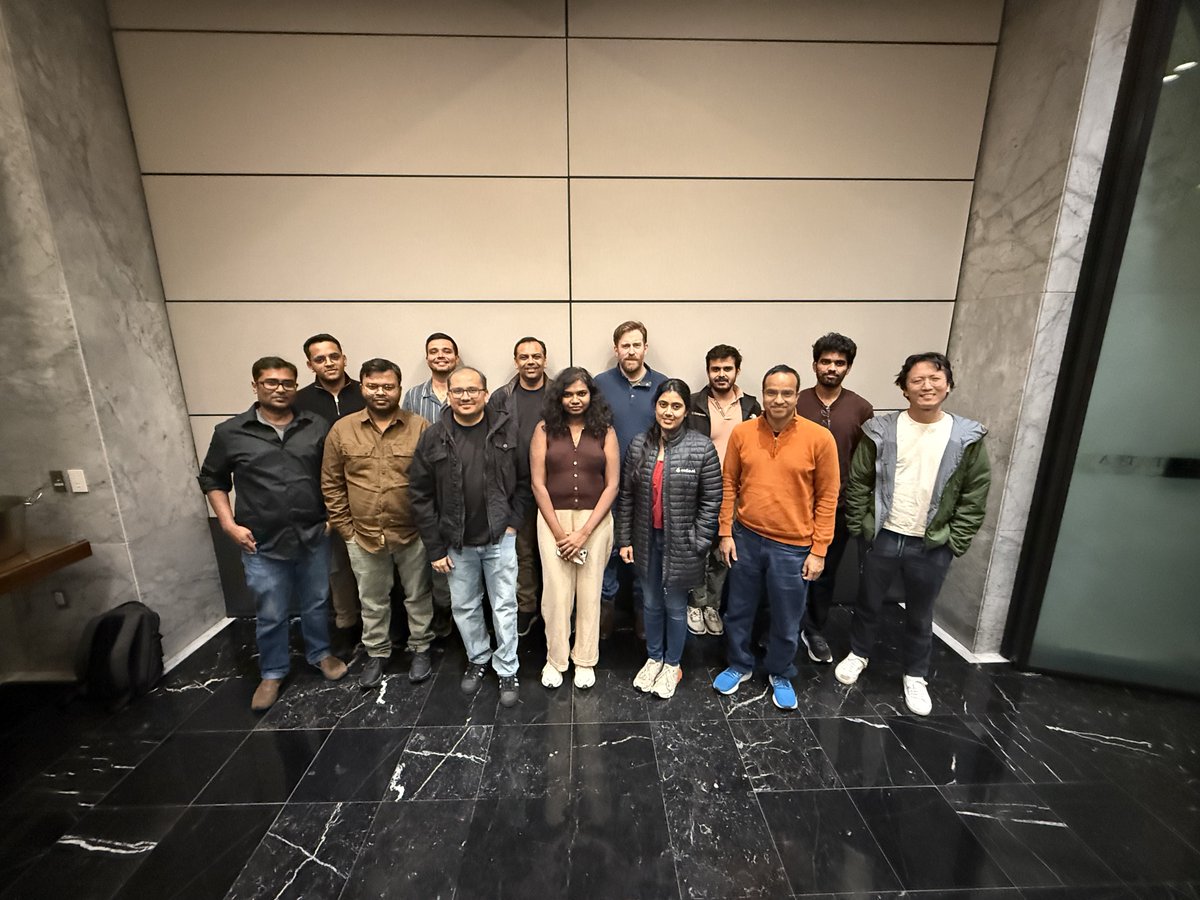
That's what founders and eng leaders got into at [@Oodle]'s first Eng Leaders dinner with [@Vorflux]. Thanks to everyone who joined.
"It was never about the code, always about the outcomes"
"You were wrong to get attached"
Just ask yourself this: do you want to be the person who is responding to grief and mourning with smug superiority and condescension? https://t.co/lybw6ePX6X
Some hoomans who made Rootconf 2026.
Thank you to the presenters, attendees, online participants, editors, reviewers, volunteers, crew, sponsors and members.
Two days of comparing engineering notes. More conversations ahead.
What are you taking back to your team?
The moment I find perfect couplet for my slide deck, it is complete and I stop working on it.
And, what would be a more fitting couplet for a talk titled "𝗦𝘂𝗿𝘃𝗶𝘃𝗶𝗻𝗴 𝘁𝗵𝗲 𝗾𝘂𝗲𝗿𝘆-𝗽𝗼𝗰𝗮𝗹𝗽𝘆𝘀𝗲" than this Ahmed Faraz's couplet.
It was a great time speaking at RootConf conference on the topic of how AI agents change the query patterns for Observability stack and why existing observability stacks are not ready for it.
"Surviving the query-pocalypse."
@gaurav25d from https://t.co/O4kLlTePyH at #Rootconf: once AI agents become users of your platform, they retry without end, send strange query shapes, and never file bug reports the way humans do. What happens when that impact availability and reliability.
#AIforPlatforms
@rootconf@hasgeek
Production has no Ctrl+Z.
No git log. No tests. No revert. That is why AI changed coding in two years and barely reached the people on call.
So we spent 136 days building them, in the open, with 300+ operators. Today it's out: Kepler, the IDE for operations.
• Learns your systems, and goes deeper with every incident
• Proof with every finding: what it ran, what it saw, what it's only guessing
• Asks before it changes anything
Code has a harness. Now operations does too.
𝗪𝗵𝗲𝗻 𝗖𝗣𝗨 𝗶𝘀 𝗮 𝗯𝗼𝘁𝘁𝗹𝗲𝗻𝗲𝗰𝗸, 𝘆𝗼𝘂 𝗻𝗲𝗲𝗱 𝗯𝗲𝘁𝘁𝗲𝗿 𝗱𝗮𝘁𝗮 𝘀𝘁𝗿𝘂𝗰𝘁𝘂𝗿𝗲𝘀. That's why DenaliDB designed a custom file format to store timeseries data. Each sample is not a row in the database.
𝗪𝗵𝗲𝗻 𝗮𝗴𝗲𝗻𝘁𝘀 𝗮𝗿𝗲 𝗴𝗼𝗻𝗻𝗮 𝗾𝘂𝗲𝗿𝘆 𝗮𝘁 𝗺𝘂𝗰𝗵 𝗵𝗶𝗴𝗵𝗲𝗿 𝗿𝗮𝘁𝗲 𝘁𝗵𝗮𝗻 𝗵𝘂𝗺𝗮𝗻𝘀, 𝘆𝗼𝘂 𝗻𝗲𝗲𝗱 𝗲𝗹𝗮𝘀𝘁𝗶𝗰 𝗰𝗼𝗺𝗽𝘂𝘁𝗲 - scalable quickly on demand. Spinning up a EC2 is too slow when an agent or a human is querying data. That's why DenaliDB is built on object storage and serverless for queries.
It is not common to see a benchmark beating ClickHouse on all dimensions - query performance, concurrent query loads, storage efficiency. Read through @mvijaykarthik experiments comparing DenaliDB and ClickHouse.
We used to run ClickHouse at Oodle, and I'm still a fan. When ClickHouse Observability launch and said it does not suffer from cardinality issues, I had to test it for metrics.
25M series on one 192 vCPU node. At 128 concurrent queries: 176 s on ClickHouse, 3.2 s on DenaliDB.
Metrics data has a very different shape from real-time analytics, so a purpose-built engine has an easier job here.
https://t.co/iKcb9FU92s
Exactly. When AI agents become the primary users, is Datadog’s premium UX built for humans still worth paying for?
This goes beyond observability to security, analytics, and other SaaS categories. The value shifts from dashboards to data, APIs, and price-performance.
At Oodle, 93% of queries now come through MCP, with agents generating 13x more queries than humans. And this is at a scale of 9 PB of telemetry and 1.8B agent spans per quarter.
We’re seeing the shift to headless observability happen in production.
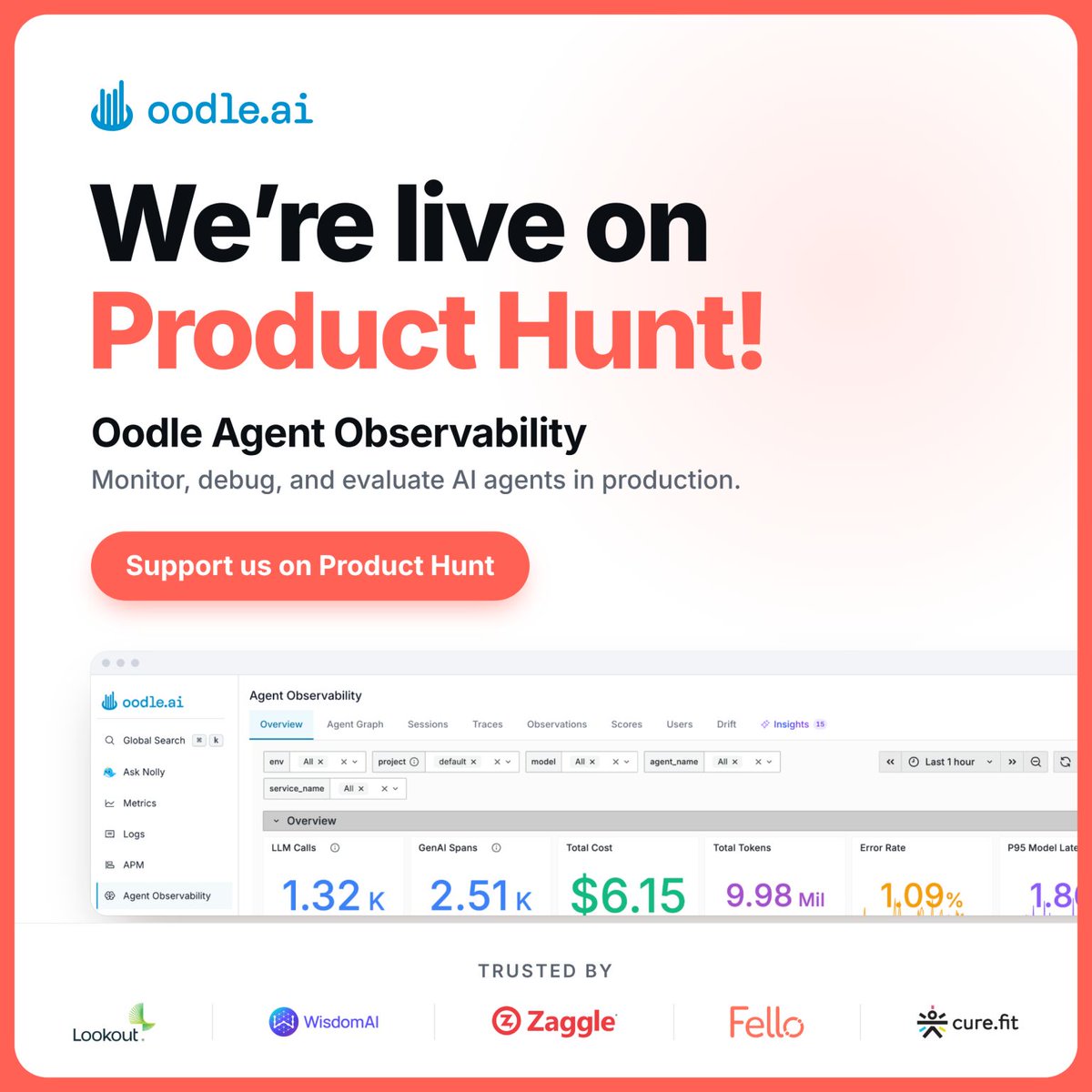
We're live on Product Hunt today! 🚀
https://t.co/HEFtU5zo9Y
Oodle brings together context across AI agents, applications, and infrastructure, so AI agents can investigate failures and humans can understand what went wrong.
All of this at scale, cost-efficiently.
Would love your support! ❤️
We're launching Oodle Agent Observability on Product Hunt today.
Unlike our logs product, DenaliDB for agent traces, the database that powers our Agent Observability, did not start from ClickHouse. It was built on a cloud architecture of object storage and serverless functions from day 1. It was the right decision. Many scaling issues we encountered in our logs product with ClickHouse Cloud (see my ClickHouse series), and also discussed by Langfuse, do not apply to DenaliDB, such as isolating reads from ingestion and actively tuning merges. It is by design.
As an engineer and data infra enthusiast, what fascinates me is that agent traces bring a new set of challenges that are different from APM traces and logs:
- A single span can be tens of megabytes, because every LLM call resends the whole conversation so far.
- A single trace can pass three gigabytes over a long session.
- When you debug, you often need one tool output from hundreds of turns back, so truncating or sampling doesn't work.
If you have agent trace use cases that might run into scale and size issues, check us out at https://t.co/6yRBpkPsZo
If you're looking for observability for agents, do try out @oodleai
They're built by a team of very strong engineers, including past directors and principal engineers from Rubrik.
Has helped us quite a bit @vorflux
(not a paid promotion)
AI Agents don't operate in silos - they invoke LLM models, MCP servers, tool calls which further call RPC endpoints in your services, interact with database etc. So, for debugging AI agents, you need both agent context (transcripts, model calls, tool calls) as well as application & infra context (RPC calls, SQL queries).
@oodleai brings both these contexts together in a single trace so your coding agents can do stack-busting efficiently.
With Oodle, so many things are just a prompt away
• /oodle-onboarding - to integrate agent traces along with metrics, logs, APM.
• find all users who are unsatisfied with the agent responses
• optimize my agents to reduce token cost / number of turns
• optimize my agents to make them faster - which endpoints / database queries are in critical path
• ... and many more
Live on Product Hunt today! 🚀
Do check it out and let us know your thoughts: https://t.co/ygihktppkI
Solid lineup of interesting talks. The reviewers have put in a lot of hard work to curate the best content for the audience. Please attend @rootconf and profit.