(𝐅𝐑𝐄𝐄) 2026 FANTASY FOOTBALL CHEAT SHEET 🏈
BOOKMARK TO DOMINATE YOUR LEAGUE 🔖
📊 Player Rankings and Tiers
📝 Top 10 Draft Day Tips
🎯 The Best Players to Target
‼️ Players You'll Want to Avoid
✅ 100% Free Advice All Season
Follow @_ColtWilliams to chat when I'm LIVE 🔴
@RepoleStable Repole why don't you build a stadium in Birmingham. People like you always want a hand out from the government. Your business plan is weak Birmingham is better off without people like you.
If the UFL put a better product on the field the issue would be moot. 47 K would be ok This league will be out of business in a couple of years anyway.
Who thought building a 47,000 seat stadium in Birmingham was a good idea???
@TheUFL, UAB and a USL team and you build a 47k seat stadium??? 🤦♂️
C’mon.
The people of Birmingham deserve a great 12,000 to 15,000 seat stadium that actually creates energy, passion, demand and a real home field advantage.
Bigger isn’t always better. The right size is better.
The Crossing: Lee's Escape at Williamsport
July 4–14, 1863
[Author's Note: The Battle of Gettysburg ended on July 3, 1863. The Gettysburg Campaign did not. Most accounts close with Pickett's Charge and skip ahead to the fall, as if the armies simply dispersed — but for eleven more days the outcome of the campaign, and arguably the war, hung unresolved along the roads and river crossings of Maryland. Lee still had to bring a bloodied army, a seventeen-mile train of wounded, and every gun and wagon he owned back across a Potomac in full flood, with the Army of the Potomac closing behind him. That story — the retreat, the stand at Williamsport, and the final fight at Falling Waters — is where this series goes next. Today's post covers the escape itself. The Wagoner's Fight at Williamsport (July 6) and the rear-guard action at Falling Waters (July 14), where the 2nd Mississippi Infantry appears in both, will each get their own posts ahead.]
It began to rain on the afternoon of July 4, and it did not stop. The men of the Army of Northern Virginia stood in it along Seminary Ridge, waiting behind their stacked rails for the counterattack that never came, while a thousand miles to the southwest — though no man on that ridge yet knew it — John Pemberton was surrendering Vicksburg and thirty thousand men to Ulysses Grant. Independence Day, 1863. The Confederacy had been struck twice in a single turning of the earth, and the second blow had not finished landing. Lee had to get his army — what was left of it, some fifty thousand men with their wounded and their trains and their guns — back across the Potomac before George Meade could pin it against the river and finish what three days at Gettysburg had begun.
Lee had already set the machinery in motion. In the small hours of the 4th he rode alone to the headquarters of John Imboden, the cavalry brigadier whose command had arrived too late for the battle and was therefore fresh enough for what came next. Imboden would remember the commanding general sitting his horse in the moonlight, so worn that for a time he did not speak at all. When he did, it was to give Imboden the hardest assignment of the campaign: take the wounded — those who could survive the moving — and get them to the Potomac ahead of everything else.
The train Imboden assembled stretched seventeen miles. More than eight thousand wounded men rode in it, packed into springless wagons on bare boards, most without straw, many without food, jolting southwest through the mountain passes over roads the rain was churning into troughs of mud. Imboden's orders forbade halting for any cause, and so the train ground forward through the night of July 4 while the men inside it screamed at every lurch. Imboden rode the length of that column in the darkness and never forgot what he heard coming out of the wagons — men begging to be lifted out and left beside the road to die, men calling on God to end it. He had commanded troops in battle. He wrote afterward that nothing he ever saw on a field of fire compared to that night on the Greencastle road.
The rain that tortured the wounded also saved them. The same downpour that turned the Confederate line of retreat into a swamp turned every road behind it into the same swamp, and Meade's pursuit — burdened with its own thousands of wounded, its own empty cartridge boxes and worn-out shoes — slogged forward at the pace the mud allowed and no faster.
Then, at the river, the trap closed. When the head of the column reached Williamsport on July 5, the news was waiting: a Federal cavalry raid had cut the pontoon bridge downstream at Falling Waters, and the rains had swollen the Potomac far past fording and it was still rising. Behind Lee's army came Meade with eighty thousand men. In front of it ran a river no army could cross. The Army of Northern Virginia, which two weeks earlier had marched into Pennsylvania as the most feared fighting force on the continent, was about to be penned against the water with its back to the flood.
Imboden did not wait for the water to decide anything. He seized the town and turned it, in his own words, into one great hospital, quartering the wounded on the citizens of Williamsport whether the citizens liked it or not — and then he found the ferry. Two flatboats, thirty wounded men to a load, fifteen minutes to the far bank and fifteen minutes back, working around the clock while the walking wounded were started on foot down the road toward Winchester. It was a trickle against a flood, but the trickle never stopped, and over the next two days and nights it carried the broken men of Gettysburg across to Virginia by the boatload — so that the wounded, who had suffered the worst of the retreat, were among the first out of the trap, safely over the river a full week before the army that had to stand and hold the bank behind them.
What happened at Williamsport on July 6 — when Federal cavalry came down on the wagon park and the crossing itself, and the defense of the army's trains fell to teamsters handed muskets, to clerks and cooks and quartermasters, and to walking wounded who climbed down from the wagons and into line of battle — is a story that deserves its own telling, and it will get one. It is enough to say here that the wagons, the guns, and the crossing were all still in Confederate hands when Lee's infantry arrived.
The main army came up on the 6th and 7th by way of Hagerstown, and what it did next tells you how far the war had traveled since 1861. There was no talk of gallant stands in the open. The men went into the ground. In less than a week, soldiers who had marched and fought for a month built six miles of entrenchments in a great arc from Downsville to the river, covering both Williamsport and the bridge site at Falling Waters — earthen parapets six feet through, rifle pits, communication trenches, obstructions, and gun platforms laid out so that more than two hundred pieces of artillery could sweep every yard of open ground in front. An observer who walked the line said the works looked as if they were meant to stand a month's siege. Stranger still, the men behind them were not beaten men. Their letters home that week spoke of confidence, not despair — they had held their ground on the last day at Gettysburg until ordered off it, they had brought the army away intact, they had Lee, and now they had six feet of Maryland earth in front of them. Bloodied, yes. Broken, no.
Across the way, George Meade could see all of it, and he knew exactly what he was looking at. He had been in command of the Army of the Potomac for seventeen days. In that span he had fought and won the largest battle ever waged in the Western Hemisphere, and it had cost him nearly a quarter of his army. Now Washington wanted the rest of the job done — Halleck's telegrams arriving daily, the President behind Halleck, the newspapers behind the President, all of them demanding that Lee be destroyed on the north bank of the Potomac and the war ended before the summer was out. On July 12 Meade closed up to the Confederate works, studied them, and called his corps commanders together. He put the question to a vote: attack, or not. The vote came back seven to two against.
The men who cast those votes were not timid men. They were men who remembered Fredericksburg — who had watched, seven months earlier, fourteen brigades break apart in front of a stone wall and a fortified ridge, twelve thousand casualties bought for nothing. Now they looked across at the Downsville line and saw Marye's Heights built longer, deeper, and better: high ground, heavy parapets, massed guns, open fields of fire, and Robert E. Lee waiting behind it, wanting nothing in this world so much as for them to come on. The arithmetic every one of them carried said an attacker needed three men for every defender at the point of assault, and the ground said even that might not serve. Military science said do not attack. Politics said attack now. Meade, a professional to his boot soles, listened to the science and spent July 13 probing and reconnoitering instead.
He was one day too late. The river had begun to fall, and Lee's engineers had not been idle. Lacking pontoons, they had made them — tearing down warehouses along the canal for lumber, building crude scows, caulking them with whatever came to hand, floating the sections down to Falling Waters and laying a new bridge across the dropping flood. On the night of July 13, in darkness and yet more rain, the Army of Northern Virginia began to move. Longstreet's and Hill's corps filed onto the swaying bridge at Falling Waters by the light of torches and crossed all night above the brown water. Upstream at Williamsport, Ewell's men went into the ford in the dark, the water armpit-deep and still pushing hard, cartridge boxes slung on bayonets over their heads, the shorter men clinging to the taller. All night the army poured south — men, guns, wagons, the whole apparatus of war passing over a hostile river within cannon shot of an enemy twice its size.
When Meade's skirmishers went forward at dawn on July 14, they walked into six miles of empty works. The rear guard was still on the north bank at Falling Waters, and there was a fight there that morning — a sharp, costly, and largely forgotten one that will also get its own telling. When it ended, the Federal cavalry held upward of five hundred prisoners, and the official reports would call them stragglers; but most were nothing of the kind. They were fighting men of Heth's rear guard — Davis's brigade and Pettigrew's own North Carolinians among them — taken in ranks, along with the killed and the wounded of the last fight north of the river. And among those wounded was Johnston Pettigrew himself, shot down within sight of the bridge; he would die three days later at Bunker Hill, thirty-five years old — he had marked the birthday on the Fourth of July, the day the retreat began — struck by the closing hour of a campaign he had unknowingly opened on the road to Gettysburg two weeks before. The army itself was gone.
In Washington, Lincoln received the news like a man struck. He said afterward that Lee's escape left him as nearly inconsolable as he could be and live; he believed the war might have ended on that riverbank, and he may have been right. The professionals saw it otherwise. They had looked at those works with their own eyes, and they understood that the most likely fruit of an assault was another Fredericksburg — ten or fifteen thousand men down in the mud, the victory of Gettysburg thrown away in an afternoon, and Lee across the river anyway. Meade had chosen to keep his army, and armies, not riverbanks, would decide the war.
That morning Federal soldiers walked the abandoned Confederate line in the rain, past the gun platforms and the six-foot parapets and the rifle pits that beaten men had carved out of Maryland in five days, and understood what they had been spared. Behind them the Potomac ran brown and quiet, carrying the rain down toward the Chesapeake. On the far bank the Army of Northern Virginia was marching south into Virginia — bloodied, unbroken, going home. The war it carried with it had twenty-one months yet to run.
On this day in 1863, Robert E. Lee bet the entire war on twelve thousand men walking a mile across an open field into the center of the Union line, and he did it over the loud objection of the general he trusted most.
Lee had spent two days hammering the ends of the Union army and gotten nowhere. So on the third day he reasoned it out like this. If the enemy had reinforced both flanks to survive all that pounding, then the middle must be thin now. Hit the center, hard, with everything, and break it, and the road to Washington opens up and the South wins its independence in an afternoon. It was bold and it was logical and it was, as it turned out, a catastrophe.
James Longstreet begged him not to do it. Longstreet had walked that ground with his eyes, measured the distance, seen the guns waiting on the ridge, and he told Lee flatly that no fifteen thousand men who ever lived could cross that field and take that position. He said it more than once. Lee heard him and said do it anyway. When the moment finally came to launch the attack, Longstreet was so sick with certainty that it was murder that he couldn't say the word. He just bowed his head and nodded, and the assault went forward on a nod.
First came the guns. The Confederates opened the largest artillery barrage of the entire war on this continent, well over a hundred cannon roaring at once, trying to smash the Union center to rubble before the infantry stepped off. The ground shook for miles. But most of the shells sailed just a little long, screaming over the heads of the front line troops and blowing up the rear. When the smoke drifted off, the Union center was battered but very much alive, and the gunners there were waiting, loaded, and furious.
Then the infantry came out of the tree line, and even the men about to kill them said it was one of the most beautiful and terrible things they ever saw. About twelve thousand Confederates, dressed in neat parade lines nearly a mile wide, battle flags up, stepping off in perfect order into the open like it was a drill. They had almost a mile of naked field to cross, uphill, in the July heat, with nowhere to hide.
The Union artillery went to work on them the whole way. First long range shells punched holes clean through the marching ranks, whole files of men vanishing at a time. The survivors closed up the gaps and kept coming, which somehow made it worse to watch. As they got closer the cannon switched to canister, basically giant shotgun blasts that scythed men down in swaths. Then the rifles opened up from behind the stone wall. The neat lines dissolved into a struggling mob still pushing forward into the storm.
And they almost, almost did it. A few hundred men under a general named Lewis Armistead actually reached the wall, Armistead out front with his hat jammed on the tip of his sword so his men could see him in the smoke. He climbed over, put his hand on a Union cannon, and for one heartbeat the Confederacy was physically inside the Union line at the very center. That spot is called the High Water Mark now, because it is the farthest the tide of the Confederacy ever reached. Armistead was shot down right there, dying a few feet past the wall. The handful who got over with him were killed or captured in minutes. The breach slammed shut.
And that was it. That was the whole war, decided in about an hour. The survivors streamed back across that awful field, and Lee rode out among them with his hat off, saying over and over, it's all my fault, it is all my fault. He told Pickett to rally his division for a possible counterattack, and Pickett looked at him and said, General Lee, I have no division. It was gone. Roughly half of the men who made that charge were dead, wounded, or captured.
The next day was the Fourth of July. Lee started his beaten army on the long, rainy retreat back to Virginia, and he would never invade the North again. And far away on that same Fourth of July, the river fortress of Vicksburg surrendered out west, cutting the Confederacy in two. The high tide had crested and broken on the same little Pennsylvania ridge, and from here on the water only ran one way.
Gettysburg — Day 3 — "Pickett's" Charge
Trapped at the Fences: The Emmitsburg Road and the Death of Pettigrew's Charge
They were ordinary fences. Post-and-rail, stout-built the way Adams County farmers built things, the kind a barefoot boy could swing over in two seconds flat without spilling the berries in his hat. On the afternoon of July 3, 1863, they became instruments of slaughter on a scale no farmer who split those rails could have conceived.
The charge that broke against them bears the wrong name — or at least an incomplete one. Say "Pickett's Charge" and the mind summons Virginians: Armistead with his black hat riding the point of his sword, Garnett going in sick and shivering on a horse he had no business riding, Kemper toppling with a ball in his groin at the moment of near-triumph. All true. All deserved. But Pickett's brigades made up barely half the assaulting column.
On their left, stepping off from Seminary Ridge into the same long mile of open ground, came Heth's division under Johnston Pettigrew — Heth himself laid up with a cracked skull from the first day's fight — and behind Pettigrew came two brigades of Pender's division under old Isaac Trimble, who at sixty-one had begged for a command and was about to pay for the privilege with a leg. These men marched into their own particular apocalypse that afternoon, and the ground itself had prepared it for them in advance.
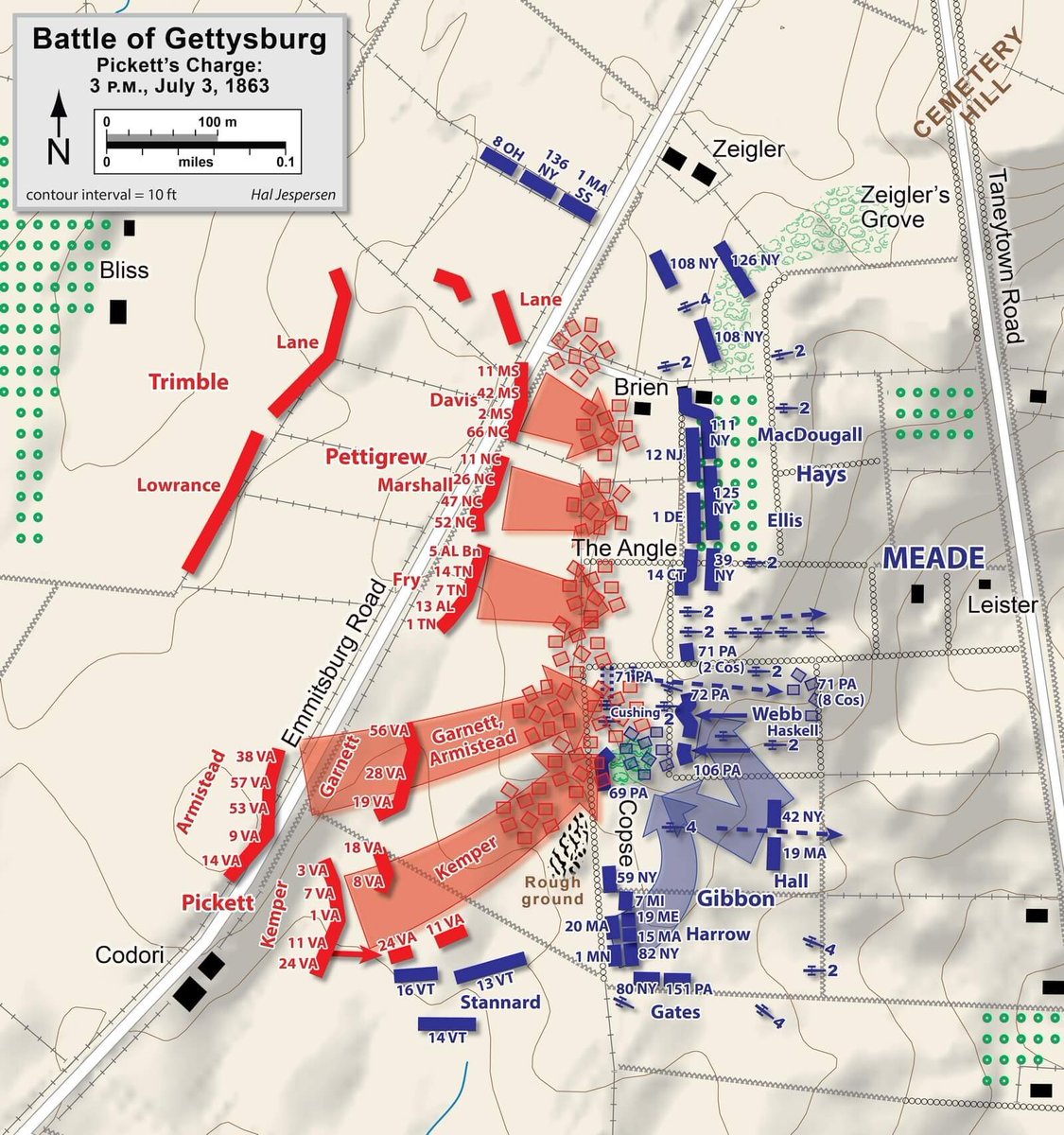
Look at the map — Hal Jespersen's rendering will do fine — and trace the Emmitsburg Road where it crosses the field of the charge, there at the tips of the red arrows. Notice what it refuses to do. It does not run parallel to the Union line waiting on Cemetery Ridge. It slants away, cutting the field at an angle, and that angle wrote a cruel arithmetic into the assault before the first man stepped off. The farther left a soldier stood in the Confederate line, the longer he would remain under fire — and, crueler still, the closer the road itself lay to the Union muskets when at last he reached it. A man in Pickett's ranks crossed the road with the worst still ahead of him. A man on Pettigrew's left crossed it nearly under the muzzles.
And the road did not merely lie there. It was bordered on both sides by those post-and-rail fences — too stout to knock flat, too well-set to push through, and standing too close under the Federal guns for Confederate pioneers to have torn them down beforehand. So they stood, waiting, while a mile away the men who would die on them dressed their lines in the shade of the trees.
Consider what crossing them required, and let the clock slow down the way it slowed for the men who lived it. You have already survived the artillery and the first long reach of the rifled muskets. You come up out of the smoke to the first fence and you climb it — and for those two or three seconds atop the rails you are the tallest thing on the field, silhouetted against the sky for every Federal rifleman on the ridge. Then you drop down into the roadbed, which is slightly sunken, and the sinking of it whispers a lie: shelter. Men are piling in around you — winded, bleeding, some carrying wounds they have not yet noticed. Behind the stone wall up the slope, the Federals watch the gray line bunch and stack up in that road, and they pour their fire into the packed mass with the deliberation of men shooting into a pen.
Now comes the choice that would haunt the survivors for the rest of their long or short lives. Stay in the road — in this trap dressed up as a refuge — and try to reform ranks while the Minié balls whine overhead and thud into the crowd? Or climb the second fence, silhouette yourself once more, and go on into the storm beyond? There was no good answer, and the farther left you were, the worse both answers got. Joe Davis's Mississippians knew it as well as any men on that field — the 2nd Mississippi among them, or what remained of it, a regiment already bled white in the railroad cut two days before and now asked to cross a road where the Union rifles stood nearest of all.
The survivors' accounts do not flinch, and neither should we. Men piled up at those fences, the dead and wounded forming barricades of flesh along the rails. Some climbed over their own fallen comrades, using them — there is no gentler way to say it — as stepping stones. Others lay flat in the roadbed, paralyzed between the two impossibilities, while the plunging fire found them where they lay.
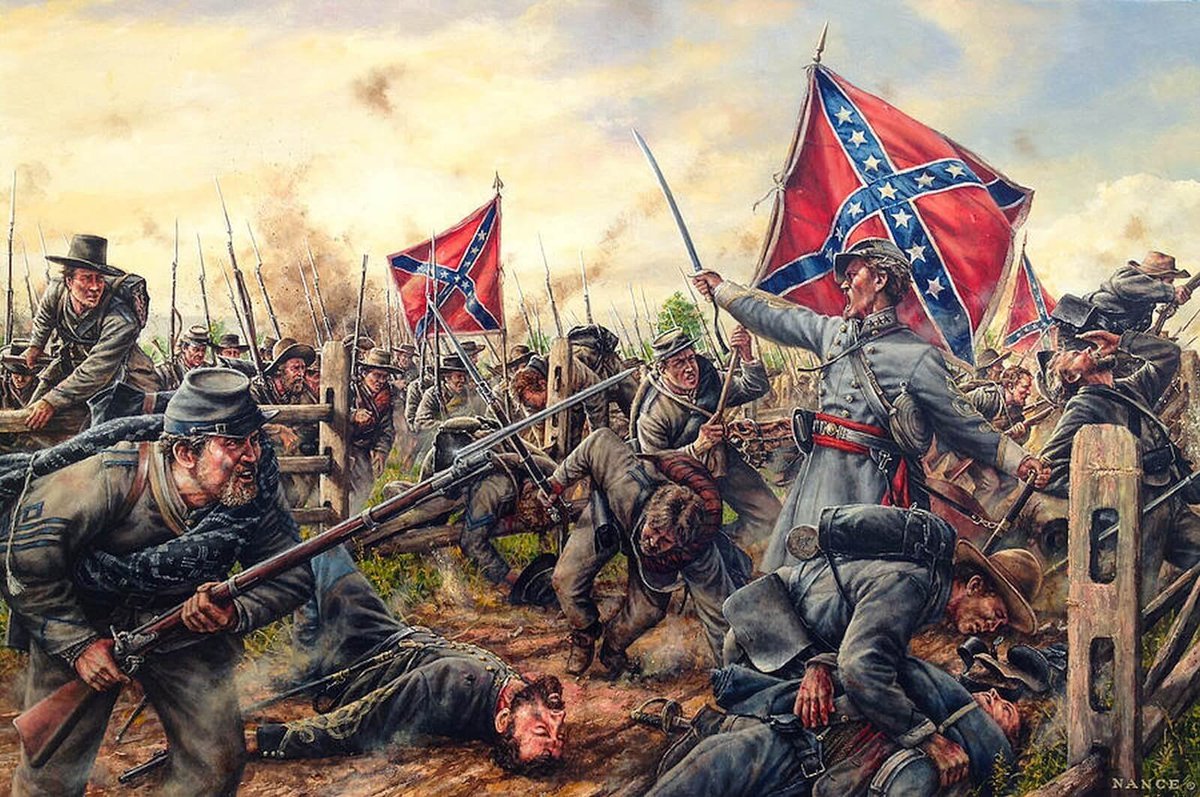
Dan Nance's painting Charge of the Tarheels catches the nightmare as well as canvas can — North Carolinians of what I take to be Marshall's brigade of Pettigrew's division, Colonel James K. Marshall commanding, breaking apart against those rails. Look at it and you understand what the word obstacle meant that afternoon: not a delay but a dissolution, formation and order and momentum all coming apart at once against a farmer's fence.
The second map tells the rest in the cold language of cartography — the farthest advance of each Confederate unit, marked and measured. Follow the line from right to left and watch the marks fall away. Pickett's men, for all their agony, got past the road in numbers. On the left, few did. Those who pressed beyond it were mostly killed, wounded, or captured within minutes. Many who stayed in the road fared no better. The road took them either way.
When you sit with the survivors' words long enough, one truth rises out of them and will not be argued down: these men did all that mortal flesh could do. They advanced into a geometry that grew deadlier with every leftward step, met an obstacle that turned courage itself into a liability, and went on anyway — over the first fence, into the road, and for the bravest of them over the second fence into the fire beyond. The Emmitsburg Road did not merely channel Pettigrew's charge. It condemned it.
The fences are rebuilt now, of course. Boys climb them.
***
Maps by Hal Jespersen, https://t.co/xuUTgoBtxM
Graphics: (the previously posted maps deserve repeating here, to illustrate the path of the Emmitsburg Road and how it slants away from the Confederate left to right.) 1) Initial positions and lines of advance; 2) Detail showing the "High Water Mark" positions; 3) "Charge of the Tarheels" by Dan Nance - North Carolinians of Marshall's Brigade, Pettigrew's Division, as they struggle to cross the post-and-rail fences along the Emmitsburg Road during Pickett's Charge
Lot of yapping about Alabama baseball from fans who lost to Milwaukee. Weird. Also lots of yapping from people who never stepped foot inside the Joe this year…strange.
Alabama's first trip to Men's College World Series since 1999 ends in most lopsided two-game performance by any team since 1957: https://t.co/BOeWc87XSK
Alabama is the ONLY school to:
Lose by 35 in the CFP 🔥
Lose by 13 in the S16😈
Go 0-2 in the CWS losing 9-0 & 14-2💪
With 0 conference titles this year😮💨😮💨
A great year for the capstone no doubt!
Alabama head coach Rob Vaughn was asked if he would do anything different next time he is in the CWS.
"Nothing I would've changed, just probably embraced this a little bit more. I would probably have enjoyed the moment a little more. And every dude I talked to warned me about that, but you just put your head down and try to get a job done. And unfortunately, it came up a little short, but what a ride."
Alabama 2026 Predictions
8-4 (5-4, tied 7th in SEC)
Vs ECU- W
At Kentucky- W
Vs Florida State- W
Vs South Carolina- W
At Mississippi State- W
Vs Georgia- L
At Tennessee- L
Vs Texas A&M- L
At LSU- W
At Vanderbilt- W
Vs Chattanooga- W
Vs Auburn- L
Alabama needs for next season
Starting 1st baseman
Starting 2nd baseman
Starting shortstop
Starting third baseman
Starting center fielder
Starting right fielder
Second and third day starter
Gonna be a big offseason for coach Vaughn
aight man just give Vaughn some funding and we should be fine in the future
worst fielding and batting team in the SEC and we went to Omaha
it will work out, RTR
Look who dropped by yesterday morning as we were moving into our Southside B’ham HQ. Stacey Abrams reminded us that we have to move so much more in this election. We have to move hearts and minds and importantly souls to the polls. Thank you Stacey for your great work and for your endorsement of our campaign to change Alabama.
Bama fans, be honest... 🔽
Head Coach Kalen DeBoer's NEW 7-year, $87.5M contract is sitting on your desk, and your signature finalizes it 🖊️
Are you SIGNING it or SHREDDING it? 🤔
The future of Alabama Football is in YOUR hands. Make the call. 🐘


![2ndMississippi's tweet photo. The Crossing: Lee's Escape at Williamsport
July 4–14, 1863
[Author's Note: The Battle of Gettysburg ended on July 3, 1863. The Gettysburg Campaign did not. Most accounts close with Pickett's Charge and skip ahead to the fall, as if the armies simply dispersed — but for eleven more days the outcome of the campaign, and arguably the war, hung unresolved along the roads and river crossings of Maryland. Lee still had to bring a bloodied army, a seventeen-mile train of wounded, and every gun and wagon he owned back across a Potomac in full flood, with the Army of the Potomac closing behind him. That story — the retreat, the stand at Williamsport, and the final fight at Falling Waters — is where this series goes next. Today's post covers the escape itself. The Wagoner's Fight at Williamsport (July 6) and the rear-guard action at Falling Waters (July 14), where the 2nd Mississippi Infantry appears in both, will each get their own posts ahead.]
It began to rain on the afternoon of July 4, and it did not stop. The men of the Army of Northern Virginia stood in it along Seminary Ridge, waiting behind their stacked rails for the counterattack that never came, while a thousand miles to the southwest — though no man on that ridge yet knew it — John Pemberton was surrendering Vicksburg and thirty thousand men to Ulysses Grant. Independence Day, 1863. The Confederacy had been struck twice in a single turning of the earth, and the second blow had not finished landing. Lee had to get his army — what was left of it, some fifty thousand men with their wounded and their trains and their guns — back across the Potomac before George Meade could pin it against the river and finish what three days at Gettysburg had begun.
Lee had already set the machinery in motion. In the small hours of the 4th he rode alone to the headquarters of John Imboden, the cavalry brigadier whose command had arrived too late for the battle and was therefore fresh enough for what came next. Imboden would remember the commanding general sitting his horse in the moonlight, so worn that for a time he did not speak at all. When he did, it was to give Imboden the hardest assignment of the campaign: take the wounded — those who could survive the moving — and get them to the Potomac ahead of everything else.
The train Imboden assembled stretched seventeen miles. More than eight thousand wounded men rode in it, packed into springless wagons on bare boards, most without straw, many without food, jolting southwest through the mountain passes over roads the rain was churning into troughs of mud. Imboden's orders forbade halting for any cause, and so the train ground forward through the night of July 4 while the men inside it screamed at every lurch. Imboden rode the length of that column in the darkness and never forgot what he heard coming out of the wagons — men begging to be lifted out and left beside the road to die, men calling on God to end it. He had commanded troops in battle. He wrote afterward that nothing he ever saw on a field of fire compared to that night on the Greencastle road.
The rain that tortured the wounded also saved them. The same downpour that turned the Confederate line of retreat into a swamp turned every road behind it into the same swamp, and Meade's pursuit — burdened with its own thousands of wounded, its own empty cartridge boxes and worn-out shoes — slogged forward at the pace the mud allowed and no faster.
Then, at the river, the trap closed. When the head of the column reached Williamsport on July 5, the news was waiting: a Federal cavalry raid had cut the pontoon bridge downstream at Falling Waters, and the rains had swollen the Potomac far past fording and it was still rising. Behind Lee's army came Meade with eighty thousand men. In front of it ran a river no army could cross. The Army of Northern Virginia, which two weeks earlier had marched into Pennsylvania as the most feared fighting force on the continent, was about to be penned against the water with its back to the flood.
Imboden did not wait for the water to decide anything. He seized the town and turned it, in his own words, into one great hospital, quartering the wounded on the citizens of Williamsport whether the citizens liked it or not — and then he found the ferry. Two flatboats, thirty wounded men to a load, fifteen minutes to the far bank and fifteen minutes back, working around the clock while the walking wounded were started on foot down the road toward Winchester. It was a trickle against a flood, but the trickle never stopped, and over the next two days and nights it carried the broken men of Gettysburg across to Virginia by the boatload — so that the wounded, who had suffered the worst of the retreat, were among the first out of the trap, safely over the river a full week before the army that had to stand and hold the bank behind them.
What happened at Williamsport on July 6 — when Federal cavalry came down on the wagon park and the crossing itself, and the defense of the army's trains fell to teamsters handed muskets, to clerks and cooks and quartermasters, and to walking wounded who climbed down from the wagons and into line of battle — is a story that deserves its own telling, and it will get one. It is enough to say here that the wagons, the guns, and the crossing were all still in Confederate hands when Lee's infantry arrived.
The main army came up on the 6th and 7th by way of Hagerstown, and what it did next tells you how far the war had traveled since 1861. There was no talk of gallant stands in the open. The men went into the ground. In less than a week, soldiers who had marched and fought for a month built six miles of entrenchments in a great arc from Downsville to the river, covering both Williamsport and the bridge site at Falling Waters — earthen parapets six feet through, rifle pits, communication trenches, obstructions, and gun platforms laid out so that more than two hundred pieces of artillery could sweep every yard of open ground in front. An observer who walked the line said the works looked as if they were meant to stand a month's siege. Stranger still, the men behind them were not beaten men. Their letters home that week spoke of confidence, not despair — they had held their ground on the last day at Gettysburg until ordered off it, they had brought the army away intact, they had Lee, and now they had six feet of Maryland earth in front of them. Bloodied, yes. Broken, no.
Across the way, George Meade could see all of it, and he knew exactly what he was looking at. He had been in command of the Army of the Potomac for seventeen days. In that span he had fought and won the largest battle ever waged in the Western Hemisphere, and it had cost him nearly a quarter of his army. Now Washington wanted the rest of the job done — Halleck's telegrams arriving daily, the President behind Halleck, the newspapers behind the President, all of them demanding that Lee be destroyed on the north bank of the Potomac and the war ended before the summer was out. On July 12 Meade closed up to the Confederate works, studied them, and called his corps commanders together. He put the question to a vote: attack, or not. The vote came back seven to two against.
The men who cast those votes were not timid men. They were men who remembered Fredericksburg — who had watched, seven months earlier, fourteen brigades break apart in front of a stone wall and a fortified ridge, twelve thousand casualties bought for nothing. Now they looked across at the Downsville line and saw Marye's Heights built longer, deeper, and better: high ground, heavy parapets, massed guns, open fields of fire, and Robert E. Lee waiting behind it, wanting nothing in this world so much as for them to come on. The arithmetic every one of them carried said an attacker needed three men for every defender at the point of assault, and the ground said even that might not serve. Military science said do not attack. Politics said attack now. Meade, a professional to his boot soles, listened to the science and spent July 13 probing and reconnoitering instead.
He was one day too late. The river had begun to fall, and Lee's engineers had not been idle. Lacking pontoons, they had made them — tearing down warehouses along the canal for lumber, building crude scows, caulking them with whatever came to hand, floating the sections down to Falling Waters and laying a new bridge across the dropping flood. On the night of July 13, in darkness and yet more rain, the Army of Northern Virginia began to move. Longstreet's and Hill's corps filed onto the swaying bridge at Falling Waters by the light of torches and crossed all night above the brown water. Upstream at Williamsport, Ewell's men went into the ford in the dark, the water armpit-deep and still pushing hard, cartridge boxes slung on bayonets over their heads, the shorter men clinging to the taller. All night the army poured south — men, guns, wagons, the whole apparatus of war passing over a hostile river within cannon shot of an enemy twice its size.
When Meade's skirmishers went forward at dawn on July 14, they walked into six miles of empty works. The rear guard was still on the north bank at Falling Waters, and there was a fight there that morning — a sharp, costly, and largely forgotten one that will also get its own telling. When it ended, the Federal cavalry held upward of five hundred prisoners, and the official reports would call them stragglers; but most were nothing of the kind. They were fighting men of Heth's rear guard — Davis's brigade and Pettigrew's own North Carolinians among them — taken in ranks, along with the killed and the wounded of the last fight north of the river. And among those wounded was Johnston Pettigrew himself, shot down within sight of the bridge; he would die three days later at Bunker Hill, thirty-five years old — he had marked the birthday on the Fourth of July, the day the retreat began — struck by the closing hour of a campaign he had unknowingly opened on the road to Gettysburg two weeks before. The army itself was gone.
In Washington, Lincoln received the news like a man struck. He said afterward that Lee's escape left him as nearly inconsolable as he could be and live; he believed the war might have ended on that riverbank, and he may have been right. The professionals saw it otherwise. They had looked at those works with their own eyes, and they understood that the most likely fruit of an assault was another Fredericksburg — ten or fifteen thousand men down in the mud, the victory of Gettysburg thrown away in an afternoon, and Lee across the river anyway. Meade had chosen to keep his army, and armies, not riverbanks, would decide the war.
That morning Federal soldiers walked the abandoned Confederate line in the rain, past the gun platforms and the six-foot parapets and the rifle pits that beaten men had carved out of Maryland in five days, and understood what they had been spared. Behind them the Potomac ran brown and quiet, carrying the rain down toward the Chesapeake. On the far bank the Army of Northern Virginia was marching south into Virginia — bloodied, unbroken, going home. The war it carried with it had twenty-one months yet to run.](https://pbs.twimg.com/media/HMYd0foX0AAGbHo.png)
![2ndMississippi's tweet photo. The Crossing: Lee's Escape at Williamsport
July 4–14, 1863
[Author's Note: The Battle of Gettysburg ended on July 3, 1863. The Gettysburg Campaign did not. Most accounts close with Pickett's Charge and skip ahead to the fall, as if the armies simply dispersed — but for eleven more days the outcome of the campaign, and arguably the war, hung unresolved along the roads and river crossings of Maryland. Lee still had to bring a bloodied army, a seventeen-mile train of wounded, and every gun and wagon he owned back across a Potomac in full flood, with the Army of the Potomac closing behind him. That story — the retreat, the stand at Williamsport, and the final fight at Falling Waters — is where this series goes next. Today's post covers the escape itself. The Wagoner's Fight at Williamsport (July 6) and the rear-guard action at Falling Waters (July 14), where the 2nd Mississippi Infantry appears in both, will each get their own posts ahead.]
It began to rain on the afternoon of July 4, and it did not stop. The men of the Army of Northern Virginia stood in it along Seminary Ridge, waiting behind their stacked rails for the counterattack that never came, while a thousand miles to the southwest — though no man on that ridge yet knew it — John Pemberton was surrendering Vicksburg and thirty thousand men to Ulysses Grant. Independence Day, 1863. The Confederacy had been struck twice in a single turning of the earth, and the second blow had not finished landing. Lee had to get his army — what was left of it, some fifty thousand men with their wounded and their trains and their guns — back across the Potomac before George Meade could pin it against the river and finish what three days at Gettysburg had begun.
Lee had already set the machinery in motion. In the small hours of the 4th he rode alone to the headquarters of John Imboden, the cavalry brigadier whose command had arrived too late for the battle and was therefore fresh enough for what came next. Imboden would remember the commanding general sitting his horse in the moonlight, so worn that for a time he did not speak at all. When he did, it was to give Imboden the hardest assignment of the campaign: take the wounded — those who could survive the moving — and get them to the Potomac ahead of everything else.
The train Imboden assembled stretched seventeen miles. More than eight thousand wounded men rode in it, packed into springless wagons on bare boards, most without straw, many without food, jolting southwest through the mountain passes over roads the rain was churning into troughs of mud. Imboden's orders forbade halting for any cause, and so the train ground forward through the night of July 4 while the men inside it screamed at every lurch. Imboden rode the length of that column in the darkness and never forgot what he heard coming out of the wagons — men begging to be lifted out and left beside the road to die, men calling on God to end it. He had commanded troops in battle. He wrote afterward that nothing he ever saw on a field of fire compared to that night on the Greencastle road.
The rain that tortured the wounded also saved them. The same downpour that turned the Confederate line of retreat into a swamp turned every road behind it into the same swamp, and Meade's pursuit — burdened with its own thousands of wounded, its own empty cartridge boxes and worn-out shoes — slogged forward at the pace the mud allowed and no faster.
Then, at the river, the trap closed. When the head of the column reached Williamsport on July 5, the news was waiting: a Federal cavalry raid had cut the pontoon bridge downstream at Falling Waters, and the rains had swollen the Potomac far past fording and it was still rising. Behind Lee's army came Meade with eighty thousand men. In front of it ran a river no army could cross. The Army of Northern Virginia, which two weeks earlier had marched into Pennsylvania as the most feared fighting force on the continent, was about to be penned against the water with its back to the flood.
Imboden did not wait for the water to decide anything. He seized the town and turned it, in his own words, into one great hospital, quartering the wounded on the citizens of Williamsport whether the citizens liked it or not — and then he found the ferry. Two flatboats, thirty wounded men to a load, fifteen minutes to the far bank and fifteen minutes back, working around the clock while the walking wounded were started on foot down the road toward Winchester. It was a trickle against a flood, but the trickle never stopped, and over the next two days and nights it carried the broken men of Gettysburg across to Virginia by the boatload — so that the wounded, who had suffered the worst of the retreat, were among the first out of the trap, safely over the river a full week before the army that had to stand and hold the bank behind them.
What happened at Williamsport on July 6 — when Federal cavalry came down on the wagon park and the crossing itself, and the defense of the army's trains fell to teamsters handed muskets, to clerks and cooks and quartermasters, and to walking wounded who climbed down from the wagons and into line of battle — is a story that deserves its own telling, and it will get one. It is enough to say here that the wagons, the guns, and the crossing were all still in Confederate hands when Lee's infantry arrived.
The main army came up on the 6th and 7th by way of Hagerstown, and what it did next tells you how far the war had traveled since 1861. There was no talk of gallant stands in the open. The men went into the ground. In less than a week, soldiers who had marched and fought for a month built six miles of entrenchments in a great arc from Downsville to the river, covering both Williamsport and the bridge site at Falling Waters — earthen parapets six feet through, rifle pits, communication trenches, obstructions, and gun platforms laid out so that more than two hundred pieces of artillery could sweep every yard of open ground in front. An observer who walked the line said the works looked as if they were meant to stand a month's siege. Stranger still, the men behind them were not beaten men. Their letters home that week spoke of confidence, not despair — they had held their ground on the last day at Gettysburg until ordered off it, they had brought the army away intact, they had Lee, and now they had six feet of Maryland earth in front of them. Bloodied, yes. Broken, no.
Across the way, George Meade could see all of it, and he knew exactly what he was looking at. He had been in command of the Army of the Potomac for seventeen days. In that span he had fought and won the largest battle ever waged in the Western Hemisphere, and it had cost him nearly a quarter of his army. Now Washington wanted the rest of the job done — Halleck's telegrams arriving daily, the President behind Halleck, the newspapers behind the President, all of them demanding that Lee be destroyed on the north bank of the Potomac and the war ended before the summer was out. On July 12 Meade closed up to the Confederate works, studied them, and called his corps commanders together. He put the question to a vote: attack, or not. The vote came back seven to two against.
The men who cast those votes were not timid men. They were men who remembered Fredericksburg — who had watched, seven months earlier, fourteen brigades break apart in front of a stone wall and a fortified ridge, twelve thousand casualties bought for nothing. Now they looked across at the Downsville line and saw Marye's Heights built longer, deeper, and better: high ground, heavy parapets, massed guns, open fields of fire, and Robert E. Lee waiting behind it, wanting nothing in this world so much as for them to come on. The arithmetic every one of them carried said an attacker needed three men for every defender at the point of assault, and the ground said even that might not serve. Military science said do not attack. Politics said attack now. Meade, a professional to his boot soles, listened to the science and spent July 13 probing and reconnoitering instead.
He was one day too late. The river had begun to fall, and Lee's engineers had not been idle. Lacking pontoons, they had made them — tearing down warehouses along the canal for lumber, building crude scows, caulking them with whatever came to hand, floating the sections down to Falling Waters and laying a new bridge across the dropping flood. On the night of July 13, in darkness and yet more rain, the Army of Northern Virginia began to move. Longstreet's and Hill's corps filed onto the swaying bridge at Falling Waters by the light of torches and crossed all night above the brown water. Upstream at Williamsport, Ewell's men went into the ford in the dark, the water armpit-deep and still pushing hard, cartridge boxes slung on bayonets over their heads, the shorter men clinging to the taller. All night the army poured south — men, guns, wagons, the whole apparatus of war passing over a hostile river within cannon shot of an enemy twice its size.
When Meade's skirmishers went forward at dawn on July 14, they walked into six miles of empty works. The rear guard was still on the north bank at Falling Waters, and there was a fight there that morning — a sharp, costly, and largely forgotten one that will also get its own telling. When it ended, the Federal cavalry held upward of five hundred prisoners, and the official reports would call them stragglers; but most were nothing of the kind. They were fighting men of Heth's rear guard — Davis's brigade and Pettigrew's own North Carolinians among them — taken in ranks, along with the killed and the wounded of the last fight north of the river. And among those wounded was Johnston Pettigrew himself, shot down within sight of the bridge; he would die three days later at Bunker Hill, thirty-five years old — he had marked the birthday on the Fourth of July, the day the retreat began — struck by the closing hour of a campaign he had unknowingly opened on the road to Gettysburg two weeks before. The army itself was gone.
In Washington, Lincoln received the news like a man struck. He said afterward that Lee's escape left him as nearly inconsolable as he could be and live; he believed the war might have ended on that riverbank, and he may have been right. The professionals saw it otherwise. They had looked at those works with their own eyes, and they understood that the most likely fruit of an assault was another Fredericksburg — ten or fifteen thousand men down in the mud, the victory of Gettysburg thrown away in an afternoon, and Lee across the river anyway. Meade had chosen to keep his army, and armies, not riverbanks, would decide the war.
That morning Federal soldiers walked the abandoned Confederate line in the rain, past the gun platforms and the six-foot parapets and the rifle pits that beaten men had carved out of Maryland in five days, and understood what they had been spared. Behind them the Potomac ran brown and quiet, carrying the rain down toward the Chesapeake. On the far bank the Army of Northern Virginia was marching south into Virginia — bloodied, unbroken, going home. The war it carried with it had twenty-one months yet to run.](https://pbs.twimg.com/media/HMYdxYOWAAApaG0.png)








![2ndMississippi's tweet photo. The Crossing: Lee's Escape at Williamsport
July 4–14, 1863
[Author's Note: The Battle of Gettysburg ended on July 3, 1863. The Gettysburg Campaign did not. Most accounts close with Pickett's Charge and skip ahead to the fall, as if the armies simply dispersed — but for eleven more days the outcome of the campaign, and arguably the war, hung unresolved along the roads and river crossings of Maryland. Lee still had to bring a bloodied army, a seventeen-mile train of wounded, and every gun and wagon he owned back across a Potomac in full flood, with the Army of the Potomac closing behind him. That story — the retreat, the stand at Williamsport, and the final fight at Falling Waters — is where this series goes next. Today's post covers the escape itself. The Wagoner's Fight at Williamsport (July 6) and the rear-guard action at Falling Waters (July 14), where the 2nd Mississippi Infantry appears in both, will each get their own posts ahead.]
It began to rain on the afternoon of July 4, and it did not stop. The men of the Army of Northern Virginia stood in it along Seminary Ridge, waiting behind their stacked rails for the counterattack that never came, while a thousand miles to the southwest — though no man on that ridge yet knew it — John Pemberton was surrendering Vicksburg and thirty thousand men to Ulysses Grant. Independence Day, 1863. The Confederacy had been struck twice in a single turning of the earth, and the second blow had not finished landing. Lee had to get his army — what was left of it, some fifty thousand men with their wounded and their trains and their guns — back across the Potomac before George Meade could pin it against the river and finish what three days at Gettysburg had begun.
Lee had already set the machinery in motion. In the small hours of the 4th he rode alone to the headquarters of John Imboden, the cavalry brigadier whose command had arrived too late for the battle and was therefore fresh enough for what came next. Imboden would remember the commanding general sitting his horse in the moonlight, so worn that for a time he did not speak at all. When he did, it was to give Imboden the hardest assignment of the campaign: take the wounded — those who could survive the moving — and get them to the Potomac ahead of everything else.
The train Imboden assembled stretched seventeen miles. More than eight thousand wounded men rode in it, packed into springless wagons on bare boards, most without straw, many without food, jolting southwest through the mountain passes over roads the rain was churning into troughs of mud. Imboden's orders forbade halting for any cause, and so the train ground forward through the night of July 4 while the men inside it screamed at every lurch. Imboden rode the length of that column in the darkness and never forgot what he heard coming out of the wagons — men begging to be lifted out and left beside the road to die, men calling on God to end it. He had commanded troops in battle. He wrote afterward that nothing he ever saw on a field of fire compared to that night on the Greencastle road.
The rain that tortured the wounded also saved them. The same downpour that turned the Confederate line of retreat into a swamp turned every road behind it into the same swamp, and Meade's pursuit — burdened with its own thousands of wounded, its own empty cartridge boxes and worn-out shoes — slogged forward at the pace the mud allowed and no faster.
Then, at the river, the trap closed. When the head of the column reached Williamsport on July 5, the news was waiting: a Federal cavalry raid had cut the pontoon bridge downstream at Falling Waters, and the rains had swollen the Potomac far past fording and it was still rising. Behind Lee's army came Meade with eighty thousand men. In front of it ran a river no army could cross. The Army of Northern Virginia, which two weeks earlier had marched into Pennsylvania as the most feared fighting force on the continent, was about to be penned against the water with its back to the flood.
Imboden did not wait for the water to decide anything. He seized the town and turned it, in his own words, into one great hospital, quartering the wounded on the citizens of Williamsport whether the citizens liked it or not — and then he found the ferry. Two flatboats, thirty wounded men to a load, fifteen minutes to the far bank and fifteen minutes back, working around the clock while the walking wounded were started on foot down the road toward Winchester. It was a trickle against a flood, but the trickle never stopped, and over the next two days and nights it carried the broken men of Gettysburg across to Virginia by the boatload — so that the wounded, who had suffered the worst of the retreat, were among the first out of the trap, safely over the river a full week before the army that had to stand and hold the bank behind them.
What happened at Williamsport on July 6 — when Federal cavalry came down on the wagon park and the crossing itself, and the defense of the army's trains fell to teamsters handed muskets, to clerks and cooks and quartermasters, and to walking wounded who climbed down from the wagons and into line of battle — is a story that deserves its own telling, and it will get one. It is enough to say here that the wagons, the guns, and the crossing were all still in Confederate hands when Lee's infantry arrived.
The main army came up on the 6th and 7th by way of Hagerstown, and what it did next tells you how far the war had traveled since 1861. There was no talk of gallant stands in the open. The men went into the ground. In less than a week, soldiers who had marched and fought for a month built six miles of entrenchments in a great arc from Downsville to the river, covering both Williamsport and the bridge site at Falling Waters — earthen parapets six feet through, rifle pits, communication trenches, obstructions, and gun platforms laid out so that more than two hundred pieces of artillery could sweep every yard of open ground in front. An observer who walked the line said the works looked as if they were meant to stand a month's siege. Stranger still, the men behind them were not beaten men. Their letters home that week spoke of confidence, not despair — they had held their ground on the last day at Gettysburg until ordered off it, they had brought the army away intact, they had Lee, and now they had six feet of Maryland earth in front of them. Bloodied, yes. Broken, no.
Across the way, George Meade could see all of it, and he knew exactly what he was looking at. He had been in command of the Army of the Potomac for seventeen days. In that span he had fought and won the largest battle ever waged in the Western Hemisphere, and it had cost him nearly a quarter of his army. Now Washington wanted the rest of the job done — Halleck's telegrams arriving daily, the President behind Halleck, the newspapers behind the President, all of them demanding that Lee be destroyed on the north bank of the Potomac and the war ended before the summer was out. On July 12 Meade closed up to the Confederate works, studied them, and called his corps commanders together. He put the question to a vote: attack, or not. The vote came back seven to two against.
The men who cast those votes were not timid men. They were men who remembered Fredericksburg — who had watched, seven months earlier, fourteen brigades break apart in front of a stone wall and a fortified ridge, twelve thousand casualties bought for nothing. Now they looked across at the Downsville line and saw Marye's Heights built longer, deeper, and better: high ground, heavy parapets, massed guns, open fields of fire, and Robert E. Lee waiting behind it, wanting nothing in this world so much as for them to come on. The arithmetic every one of them carried said an attacker needed three men for every defender at the point of assault, and the ground said even that might not serve. Military science said do not attack. Politics said attack now. Meade, a professional to his boot soles, listened to the science and spent July 13 probing and reconnoitering instead.
He was one day too late. The river had begun to fall, and Lee's engineers had not been idle. Lacking pontoons, they had made them — tearing down warehouses along the canal for lumber, building crude scows, caulking them with whatever came to hand, floating the sections down to Falling Waters and laying a new bridge across the dropping flood. On the night of July 13, in darkness and yet more rain, the Army of Northern Virginia began to move. Longstreet's and Hill's corps filed onto the swaying bridge at Falling Waters by the light of torches and crossed all night above the brown water. Upstream at Williamsport, Ewell's men went into the ford in the dark, the water armpit-deep and still pushing hard, cartridge boxes slung on bayonets over their heads, the shorter men clinging to the taller. All night the army poured south — men, guns, wagons, the whole apparatus of war passing over a hostile river within cannon shot of an enemy twice its size.
When Meade's skirmishers went forward at dawn on July 14, they walked into six miles of empty works. The rear guard was still on the north bank at Falling Waters, and there was a fight there that morning — a sharp, costly, and largely forgotten one that will also get its own telling. When it ended, the Federal cavalry held upward of five hundred prisoners, and the official reports would call them stragglers; but most were nothing of the kind. They were fighting men of Heth's rear guard — Davis's brigade and Pettigrew's own North Carolinians among them — taken in ranks, along with the killed and the wounded of the last fight north of the river. And among those wounded was Johnston Pettigrew himself, shot down within sight of the bridge; he would die three days later at Bunker Hill, thirty-five years old — he had marked the birthday on the Fourth of July, the day the retreat began — struck by the closing hour of a campaign he had unknowingly opened on the road to Gettysburg two weeks before. The army itself was gone.
In Washington, Lincoln received the news like a man struck. He said afterward that Lee's escape left him as nearly inconsolable as he could be and live; he believed the war might have ended on that riverbank, and he may have been right. The professionals saw it otherwise. They had looked at those works with their own eyes, and they understood that the most likely fruit of an assault was another Fredericksburg — ten or fifteen thousand men down in the mud, the victory of Gettysburg thrown away in an afternoon, and Lee across the river anyway. Meade had chosen to keep his army, and armies, not riverbanks, would decide the war.
That morning Federal soldiers walked the abandoned Confederate line in the rain, past the gun platforms and the six-foot parapets and the rifle pits that beaten men had carved out of Maryland in five days, and understood what they had been spared. Behind them the Potomac ran brown and quiet, carrying the rain down toward the Chesapeake. On the far bank the Army of Northern Virginia was marching south into Virginia — bloodied, unbroken, going home. The war it carried with it had twenty-one months yet to run.](https://pbs.twimg.com/media/HMYd7tsWMAAYJfR.png)