America already made daylight saving time permanent once. In December 1973, 79% of Americans supported it and Nixon signed it into law. By February 1974, eight weeks into the experiment, support had collapsed to 42%. The policy never changed. Winter arrived.
Sunrise in Washington DC came at 8:27am. Kids left for school in total darkness, carrying flashlights and wearing reflective tape. When Congress moved to repeal, members cited the deaths of eight Florida schoolchildren in the first weeks of the change.
The energy case collapsed too. The whole point was the oil embargo, and the Department of Transportation concluded the fuel savings were too small to matter. Ten months after signing it, Congress repealed it and Ford put the country back on standard time.
There's a mechanism that makes this cycle repeat: permanent DST is only ever voted on when the sun is up. Polls run in the abstract, votes happen in warm months, and the benefit, a free hour of evening light, is easy to imagine year-round. The cost is concentrated in about 10 weeks of dark winter mornings and only becomes real after implementation. So the policy polls beautifully right up until January.
Today's vote happened in July. The 1974 law passed in December, right before the exact winter that killed it. If this clears the Senate, the first real test arrives in January 2027, when sunrise in Indianapolis comes after 9am.
Sleep researchers have watched this loop for 50 years, which is why the American Academy of Sleep Medicine, the AMA, and the National Sleep Foundation all back the opposite reform, permanent standard time. Congress just picked the one version of clock reform America has already tried, hated, and repealed.
🚨🚨🚨🚨Today the U.S. House passed the Sunshine Protection Act, advancing legislation that would make Daylight Saving Time permanent nationwide.
This is the biggest legislative step this issue has taken in years but it is not law.
The bill now moves to the U.S. Senate, where there is still an opportunity for it to be debated, amended, or rejected. If you care about health and circadian biology, this is the time to speak up.
The scientific case against permanent DST has become increasingly strong:
• Morning light is the most powerful signal for synchronizing the human circadian clock.
• Permanent DST delays sunrise for much of the year, especially in winter, reducing exposure to morning light when our brains need it most.
• Later sunrises are associated with chronic circadian misalignment, sleep loss, poorer mood, reduced alertness, and increased cardiometabolic risk.
• Studies comparing western versus eastern portions of time zones consistently show worse health outcomes where people experience later sunrises despite sharing the same clock time.
• The American Academy of Sleep Medicine and numerous sleep and circadian experts recommend permanent Standard Time, not permanent DST, as the option that best aligns with human biology.
The argument for permanent DST is largely one of convenience and preference for lighter evenings. The argument for permanent Standard Time is one of physiology and public health.
If you believe our laws should reflect the best available scientific evidence, now is the time to respectfully contact your U.S. Senators. Tell them that while ending the twice-yearly clock changes is a worthy goal, permanent Daylight Saving Time is not the healthiest solution. Ask them instead to support permanent Standard Time, which preserves the morning light our circadian system depends on.
Please REPOST this. The Senate has not yet voted, and informed voices can still make a difference.
@LeaderJohnThune is the Senate majority leader that will determine when this legislation comes to the Senate for debate. He should know how you feel.
Karl Marx spent his life explaining an economy he never once participated in. He wrote *Das Kapital* in the reading room of the British Museum, subsisting on handouts from Friedrich Engels, whose family owned the very factories Marx despised. But that irony is the least of his problems.
Start with the labor theory of value, the rotten foundation holding the whole structure up. Marx claimed a good's value comes from the socially necessary labor time poured into it. Sounds tidy. It collapses on contact with reality. You can spend forty hours hand-carving a mud pie and it remains worthless. Value lives in the mind of the buyer, not the sweat of the maker. Carl Menger settled this in 1871 with the theory of marginal utility. Value is subjective. A bottle of water sells for pennies in Vienna and for a fortune in the Sahara, and the labor inside it never changed.
Once subjective value stands, Marx's "surplus value" story falls with it. He insisted the capitalist steals the gap between what labor produces and what labor gets paid. But the worker gets paid today for output the entrepreneur sells months later, at a price nobody can guarantee. Eugen von Böhm-Bawerk named this correctly: the capitalist advances wages now and shoulders the risk of loss. Time preference explains the wage gap. That is not theft. That is a service, and workers line up for it because they prefer a paycheck Friday over a gamble that pays off next year.
Then there is calculation. In 1920 Ludwig von Mises demolished the socialist project in a single stroke: without private ownership of capital goods, you have no market prices for them, and without prices you cannot calculate whether building tractors or grain silos wastes resources. The planner flies blind. The Soviets proved it for seventy years, producing shoes nobody could wear and steel nobody needed while people queued for bread. Twenty million dead in the process, give or take a census.
Marx predicted capitalism would immiserate the worker until revolution. Instead the worker got refrigerators, antibiotics, and a smartphone with more computing power than NASA had in 1969.
His theory failed the exam. Every single question.
This is one of the most important moments ever aired on CNBC.
Billionaire investor Chamath Palihapitiya says the media lied to millions of Americans about President Trump, and that after going back to the original source material, he realized he had been completely misled about Trump’s character.
PALIHAPITIYA: “The reality is that most of us were lied to by the media about President Trump.”
“And if you just go back to the source material, you should take away two things.”
“One, he didn’t say half the things he said, and two, why did these other people just fabricate what they wanted to say so that they could essentially assassinate his character?”
“I think that that second thing is completely unacceptable in America, and there’s still been no repercussions, really.”
“I took the time to learn about it. I admitted where…you know, the way that I met him was, I admitted on the pod, which, you know, has millions of viewers.”
“And I said, I got it totally wrong because I went and I watched Charlottesville.”
“And, you know, the first person to call me? President Trump.”
“And I got to know him and I put the phone down, I called my wife, and I said, we got it TOTALLY, totally wrong. We were lied to.”
“And then I got to know him and he is fantastic!”
@chamath
The latest Obamacare enrollment numbers tell a good news/bad news story.
The good news: improper enrollments have been cut from last year’s record 5.6 million to an estimated 2.6 million this year.
The bad news: millions of fraudulent or improper enrollments are still costing taxpayers.
Niccolò Machiavelli wrote The Prince in 1513 as a practical manual for power. For five centuries, polite society has pretended to be shocked by it. Meanwhile, every successful political operator — on every side — has been quietly following it. The only people who haven’t read it are the ones who keep losing.
1. Machiavelli’s central insight is not that the ends justify the means. That is the misquote that lets comfortable people dismiss him. His actual insight is simpler and more disturbing: power has its own logic, independent of morality, and those who refuse to understand that logic will be defeated by those who do. The Prince is not a villain’s manual. It is a description of reality that makes virtuous people uncomfortable – because reality doesn’t care about their virtue.
2. The current progressive system applies Machiavelli more fluently than any of its opponents. His first rule: the appearance of virtue matters more than virtue itself. The DEI statement while systematically excluding dissent. The democracy rhetoric while suppressing opposition. The compassion branding while destroying careers. This is Machiavelli’s prince – not good, but performing goodness to maintain legitimacy. The performance is the power.
3. His second rule, which the current system also applies perfectly: cruelty, when necessary, should be delivered swiftly, completely, and early. Cancellation is Machiavellian – total, swift, exemplary. The point isn’t the individual being cancelled. The point is the ten thousand people watching who quietly adjust their behavior. One public destruction purchases a million private silences. Machiavelli would have recognized the mechanism immediately. He invented the theory.
4. Communism applied the fear side of Machiavelli with full conviction – Stalin made the explicit choice Machiavelli described: better to be feared than loved. The show trial is pure Machiavellian theater – a public demonstration of power functioning as a warning to everyone who isn’t on trial. But communism made his fatal mistake: it destroyed the people’s goodwill so completely that it generated not just fear but hatred. And Machiavelli is unambiguous – you can rule through fear, you cannot survive through hatred.
5. His most important democratic insight — the one nobody quotes — is that the prince who builds his power on the people is more secure than one who builds it on elites. Elites are few, demanding, and treacherous. The people are many, ask only not to be oppressed, and are a more stable foundation. The political movement that actually connects with ordinary people against the credentialed elite is applying Machiavelli more correctly than the elite relying on institutional capture alone.
6. What should we do? Stop bringing virtue to a knife fight. The chronic error of the opposition is the naive prince Machiavelli explicitly warns against – the leader who assumes truth wins automatically, who believes that being right is a strategy. It is not a strategy. It is a precondition. Being right gives you something worth fighting for. Machiavelli tells you how to fight: build your own power base, never rely entirely on others, control your narrative before your enemies do, and treat fortune as something to be seized, not waited for. Fortune favors the bold. Not the righteous. The bold.
7. Machiavelli is taught in universities as cynical amoralism – the thing decent people reject. This framing is itself Machiavellian – it keeps the manual out of the hands of the people who most need it. The current establishment didn’t reject Machiavelli. It institutionalized him, rebranded him in the language of social justice, and uses him daily. The opposition reads Augustine and loses. The system reads Machiavelli and wins. Until the side that is actually right decides that understanding power is not a betrayal of principle but a precondition for defending it – the result will be the same. Virtue without strategy is just a dignified way of losing.
That’s right kids, socialism “works” until the bill comes due! Here’s the cycle: A socialist implements a proven failed policy that makes the problem worse. Then when it predictably fails they blame “greed”, the weather, anything but to admit their own policies. Because socialists demand we judge them by intentions not results!
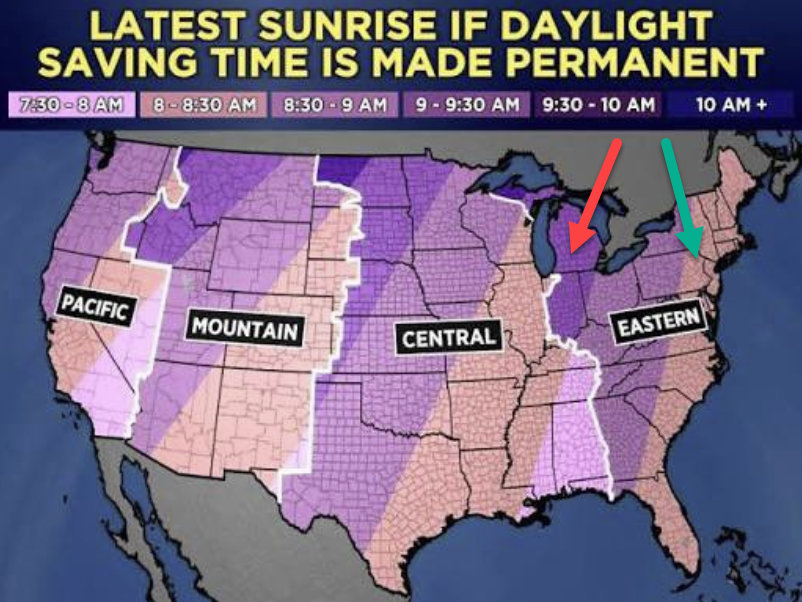
We already know what happens when you have different sunrise times. We've set up the experiment within each time zones and it's not pretty. Later sunrises (western portion of a particular time zone - red arrow) have higher disease rates than those in the eastern portion of the same time zones - green arrow).
Giuntella O, Mazzonna F. “Sunset time and the economic effects of social jetlag: evidence from US time zone borders.” Journal of Health Economics. 2019;65:210–226.
https://t.co/apisuuTxpP
Gu F, Xu S, Devesa SS, et al. “Longitude Position in a Time Zone and Cancer Risk in the United States.” Cancer Epidemiology, Biomarkers & Prevention. 2017;26:1306–1311.
https://t.co/L9wuhvN01h
VoPham T, Weaver MD, Vetter C, et al. “Circadian Misalignment and Hepatocellular Carcinoma Incidence in the United States.” Cancer Epidemiology, Biomarkers & Prevention. 2018;27:719–727.
https://t.co/w1FxPU2au9
Borisenkov MF. “Latitude of Residence and Position in Time Zone Are Predictors of Cancer Incidence, Cancer Mortality, and Life Expectancy at Birth.” Chronobiology International. 2011;28:155–162.
https://t.co/BAsq8qreIE
Reis DJ, Yen P, Tizenberg B, et al. “Longitude-based time zone partitions and rates of suicide.” Journal of Affective Disorders. 2023;339:933–942.
https://t.co/jOVIhhkftQ
People living where solar time is delayed relative to social clock time—particularly toward the western portions of time zones—have been found in several large studies to sleep less and to experience higher rates of obesity, diabetes, cardiovascular disease, certain cancers and suicide.
About 250 years ago a quirky moral philosopher named Adam Smith discovered a chain of logic whereby the selfish desires of man would result in widespread prosperity. It’s one of the greatest discoveries of all time.
Here’s how it goes…
1.Selfish desire seeks wealth, status, security. No virtue required. This is the raw material, as unpromising as it sounds.
2. In a market with property rights, you can’t take, you must trade. Theft and fraud are policed, so the only legal route to someone else’s money is offering them something they want more. Self-interest is channelled through voluntary exchange. This is the crucial valve: the baker serves your bread not from benevolence, but because it’s how he gets paid.
3.Every voluntary trade creates value for both sides. Nobody trades unless they prefer what they’re getting to what they’re giving. So each transaction is positive-sum by construction. Wealth isn’t moved; it’s made.
4.Competition forces the selfish to serve better. You’re not the only one chasing that customer’s money. To win, you must offer more value, lower prices, or something new. Greed disciplined by rivalry becomes, functionally, service. The customer becomes the boss of every capitalist.
5.Prices emerge as signals of what people actually want. Millions of trades compress dispersed knowledge - scarcity, preference, urgency - into a single number. No planner needed. High prices shout “make more of this” and falling prices say “stop making this.” The cure for high prices IS high prices.
6.Profit directs capital toward unmet needs. Profit is the reward for spotting something people want but can’t get, and losses are the punishment for guessing wrong. Capital flows automatically toward solving problems and away from waste - a self-correcting search algorithm running on selfishness. The profit motive pulls the greedy person towards genuine service and efficiency.
7.The pursuit of advantage drives innovation. The only durable way to out-earn competitors is to do something new - create a better product, a cheaper process. Each entrepreneur trying to get rich makes the previous solution obsolete and the average person’s life better.
8.Specialisation and scale compound productivity. Competition pushes everyone toward what they do best; trade lets them exchange it. Output per person rises.
9.Rising productivity spreads as falling prices and rising wages. Competition doesn’t let producers keep the gains forever - they’re competed away to consumers. The luxuries of one generation (cars, flights, antibiotics, computing) become the staples of the next. The rich get richer, but the poor get richer too.
10. Prosperity becomes self-reinforcing and civilising. Wealth funds education, health, science, and even the welfare state that redistributes it. Commerce rewards trust, reliability, and cooperation with strangers (doux commerce).
A system built on self-interest ends up producing the most extensive cooperation network in human history: millions of strangers coordinating to put breakfast on your table.
The hockey stick after 1800: from ~$3/day for all of human history to a 30-fold rise in living standards wherever this system took hold is pure magic.
"Across multiple datasets from multiple nations, people who placed more value on free speech were more likely to hold racially tolerant attitudes. This is consistent with the idea that free speech and tolerance spring from the same broader liberal ethos." https://t.co/4AJFl0eNfX
You know what else is a priority to Spanberger? Adding a half a billion carbon tax to every Virginians power bill. Only to the Left does “affordability” really mean “massive tax hikes on working class Virginians.”
This girl is cruising down the highway in her stick shift, windows down, wind in her hair, belting out songs while she shifts gears without missing a beat. She looks genuinely happy and in control.
Most people these days never learn how to drive manual. It takes real timing and coordination to get the clutch and gas right, especially when you’re just trying to have fun and sing along. Seeing her do it so naturally makes you realize how much of that skill is disappearing.
Do you think driving stick is becoming a lost art, or do you still think it’s worth teaching people even if almost every new car is automatic?
🚨 SCOTUS JUSTICE CLARENCE THOMAS JUST WENT FULL BASED
"It's the best speech I've ever heard in my LIFE on the Declaration of Independence" — Fox legal editor
Wow!
He's drawing a STARK contrast to leftist Ketanji Brown Jackson:
Thomas FIRED BACK at the left demonizing our Founding.
"Give me liberty or give me death. That devotion has driven the great achievements and heroism of Americans in the 250 years since!"
"Think of the frontiersmen who settled the West. Think of the families who built their little towns on the prairies. Think of the women who raised their children to love God and country and sent them off to fight wars."
"It is a devotion expressed in the final sentence of the Declaration, the willingness to do anything for our principles that has throughout American history been most indispensable."
"It is that devotion that we are missing today and that we must find in our hearts if this nation is to endure."
TRAIN BREAK: UP 4014 gets underway from a dead stop after a whistle stop at Leetsdale, PA in front of a YUGE crowd. ✊️
Great look at the other engines and the consist.
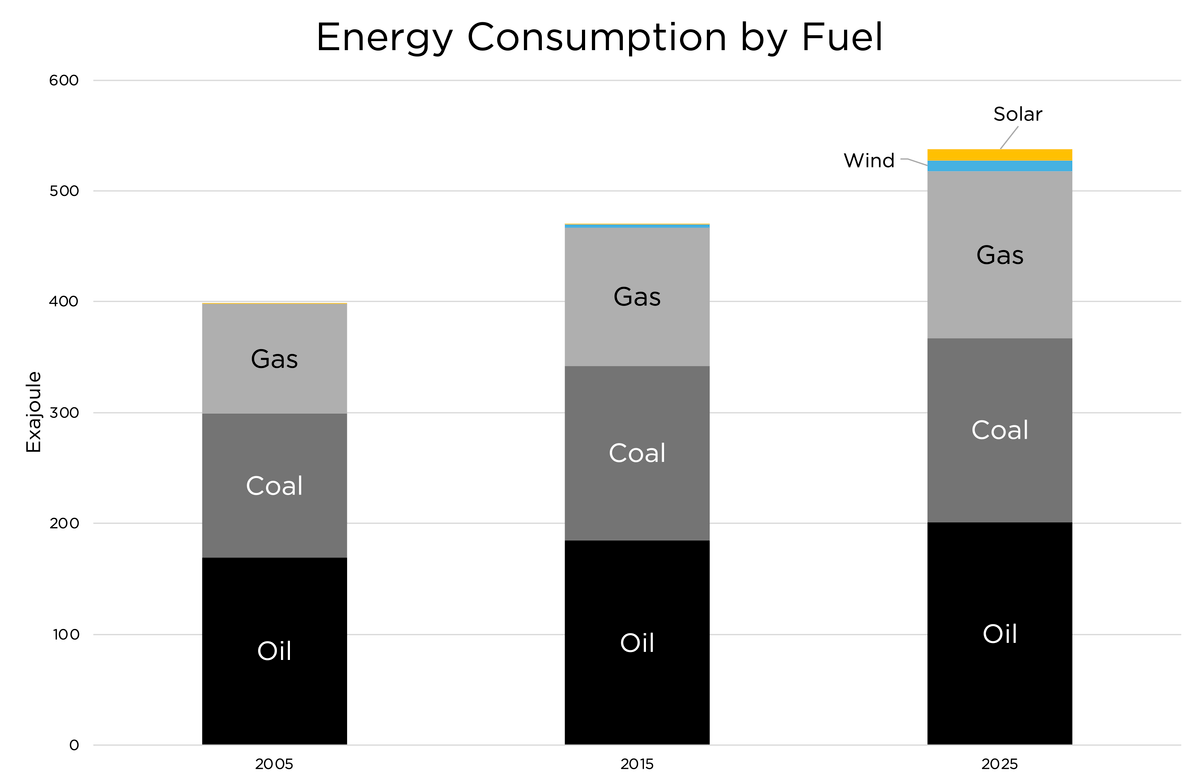
Energy Institute just released its latest Statistical Review of World Energy.
Surprise: The vast majority of global energy consumption is oil, coal, and gas! A tiny proportion is solar and wind—and that’s not reliable energy, it’s fuel-saving for reliable energy.
TRAIN BREAK! UP 4014 Big Boy moving upgrade with "stack talk"
Approaching Tunnelhill between the Altoona Curve and Cresson.
Protip: Don't be the one whistling or making unnecessary loud noises as the train approaches 😉👍