https://t.co/6lE526e4us
Check it out
#17776
*Set in the distant future in which all humans have become immortal and infertile, the series follows three sapient space probes that watch humanity play an evolved form of. .
India has more semiconductor design engineers than any country except the US.
It has the world's fastest-growing aviation market.
It is the world's largest arms importer.
And it spends 0.65% of GDP on R&D less than Brazil.
These four facts describe the most consequential gap in India's economic architecture.
The IT services era built a foundation. But services are what you sell when you don't own the technology. Products, platforms, and systems are what you build when you do.
TSMC's market cap alone exceeds India's entire IT services industry combined. That's the difference between owning technology and renting out engineers.
The good news: for the first time, the conditions to close this gap actually exist.
Semiconductor supply chains are being redrawn globally. India's defence exports just hit ₹38,424 crore up 63% in one year, reaching 80+ countries. Ten semiconductor projects worth ₹1.60 lakh crore are approved and moving. ISM 2.0 targets 3nm capability by 2035.
France population smaller than UP builds its own fighter jets, nuclear submarines, jet engines, and satellites. Sweden population of Bengaluru builds the Gripen fighter and spends 3.4% of GDP on R&D. South Korea went from importing all its weapons to exporting howitzers to NATO in one generation.
None of them had more engineers than India. All of them had more strategic patience.
The decade ahead will decide whether India's start becomes a transformation.
Wrote a detailed piece on why semiconductors, defence, and aerospace are the forge in which technological nations are made and why India must enter that forge now. Link below.
#AatmanirbharBharat #Semiconductors #MakeInIndia #DefenceManufacturing #Aerospace #IndianIndustry #DeepTech #SemiconductorMission @narendramodi@nsitharaman@PiyushGoyal@DrSJaishankar@rajnathsingh@AshwiniVaishnaw
Check out my latest article: India's Industrial Moment https://t.co/H2o0h81A8q via @LinkedIn
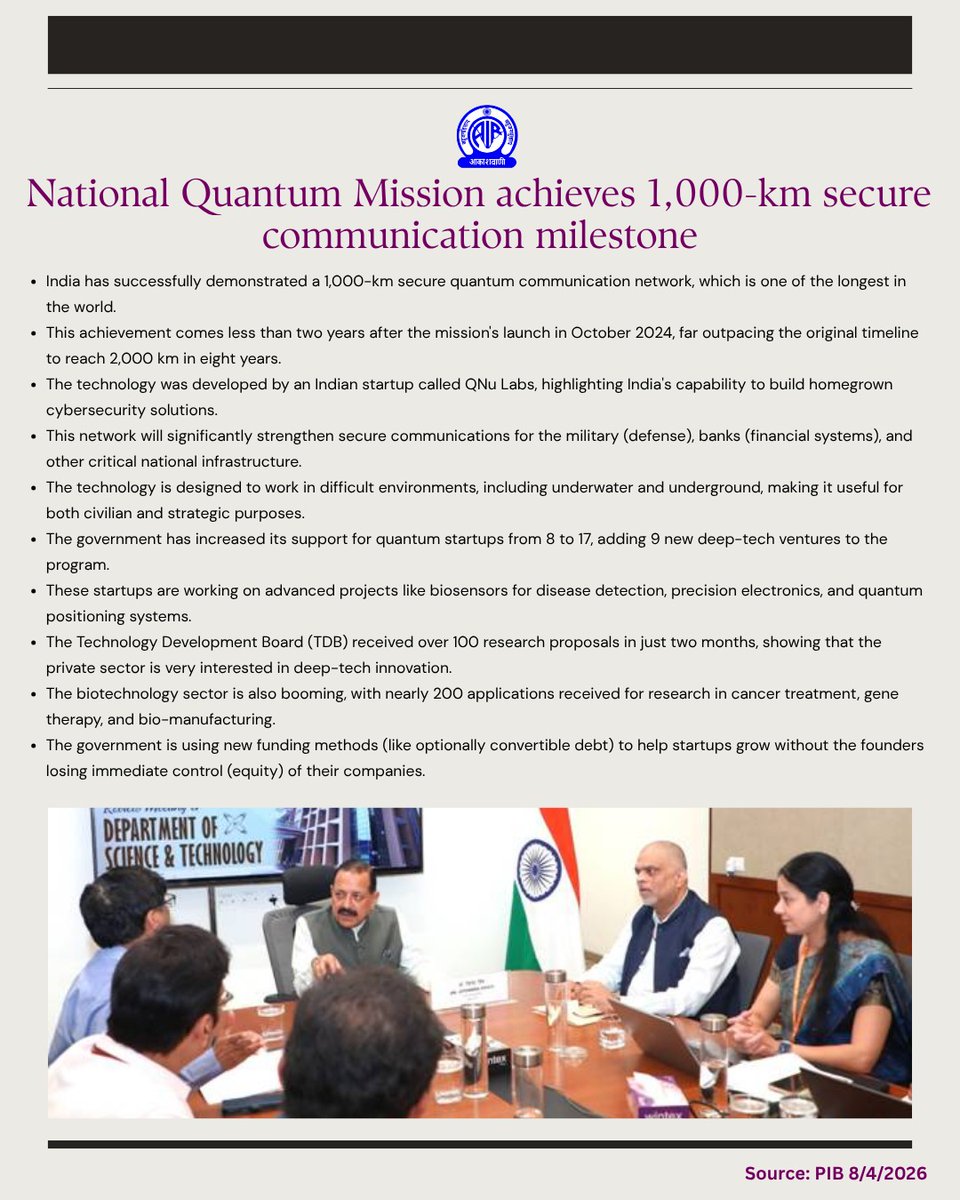
National Quantum Mission achieves 1,000-km secure communication milestone
India has successfully demonstrated a 1,000-km secure quantum communication network, which is one of the longest in the world.
This achievement comes less than two years after the mission's launch in October 2024, far outpacing the original timeline to reach 2,000 km in eight years......
For more information PIB Link: https://t.co/Wa8LkMplAE
@MIB_India@airnewsalert
The West poured $50 billion into fast breeder nuclear reactors and abandoned every single one. India poured $900 million and just achieved criticality on the first commercially viable one outside Russia.
The US spent $15 billion. Gave up. Japan spent $12 billion. Their Monju prototype had one sodium fire in 1995 and never recovered. The UK spent $8 billion. Germany spent $6 billion. France, Italy, all walked away. Six of the richest nations on Earth concluded this technology was too hard and too expensive to pursue.
India started building in 2004 with an initial budget of $420 million. Twenty-two years, a dozen missed deadlines, and a cost doubling later, the Prototype Fast Breeder Reactor at Kalpakkam just sustained a controlled fission chain reaction. The reactor is now alive.
The reason India never quit is a constraint most people have never thought about. India has only 1-2% of the world's uranium reserves. For a country of 1.4 billion people trying to build energy independence, that's a death sentence if you're running conventional nuclear.
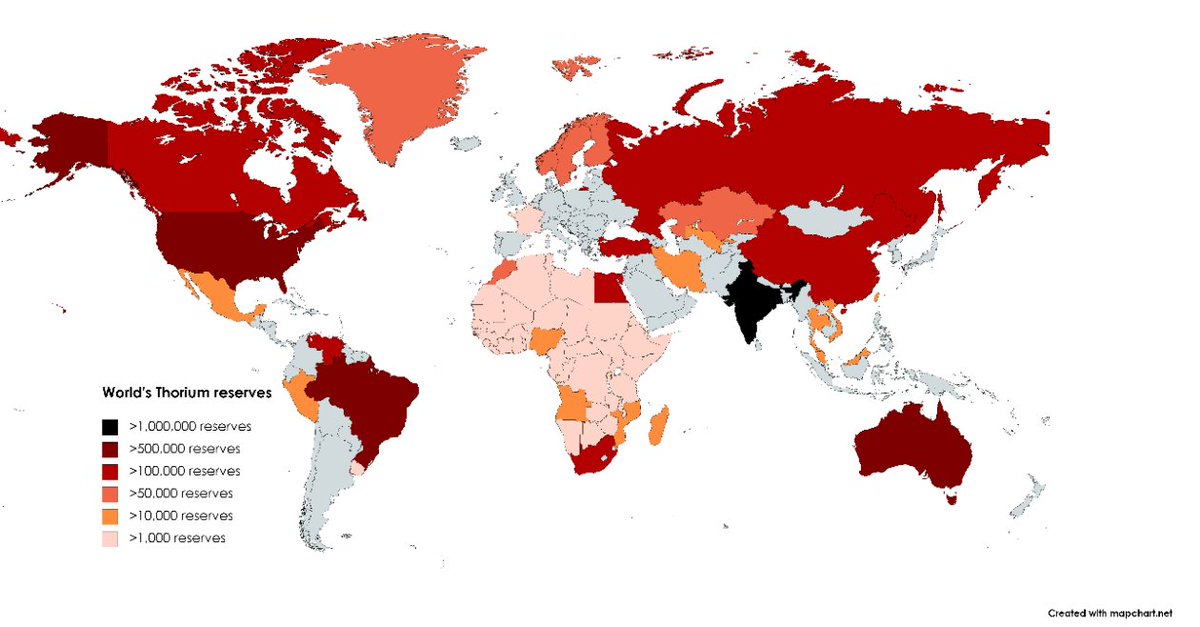
But India has 25% of the world's thorium. The single largest national reserve on Earth.
The problem: you can't just burn thorium the way you burn uranium. A physicist named Homi Bhabha designed a three-stage nuclear program in the 1950s specifically to solve this. Stage 1: burn natural uranium in heavy water reactors, collect plutonium as a byproduct. Stage 2: feed that plutonium into fast breeder reactors, where it breeds MORE plutonium AND converts thorium into fissile uranium-233. Stage 3: burn thorium directly at scale.
India just entered Stage 2. Seventy years after Bhabha drew it up on paper.
The math on the thorium endgame is wild. At current energy consumption rates, India's thorium reserves could power the country for over 700 years. Most nuclear nations are playing a uranium game with maybe 80-100 years of runway. India is playing a completely different game with a 7x longer fuel supply.
The West quit because uranium stayed cheap and sodium coolant is terrifying. It catches fire on contact with air. It explodes on contact with water. Russia's BN-600 had 27 sodium leaks and 14 sodium fires between 1980 and 1997. And Russia kept going anyway because Russia doesn't quit nuclear projects. India watched all of that and kept going too.
When you have 1% of the uranium but 25% of the thorium, the engineering difficulty stops being a reason to quit. It becomes the price of admission to a 700-year energy supply that nobody else can access.
India just crossed a line that only a handful of nations in the world ever have.
This isn’t just another reactor going live.
This is India stepping into one of the most elite and strategic clubs in global energy, Fast Breeder Nuclear Technology.
With the Prototype Fast Breeder Reactor (PFBR) at Kalpakkam achieving criticality, India has officially moved into Stage 2 of its nuclear program, a stage where the game changes completely.
Here’s why this matters globally 👇
Most countries run nuclear reactors that consume fuel.
Fast breeder reactors do the opposite — they create more fuel than they burn.
Think about that for a second.
In a world obsessed with energy shortages, supply chains, and resource wars…
India is building a system that can multiply its own fuel.
Only a few countries have ever reached this level:
- Russia — operational leader
- China — scaling aggressively
- France & Japan — tried, but stepped back
Now India joins that list.
But here’s where it gets even bigger…
India isn’t just copying the global model.
It’s playing a completely different endgame.
While most nations are stuck in the uranium cycle, India is building toward thorium-based energy — something it has in abundance.
And if India cracks thorium power at scale, this is where the narrative explodes:
Thorium is far more abundant than uranium, especially in India.
A successful thorium cycle would mean:
→ Fuel constraints practically disappear
→ Energy can be produced domestically for generations
→ Import dependence drops dramatically
At that point, you’re not just energy secure…
you’re sitting on something close to structurally unlimited power potential.
That’s not an exaggeration, that’s the strategic vision behind India’s 3-stage nuclear program.
This is not a short-term headline.
This is a multi-decade shift in capability.
From a global lens:
This signals that India is no longer just a participant in energy markets,
it’s becoming a future technology and energy powerhouse.
From a market lens:
This quietly strengthens long-term narratives around:
- Nuclear energy expansion
- Uranium demand (near term)
- Thorium-based innovation (long term)
- Domestic heavy engineering & infra
And from a geopolitical lens:
Energy independence = policy independence.
That’s the real story.
This moment won’t move markets tomorrow.
But 10–15 years from now, we might look back and say,
This is where the foundation was laid.
This is the mysterious “Lady of the Spiked Throne” artefact, dated to around 2800 BC. It depicts a boat shaped like a buffalo, with two turbaned men standing at the front, numerous people seated, and one woman at the very back on a large spiked throne. There is no clear context for who these people are, as little is known about the civilisation.
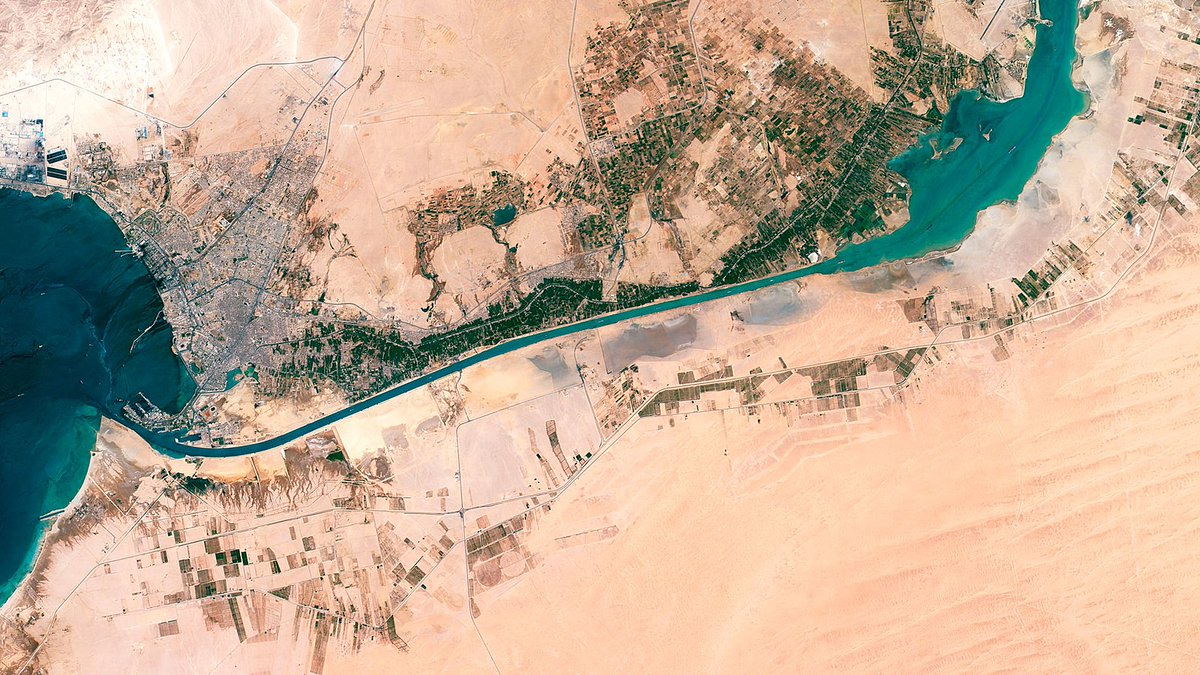
1/x In June 1967, during the Six-Day War between Israel and Egypt, Egyptian forces blocked the Suez Canal by sinking ships, laying mines, and filling it with debris to prevent Israeli use. A northbound convoy of 15 cargo vessels became trapped.
Humans going to the Moon isn’t just another spacetrip, and it isn't made trivial by todays technology just because a group of absolute madmen managed to pull it off with calculators in the 1960s and 70s
It is the farthest distance humans have ever traveled. Because the Moon looks large in the sky, many people underestimate how far away it really is. The Moon is about 1000 times further from Earth than the International Space Station. Artemis II will take 10 days, with astronauts traveling at thousands of miles per hour through deep space only to slam back into Earth’s atmosphere going 25000 mph relying on a heat shield to survive.
There’s something both inspiring and reassuring about the fact that humans are willing to take that kind of risk and to come back home to tell us what they experienced
For the first time in over 50 years, humans are Moonbound.
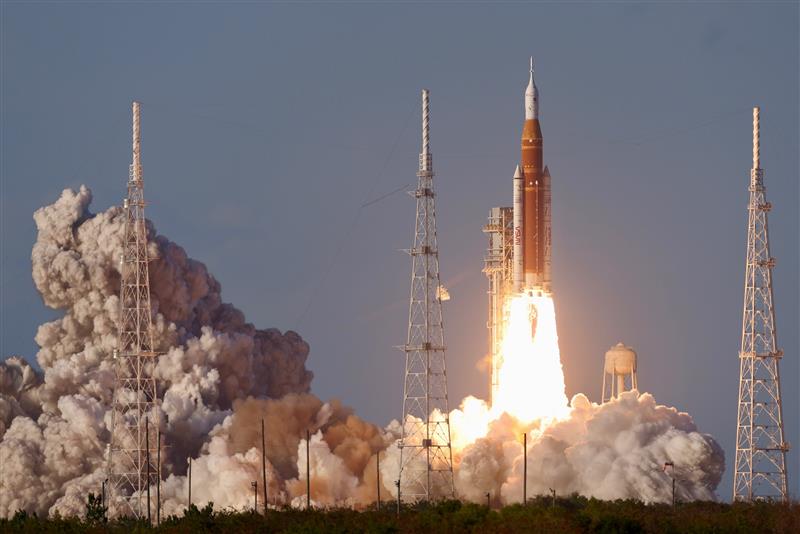
At 6:35 p.m. EDT (2235 UTC) NASA’s Space Launch System rocket and the Orion spacecraft lifted off from the agency’s Kennedy Space Center in Florida, sending four astronauts on a planned test flight around the Moon and back. https://t.co/0Q9ZB4IWVI