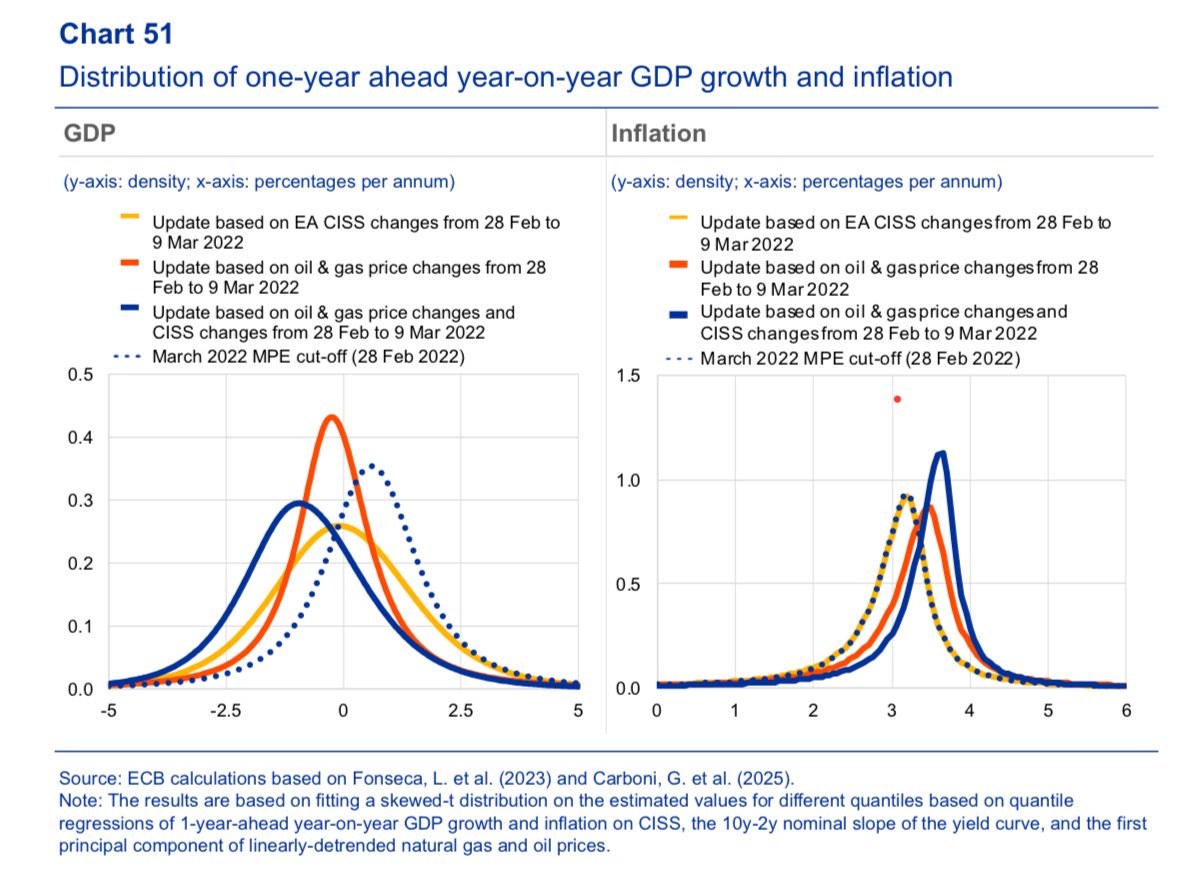
The review cites my paper, with @LeonardoMelosi and Ivan Petrella, as providing a theoretical justification to risk-adjusted predictive assessments. We show that this approach can contribute to the risk management approach to monetary policy in real-time.
https://t.co/JAXmPvMmkH
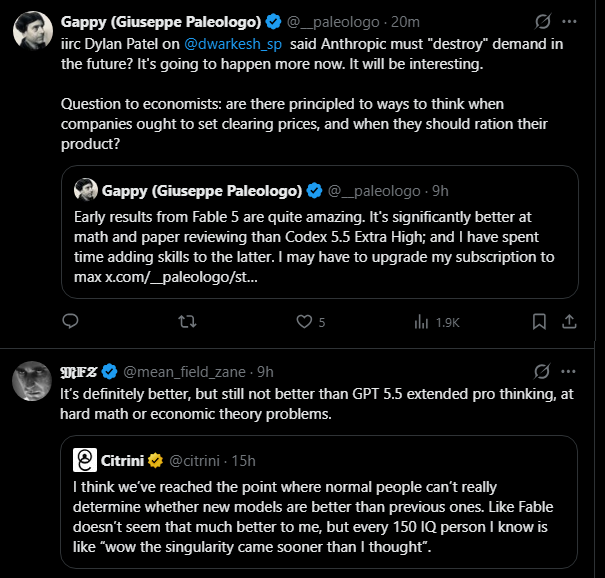
My working theory is that every time a new model gets released, everyone rushes to claim that it's either better or not better than the previous model, but in fact no one really has any basis for knowing one way or the other, and they're just reflecting their personal biases.
Here is a puzzle. On the days when major AI labs release new frontier models — the kind of news that presumably raises expectations about future productivity growth — nominal and real Treasury yields fall. Andrews and Farboodi (2025) document this pattern across 17 model releases in a fascinating paper. Standard theory predicts that risk-free real rates increase when we expect higher economic growth as some of us try to consume some of that extra future income today by borrowing, thus pushing up rates. The conventional interpretation of these findings is that markets are revising growth expectations down, not up: bad news for AI optimism.
What's going on? U.S. Treasury Investors' Massive Bet on AI (post with James Paron and Howard Kung)
https://t.co/G5SbhnMJfp
Italian efficiency when it comes to coffee should be studied.
In Italy:
- Walk into a bar and look at the guy
- Un caffe
- 30 seconds later it’s ready
- Shoot it
- Leave €1
- Walk out
In the US:
- Join a line
- Wait
- Order coffee
- Answer 12 questions: Size? Milk? Roast? Sugar? Temperature? Colombia beans? Name? How do you spell it?
- $12.34
- Ask for a 20% tip. Click 5 times on a ipad to have a custom tip
- Tap phone
- ask where to send the invoice
- Wait again on a different line
- Someone call a name that sounds similar to mine
- get the coffee
- too hot, can't drink it
- finally at temperature
taste like shit
RIP Chris Sims.
I was enormously influenced by Chris. My own, perhaps idiosyncratic take:
His main contribution came at a time when macroeconomists had constructed the first wave of big macroeconometric models. They were constructed piece by piece, a consumption block, an investment block, and so on. Each piece looked reasonable, but when assembled together, the implied macro dynamics were all wrong.
What Chris did was to turn things around, namely argue that one had to start from the actual macro dynamics, the so called VARs, and show how, with minimal identification conditions (leading to "structural" VARs), they could be used to suggest the dynamic effects of various shocks, dynamics that the structural models had to replicate.
To say that his approach was influential would be to understate its influence. Today, a model that did not fit the VAR evidence, would be simply dismissed.
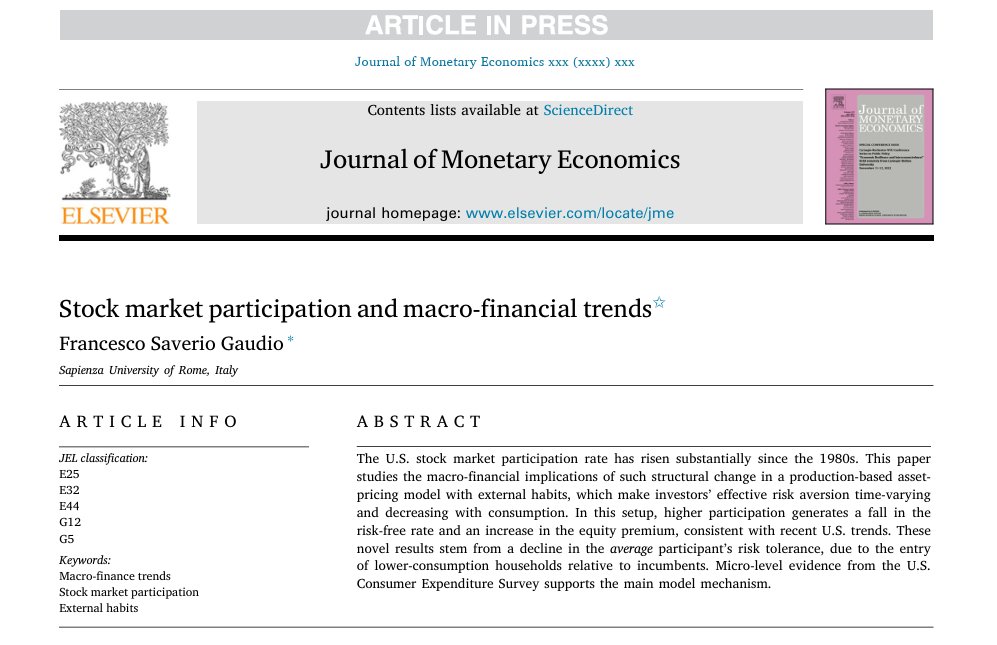
Excited to share that my article, "Stock market participation and macro-financial trends", is now in press at the Journal of Monetary Economics!
Link here: https://t.co/TcrDeFh0v4
Parla pure di Palestina e di cosa significa quello che accade lì per tante persone nelle periferie degli imperi.
È un fumetto complicato quindi dura 37 pagine, se volete litigà ve prego almeno leggetevele tutte.
I colori sono di Alberto Madrigal
https://t.co/dNVE86wVLS
The review cites my paper, with @LeonardoMelosi and Ivan Petrella, as providing a theoretical justification to risk-adjusted predictive assessments. We show that this approach can contribute to the risk management approach to monetary policy in real-time.
https://t.co/JAXmPvMmkH
The latest monetary policy strategy assessment of the ECB highlights the importance of considering the risks surrounding baseline projections for policy making.
https://t.co/TFU4LL0iXb
🧵New Working Paper by I. Petrella, @Depomtx & @LeonardoMelosi “The taming of the skew: asymmetric inflation risk and monetary policy” https://t.co/m39Dj7LSv4 1/6
📚 Dive into this enlightening work! The paper titled **The taming of the skew: asymmetric inflation risk and monetary policy** by Andrea De Polis, Leonardo Melosi, Ivan Petrella explores how inflation risks change over time! (link below) 🧵1/3
🧵 New Working Paper by A.Allayioti, L. Górnicka, S.Holton and C. Martínez Hernández: "Monetary policy pass-through to consumer prices: evidence from granular price data"
https://t.co/Mrkp3xCSva 1/5
Some great presentations at the @ESCoEorg PhD and Early Career workshop @kingsbschool
This is @Depomtx talking about mixed frequency models for income distribution
Nice to be back seeing some old colleagues 😄
Surging inflation in 2021 and 2022 came with strong divergences across euro area countries, largely due to the role of energy and food prices.
Read the #EconomicBulletin to find out how inflation differentials evolved more recently https://t.co/wkqyRdExBZ
Finally out on the latest issue of JBES.
Modeling and Forecasting Macroeconomic Downside Risk, joint with Davide Delle Monache (Bank of Italy) and Ivan Petrella (Warwick).
Sample codes here: https://t.co/QTUVoM0UXK
https://t.co/au9uIl80cK
This afternoon @Depomtx is presenting some of our latest @ESCoEorg research at #EM2024 on modelling the income distribution to help us understand the effect of economic shocks on resilience. Full abstract https://t.co/s2XYWdYP8V
New Working Paper by A. Allayioti & F. Venditti: “The role of comovement and time-varying dynamics in forecasting commodity prices” https://t.co/6xMUCAgua1
One therefore must approach any 2024 forecast with humility. Still, the basic task is the same: start with a baseline, an upside, and a downside scenario, and then assign time-varying probabilities to each. https://t.co/NKEVxemcGT