@SWagenknecht Ausgerechnet Gabriele Krone-Schmalz als Bundespräsidentin? Ein ziemlich entlarvender Vorschlag. Seit Jahren erklärt und relativiert sie russische Politik aus der Perspektive Moskaus – bis hin zur Bezeichnung der völkerrechtswidrigen Krim-Annexion als „Notwehr" 🥹
The birth-rate collapse isn’t just about money, housing, or women choosing careers. The sharper diagnosis: fewer couples. Across the world, young people still say they want kids. But they socialize less, partner less, commit less – and become parents less. Smartphones didn’t make us infertile. They may have made us lonelier. The fertility crisis is really a bonding crisis. https://t.co/DSi1emv0HU
6 coisas que os filhos fazem só por um tempo... e depois desaparecem para sempre 😞
1. Um dia eles param de correr até você assim que acordam.
Aquele barulho de pezinhos no corredor, o abraço na cama... aos poucos dá lugar ao silêncio e à porta fechada do quarto.
2. Eles param de dizer: "Mamãe, papai, olha!"
Já não correm mais para te mostrar cada pedrinha ou cada desenho.
Pouco a pouco, o mundo deles fica mais silencioso... e mais deles.
3. Um dia eles param de segurar sua mão enquanto caminham.
E de repente você sente o vazio.
Não porque o amor acabou... mas porque eles estão crescendo.
4. Um dia eles param de dormir nos seus braços.
Aquele apoio no seu ombro, a respiração ficando calma...
são momentos que, sem aviso, acabam.
5. Em algum momento, eles deixam de acreditar que o seu beijo resolve tudo.
Antes bastava um curativo.
Depois, as feridas mais profundas começam a se esconder na música e no silêncio... não mais nos seus braços.
6. Eles param de te trazer seus "tesouros".
Folhas, papéis, pequenas descobertas.
Aquele amor puro e espontâneo... simplesmente diminui.
A infância não é um ensaio. Acontece agora e, enquanto ainda pedem colo e chamam você o dia inteiro, aproveite cada momento. ❤️
I haven't really talked about this, but about five years ago, I invested $45M in a Series A that created Beast Industries by bringing together all of Jimmy's various business interests under one umbrella.
Creating Beast Industries allowed us to streamline our capital allocation and double down on the big long term opportunities like financial services, telecoms, a creator marketplace etc.
Jimmy has come a long way in these past 5 years and the business is just starting to get going. I'm very excited for him to have a chance to achieve his ambition.
He's a very special entrepreneur.
Bitcoin's price will go parabolic if ETF demand persists long-term. A lesson from gold's 2025 move...
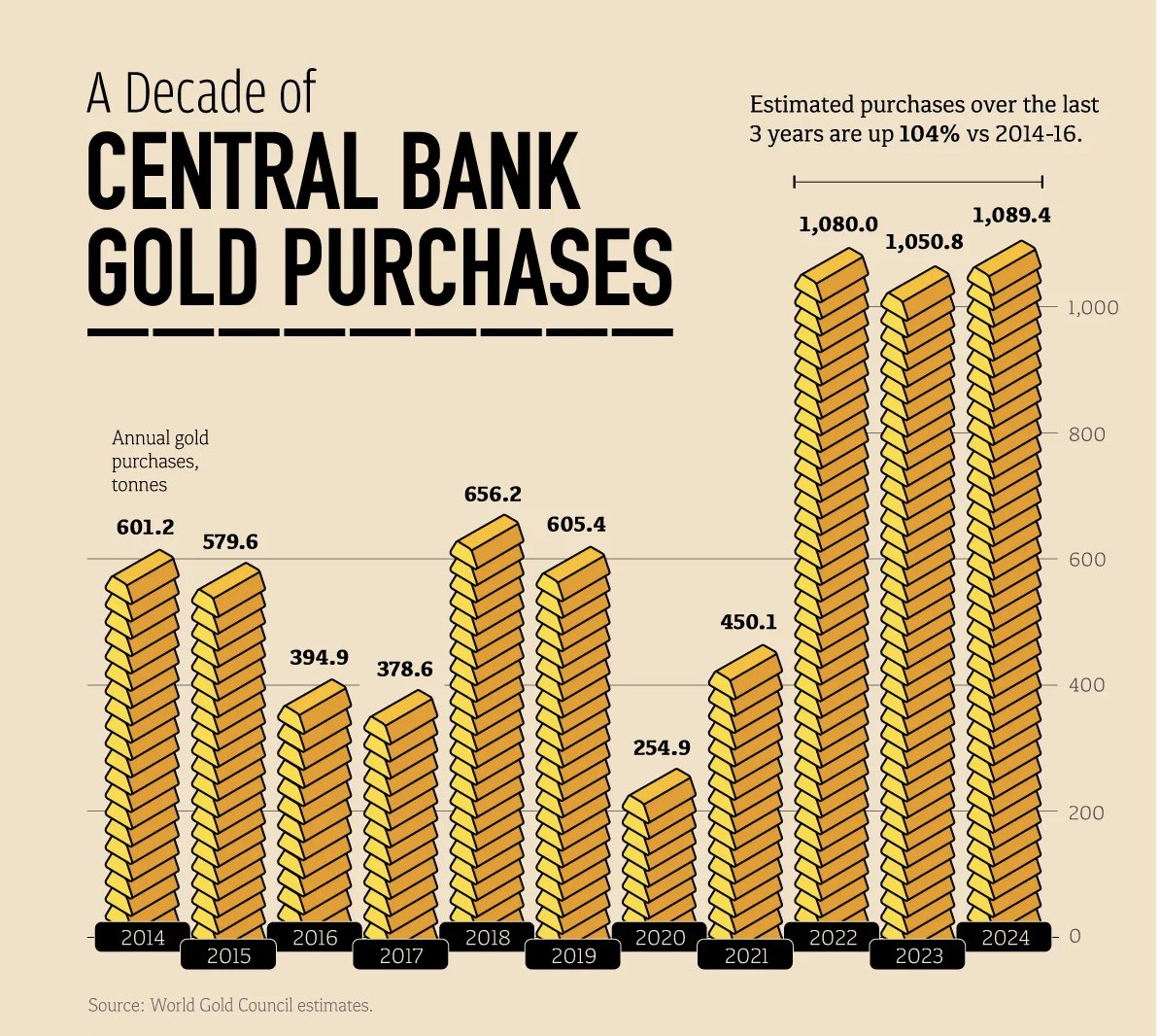
The price of both gold and bitcoin are set by supply-and-demand. The popular story is that gold prices spiked in 2025 (up 65%) because central bank purchases tilted the supply-demand balance. History teaches us something different, and tells us what's happening with bitcoin.
Central bank purchases of gold spiked in 2022 after the US seized Russia's Treasury deposits. Annual purchases rose from ~500 tonnes to ~1000 tonnes. They have stayed consistent since .
These purchases tilted the supply-demand balance, but didn't immediately show up in prices. Gold rose 2% in 2022, 13% in 2023, and 27% in 2024. It wasn't until 2025 that prices went parabolic. That's because, for the first few years, central bank demand was met by people willing to sell their gold holdings. But eventually, the sellers ran out of ammo. And as demand persisted, prices soared.
The same thing is happening with bitcoin and ETFs. Since ETFs debuted in Jan 2024, they've been buying more than 100% of the new supply of bitcoin. But the price hasn't gone parabolic, because existing holders have been willing to sell. If ETF demand persists - and I think it will - eventually, these sellers will run out of ammo. And when they do...
BitMine has staked another $478,770,000 in $ETH today.
They have now staked $4,170,000,000 in Ethereum.
At 2.1% annual yield, BitMine will make almost $90,000,000 each year.
ETHEREUM SEEN OUTPERFORMING BITCOIN
Standard Chartered says Ethereum’s outlook has improved and it is likely to outperform bitcoin. While weak bitcoin performance has weighed on the broader crypto market, rising institutional demand for ethereum and its dominance in stablecoins, real-world assets, and DeFi support a stronger outlook. Increased network throughput and potential U.S. regulatory clarity could provide further upside. The bank forecasts ethereum at $7,500 this year and $30,000 by 2029.
Ethereum itself must pass the walkaway test.
Ethereum is meant to be a home for trustless and trust-minimized applications, whether in finance, governance or elsewhere. It must support applications that are more like tools - the hammer that once you buy it's yours - than like services that lose all functionality once the vendor loses interest in maintaining them (or worse, gets hacked or becomes value-extractive). Even when applications do have functionality that depends on a vendor, Ethereum can help reduce those dependencies as much as possible, and protect the user as much as possible in those cases where the dependencies fail.
But building such applications is not possible on a base layer which itself depends on ongoing updates from a vendor in order to continue being usable - even if that "vendor" is the all core devs process. Ethereum the blockchain must have the traits that we strive for in Ethereum's applications. Hence, Ethereum itself must pass the walkaway test.
This means that Ethereum must get to a place where we _can ossify if we want to_. We do not have to stop making changes to the protocol, but we must get to a place where Ethereum's value proposition does not strictly depend on any features that are not in the protocol already.
This includes the following:
* Full quantum-resistance. We should resist the trap of saying "let's delay quantum-resistance until the last possible moment in the name of ekeing out more efficiencies for a while longer". Individual users have that right, but the protocol should not. Being able to say "Ethereum's protocol, as it stands today, is cryptographically safe for a hundred years" is something we should strive to get to as soon as possible, and insist on as a point of pride.
* An architecture that can expand to sufficient scalability. The protocol needs to have the properties that allow it to expand to many thousands of TPS over time, most notably ZK-EVM validation and data sampling through PeerDAS. Ideally, we get to a point where further scaling is done through "parameter only" changes - and ideally _those_ changes are not BPO-style forks, but rather are made with the same validator voting mechanism we use for the gas limit.
* A state architecture that can last decades. This means deciding, and implementing, whatever form of partial statelessness and state expiry will let us feel comfortable letting Ethereum run with thousands of TPS for decades, without breaking sync or hard disk or I/O requirements. It also means future-proofing the tree and storage types to work well with this long-term environment.
* An account model that is general-purpose (this is "full account abstraction": move away from enshrined ECDSA for signature validation)
* A gas schedule that we are confident is free of DoS vulnerabilities, both for execution and for ZK-proving
* A PoS economic model that, with all we have learned over the past half decade of proof of stake in Ethereum and full decade beyond, we are confident can last and remain decentralized for decades, and supports the usefulness of ETH as trustless collateral (eg. in governance-minimized ETH-backed stablecoins)
* A block building model that we are confident will resist centralization pressure and guarantee censorship resistance even in unknown future environments
Ideally, we do the hard work over the next few years, to get to a point where in the future almost all future innovation can happen through client optimization, and get reflected in the protocol through parameter changes. Every year, we should tick off at least one of these boxes, and ideally multiple. Do the right thing once, based on knowledge of what is truly the right thing (and not compromise halfway fixes), and maximize Ethereum's technological and social robustness for the long term.
Ethereum goes hard.
This is the gwei.
#Obacht! „Gold and silver are amongst the commodities which will likely be negatively affected by BCOM index rebalancing during the month of January, in addition to aluminium. On the other hand, cocoa, crude oil, natural gas and gas oil will likely be positively affected. This year's rebalancing window will run from 9 January to 15 January“
Deutsche Bank Commodities Research
@modelxultra@WatcherGuru Yes, MSCI announced today (Jan 6, 2026) that it will not exclude digital asset treasury companies from its indexes for now, opting for a broader consultation instead. Source: MSCI's official statement.
BREAKING: US ADP Private Payrolls unexpectedly fall by -32,000 jobs in November, while a gain of +10,000 jobs was expected.
The Fed will have no choice but to cut rates again.
SEC EXPECTS CRYPTO EXEMPTION “IN A MONTH OR SO”
SEC Chair Paul S. Atkins said he expects the agency’s innovation exemption for cryptocurrencies to be released “in a month or so.” He noted that progress was delayed by the government shutdown but confirmed the SEC is back on track and aims to support crypto innovation after years of resistance.
Atkins also said the SEC plans to introduce new policies next year designed to improve market conditions for IPOs.