So excited to see this collection published! @briandnbird and I would also like to thank everyone who participated in last year's Symposium where these papers were presented - the questions and feedback truly enriched the discussion and resulting articles.
Delighted to see this stellar set of essays on section 1 of the Charter come to life! As editors, @derekbmross and I were honoured to work with a wonderful group of authors. This project stems from a @CLF_Canada conference held at @AllardLaw in 2022, supported by @SSHRC_CRSH.
50 years ago today, Canada entered into a covenant with the nations of the world to uphold fundamental human rights. We still have a lot of work to do - which is why we’ve launched the “Realizing Rights” project. Check out our video to learn more: https://t.co/OtQ1EX0FqL
Can't wait to discuss the Notwithstanding Clause with a great panel of scholars this Monday. Kudos to all the student groups who organized what is certain to be an enlightening and stimulating discussion, which, to say the least, is timely (& indeed, pressing!) See you all then!
Excited to share my article "The Universal Rights of the Family", now on SSRN, and published in the Supreme Court Law Review, which examines the idea of the right to family integrity.
Feedback is most welcome!
https://t.co/myI1jRwJX2
@LexisNexisCan
This is profoundly important advice for any academic - young or otherwise. I am all too familiar with the desire for praise, with the intoxicating effects of getting it, and with the bitter disappointment of having it withheld. And we should take seriously the opinions of other academics in our field, because they often have things to teach us. But sometimes we have to hold our nose and just dive in with the truth as we see it, and just hope it works out for the best. Otherwise, what on earth is the point?
Prayer is, quite literally, talking to God. The government has no business telling citizens they can’t talk to God in public, any more than they can prohibit talking to another person. This isn’t “state neutrality” but coerced irreligion.
https://t.co/lHOPCLZibr
@mtlgazette
There is much confusion around PCEPA and what it does - and doesn’t - do. I highly recommend this article for some much-needed clarification from Prof. @DebraMHaak, one of Canada’s leading legal experts on the subject.
For some further thoughts on Kloubakov, the legality of prostitution in Canada, what the current criminal laws do & do not capture, and what PCEPA & the Commodification Offences aim to accomplish, see my article forthcoming in the Supreme Court Law Review
https://t.co/M7yXXlLxV0
Thus, the scenarios posed during Parliamentary debates (embedding threats of violence in a so-called prayer, for example) would not fall within the s. 319(3)(b) defence, and should not be relied on to suggest that s. 319(3)(b) would protect threats of violence.
Contrary to what some have suggested, the good faith religious opinion defence in the Criminal Code does *not* shield calls to violence. Courts have been clear on this point, as I explained to the Justice Committee (you can read my submissions here: https://t.co/YzeIpTwhpb).
Similarly, s. 319(3)(b) does not excuse the wilful promotion of hatred simply because someone cites a religious text. What it clarifies is that a good faith, truth-seeking exegesis of a religious text is not *itself* a hate crime.
Yes we must do better. Freedom of religion or belief is not only an inalienable right, #FoRB is core to our very humanity. The right to have, adopt and change thought, conscience, religion or belief-without coercion-is an absolute right & cannot be infringed in any circumstances
Today marks the World Day Against Trafficking in Persons. Human trafficking isn’t just happening in faraway places – it is a major problem right here in Canada. Read more about that, and CLF's efforts to #EndHumanTrafficking, here:
https://t.co/IayE2pAIzg
Significant, and unanimous, decision from SCOTUS today highlights the need for nuanced understandings of the diverse ways that religious communities express faith through charity.
https://t.co/k0u9LYGZCq
"...Decisions about whether to “express and inculcate religious doctrine” through worship, proselytization, or religious education when performing charitable work are, again, fundamentally theological choices..." https://t.co/s0aJ3baccN
Happy to have a teaching assignment for the coming academic year that includes a new course on Law & Religion. Will be working hard to deliver an excellent course for students of all religions (and none) that engages thoughtfully with complex intersections of law and religion.
I welcome feedback on a new article on The Right of Equal Access to Public Service-a right protected in the UDHR and Canada’s international commitments but rarely referenced in our case law to date. Hope to generate some further thought on this protection: https://t.co/c2NYnn6cPD
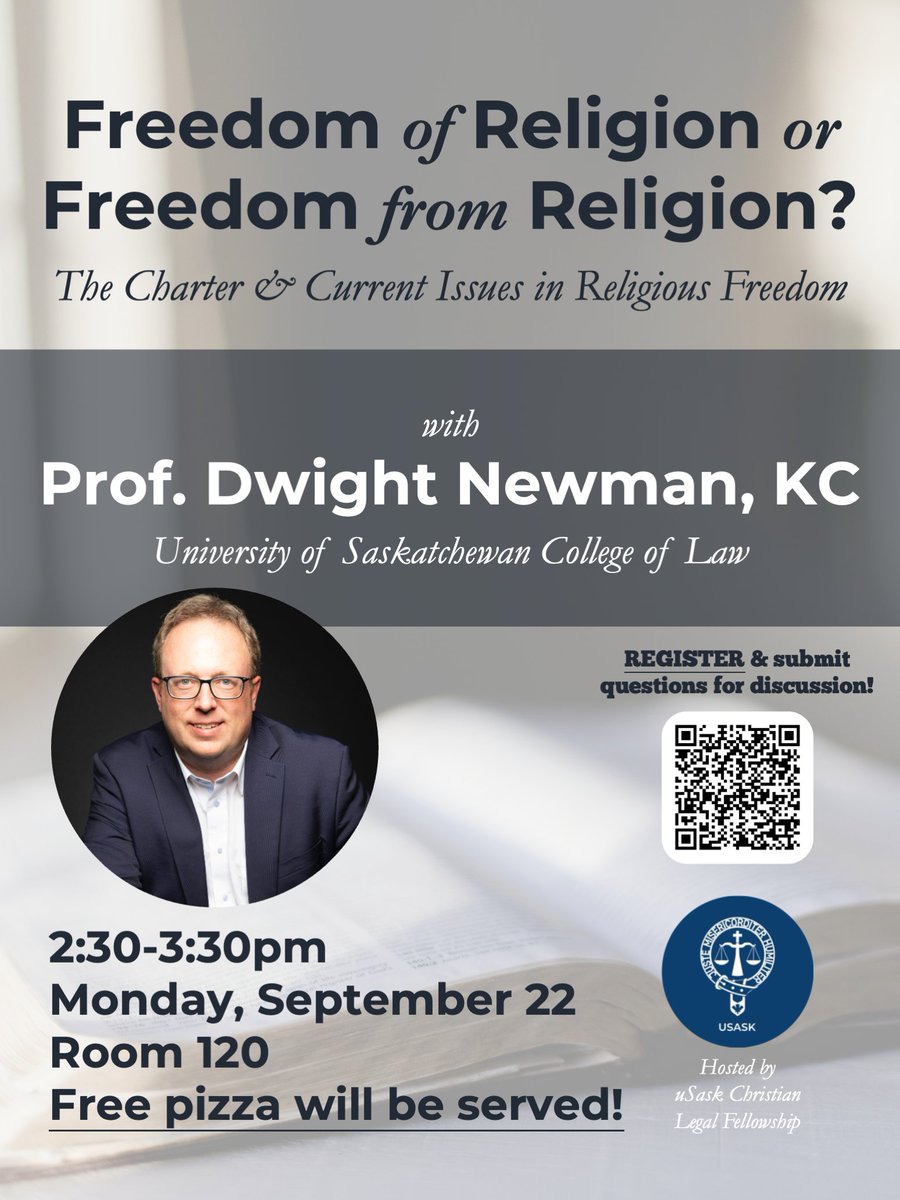
Looking forward to appearing as guest speaker on Monday at a Lunch and Learn event of @usasklaw chapter of @CLF_Canada on topic of Law, Religion, and the Charter