EXPLANATION
Why Avelino vs Cuenco 1949 is enough for a quorum of 12
Normally, the Senate has 24 senators, so quorum is 13.
Senate PH Rule II says that for Senate officers: they are elected by “majority vote of all its members.”
So if all 24 are counted, 12 is not enough.
But the anti-Cayetano camp’s argument comes from Avelino v. Cuenco, 1949.
In that case, the Supreme Court accepted the idea that because one senator was outside the country and could not participate, the Senate could be treated as having only 23 participating members. That made 12 a majority.
The Supreme Court said that “an absolute majority (12)” of the Senate “less one (23)” could be quorum, and Justice Feria explained that the count may be based on “actual members or incumbents” who are not incapacitated or outside the Senate’s jurisdiction.
Applied today: if Jinggoy Estrada is unable to participate because he is arrested, they can argue the working Senate is 23, not 24.
So 12 becomes quorum under Avelino logic.
Now add the Cayetano issue.
A Senate President is not the owner of the Senate.
The Senate Rules say the Senate normally meets at 3 PM on weekdays, unless the Senate decides otherwise.
If a session is postponed, the Senate President must consult the Majority and Minority Leaders. And the Senate President cannot just suspend or adjourn a session by himself without a motion or resolution approved by senators present, except in the specific postponement situation.
So if Cayetano refuses to preside or tries to stop the chamber from functioning, the anti-Cayetano camp can say - the chair cannot kill the chamber.
That is also consistent with Avelino v. Cuenco, 1949.
In that case, the Senate President abandoned the chair and did not attend.
Worse, Cayetano not only was absent, he did not designate a Presiding Officer either - the Senate is not functioning.
The anti-Cayetano senators continued, and the case records say the deliberate abandonment made it necessary for the remaining members to continue “in order NOT TO PARALYZE the functions of the Senate.”
So the anti-Cayetano camp’s legal theory is basically this:
(1) The Senate is bigger than Former SP Cayetano.
(2) If he refuses to preside, and enough senators are present, the Senate can still function.
(3) If Jinggoy cannot participate, Avelino gives them an argument that 12 is quorum.
(4) Once quorum exists, the Senate can act on its internal organization, including committees per the Senate Rules.
They are on stronger ground when reorganizing committees, because committees are part of Senate internal organization.
Rule X says permanent committees are formed by the Senate after organization, including the Committee on Rules (take notice, yan ang unang call to motion ni Sotto).
So what did Cayetano did wrong?
Essentially by refusing to attend the Senate or any of the presiding officers (ie: Former Pro Tempore Legarda, and Former Majority Leaders), the situation became more and more similar to Avelino v. Cuenco, 1949.
The former Majority could even argue that Avelino v. Cuenco, 1949 is a "special circumstance" . However, the similarities between then and now became more apparent with the former Majority leaders absence and made the arguments of the anti-Cayetano camp stronger.
With this, the new Majority got their quorum and they rearranged leadership.
So why only the leaderships and not the actual Senate Presidency?
So the pro-Cayetano camp can ask: "If you truly have quorum, and the majority of all members, why not also elect a Senate President?"
Short answer: Because of the Constitution.
The Constitution makes electing a new Senate President more sensitive because it specifically requires a “majority vote of all its respective Members” for that office.
The Constitution then separately says each House may choose “such other officers as it may deem necessary.”
For Senate President:
The Constitution itself sets the rule. The Senate President must be elected by “a majority vote of all its respective Members.”
For President Pro Tempore and other officers:
The Constitution does not give a specific voting threshold. It only says each House may choose “such other officers as it may deem necessary.” (Sec. 16)
It also says each House may determine its own rules.
That is where Senate Rule II comes in:
the Senate used its rule-making power to say its officers, including the President Pro Tempore, Secretary, and Sergeant-at-Arms, are elected by majority vote of all members.
LOGICAL DIFFERENCE:
So the Constitution does not dictate the definition of "all members" for other Senate officers - only for the Senate President.
Thus, the dictation and definition of "all members" lies on Senate Rules per the Constitution Sec. 16, "...as they deem necessary..."
But with Avelino v. Cuenco 1949 coming in...
The Senate PH has already defined "majority of all members" to be "active members of the Senate - that could participate"
In the ruling,
Justice Feria said the count may be based on the Senate’s “actual members or incumbents,” excluding those unable to discharge their duties because of death, incapacity, absence from jurisdiction, or other causes making attendance impossible (ie: arrest).
Feria treated the Senate as having 23 actual members, so 12 became a quorum and majority.
Naniniwala ang isang eksperto na dapat bigyan ng exemption sa income tax ang mga manggagawang Pilipinong kumikita ng hanggang P1 milyon taon-taon upang makatulong sa pagbangon ng aniya'y nahihirapang middle class.
BASAHIN: https://t.co/ielV5h1Qoe
PWEDE NAMAN PALA.
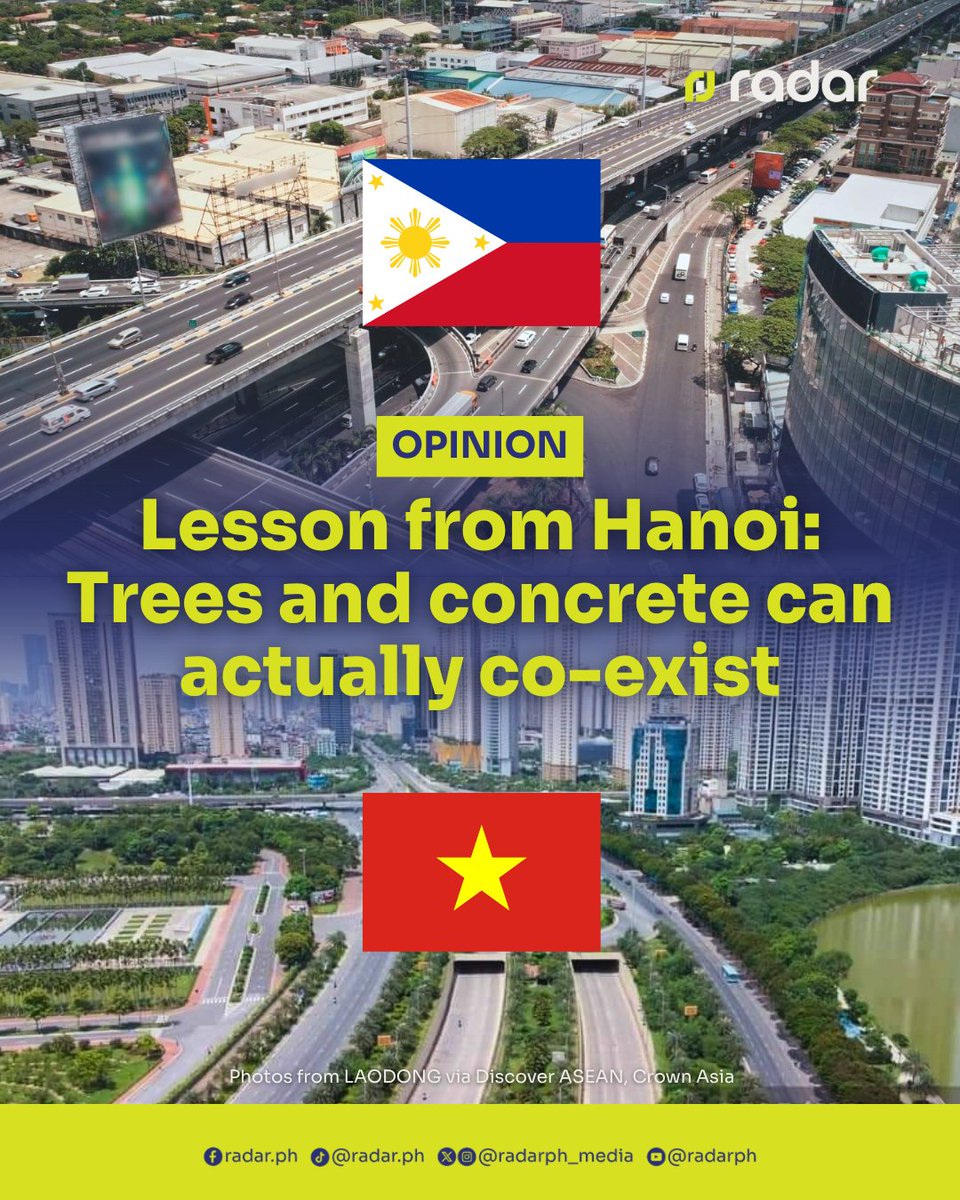
A viral social media contrast has been making the rounds, depicting Hanoi before and after planting 1.6 million trees. It is a stunning visual transformation—but more importantly, it shows that trees and concrete can co-exist in a third-world country.
Between 2016 and 2020, the program "One Million Trees" was rolled out and Hanoi smashed it two years ahead of schedule, ultimately planting over 1.6 million trees across the capital.
The success was so profound that it paved way into a nationwide "One Billion Trees" initiative running through 2025.
Hanoi's victory is a lesson in progressive urban development for the Philippines. Both are fast-growing Southeast Asian countries caught at the crossroads of rapid growth, dense populations, and extreme climate vulnerability. The difference is not in resources, but rather in political imagination.
While Manila allows the removal of mature tree canopies for expressways, Hanoi demonstrated that true 21st-century progress builds with nature, treating the urban canopy as critical public infrastructure.
So what can we learn from Hanoi’?
First, we need to move from seedling statistics to living canopies. The DENR allows developers to offset environmental damage by buying thousands of cheap seedlings, a numbers game that does nothing to cool a sweltering city. Hanoi turned down this lazy formula.
They planted mature, standard saplings that had been chosen for their ability to trap dust and absorb carbon dioxide. Vietnam's policy is that every tree must survive, and it supports it with budgets for years of rigorous post-care. We plant for the cameras and let saplings die in the sun. Hanoi plants to shield the public.
Second, Hanoi eliminated the fragmented planning that plagues our bureaucracy. In Manila, the DPWH builds a road, utility companies dig it up, and trees are felled because they are “in the way." Hanoi integrated its tree-planting directly into transport networks and underground utility blueprints. If an infrastructure design threatens the green grid, the blueprints are adjusted. In the Philippines, the living infrastructure is sacrificed to keep the concrete straight.
Third, Vietnam depoliticized its green spaces. Philippine urban forestry is a hostage to the three-year local election cycle. One mayor plants a pocket park; the next paves over it for a multipurpose gym bearing their name. Hanoi turned urban greening into a permanent civic duty, insulating it from political transitions and integrating it across schools, communities, and conglomerates.
We can no longer hide behind the developing nation moniker to justify the ecological vandalism of Metro Manila. Vietnam operates within our economic bracket, yet they chose to invest in a livable capital.
If we want to stop choking on our own progress, our national government must adopt Hanoi's playbook.
We must legislate a strict minimum canopy cover per capita for LGUs, making it a metric for the Seal of Good Local Governance. We must mandate "avoidance engineering" in public-private partnerships, forcing designers to map transport links around existing natural assets.
Finally, the DENR must end the seedling scam; developers must be held financially liable for the value of lost ecosystem services until replacement trees reach full maturity.
How do you find Hanoi’s cityscape? Share your comment below.
(By Walter C. Villa)
#radarPHLifestyle #radarPH
Mass tree cutting in Philippines
More than 200,000 Trees to be felled for mining
Could not be the same country that is inundated with floods
https://t.co/L2eheutEmG
Sharing this video recoring during session suspension in the Senate last May 11. Nakaka-bother how Alan Cayetano shouted at the former sergeant at arms Gen. Samonte and got him fired a few minutes after. Then, pinalit na si Gen. Aplasca to be the new Sergeant at Arms. 2 days after, Aplasca fired gun shots from inside the Senate. Saan kinuha ang confidence ?? Malamang sa bagong Senate President! 😡 Also, how selfish of Alan Cayetano to make an enemy out of the NBI. Our very own NBI. Sarili nating law enforcement agency. Lahat talaga gagawin niya kahit gaano ka dumi basta para sa mga ambisyon niya. Wala na akong ibang salitang maisip na ihalintulad sa kaniya kundi DEMONYO.
Upgrading and modernizing the entire Luzon power grid system will cost up to P460 billion according to the National Grid Corporation of the Philippines (NGCP).
That's less than half the amount estimated to have been stolen or lost as a result of the Flood Control scandal.
Just saying.
If you really think about it, the Duterte camp is in absolute shambles. Resorting to dirty political maneuvers just to stay in power only makes people ask: what are they so afraid of?
If there was truly nothing to hide, there would be no need for this level of desperation.
JUST IN: Senate President Allan Peter Cayetano announced that the members of the NBI who chased after Senator Ronald “Bato” Dela Rosa are held in contempt, directing the Office of the Sergeant-at-Arms (OSAA) to put them into Senate custody and detain them in the Senate premises on Monday.
LIVESTREAM: https://t.co/sflEoQWsDc
If Senator Vicente “Tito” Sotto III is removed as Senate President today, then let us stop pretending this is about “leadership change.” This is political surrender.
Senator Alan Cayetano’s bloc is making one thing clear — they would rather protect the Dutertes than defend the Constitution and the independence of the Senate.
History will remember the senators who chose loyalty to power over loyalty to the Filipino people.
Shame on them.