@GooglePlay
Can we *please* have the old icons back for the Google apps on Android?
There is absolutely no need for you to imitate Apple's lollipop design irritations! 🙄
📢 The wait is over - the European Microsoft Fabric + SQL Community Conference programme is live.
Prepare for 130+ sessions packed with practical insights, real-world experience and the latest thinking across #MicrosoftFabric and #MicrosoftSQL.
View ➡️ https://t.co/lB0sGMqkJy
That water clarity is an engineering decision, and the math behind it is wilder than the video.
Roman aqueducts ran on gravity alone. No pumps, no pressure systems. Engineers carved channels with a gradient so shallow it borders on absurd. The Pont du Gard in southern France drops 2.5 centimeters over 275 meters. That's roughly the thickness of a coin over the length of three football fields. They surveyed that accuracy with plumb lines and wooden leveling instruments.
The clarity you're seeing is a direct product of flow velocity. Too steep and the water erodes the channel walls, picks up sediment, turns brown. Too flat and it stagnates. Roman engineers targeted a slope of about 20 centimeters per kilometer, which kept the water moving fast enough to stay fresh but slow enough to stay clear. Before the water reached the city, it passed through multi-chamber settling tanks where velocity dropped near zero. Suspended particles sank. Clean water flowed out the top into the next chamber. Repeat three or four times.
Pliny specified the minimum slope in writing. Vitruvius published the exact mortar ratio for hydraulic cement: one part lime to two parts volcanic ash for underwater work. The pozzolana from Pozzuoli reacted with water to form a calcium-aluminum-silicate compound that actually gets stronger the longer it sits submerged. Modern concrete degrades in water. Roman concrete bonds with it.
Scale the whole system and it gets harder to process. Eleven aqueducts fed Rome at its peak. Combined output: roughly 1 million cubic meters of water per day. That works out to about 250 gallons per person for a city of one million. Modern New York delivers about 125 gallons per person per day. Ancient Rome had access to double the per capita water supply of the largest city in the United States, running entirely on slope and stone.
The Trevi Fountain in Rome is still fed by one of them. Two thousand years, same source, same gravity, same water.
@AbakpaJob@sqL_handLe No no, please, 4pm is already known as "beer o'clock" 🍻
In German, we say "Kein Bier vor vier".
But it's always past 4 somewhere on this world... 😅
Doug Engelbart, inventor of the computer mouse, shares a story from his early days in Silicon Valley:
After completing his thesis work at Berkeley, Engelbart had built up a portfolio of patents in what he describes as "a new phenomenon."
Looking to find a home for them, he approached Hewlett-Packard directly.
"I ended up with 10 to 20 patents that were in a new phenomenon and one thing I did was go to Hewlett Packard to see if they would like to buy them. Bill Hewlett and Dave Packard were still very active."
HP agreed to buy a package of the patents from him.
But Engelbart had a concern. He wasn't done inventing yet.
"One thing I was worried about is I'm going to keep on inventing and I haven't even got all tied down yet. The package isn't all that's here in my head."
Dave Packard's response won him over immediately:
"I'll make you a deal. For the first six months everything you can write down will be yours, part of that deal. And after that they're ours."
Engelbart describes Packard as "very pragmatic." It was a handshake style of deal-making that sealed it on the spot.
But the most telling moment came on his way out the door. Engelbart asked the research director a simple question, one that, in hindsight, exposed a massive blind spot at one of the most respected technology companies of the era:
"I'm assuming that Hewlett Packard will go into digital techniques for their instrumentation and likely in digital processing on computers."
The answer: "Not a chance."
"So that whole thing fell through right then."
A man sitting on patents that anticipated the digital future walked into HP, and HP, a company that would later become synonymous with computing, told him they had no interest in going digital.
@twitkalk Die Fleischbeschau hat's offenbar auch nicht raus gerissen. Das hat auch alles mit dem ursprünglichen ... Eurovision de la Chanson nix mehr zu tun.
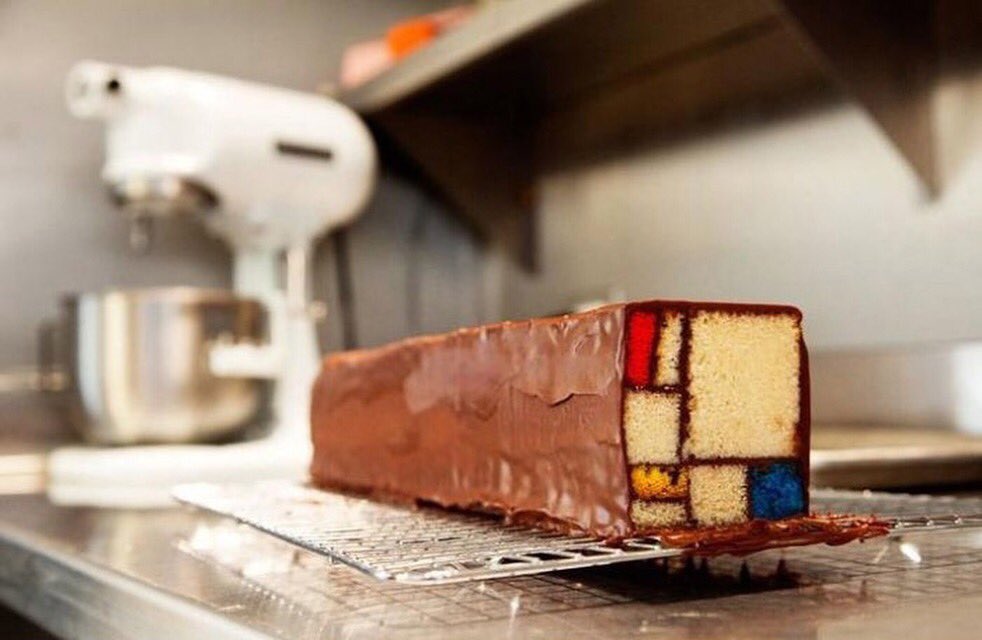
#Mondrian, reinterpreted as dessert. #Geometric blocks of white velvet #cake in red, blue and yellow, stacked like a #composition between art, structure and taste.