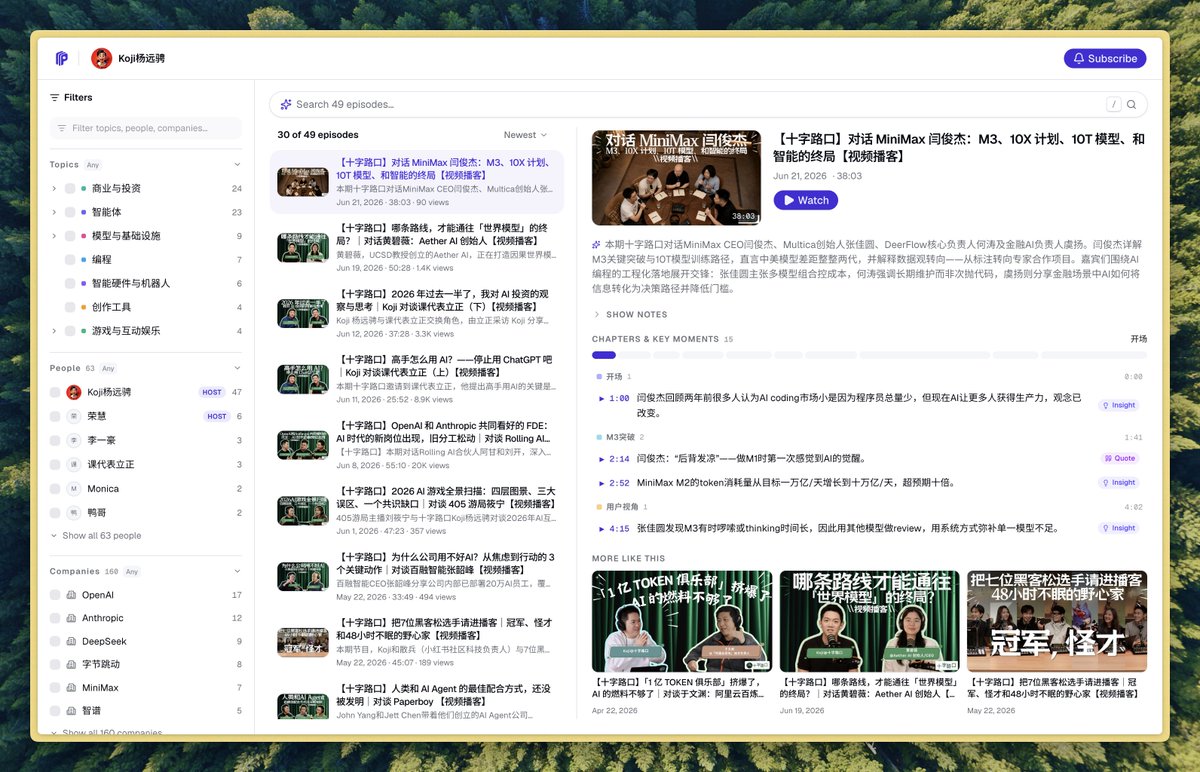
Learn why podcast episodes don't show up on Google—and how podcast SEO turns
each episode into a useful, discoverable watch page:
https://t.co/jeAzxTgX6c
Four ways your podcast gets found.
One connection — a YouTube channel or a podcast feed — turns an invisible archive into something people, search engines, and AI agents can all reach.
1. Searchable
Your listeners find any moment. Across the whole catalog, by what was actually said — and they jump straight to it.
2. Queryable
Your archive is a live tool. It connects to Claude and ChatGPT over MCP — agents query it and answer with timestamped citations.
3. Crawlable
Audio can’t be crawled; this can. Every episode becomes a real, server-rendered page — the text search engines and AI can actually read.
4. Citable
The structure answer engines quote. A disambiguated graph of the people, topics, and moments in each episode — what ChatGPT, Claude, and Google AI cite as the source.
@patrick_oshag This is the kind of answer I’d want to find again six months from now. I used PodHood to make the full conversation AI-queryable; ask about OpenAI’s structure and it cites this exact moment at 51:35:
https://t.co/LDqc5LpTBB
Imagine that across the Colossus archive.
@JoannaStern I made this interview searchable around a question I couldn’t stop thinking about: “Why does ChatGPT Voice say things like ‘uh-huh’?” The answer links back to the exact moment:
https://t.co/tCJlBK0lyA
The idea: AI should point people back to your reporting—not summarize it away.
@asmartbear@DmytroKrasun Totally fair—I pitched the wrong feature. You should keep your 60K list, newsletter workflow, and Transistor. PodHood can live on a domain you own. For you, the value would be the searchable, AI-queryable episode archive with exact-second citations—not another email list.
@liangsays@MTSlive “Media + intelligence” is why I built a live MTS demo with PodHood: https://t.co/HiSORZ57P6. The Ruby Thelot episode is already a searchable Brief; as the archive grows, every show becomes queryable by AI with exact-second citations. Would love to build this with you.
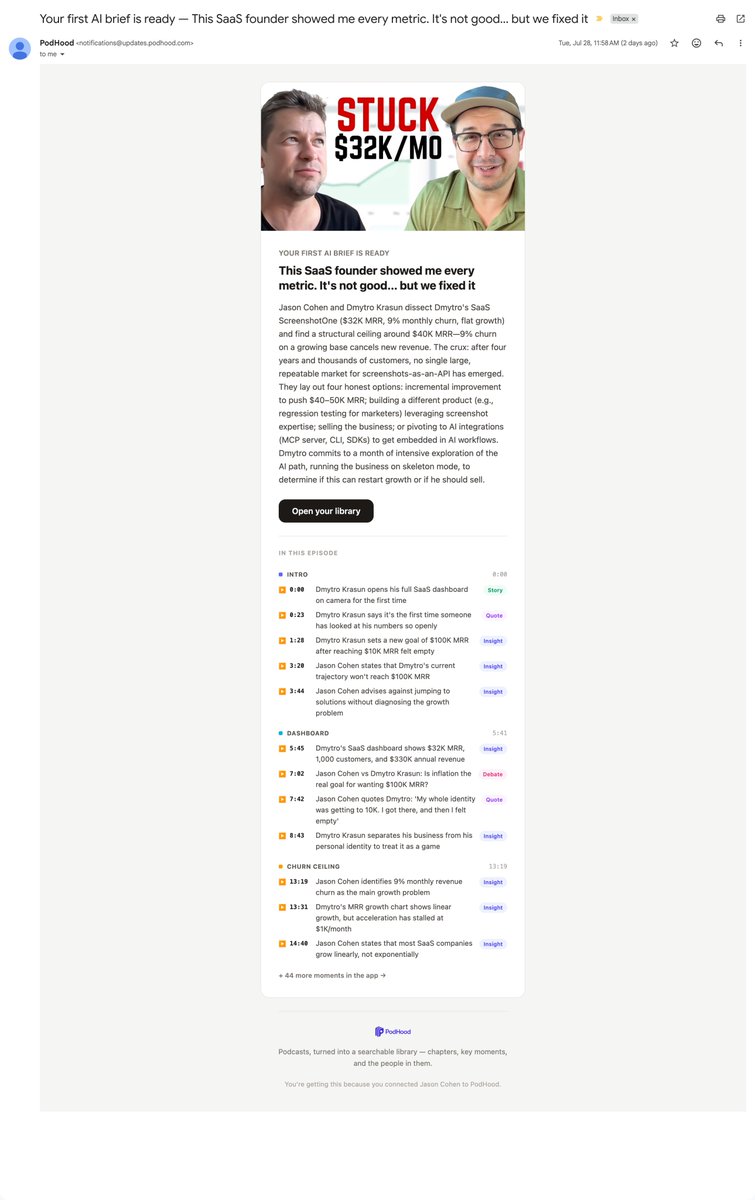
@asmartbear@DmytroKrasun PodHood’s Subscribe builds an opt-in list you own. Then it’s fully automated: publish to Transistor or YouTube; PodHood detects the episode, creates a Brief—summary, chapters, exact-moment links—and emails it to subscribers under the show’s name. I’ve attached an example below.
recommended reading. truely love @AndrewYNg 's vision for a 21st century learning path. this is what wr need for diffusing the benefits of the tech into the economy.
https://t.co/i0TDei9Hnb