Lumibuild Studio got acquired by Klay Studio last month. (LA based growth agency).
I've been sitting with that for a few days now. not because it was a surprise, honestly, when the offer came in, we were still heads down, actively delivering for clients.
but Zach as the Founder and me as CEO never had plans to make this THE thing.
we both had bigger, separate things we were moving toward.
so when the offer arrived, it just felt like the right moment to close it neatly.
no drama, just good timing.
just over a year of building together, we managed to help 40+ SaaS, Agency, B2B founders with web design, dev and branding solutions.
and looking back, I realize that the work was real.
- TVG closed 5-6 figure contracts after the redesign.
- PinPoint raised a $2.5M round, and we were part of what made that moment possible.
- AskCatGPT, Joshua Graham, Jamie Robbins….
and a lot of other founders too.
sales came in, conversion rates went up, and real business outcomes were felt after launch.
the kind of results that make you feel like what you were doing actually mattered.
Zach had the client relationships and trusted my creative direction & management outputs completely.
that combo - full trust, clear lanes, and no politics is something I didn't fully appreciate while it was happening. I really do now.
grateful for Zach. grateful for every client who trusted us with something that actually mattered to them.
this one ended the right way, and honestly, I'm glad it happened.
40+ projects across a year of agency work teaches you things you can't learn any other way.
but the sharpest one came from working with creators and coaches who were right at the edge of launching.
Jamie Robbins, Nana Del Rey, AskCatGPT, none of them came to us lost or confused.
they had the vision, the branding, the creative direction fully formed.
in some cases, more clarity than founders I'd worked with who had entire teams behind them.
and still, every single one of them hit the same wall.
some of them had already tried AI website builders. but they knew it was just the bones. a starting point.
and even with a solid prototype in hand, as they kept telling me: “something was still missing."
for me though, it was quite clear: the bones existed. the muscles didn't.
what I mean is that building a website and building something that actually sells are two completely different things.
one is assembly. the other requires a very specific stack of skills that most creators & coaches never had a reason to develop.
think of it like trying to build a Lego Death Star without the instruction book:
all the pieces are right there in front of you, and the vision seems to be clear.
but without knowing exactly which block goes where and why, you're just staring at a pile of potential.
that instruction book is what was always missing.
not the creativity. not the offer. not the audience.
just the one thing that knows how to take everything you already have and assemble it into a 24/7 sales system that works while you're not online.
I watched that pattern repeat enough times that I stopped being surprised by it.
now I can't ignore it anymore.
We analyzed the last 30 web projects we've done.
The ones needing 5+ revision rounds had one thing in common: we skipped our "internal filter" before moving to development.
Now we run every design through it before executing. Takes 5 minutes to answer, and eliminates 80% of revisions.
Here are the questions:
1. Does this solve the actual problem, or just look good?
Easy to create something beautiful that accomplishes nothing.
We ask: what job does this design need to do? Does it actually do that job?
If it's optimized for aesthetics over outcomes, we start over.
2. Is the most important thing obviously the most important?
If a visitor can't tell what matters most in 3 seconds, the hierarchy failed.
We look at the layout: what do we want them to see first? Does that actually stand out?
If not, we fix it before moving forward.
3. Would this make sense to someone seeing it for the first time?
We've been staring at this for hours. We know the context, the strategy, the backstory.
Clients and their visitors don't.
If someone landed here with zero context, would they immediately understand what this is and why it matters?
If we have to explain it, it's not clear enough yet.
4. Are we following the strategy, or did we drift?
Easy to chase a design direction that looks interesting and forget what we're solving for.
Quick check: does this align with the brief? The goals? The audience we're trying to reach?
If we've wandered into something that's cool but off-strategy, we pull back.
5. What would we change if we had one more day?
There's always something we know could be better.
Sometimes it's minor—tighten spacing, refine a headline. Sometimes it's structural—the flow doesn't quite work.
If there's something we'd fix with more time, we fix it in design, not after development.
The result:
Projects now typically need 1-2 revision rounds instead of 4-5.
That's 10-15 hours saved per project.
Clients can focus feedback on strategic direction instead of catching basic execution problems we should've spotted ourselves.
Not perfectionism. Just catching our own issues before they become someone else's feedback.
What would you add to this filter?
We just wrapped 4 website projects—2 startups, 1 agency, 1 B2B business.
Quality stayed consistent because we didn't change our communication system: proactive updates, structured revisions, documented decisions.
The system works regardless of who the client is.
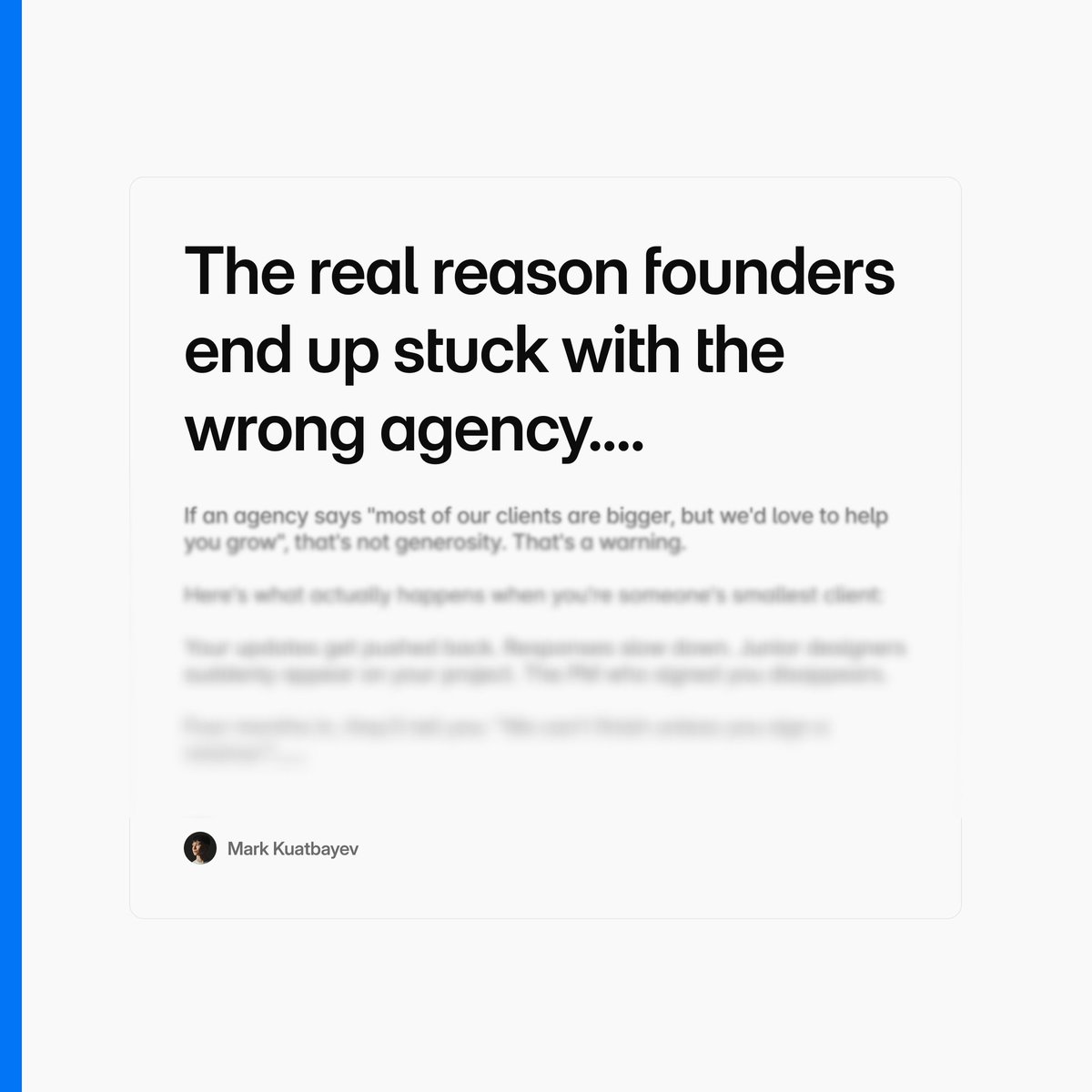
If an agency says "most of our clients are bigger, but we'd love to help you grow", that's not generosity.
That's a warning.
Here's what actually happens when you're someone's smallest client:
Your updates get pushed back.
Responses slow down.
Junior designers suddenly appear on your project.
The PM who signed you disappears.
Four months in, they'll tell you: "We can't finish unless you sign a retainer."
By then, everything's 80% done, but nothing's usable. Switching vendors means starting over.
They know it. You know it. So you sign.
It's not evil. It's resource allocation.
Most agencies optimize for their ideal client size. When you're below it, you're the filler work between retainer commitments.
At Lumibuild Studio, we only work with agencies and SaaS startups doing $10K-100K/month. That's our sweet spot.
We don't take enterprise clients with $40K/month budgets because it would force us to deprioritize you.
When you're in our designed-for range, you get our best resources, fastest timelines, tightest communication.
No bigger fish to bump you.
We analyzed the last 30 web projects we've done.
The ones needing 5+ revision rounds had one thing in common: we skipped our "internal filter" before moving to development.
Now we run every design through it before executing. Takes 5 minutes to answer, and eliminates 80% of revisions.
Here are the questions:
1. Does this solve the actual problem, or just look good?
Easy to create something beautiful that accomplishes nothing.
We ask: what job does this design need to do? Does it actually do that job?
If it's optimized for aesthetics over outcomes, we start over.
2. Is the most important thing obviously the most important?
If a visitor can't tell what matters most in 3 seconds, the hierarchy failed.
We look at the layout: what do we want them to see first? Does that actually stand out?
If not, we fix it before moving forward.
3. Would this make sense to someone seeing it for the first time?
We've been staring at this for hours. We know the context, the strategy, the backstory.
Clients and their visitors don't.
If someone landed here with zero context, would they immediately understand what this is and why it matters?
If we have to explain it, it's not clear enough yet.
4. Are we following the strategy, or did we drift?
Easy to chase a design direction that looks interesting and forget what we're solving for.
Quick check: does this align with the brief? The goals? The audience we're trying to reach?
If we've wandered into something that's cool but off-strategy, we pull back.
5. What would we change if we had one more day?
There's always something we know could be better.
Sometimes it's minor—tighten spacing, refine a headline. Sometimes it's structural—the flow doesn't quite work.
If there's something we'd fix with more time, we fix it in design, not after development.
The result:
Projects now typically need 1-2 revision rounds instead of 4-5.
That's 10-15 hours saved per project.
Clients can focus feedback on strategic direction instead of catching basic execution problems we should've spotted ourselves.
Not perfectionism. Just catching our own issues before they become someone else's feedback.
What would you add to this filter?