For years, people mocked anyone who warned about Islamist long-term strategies. Now it’s unfolding in plain sight. The Muslim Brotherhood and its allies don’t rely on one tactic - they use immigration jihad, money jihad, political jihad, birth jihad, and of course violent jihad. Each one chips away at Western resilience in different ways, all serving the same ideological goal: the spread of Islamist rule. To them there is "Dar Al-Islam" ("the house of Islam"), and "Dar Al-Harb" (the house of war) - the latter to be made house of Islam through war.
Dismissing “jihad” as merely “spiritual struggle” is like pretending Mein Kampf ("My struggle" in German) was just a self-help book. Imagine falling for that twice. The ideology is openly stated - you just have to take it seriously.
Israel is living the front line of what Europe is sleepwalking into. Islamists can’t tolerate non-Muslim sovereignty, especially on lands they once colonized. That’s why Israel (like Spain) is a particular obsession: Judaism and Christianity re-emerged there, defying Islamist supremacy. A strong Israel is literally blasphemy, and Spain is so confused it's joining it's own enemy against those who fight it.
Qatar bankrolls and platforms this machine - funding the Muslim Brotherhood, buying influence in universities and media, weaponizing Al-Jazeera as a propaganda arm. Meanwhile, waves of unvetted, military-aged men enter Europe; mosques become hubs for radical preaching; birthrates shift demographics; and short-sighted leaders keep feeding the crocodile, hoping to be eaten last, and emboldening the same terrorists - that start riots and "intifada" in the west - driving away the Jews - and showing their weakness to the predators, awaiting to feast.
Europe is approaching a breaking point. Islamist movements are patient, organized, and ideological. Western elites are distracted, divided, and afraid of being called names, and woke demoralization campaigns make sure it's stays that way. If Europe wants to survive as a free civilization, it has to wake up - before it's too late, stand with Israel, and stop mistaking appeasement for virtue.
https://t.co/hnQdrdBZti
The Muslim Brotherhood’s War on the West Is Real - and It's Working
This isn’t paranoia. It’s a documented strategy - already underway.
The Muslim Brotherhood, the ideological engine behind Hamas and most Sunni Islamist movements, has a 100-year plan to conquer the West - not through bombs, but through institutions, infiltration, and subversion.
Their model? Indonesia.
Once a Hindu-Buddhist society, it gradually fell to Islam without war, through mass migration, slow cultural domination, and the systematic erosion of native identity.
That’s the Brotherhood’s blueprint for Europe and North America.
We know this because they told us.
In the 2008 Holy Land Foundation Trial - the largest terror-financing case in U.S. history - prosecutors exposed a secret Muslim Brotherhood document called "An Explanatory Memorandum".
It stated, in plain Arabic, their goal:
“To destroy Western civilization from within... and sabotage its miserable house... so that it is eliminated and God's religion is made victorious.”
They weren’t vague. They listed their tools:
CAIR (Council on American-Islamic Relations)
ISNA (Islamic Society of North America)
ICNA (Islamic Circle of North America)
Muslim Students Association (MSA)
All still active. All still funded.
And they infiltrated the U.S. government too.
Obama’s administration welcomed figures with deep Brotherhood ties - like Dalia Mogahed and Rashad Hussain - as advisers on Muslim outreach.
They shaped narratives, softened the West’s stance on Islamism, and helped redefine criticism of political Islam as “Islamophobia.”
In France, Macron suddenly recognized a Palestinian state - days later, Qatar wired billions in investment into the French economy.
Coincidence? Or a deal?
Meanwhile, Qatar owns more of London than King Charles does.
Luxury properties, financial firms, even iconic buildings - all controlled by a regime that funds the Brotherhood and shelters Hamas leaders in five-star hotels.
Their mission:
Import large numbers of Muslims into the West, even illegally
Use identity politics to silence dissent
Ban criticism of Islam under “hate speech” laws
Demoralize the population through crime, riots, and cultural guilt
Destroy national unity using Soviet-style psychological operations (exactly what the KGB did during the Cold War)
This isn’t immigration. It’s infiltration.
And yet, the Brotherhood is still legal in the U.S., UK, and EU.
Why?
Because the elites they bought are too compromised, too cowardly, or too blind to act.
This is not about Islam.
It’s about radical Islamism - a political ideology cloaked in religion.
Even Muslim-majority countries like Egypt, Saudi Arabia, and the UAE have banned the Muslim Brotherhood and declared it a terror group.
They know how dangerous it is - so why doesn’t the West?
The Muslim Brotherhood must be banned.
Its institutions dismantled. Its networks exposed.
Not tomorrow. Now.
Because if we wait — our children will be strangers in their own homelands.
@GadSaad@JonahPlatt It‘s when Western Democracies fund the invasion of illegal Islamist migrants so they can take over the country and convert it to the shithole they came from.
There is a concept that @GadSaad calls “suicidal empathy” - and once you see it, you can’t unsee it.
Empathy, in its healthy form, is one of the foundations of civilization. It allows us to care, to build, to protect. But empathy without boundaries, without context, without the discipline of truth, becomes something else entirely. It becomes a vulnerability - one that can be studied, exploited, and ultimately weaponized.
You can see this most clearly in two arenas that, at first glance, seem unrelated: illegal immigration and the pro-Palestinian street movement in the West. In both cases, the mechanism is the same. Flood the system with images of suffering - children crying, civilians injured, desperate faces - and you trigger a visceral response. For people with high baseline empathy, this is overwhelming. It bypasses analysis. It short-circuits skepticism. It creates identification so strong that the observer stops asking questions.
And this is exactly the point.
Populations with higher empathy - women on average, and professions built around care like nurses, doctors, and psychologists - are more susceptible to this kind of emotional override. And we are now seeing something deeply uncomfortable: individuals from these very groups, whose role is to heal and protect, publicly echoing or amplifying narratives that include antisemitic tropes or open support for movements aligned with violent ideologies and terrorism. Not because they are hateful - but because they have been emotionally captured.
Once that capture happens, logic becomes secondary. Context disappears. The fact that some of the suffering is staged, manipulated, or even self-inflicted - such as misfired rockets in Gaza - becomes irrelevant. The emotional imprint is already made. And from that point on, the individual is no longer evaluating reality - they are reacting to it.
This is how propaganda works in the modern era. It doesn’t try to convince you of a coherent alternative truth. It overwhelms you emotionally until you no longer require one.
In Europe, this contradiction becomes even sharper. Women - statistically the most vulnerable to certain forms of violence linked to uncontrolled migration - are also among the strongest voices advocating for policies that increase that very risk. It’s tempting, and increasingly common, to blame women for this. That’s a mistake. This is not a gender problem. It’s a cognitive and informational one.
The real issue is the collision between unbounded empathy and an environment saturated with unfiltered, emotionally manipulative content - combined with a collapse in critical thinking and historical literacy. When people are not taught how to interrogate what they see, when they are not given the tools to understand actors like Iran or the legacy of systems like the Soviet Union’s propaganda apparatus, they become easy targets.
Add to that a moral framework that teaches people - explicitly or implicitly - that Western societies are inherently guilty, that “whiteness” is synonymous with oppression, and that self-preservation is morally suspect, and you create something deeply unstable. A society that has been taught to distrust its own instincts will not defend itself. It will rationalize its own erosion.
We are already seeing the consequences. Boundaries - physical, cultural, intellectual - are treated as immoral. Pattern recognition is dismissed as “profiling”. Justice becomes performative rather than rigorous. Complex geopolitical conflicts are flattened into simplistic oppressor-oppressed binaries that explain nothing and obscure everything. And when reality inevitably breaks through that framework, people reach for conspiracy theories to fill the gap - very often landing on antisemitism as the most convenient, historically recycled explanation.
None of this is sustainable.
The solution is not less empathy. It is disciplined empathy - anchored in truth, filtered through reason, and constrained by reality. It is education that prioritizes history, context, and critical thinking over ideological simplifications. It is the ability to look at suffering and still ask: what caused this, who benefits from this image, and what happens if I respond the way I’m being nudged to respond?
Because if a society loses that ability - if it trades judgment for emotional reflex - it doesn’t become kinder. It becomes easier to manipulate.
And that is not compassion - that is suicide.
America may lose the AI race to China. Not because it lacks the technology, talent, or capital, but because Americans are increasingly voting against the infrastructure required to compete.
The 2026 midterms exposed a remarkable trend: voters favored restricting data-center development in 40 of 41 local ballot contests. Opposition crossed party lines, driven by concerns about electricity prices, water consumption, environmental damage, and corporate subsidies.
But how much of this opposition survives scrutiny?
Data centers consume substantial electricity, but households don’t have to subsidize them. Dedicated generation, long-term energy contracts, and appropriate utility pricing can protect consumers. New generation and transmission investments can also strengthen the grid.
Water consumption depends heavily on cooling technology. Closed-loop systems, air cooling, and appropriate site selection can dramatically reduce freshwater demand. Environmental impact is an engineering challenge, not an inherent argument against data centers.
And the complaint that data centers create relatively few permanent jobs misses their economic purpose. We don’t measure the value of power plants, telecommunications networks, or ports by the number of people employed inside them, but by the industries they enable.
Corporate subsidies are a legitimate policy debate. Governments can reject excessive incentives and require developers to finance infrastructure upgrades without obstructing an entire strategic industry.
Meanwhile, China understands exactly what’s at stake.
In June, OpenAI exposed a suspected Chinese influence operation called “Data Center Bandwagon”, using AI-generated content to amplify American fears about electricity costs and data-center development. In August, X identified approximately 200 accounts within a larger suspected Chinese bot network attempting to manipulate the same debate.
And this week, reports emerged that U.S. intelligence suspects a Chinese intelligence operative cultivated a close relationship with Nvidia CEO Jensen Huang, allegedly seeking intelligence about American AI chips and influence over decisions about exporting advanced processors to China. The allegations remain disputed and unproven.
But the competition extends far beyond hardware.
Research into leaked documents from Chinese technology company GoLaxy revealed an alleged AI-powered propaganda system capable of profiling political figures, manufacturing convincing online personas, and tailoring narratives to influence public opinion.
This is the other side of the AI race: not merely developing systems that answer questions, but influencing the information those systems consume and the historical narratives they reproduce. Whoever dominates the AI ecosystem could acquire extraordinary influence over how billions of people encounter information, interpret history, and understand political reality.
AI isn’t merely about chatbots. It’s about military intelligence, cyberwarfare, autonomous weapons, scientific discovery, industrial productivity, and increasingly, the infrastructure through which societies acquire knowledge.
And AI requires compute. Compute requires chips, electricity, and data centers.
China is investing in those capabilities while Americans increasingly treat their own infrastructure as a political liability.
The irony is extraordinary. Americans fear losing their economic and technological advantage to AI while opposing the infrastructure that would allow American companies to compete.
Beijing doesn’t need Americans to support China. It benefits when Americans obstruct their own technological development.
The AI race isn’t just about who builds the most powerful model. It’s about who possesses the infrastructure to run it, the capacity to shape its outputs, and ultimately the influence to define what the world believes.
The next war Washington seems tempted to outsource is a particularly dangerous one: using Ahmed al-Sharaa’s new Sunni Islamist Syria against Iran’s Shiite Islamist Hezbollah.
There is a certain geopolitical logic to it. There is also an enormous trap.
To understand what is happening, you first have to understand that al-Sharaa and Hezbollah are not merely two rival armed factions. They emerged from opposite sides of one of the Middle East’s deepest religious and geopolitical divides.
The Sunni-Shiite split began with the dispute over who should lead the Muslim community after Muhammad’s death. Sunnis ultimately accepted the succession represented by the early caliphs, based broadly on communal consensus and the authority of the Prophet’s companions. Shiites held that legitimate leadership belonged through Muhammad’s family, beginning with his cousin and son-in-law Ali and continuing through his descendants, whom Twelver Shiites regard as divinely designated Imams.
This disagreement over authority - textual, political and spiritual - became the foundational fracture of Islam.
But the split was not only theological. It became violently historical very early on.
The defining event in Shiite historical memory is the Battle of Karbala in 680 CE. Husayn ibn Ali, grandson of Muhammad and son of Ali, refused to pledge allegiance to the Umayyad caliph Yazid, whom he regarded as illegitimate. Husayn and his small group were intercepted in present-day Iraq, surrounded and killed, while surviving members of his family were taken captive.
For Shiites, Karbala became much more than an ancient battle. It became a central moral narrative of martyrdom, betrayal and resistance against unjust power. Husayn’s supporters in Kufa had promised to support him, but many failed to come to his aid when Yazid’s forces advanced. That abandonment became part of the tragedy.
Sunnis also revere Husayn and regard his killing as a tragedy, but Sunni political theology did not develop around Karbala and the Imamate in the way Shiism did.
Fourteen centuries later, that ancient division is intertwined with the geopolitical struggle now playing out across the Middle East.
And Syria adds another religious complication: the Assad dynasty was Alawite.
Alawites are not simply another Shiites. They are a distinct religious community that emerged historically from a branch of early Shiite thought but developed an esoteric tradition of its own, incorporating highly distinctive doctrines and practices. Historically called Nusayris, after Muhammad ibn Nusayr, the community was concentrated largely along Syria’s Mediterranean coastal mountains.
Their theology diverged substantially from mainstream Twelver Shiism. Historically, Alawite religious teachings were secretive and accessible primarily to initiated men. Their tradition has incorporated distinctive interpretations of Ali, religious symbolism and festivals that do not correspond neatly to either conventional Sunni or Twelver Shiite practice.
For centuries, both Sunni and mainstream Shiite authorities often regarded Alawites as outside orthodox Islam.
That began changing politically in the twentieth century. As the Assad family consolidated power, it became enormously useful for the Alawite rulers of overwhelmingly Sunni Syria to emphasize their Muslim identity. Shiite clerics, most importantly Lebanese cleric Musa al-Sadr, recognized Alawites as part of the broader Shiite community in the 1970s. The alliance between Assad’s Syria and revolutionary Iran subsequently reinforced that political identification.
Iran is the great Twelver Shiite revolutionary power. Hezbollah is its Lebanese creation and proxy, established with the assistance of Iran’s Islamic Revolutionary Guard Corps in the 1980s. Assad’s Syria became Iran’s indispensable geographic bridge to Lebanon.
For decades, the map was devastatingly simple:
Iran → Iraq → Syria → Hezbollah in Lebanon.
Weapons, money, personnel and increasingly sophisticated missile technology could move westward through this corridor toward Israel.
Then came the Syrian civil war.
In 2012–2013, when Assad appeared capable of falling, Hezbollah did not merely cheer him on from Lebanon. It sent thousands of fighters into Syria to keep him alive. Hezbollah fought Sunni rebels - including the forces from which Ahmed al-Sharaa, then known as Abu Mohammed al-Jolani, emerged. Iran poured enormous resources into Assad’s survival as well.
So the rivalry between Jolani’s camp and Hezbollah is personal, ideological and strategic.
Jolani’s men remember who helped Assad kill them.
And Hezbollah remembers who eventually overthrew Assad.
Then the balance of the region shifted dramatically.
After October 7, Israel was immediately forced into a multi-front war. Hezbollah entered the conflict the very next day, launching sustained rocket fire into northern Israel. Over the following months, Hezbollah launched thousands of rockets, missiles and drones, forced tens of thousands of Israelis from their homes, caused extensive destruction and fires across northern Israel, and killed civilians - including twelve Druze children and teenagers in Majdal Shams who were struck while playing soccer.
Israel eventually launched a major campaign against Hezbollah that decimated much of its senior leadership, including Hassan Nasrallah, and significantly degraded its command structure, rocket arsenal and operational capacity, although it did not fully eliminate the organization.
That had consequences far beyond Lebanon.
When al-Sharaa’s rebel coalition launched its astonishing offensive in late 2024, Assad’s old rescuers were no longer capable of rescuing him as they had before.
The regime that had survived more than a decade of civil war collapsed in eleven days.
Damascus fell.
Assad fled.
And the Iranian land bridge to Hezbollah was suddenly broken.
That may turn out to be one of Israel’s most consequential strategic achievements of the entire war.
The new Syrian government is now doing something Assad would never have done: intercepting Hezbollah’s weapons pipeline.
Syrian authorities have intercepted weapons shipments and cracked down on smuggling networks along the Lebanese frontier. Hezbollah can no longer assume that Syria is its friendly logistical highway from Iran.
This is excellent news for Israel and Lebanon, a once christian country that is now captured by Hezbollah.
It does *not* follow that turning al-Sharaa into America’s proxy army against Hezbollah is a good idea.
The Trump administration has been pushing Damascus toward a more aggressive role against Hezbollah. Al-Sharaa has so far resisted direct military intervention in Lebanon.
On this, he may understand the danger better than Washington does.
Syria is barely a functioning state. Its new military incorporates former rebel organizations, Islamist factions and fighters emerging from a catastrophic fourteen-year civil war. The government is still attempting to establish control over the country itself.
Sending that force across the Lebanese border to fight Hezbollah could ignite precisely the Sunni-Shiite sectarian war Iran would love to exploit.
And there is another problem Washington seems increasingly determined not to see:
Ahmed al-Sharaa did not emerge from nowhere.
Before the suits, presidential palace and diplomatic receptions, he was Abu Mohammed al-Jolani.
He fought in the Iraqi jihadist milieu after the American invasion and was imprisoned by the Americans. He emerged from the al-Qaeda in Iraq ecosystem, received support from Abu Bakr al-Baghdadi’s organization to establish Jabhat al-Nusra in Syria, and then pledged allegiance directly to al-Qaeda leader Ayman al-Zawahiri when he rejected Baghdadi’s attempt to absorb Nusra into what became ISIS.
He later formally broke with al-Qaeda as well and eventually transformed his organization into Hayat Tahrir al-Sham.
Sanitizing al-Sharaa's history would be dishonest.
He was the leader of al-Qaeda’s Syrian affiliate - part of the same al-Qaeda network that carried out the September 11, 2001 attacks on the United States.
The name “Jolani” itself is derived from *al-Jolan*, the Arabic name for the Golan Heights, signaling a nom de guerre tied to Syria’s contested southwestern frontier. It is also notable that after the fall of Damascus, he was recorded addressing his fighters in terms that went beyond Syria’s borders, telling them that they will take Jerusalem in the same way.
And that is the question Washington should be asking:
Has al-Sharaa genuinely abandoned the jihadist worldview that shaped his entire adult life - or has he simply become extraordinarily good at strategic deception, trading fatigues for suits and jihadist propaganda for Western diplomacy while his forces consolidate power?
Washington increasingly appears willing to assume the former.
President Trump hosted al-Sharaa at the White House in November 2025 - the first visit by a Syrian head of state since Syrian independence - and has repeatedly spoken approvingly of him.
There are perfectly legitimate reasons to engage him.
Breaking Syria away from Iran is an enormous strategic opportunity. Keeping Hezbollah’s supply corridor closed is extremely valuable. Preventing Syria from returning to the Iranian orbit matters.
But engagement is not the same thing as trust.
And what has happened inside Syria since Assad’s fall should make Washington considerably less trusting.
The Alawite community, in particular, has already paid a horrifying price.
After clashes involving Assad loyalists in Syria’s coastal region, forces associated with the new order and allied armed groups carried out sectarian revenge killings. Alawite civilians were massacred.
That is particularly significant given the history. Ordinary Alawites are not Bashar al-Assad. They are a religious minority whose association with the Assad dynasty now makes them extraordinarily vulnerable to collective punishment by Sunni Islamists who remember decades of Assad rule and the atrocities of the civil war.
The same warning signs appeared in Druze-majority Sweida, where civilians were killed in their homes and streets amid executions, looting and sectarian violence after government forces entered the area - violence that increasingly looked less like simple revenge and more like a form of Islamist cleansing directed at communities deemed insufficiently Muslim or outside the bounds of Sunni orthodoxy.
There have also been continuing tensions involving Christians and Kurds, while Turkey - the principal regional patron of the new Syrian order - has its own longstanding conflict with Kurdish forces and continues to carry out airstrikes against them in Syria with little international attention.
This demonstrates that al-Sharaa's armed forces incorporated into his new state still hold the jihadist and sectarian currents Washington should be treating with extreme caution.
There are troubling signs in education as well. Research into an HTS-affiliated school network incorporated into Syria’s emerging educational system has identified jihadist and anti-Israel ideological material, while the new authorities have undertaken substantial curricular revisions.
That is not what a confident transition toward liberal pluralism looks like.
And the Trump administration’s Muslim Brotherhood policy illustrates the larger inconsistency.
Trump deserves credit for targeting Muslim Brotherhood branches. But the administration has pursued chapter-by-chapter designations rather than treating the Brotherhood’s broader transnational Islamist project comprehensively, and Syria was not included in the initial designations.
Washington remains remarkably willing to divide Islamist movements into convenient bureaucratic boxes while underestimating the ideological ecosystem from which they emerge.
America needs to be very careful about what problem it thinks it is solving.
The Sunni-Shiite distinction matters enormously inside the Muslim world, but neither camp’s radical Islamist movements offer a liberal alternative to the other.
Hezbollah’s revolutionary Shiite ideology is built around Iran’s Islamic Republic and its “resistance” project against Israel. Sunni jihadist organizations such as al-Qaeda emerged from a different theological and political tradition and frequently regard Shiites themselves as apostates.
They can hate each other ferociously while simultaneously hating Israel and the West.
And violent antisemitism and Jihadi belief are hardly confined to one camp.
Iran’s revolutionary leadership and Hezbollah have repeatedly embraced eliminationist rhetoric toward Israel. Al-Qaeda, ISIS, Hamas and other Sunni Islamist and jihadist movements have their own extensive histories of antisemitism, glorification of jihad and calls for violence against Jews.
The fact that two enemies hate each other does not make either one our friend.
That is why replacing one Islamist axis with another is not a strategy.
Hezbollah should be disarmed.
Iran’s land bridge should remain broken.
Syria should absolutely continue stopping Iranian weapons from crossing its territory.
Every Hezbollah missile that fails to cross Syria is a victory.
But there is an enormous difference between exploiting the conflict between Sunni Islamist Syria and Shiite Islamist Hezbollah and building al-Sharaa into America’s proxy army and encouraging him to invade Lebanon.
The latter could give Jolani something every revolutionary movement understands the value of: a foreign enemy, a mobilized army, Western legitimacy and a justification for consolidating power.
And once you help build that army, you do not get to decide forever where it points.
This is where Tom Barrack and the advisers selling Trump on al-Sharaa appear dangerously overconfident.
They see a man who hates Iran, fought Assad and is willing to choke Hezbollah’s supply routes - and conclude that he is becoming our friend.
But those things establish an alignment of interests, not an alignment of values.
For the moment, America’s interests, Israel’s interests and Jolani’s interests overlap.
Exploit that overlap.
Keep Iran out of Syria.
Keep Hezbollah isolated.
Keep the weapons corridor closed.
But do not confuse usefulness with moderation, and certainly do not build Jolani a powerful army and send it into Lebanon on America’s behalf.
The Middle East has punished that mistake repeatedly.
The enemy of your enemy is sometimes just your next enemy.
Israel helped break the Iranian-Hezbollah-Assad axis that dominated the Levant for decades. Washington should exploit that extraordinary strategic opportunity without constructing the Islamist power that replaces it.
The objective should be a disarmed Hezbollah, a permanently severed Iranian corridor, a stable Lebanon, and a Syria that cannot threaten Israel or massacre its own minorities - with al-Sharaa judged by what his regime actually does, not by how convincingly its former jihadists have learned to wear suits.
Because replacing Iran’s radical Shiite Islamists with Jolani’s radical Sunni Islamists isn’t victory.
It is just changing which jihadists control the road to Israel, and to the rest of the west.
If you want to understand much of the Western “Free Palestine” movement, start with Greta Thunberg, the archetype of the movement.
Based on her father's account, Greta is a lonely girl, struggling with depression and isolation, finds activism - and suddenly receives what every lost person craves: purpose, status, belonging, applause, and “comrades”.
That is the emotional architecture of the useful idiot.
Not necessarily malice. Need.
Not knowledge. Identity.
And once a cause becomes someone’s source of identity, facts become almost irrelevant. Contradiction feels like attack. Evidence feels like betrayal. The tribe becomes more important than the truth.
This is where the parallel with Europe becomes unavoidable.
In his book, Suicidal Empathy, @GadSaad has argued that Europe suffers from a failure of theory of mind when dealing with Islamists. It cannot imagine that others may not share its assumptions about pluralism, compromise, coexistence, tolerance, and peace.
So when Islamists say “justice", Europe hears human rights.
When they say “resistance”, Europe hears liberation.
When they say “peace”, Europe hears coexistence.
It never asks what those words mean inside the ideological universe of the speaker.
Greta’s story is the individual version of Europe’s disease.
A sincere person meets an insincere movement and mistakes performance for truth.
An emotionally vulnerable person meets a political machine and mistakes recruitment for belonging.
A Western activist hears slogans and never asks who wrote them, who benefits from them, or what world they are designed to build.
That is why the movement is so full of actors, singers, influencers, students, professional protesters, and moral exhibitionists - and so empty of serious historians, war scholars, regional experts, or people who understand Islamist strategy.
They do not need to understand the conflict.
They need to belong to the performance.
And Hamas understood this long before Europe did.
The Muslim Brotherhood understood it.
Iran understood it.
The entire Islamist propaganda ecosystem understood it.
The West produces lost children with smartphones, guilt, and no civilizational confidence. Islamists provide them with a script, a villain, a costume, and a tribe.
The result is a remote-controlled moral theatre.
And the cruelest part is that the people most certain they are “speaking truth to power” are often just laundering the talking points of the most brutal powers on earth.
That is the useful idiot’s tragedy.
They think they found a cause.
The cause found them.
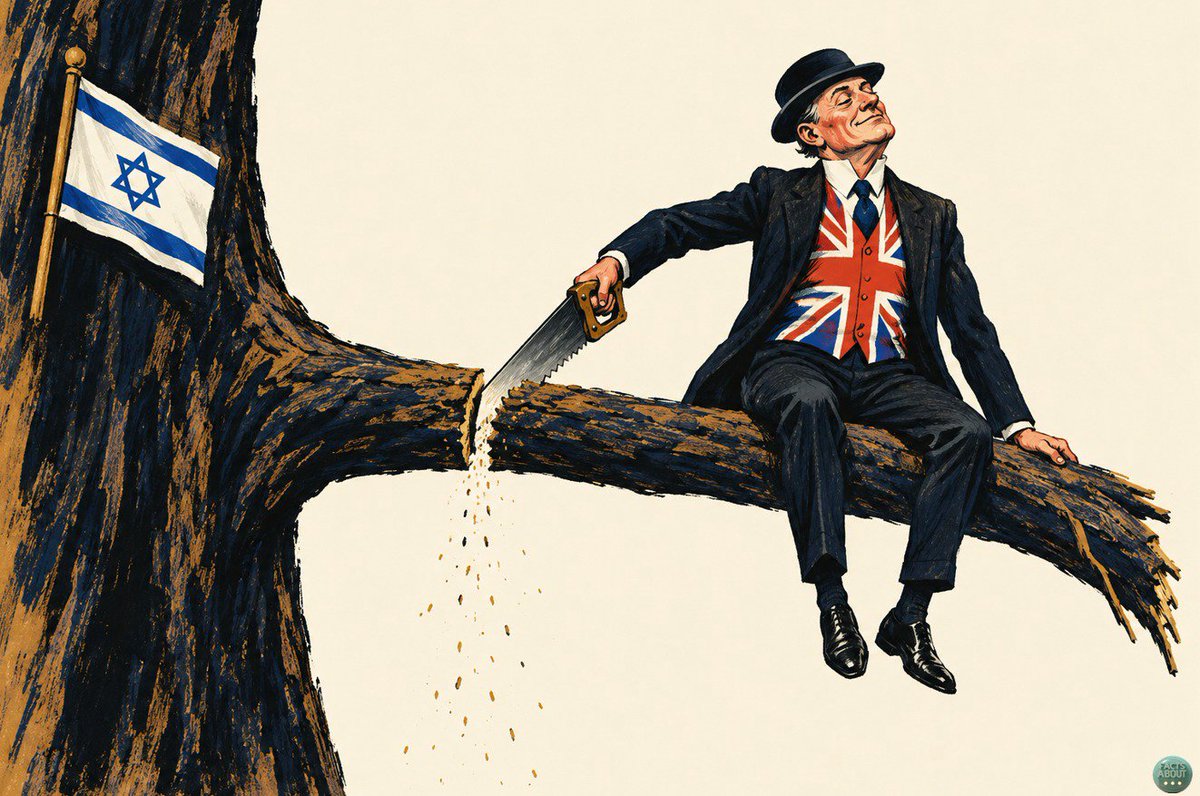
Britain’s strategy toward Israel is worse than virtue signalling. It is undermining its own stated objectives - even where those objectives differ from Britain’s national interest. London claims to be helping Palestinians and advancing peace, yet keeps surrendering the influence needed to do either, while putting British security and economic interests at risk.
Start with recognizing Palestine. The announcement did not create a functioning state, deliver democratic government or secure the hostages’ release - that wasn't even negotiated. Britain recognized Palestine while Hamas still held hostages and Palestinian institutional reforms remained promises. The diplomatic gesture was real. The promised transformation on the ground was not delivered by it.
Recognition was something Palestinian leaders wanted. That made it leverage.
Recognition could have been part of a coordinated bargain for the hostages, backed by pressure on Hamas and the governments with influence over it. Success was never guaranteed. But Britain surrendered that particular bargaining chip without securing their release.
Britain could have also tied it to verifiable reforms serving Palestinians: elections, accountable government, the effective abolition of payments rewarding terrorism, and removing incitement and the glorification of violence from classrooms. London acknowledged commitments on elections, prisoner payments and curriculum reform before recognition. It accepted promises where it could have demanded results. That was a missed opportunity to help Palestinians hold their own leadership accountable.
All this was supposedly done to save the “two-state solution”. Yet that formula has lost credibility among the people expected to live with its consequences. In Pew’s 2026 survey, only 17% of Israelis believed Israel and a Palestinian state could coexist peacefully, after October 7th. Fifty-six percent believed they could not. Among Palestinians surveyed in the West Bank and East Jerusalem, just 21% believed peaceful coexistence was possible, while 68% did not.
Another declaration from London cannot repair that collapse of trust.
And there is a fundamental contradiction Britain prefers to leave unaddressed, at best. If Palestinian statehood in Gaza and the West Bank is combined with an unrestricted “right of return” into Israel sufficient to eliminate its Jewish majority, the destination is effectively two Palestinian-majority states. A negotiated refugee settlement could avoid that outcome. An unlimited demand cannot simply be hidden behind the reassuring phrase “two states”. Two states for two peoples requires accepting Jewish national self-determination too. Only a small fraction of Palestinians support that.
Then consider military education. Britain suspended future Israeli participation in its military training and education courses, including the Royal College of Defense Studies. The government simultaneously explained that these courses emphasize compliance with international humanitarian law. If Britain believes Israeli officers need to learn British standards, excluding them from the institutions teaching those standards is a peculiar remedy. It also didn't apply these standards to Chinese and Qatari personal - actual violators of international humanitarian law, and not a fake one: Discussing the 2014 Gaza conflict, British Colonel Richard Kemp described Israeli efforts to protect civilians as “unprecedented in any other army”. After visiting in 2024, General Sir John McColl wrote: “The procedures are at least as rigorous as those applied in the UK armed forces”. Perhaps even more.
Asked why Chinese and Qatari personnel were not similarly banned, the government offered a case-by-case explanation about partnerships, risks and benefits. Apparently engagement can have strategic value with those countries, while exclusion is the preferred instrument for a democratic ally.
Next came restrictions targeting Israeli settlements. Britain’s businesses now face potential exposure to American anti-boycott rules, including restrictions on government contracts and public investment in Florida and Texas. Going against British national interest.
The retaliation was considerably more concrete than the diplomatic gains. Israel ordered the closure of Britain’s East Jerusalem consulate. The eventual agreement preserved a much smaller mission: Britain’s presence serving Palestinians was sharply reduced. Israel also announced Britain’s exclusion from the US-led Gaza coordination mission. A policy advertised as helping Palestinians reduced Britain’s capacity to work on their behalf.
Palestinian workers face another potential cost. Businesses targeted because they operate in settlements also employ Palestinians. Palestinian statistics put average daily wages in Israel and settlements at approximately 3 times more that in the West Bank’s private sector. If export restrictions cause employers to cut production or close, Palestinian families lose livelihoods too. Calling a measure pro-Palestinian does not protect their paychecks. Calling it anti-Israeli seems more fitting.
The diplomatic priorities are equally revealing. During September’s sanctions dispute, Pat McFadden acknowledged that Andy Burnham had not yet spoken to Netanyahu. Later that month, Ed Miliband met and shook hands with Iranian Foreign Minister Abbas Araghchi at the UN, while the Jewish Chronicle reported that he met no Israeli official during that visit. Talking to adversaries might be necessary. Failing to engage an ally while trying to change its behavior is harder to explain.
The Iranian meeting took place three days before the RAF Fairford plot. Netanyahu subsequently said Israel had warned Britain about an Iranian-sponsored threat beforehand. The strategic question is hence unavoidable: why treat a country supplying potentially life-saving intelligence as a relationship Britain can casually degrade?
Israel still has choices. Intelligence cooperation with MI6 and other British agencies is a relationship to maintain, not an entitlement. Reduced collaboration would mean fewer warnings, less visibility and greater risk for Islamist terror attacks on British soil. British security should not become collateral damage in a contest to display disapproval.
Nor should Britain overlook the economic opportunity. Dealroom’s 2025 analysis identified more than 180 international billion-dollar companies with offices in Tel Aviv, and a startup-to-unicorn conversion rate far above the wider region’s. This is a substantial partner in technology, investment and innovation. A foreign policy built around the Israel portrayed in protest slogans cannot adequately account for the Israel British businesses and security services actually work with.
Recognition spent before reforms were delivered. Military exchanges suspended. Diplomatic access reduced. Businesses exposed to competing restrictions. Palestinian livelihoods potentially damaged. A valuable security relationship placed under strain. Britain played most of it's cards.
But where is the corresponding achievement?
Britain is entitled to criticize Israeli policy. Its government is responsible for making that criticism serve a practical purpose. Sacrificing influence, commercial opportunity and security cooperation for domestic political applause and without even the guarantee of electoral reward - is a remarkable way to confuse moral performance with national interest.
There is something almost unbearable about watching Britain accuse Jews of "ethnic cleansing" in Judea and Samaria, while calling for the Ethnic cleansing of Jews from Judea and Samaria. Again.
Before lecturing Jews about racism, dispossession and international law, perhaps Britain should open its own archives.
Britain received the Mandate for Palestine with an explicit obligation to facilitate a Jewish national home, recognizing the Jewish people’s historical connection to the land. It then carved more than three-quarters of the Mandate territory away from that project to create Arab Muslim Transjordan and progressively restricted Jewish immigration as Europe’s Jews became increasingly desperate.
During the Holocaust, Britain arrested some Jews who had escaped Hitler as "enemy aliens". In 1940, it shipped more than 2,500 internees to Australia aboard the Dunera. About two-thirds were Jews; most were anti-Nazi refugees from Germany and Austria.
Britain transported them alongside actual Nazis, fascist sympathizers and Axis prisoners. Australia’s National Archives records approximately 250 German Nazis and 200 Italian Fascists aboard, alongside predominantly anti-fascist refugees.
British guards stole their belongings, threw documents into the sea, beat them and stabbed some with bayonets. One account describes soldiers smashing bottles and forcing prisoners to walk barefoot over the glass. The British government eventually paid compensation and court-martialed several guards.
In Australia, the refugees were imprisoned behind barbed wire at Hay, Orange and Tatura, alongside Nazi and fascist prisoners. Jews who had escaped Hitler were classified and imprisoned with his people.
Britain’s behavior toward Jews in Mandatory Palestine became uglier still.
By 1946, the British press was reporting rising antisemitism among British troops. These were contemporary reports, not accusations invented decades later.
Soldiers reportedly drove around Jerusalem, asking pedestrians whether they were Jewish, then beating and robbing those who said yes. Others fired a burst of machine-gun fire into a Jewish home in Tel Aviv, wounding a girl.
In Jerusalem in April 1947, British troops shot dead 22-year-old Moshe Cohen. Seventeen-year-old Itzhak Abrahamov was reportedly beaten unconscious and then shot. Contemporary accounts describe another incident in which British troops shot two Jewish boys, aged 14 and 16.
British troops clubbed and tear-gassed Jewish refugees who refused to enter Cyprus detention camps. Twenty-four Jewish detainees, including minors, went on hunger strike alleging beatings by British police.
A British lieutenant-colonel subjected journalists to an anti-Jewish tirade, calling Jews a "despicable race". In July 1947, the Jerusalem correspondent of Britain’s own Observer reported "openly expressed anti-Semitism" in senior military circles, including allegations that senior officers said Hitler should have been given longer to finish murdering the Jews.
British fascists also circulated anti-Jewish material among the forces. Contemporary reporting described a “hymn of hate” circulating among armed forces and police personnel, predicting the day Jews would be forced to their knees.
This was two years after Bergen-Belsen. Parts of Britain’s apparatus in Palestine had developed an unmistakably anti-Jewish culture.
Then came 1948.
The Arab Legion, the most effective Arab army fighting the newly created Jewish state, was financed, trained and equipped with massive British involvement and commanded by British officer John Bagot Glubb.
American diplomatic records from May 1948 explicitly discuss British officers serving with Arab Legion forces during the fighting. British representatives acknowledged approximately 30 officers and several enlisted men seconded to the Legion, alongside British nationals such as Glubb.
That force conquered eastern Jerusalem and Judea and Samaria. Jerusalem’s ancient Jewish Quarter fell, its Jewish population was ethnically cleansed, and synagogues were destroyed or desecrated.
Jordan then annexed Judea and Samaria, an annexation recognized internationally by almost nobody except Jordan itself, and renamed the region to the "West Bank".
From 1948 to 1967, the territory Britain now insists must form the heart of a Palestinian state became virtually "Jew-free". Jewish residents were expelled from Jerusalem’s Old City, while synagogues, cemeteries and other Jewish sites were destroyed or desecrated. Communities in Jerusalem, Hebron, Gush Etzion and elsewhere - with roots extending centuries and, in some cases, thousands of years before the seventh-century Arab conquest - were driven out, prevented from returning and erased from territory under Jordanian rule.
Now consider Britain in 2026.
Foreign Secretary Ed Miliband accuses Israel of "ethnic cleansing" over Judea and Samaria. Britain is moving to ban settlement goods, penalize connected businesses and potentially extend sanctions to construction, finance and other services. An immediate target is E1.
E1 is in Area C, which Oslo left under Israeli civil and security administration. Yet Britain treats the territorial question as already adjudicated and declares that “international law is clear".
It is far from clear in the direction Britain claims.
The ICJ conclusion Britain quotes rests on the premise that Judea and Samaria are legally "occupied" Palestinian territory. But Israel did not take the territory from a sovereign Palestinian state; none existed. The more accurate description is disputed territory, and a non-binding advisory opinion did not change that fact, as Judge Julia Sebutinde’s dissent pointed out.
Article 49(6) of the Fourth Geneva Convention was written after Nazi population transfers to prevent an occupying power from forcibly deporting or transferring its population into conquered territory. It does not prohibit individuals from voluntarily moving to communities in disputed territory.
Israelis living in Judea and Samaria moved voluntarily; their government did not deport them there. The text of Article 49(6) itself has not established that conduct as illegal, nor can the ICJ assume a disputed legal premise and present its conclusion as beyond serious disagreement.
There is also uti possidetis juris: the principle that administrative boundaries inherited at independence generally become a new state’s international borders. Applied to the Palestine Mandate, it supports the argument that Israel inherited the entire remaining Mandate territory, including Judea and Samaria, rather than only the territory within the armistice lines drawn after the 1948 war.
Britain is therefore adopting disputed interpretations of sovereignty, occupation and Article 49(6), treating a non-binding opinion as settled law, and using it to justify economic discrimination against Jewish individuals and organizations in territory administered by Israel under Oslo.
The contradiction becomes sharper when Britain calls this prevention of "ethnic cleansing".
Jewish communities on the Palestinian side of a future border are routinely discussed as "settlements" that must disappear. The Palestinian Authority contains no Jews under its governance - by law - and discussion of its envisioned state routinely assumes their removal.
If forcibly removing Arabs because they are Arab is ethnic cleansing, what is forcibly removing Jews because they are Jews?
Britain also accuses Israel of undermining the two-state solution while violating the Oslo accords which explicitly prohibited either party from taking steps to change the status of the West Bank and Gaza pending the outcome of permanent-status negotiations. It treats disputed sovereignty as settled and demands restrictions Oslo never imposed, undermining the agreements that created the Palestinian Authority and established the negotiating framework, replacing negotiation with coercion - hardly a step toward long standing peace agreement.
Invoking fake “international law” also does not resolve the separate questions these measures raise under trade rules, treaty obligations and anti-discrimination law. Britain is not enforcing a universally accepted court order; it is using a contested legal position to target businesses connected to Jewish communities in disputed territory.
This looks like political signaling. Labour knows anti-Israel activism appeals to a significant part of its electoral coalition, so it presents economic discrimination as moral courage and unilateral pressure as international law.
Then there is “settler violence.”
Genuine crimes by a tiny minority of Israeli extremists should be prosecuted. But examine what the UN’s methodology calls “settler-related violence”.
OCHA says its database includes “intimidation or trespass”, acknowledges that a person’s settler identity is sometimes presumed from circumstances, and includes categories where no casualty or property damage occurs. Entries also include cases in which Jews were defending themselves against Palestinian terrorists.
Information about incidents affecting Palestinians comes partly from Palestinian municipal bodies, NGOs and other local sources, without evidence. OCHA’s own documentation includes dog bites, elementary school trips to Shilo and Jewish visits to Jewish religious sites. Yet aggregate figures are repeatedly presented as though every entry represents an unprovoked Jewish attack on a Palestinian civilian.
Broaden the definition, aggregate the incidents, remove the context and quote an enormous number: that is how a narrative is manufactured. Britain then turns those numbers into sanctions.
These restrictions may also collide politically and commercially with American anti-BDS laws. Florida, for example, restricts state contracts with companies engaged in boycotts of Israel.
British companies could find themselves squeezed between British pressure to disengage from Israelis beyond the Green Line and American rules penalizing certain Israel boycotts. Governments normally approach such restrictions cautiously; Britain is rushing toward them while declaring the law beyond discussion.
History makes the imagery impossible to ignore.
A country that closed Palestine to desperate Jews, imprisoned refugees alongside Nazis, detained Holocaust survivors, tolerated troops assaulting Jews and officers reportedly wishing Hitler had had longer, and supplied officers to the Arab Legion during its war against Israel is once again explaining where Jews may live.
Once again, Britain is answering someone else’s political demands by restricting Jews, using a respectable vocabulary: then security, now international law.
That is why Jews should watch institutional deterioration before it reaches its final form.
In the framework I have discussed in my article for deciding when Jews should consider leaving before it's too late, the decisive danger is when institutional brakes start failing: different rules for Jews become respectable, collective punishment becomes policy, hostility toward Jews brings electoral rewards, and economic discrimination acquires moral prestige.
But this is about "zionists" not Jews, right?
A boycott targeting banks that finance Jewish homes in Area C naturally spreads across Israel’s banking system if merely serving those residents becomes enough to qualify. Banks already have legal obligations concerning basic services and discrimination based on residence.
From there, the same logic could target companies that use those banks, charities that transfer money through them, and individuals with financial, communal or family ties to Israel. Once association itself becomes grounds for exclusion, a boycott presented as targeting particular properties would reach Jewish communities worldwide.
Historical collapse does not begin at Auschwitz. Auschwitz is where the failure ends; the warning period comes much earlier.
No one knows whether Britain will cross that line, but it looks like it is moving frighteningly quickly in the wrong direction.
If its government destroys relations with Israel, damages intelligence and security cooperation, exposes British companies to retaliation and conflicting foreign rules, and normalizes economic exclusion of Jews in Judea and Samaria, Britain will bear costs too.
It is weakening its institutions and alliances to pursue a policy presented as preventing ethnic cleansing, while demanding a ethnically cleansing of Jews. It calls to not undermine the two states solutions, by flagrantly violating it itself. Hypocrisy.
Britain has seen this pattern before, and Jews certainly have. Perhaps this time we should recognize it before the two-states' "final solution".
How much of the “Free Palestine” movement is genuinely grassroots, and how much has been manufactured, financed, and amplified by foreign powers?
For three years, Western streets and universities have been consumed by demonstrations, boycotts, occupations, and relentless anti-Israel propaganda. We are told this is simply an organic expression of public outrage.
But follow the money, examine the organizations, and look at the intelligence reports. A very different picture emerges.
Iran, China, Russia, and Qatar have all invested in influencing the Western information environment surrounding Israel. Their methods differ, but their strategic interests overlap: weakening Western alliances, undermining American influence, and exploiting divisions within democratic societies.
Start with Iran.
In July 2024, U.S. Director of National Intelligence Avril Haines publicly confirmed that Iranian government-linked actors were impersonating activists online, encouraging Americans to participate in Gaza demonstrations, and even providing financial support to protesters.
Not speculation. An official American intelligence assessment.
And now we have something even more revealing.
In October 2026, OpenAI exposed an Iran-origin influence operation that used artificial intelligence to manufacture apparently independent Western journalism.
The operators created seven fictitious journalists with Western identities, complete with biographies, social-media profiles, and fabricated professional credentials.
They used AI to refine articles, tailor submissions to legitimate publications, and generate persuasive pitches to editors.
The operation succeeded in placing nearly 100 articles in online media outlets around the world.
These weren’t merely fake accounts shouting slogans into the void. They were fabricated journalists successfully infiltrating real publications.
The operators also generated batches of social-media comments designed to portray America as the aggressor, Israel as an unreliable ally, and Iran as the victim.
They manufactured supportive responses to their own articles to create the appearance of public approval. Their internal reports even used misleading engagement calculations that exaggerated the campaign’s effectiveness.
OpenAI assessed the journalism operation as having achieved significant distribution, although its social-media comments attracted little genuine engagement. The company identified an Iran-origin operation consistent with a commercial influence campaign.
The strategy is unmistakable: fabricate credibility, launder propaganda through legitimate institutions, and manufacture the appearance of independent public opinion.
And this was not an isolated incident. OpenAI had already disrupted Iran’s STORM-2035 operation in 2024, which used fake progressive and conservative outlets and fictitious social-media personas to distribute politically divisive content about Gaza, Israel, and American elections.
The regime that finances Hamas has also been caught exploiting American protests, financing some demonstrators, and using fabricated Western identities to manipulate the information Americans consume.
Then there is China.
Investigations by George Washington University’s Program on Extremism and the Network Contagion Research Institute traced connections between a funding network associated with Shanghai-based businessman Neville Roy Singham and organizations including The People’s Forum, ANSWER Coalition, and the Shut It Down for Palestine campaign.
These organizations coordinated demonstrations, distributed messaging, mobilized activists, and organized disruptive actions across American cities.
The financial and organizational connections are documented. The extent of direct Chinese Communist Party operational control remains unclear, but the network’s relationships with pro-Beijing influence activities have attracted congressional scrutiny.
An October 2026 investigation exposed another layer: an international protest campaign involving more than 179 organizations, distributing prepared slogans, multilingual propaganda materials, and coordinated instructions for demonstrations, walkouts, and political pressure campaigns.
Organized activism is not inherently foreign interference. But when sophisticated protest infrastructure intersects with foreign-linked financial networks, examining the source of the money becomes essential.
Russia operates differently.
The U.S. Department of Justice exposed a Russian government-backed operation involving nearly 1,000 fictitious social-media accounts and AI-assisted propaganda infrastructure linked to RT personnel and Russian intelligence.
Meanwhile, research by the German Marshall Fund found that Russian state-affiliated media devoted extraordinary attention to the Israel–Hamas war after October 7, at times exceeding their coverage of Russia’s own invasion of Ukraine.
Think about that.
Russia was fighting its largest European war in generations, yet its propaganda apparatus devoted enormous resources to a conflict thousands of miles away.
The geopolitical logic is straightforward: a West consumed by internal conflict and arguments over Israel has less attention available for Russia’s actions in Europe.
And just this week, Ukrainian strikes damaged Russian Yandex data-center infrastructure, and suddenly Russian-operated pro-Palestinian accounts had suddenly gone silent.
Russia’s documented information warfare operations are substantial.
And then there is Qatar.
Qatar has poured billions into financial relationships with American universities. U.S. Department of Education disclosures show more than $1 billion in Qatari gifts and contracts reported in 2025 alone, with cumulative reported transactions approaching $9 billion.
The scale of institutional financial dependence raises legitimate questions about transparency and foreign influence.
Qatar also finances Al Jazeera, one of the world’s most influential Arabic-language media organizations, while maintaining longstanding political relationships with Hamas and serving as an intermediary in negotiations.
This gives Doha something different from a bot farm: a combination of media reach, institutional relationships, and diplomatic leverage.
Now consider how these mechanisms can reinforce one another.
A foreign state promotes a narrative. Covert accounts manufacture apparent consensus. State-funded media gives it international exposure. Activist organizations convert the message into demonstrations, campus occupations, and coordinated political campaigns. Politicians then respond to what appears to be overwhelming public pressure.
Eventually, the original source becomes almost irrelevant.
Real people repeat the message. Journalists report on the demonstrations. Universities respond to the activists. Governments react to the apparent public consensus.
The protesters themselves need not know who financed the organizations, who manufactured the online personas, or which foreign intelligence service is amplifying their slogans.
That is precisely what makes influence operations effective.
And here is the larger point.
This is not fundamentally about Israel. It is about the West.
Israel is the issue around which these particular operations converge. But Protests feature communist messaging, trans activism and other grievances. But the Iranian influence campaigns exposed by OpenAI also targeted American elections, domestic political divisions, and the legitimacy of American institutions.
Russia’s information operations have similarly targeted Western political cohesion across multiple issues. Chinese-linked influence networks operate within broader ideological and geopolitical struggles. Qatar’s international media and educational investments extend far beyond the Palestinian question.
The common strategic opportunity is not simply to persuade Western audiences to criticize Israel.
It is to exploit existing grievances, deepen distrust, intensify polarization, and weaken confidence in Western institutions.
This is the logic of political demoralization: convince a society that its institutions are illegitimate, its history is irredeemable, its allies are enemies, and its political opponents are morally beyond redemption.
Israel can serve as a powerful catalyst because the conflict already generates intense emotions. Foreign influence operations do not need to invent those emotions. They can exploit them.
The result can be a society increasingly consumed by internal accusations, institutional distrust, and ideological conflict.
The documented operations reveal something important: foreign powers are not merely observing Western political divisions. Some are actively investing in amplifying them.
Israel is not the ultimate target of these operations. Western social cohesion, institutional legitimacy, and political stability are also at stake.
The “Free Palestine” campaign is the biggest arena in which that struggle is taking place, and it’s the most successful one to date.
It is the one that convinces people to turn against their own society, believing the conclusion was entirely their own.
Still think this is about Israel?
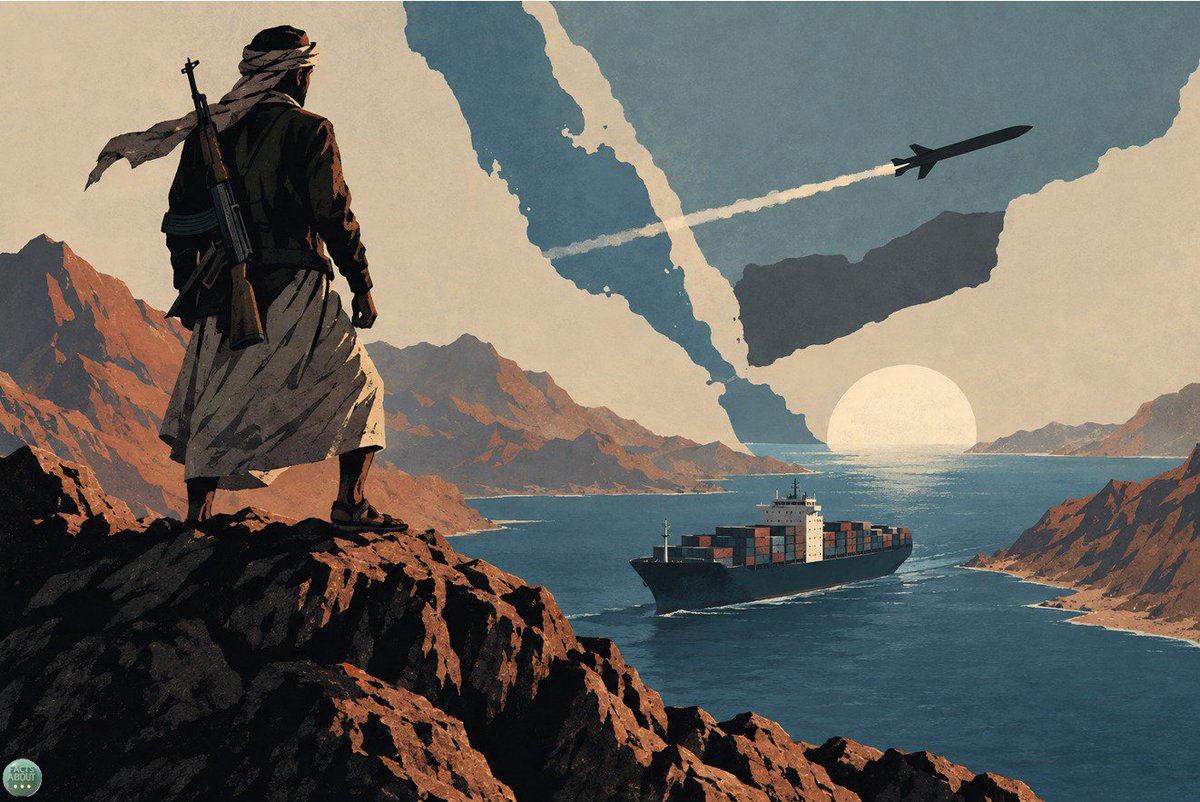
The Houthis look ridiculous. That is part of what makes them so easy to underestimate.
They chant slogans about death, produce propaganda that sometimes looks like a low-budget music video, and emerged from one of the poorest countries on earth.
Yet today they are one of the most consequential armed Iranian proxy in the Middle East.
To understand why, you have to understand Yemen.
Yemen is overwhelmingly Muslim, but roughly 65% is estimated to be Sunni and about 35% Zaydi. The Sunnis are concentrated particularly in the south and coastal regions; the Zaydis historically dominated much of Yemen’s mountainous northwest.
Zaydism is technically a branch of Shi’a Islam, but it is quite different from the Twelver Shi’ism of Iran and Hezbollah. In theology and jurisprudence, Zaydis have historically been considerably closer to Sunnis than Iranian Shi’ism is.
And for roughly a thousand years, Zaydi imams ruled parts of Yemen.
That order collapsed with the 1962 revolution.
The resulting North Yemen civil war should have been a warning about what Yemen does to foreign armies. Egypt eventually deployed tens of thousands of troops there and found itself fighting tribesmen through some of the most difficult mountainous terrain on earth.
Egypt even resorted to chemical warfare. Historical research documents poison-gas attacks against the royalists and their cave networks, including the notorious 1967 Kitaf attack.
Decades later, another foreign power discovered the same problem.
Saudi Arabia intervened against the Houthis in 2015.
Eleven years later, the Houthis are still there.
In fact, they are stronger.
The modern Houthi movement grew out of a Zaydi religious revival in northern Yemen during the 1980s and 1990s, partly in reaction to the growing influence of Saudi-backed Salafism.
Hussein al-Houthi became its central figure. After increasingly bitter confrontations with President Ali Abdullah Saleh’s government, Yemeni forces killed him in 2004.
Instead of destroying the movement, they gave it a martyr.
The Houthis then fought six wars against the Yemeni government between 2004 and 2010.
Then Yemen collapsed during the Arab Spring.
The Houthis exploited the chaos, expanded well beyond their original stronghold, allied temporarily with their former enemy Saleh and in 2014 seized Sanaa, the capital.
Eventually they killed Saleh too.
Today Yemen effectively contains competing governments. The internationally recognized government and its allies are themselves fragmented among factions backed by Saudi Arabia and the UAE.
The Houthis, meanwhile, control Sanaa and much of Yemen’s most populous northwest - and have just dramatically expanded along the Red Sea coast. Reuters reports their armed strength has grown from roughly 30,000 fighters in 2015 to estimates around 350,000.
They Houthis have genuine Yemeni roots, a religious constituency, tribal alliances and a political history that predates their close relationship with Tehran. Not all Zaydis support them, and their rule also rests heavily on coercion.
But Iran recognized an extraordinary opportunity.
Think of the Houthis as a rougher Yemeni cousin of Hezbollah.
Both are Shi’a movements.
Both developed an armed organization alongside a political project.
Both received Iranian weapons, training, technology and support.
Both became militarily powerful enough to challenge - or overshadow - the internationally recognized institutions of their countries.
And Hezbollah itself helped train and develop the Houthis.
But there is an important difference: the Houthis are less dependent on Iran than Hezbollah traditionally has been. Their ideology is indigenous, their Zaydi religion is different from Iran’s Twelver Shi’ism, and they retain their own interests and decision-making.
Iran jusy helped turn a local insurgency into a regional military power.
And the price has overwhelmingly been paid by Yemenis.
Yemen has suffered one of the world’s worst humanitarian catastrophes. Millions have been displaced. Millions face serious food insecurity. Hundred of thousands of children have died from hunger and preventable disease.
The Houthis and the Saudi-led coalition’s bombing campaign and restrictions following their attacks, government forces and the economic collapse all contributed enormously to this catastrophy.
The Houthis have repeatedly been responsible for indiscriminate attacks, recruiting children, laying mines, arbitrary detention and torture, and obstructing humanitarian aid. Human Rights Watch has documented Houthi attempts to control beneficiary lists and divert assistance toward loyalists, while their blockade of roads around Taizz severely restricted food, medicine and humanitarian access.
This is the paradox of the Houthis.
They govern desperately poor people while spending enormous resources on war.
They embrace a revolutionary culture in which martyrdom is celebrated - their famous slogan - printed on their flag - literally begins with “God is great, death to America, death to Israel…”
And yet militarily, they have been extraordinarily difficult to defeat.
Saudi Arabia spent years bombing them.
The United States bombed them.
Britain bombed them.
They survived.
Their mountains, caves, dispersed infrastructure and willingness to absorb casualties make destroying them from the air extraordinarily difficult. And Iran progressively supplied the technology that transformed that resilient guerrilla force into something much more dangerous: ballistic missiles, cruise missiles, sophisticated drones and anti-ship weapons.
Which brings us to the mistake people repeatedly make:
low-tech appearance does not mean low strategic capability.
A movement can produce absurd propaganda and still sink ships.
It can fight in sandals and launch ballistic missiles.
It can live in caves and threaten one of the most important maritime chokepoints on earth.
And now the Houthis have demonstrated exactly that.
Their latest offensive has taken territory overlooking the Bab al-Mandab, through which shipping between the Indian Ocean, Red Sea and Suez Canal must pass. Saudi Arabia was caught badly off guard; The Houthis quietly assembled roughly 100,000 fighters for the offensive while Saudi-backed Yemeni forces collapsed and abandoned advanced equipment.
After eleven years of fighting them, Saudi Arabia is again scrambling for outside assistance. Riyadh has sought American military help, approached Egypt, and appealed to other partners as its vulnerability has become painfully obvious.
Israel, meanwhile, has demonstrated something the other air campaigns struggled to achieve: high-level penetration of the Houthi leadership.
An Israeli intelligence-led strike in August 2025 killed the prime minister of the Houthi-run government and several ministers - the first Israeli attack confirmed to have killed officials at that level.
And Israel now has something else it did not have before:
Somaliland.
Israel recognized Somaliland in December 2025. Somaliland now receives Israeli military and police training, and its government has openly discussed strategic security cooperation with Israel, and the geography itself is extraordinary.
Look at a map.
Somaliland sits directly across the Gulf of Aden from Yemen, near the entrance to the Bab al-Mandab.
That potentially gives Israel something enormously valuable against the Houthis: a friendly partner on the opposite shore from which intelligence collection, maritime monitoring and other security cooperation can be developed.
That may become increasingly important because the Houthis have demonstrated a lesson the Saudis have spent eleven years learning:
Never confuse primitive appearance with primitive warfare.
Iran helped arm and train them.
And now this strange, brutal, ideologically extreme movement from one of the poorest countries in the world has positioned itself beside a maritime artery capable of affecting energy prices and trade thousands of miles away.
They may look ridiculous.
They are anything but harmless.
And those pirates should be stopped.
For years, Spain’s government has been among Europe’s loudest critics of Israel. It has condemned Israeli border controls, military operations, intelligence measures, and security policies. Yet today, Spain is confronting a reality that should feel strangely familiar.
Because both countries sit on the front line of a much older ideological conflict - one that many Western politicians still refuse to study on its own terms.
To understand that conflict, you have to understand two concepts that have shaped Islamist political thought for centuries: Dar al-Islam (“the house of Islam”) and Dar al-Harb (“the house of War”).
These terms are deeply influential within Islamist movements from ISIS and al-Qaeda to Hamas and the Muslim Brotherhood - and continue to appear in their literature, speeches, and ideological writings.
The classical idea is straightforward:
* Dar al-Islam refers to lands under Islamic rule.
* Dar al-Harb refers to lands outside that rule, that should eventually be brought into the former through expansion, treaties, or conquest.
This is why Islamist leaders often speak not merely about Gaza or the West Bank, but about restoring Muslim rule over territories that were once governed by Islamic empires.
That includes Israel.
And it also includes Spain.
For Islamist ideologues, al-Andalus is not simply history. It is unfinished business.
Hamas’ charter frames the land as an Islamic waqf that cannot be permanently surrendered. Al-Qaeda leaders repeatedly invoked the “liberation of al-Andalus”. ISIS propaganda called for returning Islamic rule to Spain. Muslim Brotherhood thinkers have long described Islam as a comprehensive political system whose mission extends far beyond personal faith. This means that organized Islamist movements openly strive to recapture it.
Which makes today’s events in Ceuta impossible to ignore.
Thousands of migrants crossed from Morocco into the Spanish enclave in a matter of hours, overwhelming local authorities and forcing Spain to deploy military forces. Most visible arrivals appeared to be mostly or all army aged men.
Since Morocco is a functioning state with schools, hospitals, and a stable economy, those crossing into Spanish territory are not be fleeing war or state collapse. Instead, many are individuals seeking to exploit Spain’s more permissive legal and asylum framework, Jihadists infiltrating the west, or criminals attempting to evade Moroccan law enforcement by moving into a jurisdiction where local authorities cannot easily pursue them.
Ordinary criminals - robbers, rapists, and murderers - are dangerous enough. But they are not the worst-case scenario.
Morocco itself devotes enormous resources to dismantling jihadist cells and suppressing Islamist extremism, regularly arresting ISIS operatives and disrupting planned attacks. It does so because it understands that a handful of committed Islamists can inflict far more damage than hundreds of ordinary criminals.
Can anyone honestly say how many of the invaders are committed Islamists, planning to commit mass terror attacks in the name of Allah in Europe?
Can anyone honestly say that none are?
Of course not.
That uncertainty is precisely why states conduct security screening and maintain secure borders.
Spain has already arrested ISIS supporters in Ceuta this month, alongside other cities, after authorities alleged they were spreading support for violent jihad and seeking links to global jihadist organizations.
Meanwhile, local authorities describe the current situation as an emergency after thousands entered the enclave in a single day, overwhelming local resources.
Israel learned decades ago that Islamist terrorism can fundamentally change a nation’s security environment.
Spain has spent years condemning Israel for checkpoints.
For border barriers.
For intelligence operations.
For preventive arrests.
For military responses.
Yet every one of those policies emerged after decades of terrorism - not before.
Spain now faces a choice.
It can continue insisting that ideological Islamist movements are merely products of poverty or discrimination.
Or it can recognize what the movements themselves say about their own goals.
History suggests that ignoring declared ambitions rarely makes them disappear.
Spain should understand this better than almost any country on Earth.
For nearly eight centuries, much of the Iberian Peninsula was ruled by successive Muslim dynasties before the Reconquista gradually restored Christian kingdoms. That history remains central to Islamist propaganda today. Modern jihadist organizations invoke al-Andalus not because they are interested in medieval history, but because they present it as a future objective.
That means that dismissing Islamist ideology while condemning the only democracy in the Middle East for taking it seriously may prove to be a costly mistake.
Spain may discover that geography is less important than ideology - and that the countries most loudly criticized for defending themselves are often the only ones who succeed in that mission.
Gaza is not starving. Yemen is.
Not only that main stream media falsely blames Israel for hunger caused by the Houthis in Yemen, it is also depriving Yemenite children of attention and outrage that might move the world into action. That‘s a real tragedy.
Turkey’s Dark History, Erdogan’s Dangerous Future
The genocide of Armenians by the Ottoman Empire in 1915–1917 was one of the first great atrocities of the 20th century - the mass murder and deportation of 1.5 million Armenians through killings, starvation marches, and forced conversions. For decades, Turkey denied it, and too many Western governments looked away. Israel long avoided formal recognition of the Armenian genocide out of a desire to preserve its once-valuable alliance with Ankara. But after years of Erdogan’s Islamism and hostility, Israel formally recognized it - a moral and strategic correction after ties with Turkey collapsed under his rule.
Erdogan is not just a Turkish nationalist. He is an ideological leader of the Muslim Brotherhood, bent on reviving Ottoman imperialism and reshaping the Middle East in an Islamist mold. Under his watch, Turkey became the main political and logistical lifeline for Hamas, and turned a blind eye to ISIS fighters and smugglers who used Turkish territory as their rear base. While the Kurds bled to defeat ISIS, Erdogan was busy bombing them - attempting to crush the very people who posed the greatest threat to both ISIS and his Islamist ambitions.
Meanwhile, Turkey still occupies northern Cyprus, where its 1974 invasion displaced 200,000 Greek Cypriots, destroyed communities, and forced conversions to Islam under occupation. The same pattern repeats inside Turkey itself, with the ongoing campaign against the Kurds - a slow-motion ethnic cleansing justified as “counter-terrorism.” Erdogan silences opposition, jails journalists, and rigs the judiciary. He faces massive protests against his corruption and authoritarianism, but he meets them with batons, arrests, and censorship.
On the world stage, Erdogan plays a duplicitous game: one foot in NATO, the other flirting with BRICS, Russia, and Iran. He uses NATO membership to shield himself from consequences while openly undermining Western security. No alliance can survive with such a saboteur inside.
Israel’s relations with Turkey tell the story of Erdogan’s damage. Once close partners in trade, defense, and intelligence, the two nations had excellent ties in the 1990s. But with Erdogan, everything soured: anti-Israel tirades, harboring Hamas operatives, constant provocations. Today, relations are a shadow of what they were.
Erdogan’s Turkey is a state that denies its genocides while planning new ones, that helps ISIS survive while crushing Kurds, that destabilizes Cyprus while demanding a role in the Middle East. It is a state that hides behind NATO’s shield while cozying up to America’s and Israel’s enemies.
The conclusion is inescapable: as long as Erdogan leads Turkey, it cannot be treated as a partner, let alone trusted inside NATO. He has turned a once-promising country into a destabilizing Islamist empire-in-waiting. The West must stop pretending and start acting. Erdogan’s Turkey is a danger that must be confronted - before it writes the next bloody chapter in the region’s history.
Mohamed Soltan's support for Abdul El-Sayed matters because it shouldn't be examined in isolation.
It needs to be understood against the history and political strategy of the Muslim Brotherhood in America.
Most Americans have heard of the Muslim Brotherhood. Far fewer know what it actually seeks.
Founded in Egypt in 1928 by Hassan al-Banna, the Brotherhood is an Islamist movement - meaning Islam as the organizing principle of society and government. The Council on Foreign Relations describes its mission as Islamizing society through religious law, values and morals, with a state based on Islamic principles historically at the core of its agenda.
That history helps explain why the Brotherhood is outlawed or designated as terrorist by several governments in the Middle East, including Egypt, Saudi Arabia and the UAE; Jordan outlawed it in 2025. And in January 2026, the United States designated the Egyptian and Jordanian Brotherhood branches as Specially Designated Global Terrorists and the Lebanese branch as both an SDGT and Foreign Terrorist Organization, citing support for Hamas and violence.
But perhaps the most important American evidence comes from the Holy Land Foundation trial.
During the trial, evidence showed that the Muslim Brotherhood created a U.S. Palestine Committee to support Hamas, with Holy Land Foundation becoming its principal fundraising arm. HLF and its convicted leaders ultimately provided approximately $12.4 million in support to Hamas.
Then there was Government Exhibit 3-85: a 1991 internal Brotherhood memorandum titled An Explanatory Memorandum on the General Strategic Goal for the Group in North America.
Its author described Brotherhood work in America as a:
“Civilization-Jihadist Process”
and spoke of “eliminating and destroying the Western civilization from within”.
The objective was not simply helping Muslims freely practice Islam in America.
The memorandum spoke about establishing Islamic institutions, becoming rooted in American society and ultimately making “God's religion…victorious over all other religions".
That document demonstrates why Islamist influence is about institutions, political influence, social organizations and gradually normalizing an Islamist conception of government.
And this matters today because one of the organizations caught up in that history was CAIR.
CAIR was never convicted in the Holy Land case and disputes allegations that it was part of a Hamas-support network. But the Justice Department's Inspector General later confirmed that evidence presented at the trial linked CAIR leaders to Hamas, and that the FBI consequently adopted a policy restricting non-investigative contacts with CAIR.
Now look at Abdul El-Sayed's political network.
According to a Fox News review of campaign-finance records, his campaign has received more than $115,000 from at least 41 people who work for, formerly worked for, or held leadership positions with CAIR.
That includes senior CAIR officials.
El-Sayed's father-in-law is also a CAIR-Michigan board member and a significant financial supporter of the super PAC backing him.
Then there is Mohamed Soltan.
Soltan's father was a senior Muslim Brotherhood figure. Mohamed himself was convicted by an Egyptian court in 2015 of supporting the Brotherhood and sentenced to life imprisonment, before the Obama administration demanded his “immediate release” and after negotiations with Egypt he renounced his Egyptian citizenship, was released and returned to the United States.
Today Soltan heads the American Committee for Middle East Rights.
And according to FEC-based reporting, Soltan subsequently contributed $7,000 to Abdul El-Sayed's U.S. Senate campaign, while ACMER contributed another $25,000 to the super PAC supporting El-Sayed. The $25,000 ACMER contribution is independently reflected in reporting based on the PAC's FEC disclosure.
At what point does a pattern become worthy of serious scrutiny?
Especially when you examine El-Sayed's own record.
In 2011, El-Sayed argued that Americans should not fear the possibility of the Muslim Brotherhood taking power in Egypt.
And when Mohamed Morsi later assumed extraordinary powers - shielding presidential decisions from judicial review - El-Sayed was reportedly listed among Egyptian-Americans signing a statement supporting Morsi's “revolutionary decisions”.
And that brings us to Sharia.
El-Sayed has vigorously attacked attempts to prohibit Sharia from being considered in American courts.
In his 2022 CAIR Oklahoma speech, he compared Oklahoma's attempt to ban Sharia with a historical continuum involving the Trail of Tears, the destruction of Black Wall Street and white supremacy.
And years earlier, while explaining why he sought Sharia-compliant financing, El-Sayed said following Sharia was a religious “obligation.”
Classical Islamic jurisprudence contains legal distinctions based on sex and religion, including unequal inheritance provisions and differences in family law; traditional jurisprudence also contains hudud corporal punishments and doctrines concerning apostasy and blasphemy.
Saying that the government should govern society according to Sharia raises fundamental questions about equality before American law, freedom of religion, freedom to leave a religion, women's equality and the rights of non-Muslims.
The Muslim Brotherhood has spent nearly a century pursuing an explicitly Islamist political project. An internal Brotherhood document introduced in America's largest Hamas-financing prosecution described changing Western society from within. The same prosecution demonstrated that a real Brotherhood-organized American network had raised millions for Hamas.
And today people connected to that history participate legally in American political life and finance American political candidates.
Only recently, Ali al-Qaradaghi - the secretary-general of the International Union of Muslim Scholars, an organization founded by longtime Muslim Brotherhood ideologue Yusuf al-Qaradawi - celebrated the political rise of El-Sayed and Zohran Mamdani as among the “blessings” resulting from October 7.
Americans are allowed to ask why Islamist figures see their political rise as a victory. Does an Islamist political ecosystem exist that seeks to use Western democratic institutions to advance political Islam - and are organizations and individuals associated with that ecosystem increasingly influencing American politics?
That is a reason to understand the ideology, follow the money, read people's own words and ask what political project is actually being advanced.
Most people know that evangelical Christians are among Israel’s most committed religious allies. Far fewer know about another American religious community whose relationship with the Jewish people, the biblical land of Israel, and the concept of Zion runs remarkably deep: the Mormons.
Officially known as the Church of Jesus Christ of Latter-day Saints, Mormonism emerged in 1830, when Joseph Smith, a young American religious leader, established a new church in upstate New York. Smith claimed that Christianity had lost essential truths following the death of the original apostles and that God had chosen him to restore the authentic Church of Jesus Christ.
Unlike Catholics, Protestants, and Orthodox Christians, Mormons believe that divine revelation did not end with the Bible. They recognize additional scripture, most famously the Book of Mormon, which tells the religious history of ancient peoples who, according to Mormon belief, migrated from Jerusalem to the Americas around 600 BCE. The book describes these peoples as descendants of ancient Israel and recounts an appearance of the resurrected Jesus Christ in the Americas.
Mormons consider themselves Christians, although their theology differs substantially from traditional Christianity. They reject the classical doctrine of the Trinity, believe in living prophets who continue to receive divine revelation, and emphasize sacred temples, eternal families, and religious covenants. Their conception of God and humanity’s potential for exaltation also differs significantly from mainstream Christian doctrine.
But perhaps the most fascinating feature of Mormonism is its relationship with ancient Israel.
Like Judaism, Mormonism places extraordinary importance on covenants between God and His people, the gathering of dispersed Israel, sacred temples, genealogy, family continuity, and the idea that religious identity carries obligations extending across generations.
Mormons believe that the descendants of Israel remain central to God’s divine plan. Their tenth Article of Faith explicitly declares belief in the literal gathering of Israel and the restoration of the Ten Tribes.
They also believe in the eventual establishment of a New Jerusalem on the American continent. In Mormon theology, Zion is therefore both a spiritual ideal and a geographical concept, with the American New Jerusalem existing alongside the biblical significance of Jerusalem.
And their interest in the Jewish return to the Holy Land predates modern political Zionism.
In 1841, more than half a century before Theodor Herzl organized the First Zionist Congress, Mormon apostle Orson Hyde traveled to Jerusalem. Standing on the Mount of Olives, he offered a prayer dedicating the land for the return of the Jewish people and the fulfillment of biblical prophecy.
This was not political Zionism in the modern sense. It was religious restorationism: the conviction that the ancient promises made to Israel had not been forgotten.
There is another striking historical parallel between Jews and Mormons: persecution, displacement, and the determination to preserve a distinct religious civilization.
During the 1830s, Mormon communities were attacked, expelled from their settlements, and subjected to mob violence. In 1838, Missouri Governor Lilburn Boggs issued an extraordinary order declaring that Mormons should be expelled from the state or exterminated if necessary.
At Haun’s Mill, an armed mob massacred 17 Mormon men and boys. In 1844, Joseph Smith and his brother Hyrum were murdered by a mob in Illinois.
Under Brigham Young, thousands of Mormons subsequently undertook an arduous westward migration, eventually establishing their religious center in the Salt Lake Valley in 1847.
The historical scale and circumstances of Jewish and Mormon persecution are profoundly different. Nevertheless, both communities developed powerful collective memories of expulsion, religious hostility, migration, and rebuilding.
Both also attached enormous significance to the idea of gathering their people and establishing a society in which they could practice their religion without persecution.
There are even intriguing similarities in religious practice. Mormon temples, while theologically very different from the ancient Jewish Temple, reflect a deliberate identification with biblical Israel. Genealogical research is central to Mormon religious life because members believe sacred ordinances can connect generations, including deceased ancestors. Family, religious education, communal responsibility, and the transmission of identity occupy prominent places in both traditions.
The differences remain fundamental. Judaism does not recognize Jesus as the Messiah, while Mormonism places him at the center of its theology. Mormon beliefs about continuing revelation, salvation, and the Book of Mormon are incompatible with traditional Jewish theology.
Yet the relationship has produced some remarkable examples of religious accommodation.
Brigham Young University operates a magnificent Jerusalem Center overlooking the Old City. Under an agreement with Israel, the Mormon Church refrains from missionary proselytizing in Israel, Judea and Samaria (AKA the West Bank), and Gaza, recognizing the particular sensitivity of religious conversion in the region.
Unlike some evangelical movements, the Mormon Church does not officially adopt a political Zionist position or endorse Israeli government policies.
What makes this relationship fascinating is something deeper than contemporary politics.
Judaism is an ancient civilization whose religious identity developed around a covenant, a people, a land, and a history of exile and return. Mormonism is a comparatively young American religion that consciously incorporated many of those same biblical concepts into its understanding of itself.
The two religions disagree on fundamental questions of theology, yet both understand the power of covenant, collective memory, sacred geography, and the preservation of a people across generations.
Christian Zionism is usually discussed through the lens of evangelical Protestantism. But the Mormon story reveals another, distinctly American interpretation of Israel’s biblical significance - one that began long before the establishment of the modern Jewish state.
And perhaps the most intriguing historical coincidence is that while Jews spent centuries praying for their return to Zion, another persecuted religious community was building a new Zion of its own in the American West.
Christianity and Judaism are not rivals; they are family.
Christianity grew out of Judaism. Jesus lived, prayed, and taught as a Jew. The core moral code of the West - human dignity, justice, mercy, the sanctity of life - rests on Jewish foundations that Christianity carried across continents.
And yes, Christians believe Jesus is the Messiah and Jews do not.
That disagreement is ancient and profound - but disagreement is not hatred. Only propagandists insist it must be. Mature faiths can differ without turning each other into enemies.
A quick historical note: even the Spanish Inquisition - often remembered purely as anti-Jewish - began as an instrument against Muslim converts, and only later expanded to persecute Jew converts as well. A reminder that when things go wrong - often because of Islamic aggression or instability - Europe historically turns on its Jews, justified or not, just as we see today with people blaming Jews for the Islamist push into Europe.
Christianity moved forward. It renounced forced conversions, confronted antisemitism, and rebuilt its relationship with Judaism. The proof is everywhere: Jews wrote some of the most beloved Christmas songs - “White Christmas,” “Let It Snow,” “The Christmas Song.” Hardly the behavior of a people hostile to Christian culture.
Yet the old myths persist:
That Jews “killed Jesus” (Romans executed him).
That Jews use children’s blood for matzos (a total fabrication).
That Jews “spit on Christians” (so false even the BBC had to apologize for repeating it).
Europe gained nothing from these fantasies. They solved no threat, prevented no invasion, strengthened no society. They only weakened the West while real dangers grew.
And today that danger is Islamism, the ideological movement that destroyed ancient Jewish and Christian communities from North Africa to the Middle East and now advances inside Europe. It is an expansionist political project, not a religion, and certainly not “just another minority.”
Judaism does not seek converts.
Christianity seeks persuasion, not empire.
Islamism seeks domination.
The solution is a crusade - moral and civilizational alliance. Christians and Jews defending together the values they share: life, freedom, conscience, equality, women rights and the belief that faith cannot be imposed by fear.
We already see what cooperation looks like: churches standing with Jewish communities after October 7, joint efforts against terrorism, solidarity for persecuted minorities worldwide.
Blaming Jews never saved Europe.
It won’t save Europe now.
Those who try to pit Christians against Jews only empower the ideology that wants both gone - the same force that erased our communities in the Middle East.
Christians and Jews can disagree on theology and still stand shoulder to shoulder in defending civilization. History shows that we rise together - or we fall separately.
Many Muslim countries understand the threat of political Islam better than the West does.
Egypt banned the Muslim Brotherhood. Saudi Arabia designated it a terrorist group. The UAE lists it and its affiliates as terrorist organizations. Jordan banned it in 2025 after authorities accused Brotherhood members of weapons training and plotting attacks.
That is not “Islamophobia”.
That is Muslim-majority states saying: we know the difference between peaceful Islam and terrorism.
Europe, meanwhile, keeps pretending that making this distinction is bigotry.
And the result is visible.
The UAE has gone so far as to restrict state-funded scholarships for Emirati students going to British universities, citing fears of Islamist radicalization and Muslim Brotherhood influence on UK campuses.
Think about that for a second.
A Muslim-majority country is worried that its young people may become more radicalized in Britain than at home.
That should be a national scandal in the UK, but the BBC never bothered reporting it.
Mohamed Atta was born and educated in Egypt, but the 9/11 operational cell formed in Hamburg, Germany, around the al-Quds mosque network. Anis Amri left Tunisia and later carried out the Berlin Christmas market attack after moving through Europe and connecting with jihadist networks in Germany. Salman Abedi, the Manchester Arena bomber, was a British-Libyan radicalized inside the UK’s Islamist ecosystem.
Roshonara Choudhry, a promising British student, stabbed an MP after consuming al-Qaeda preacher Anwar al-Awlaki’s online lectures in the UK.
This is the uncomfortable pattern: the West did not merely “receive” radicalization from the Middle East. In many cases, it incubated it.
European countries produced thousands of ISIS foreign fighters. The UK reported around 900 British nationals who travelled to Syria, with up to 400 returning to continue spreading radicalism in the UK; German authorities tracked about 910 people who left for Syria or Iraq for Islamist reasons.
Meanwhile, while Europe drifts further into anti-Israel politics, several Muslim-majority countries moved in the opposite direction: the UAE, Bahrain, Morocco, and Sudan entered the Abraham Accords framework with Israel.
That should tell us something.
The problem is not "Islamophobia".
The problem is extremism.
And Europe’s failure has been its refusal to distinguish between ordinary Muslims who might want normal lives, and Islamist movements that want power, censorship, intimidation, and eventually violence.
Banning the Muslim Brotherhood is not an attack on Muslims. Deporting Illegal immigrants with known ties to terror organizations is not "Islamophobia".
It is a defense of Muslims, Jews, Christians, secular citizens, dissidents, women, minorities, and democratic states.
The Middle East learned this lesson the hard way.
The West is still pretending not to understand it.
One of the greatest linguistic tricks of the past few decades has been convincing people that *antisemitism* and *"Islamophobia"* are the same thing.
They are not.
Antisemitism is hatred of *Jews*.
Not Judaism.
Jews.
A people.
An ancient nation.
A family connected through ancestry, history, culture, language, marriage, and religion - long before the modern concepts of race, nationality, or ethnicity even existed.
Jews were not massacred because someone disagreed with the Talmud.
They were massacred because they were Jews.
The blood libels weren't about theology.
The Holocaust wasn't about doctrine.
The expulsions, pogroms, forced conversions, ghettos, quotas, and gas chambers weren't arguments over religious ideas.
They were hatred of a people.
That is antisemitism.
Islamophobia is different.
Because Islam is not a people.
Islam is an ideology.
A "religion".
A legal tradition.
A political tradition.
An idea.
Ideas can be challenged.
Ideas can be debated.
Ideas can be mocked.
Nobody calls you a "Christianophobe" for making fun of the Pope.
Nobody calls you a "Judeophobe" for criticizing the Bible.
Richard Dawkins built a career criticizing Christianity.
Comedians ridicule religion every night.
That is called free speech.
Yet somehow, criticizing Muhammad, questioning Islamic law, condemning violent jihad, or discussing the political ambitions of Islamist movements is increasingly portrayed as hatred.
Notice the shift.
The protection quietly moved from *people* to *ideas*.
That wasn't an accident.
The modern political use of the term "Islamophobia" gained prominence after Iran's 1979 Islamic Revolution, as the new regime increasingly portrayed criticism of Islam as something beyond ordinary disagreement. The campaign against Salman Rushdie after *The Satanic Verses* became one of the clearest examples: blasphemy was treated not as merely offensive speech, but as something deserving death.
Since then, the line between protecting Muslims and protecting Islam has intentionally become increasingly blurred.
The murders at *Charlie Hebdo* weren't about protecting a minority.
They were about enforcing the idea that one religion should be beyond ridicule.
Britain formally abolished its blasphemy laws in 2008.
Yet today, writers, teachers, comedians, and even ordinary citizens regularly face police investigations, public intimidation, or professional consequences after criticism of Islam. Many describe it as a de facto return of blasphemy norms - without calling them blasphemy laws.
The irony is striking.
The same people who proudly proclaim "Question everything" often insist that one ideology should be questioned less than all the others.
There is another difference people rarely mention.
The primary political goal of Jewish communities has always been remarkably simple:
Don't kill us.
Let us live safely.
After two thousand years of expulsions and massacres, Zionism became the movement for Jewish self-determination in their ancestral homeland.
Not world domination.
Not global religious rule.
One small state where Jews would not depend on the goodwill of others for survival.
Islam, by contrast, has historically been more than a personal faith. Classical Islamic jurisprudence governs criminal law, civil law, family law, taxation, warfare, and government. Many modern Islamist movements openly seek to replace secular legal systems with Islamic law.
Not wanting to live under medieval Shariah law is not bigotry.
Here's the test.
If someone attacks a Jewish child because he is Jewish, that is antisemitism.
If someone vandalizes a mosque because Muslims pray there, that is anti-Muslim hatred.
If someone criticizes Muhammad...
Questions sharia...
Condemns Hamas, ISIS, al-Qaeda, or violent jihad...
Or argues against religious law replacing democratic law...
That is not hatred of a people.
That is criticism of ideas.
Confusing those two things doesn't protect minorities.
It protects ideologies from scrutiny.
And in a free society, no ideology should ever be immune from criticism.