I agree with Dario that we need to pace the frontier. This has been a primary topic of discussions we've had at OpenAI in recent weeks.
Committing to having independent evaluators with employee-like access is a great idea, and we will do the same. We'll have more to share soon.
GOOGLE JUST SILENTLY DOWNLOADED A 4GB AI MODEL TO YOUR COMPUTER WITHOUT ASKING.
No permission dialog.
No notification.
No way to stop it.
If you use Chrome there is a 4 gigabyte file sitting on your hard drive right now that you never agreed to download.
It is called Gemini Nano.
A security researcher just proved how it works.
He set up a completely fresh Chrome profile. Did not click anything. Did not scroll. Did not type a single keystroke.
Just opened the browser and watched.
14 minutes and 28 seconds later Chrome had silently scanned his GPU, RAM, and storage. Then wrote a 4GB file to his hard drive.
No prompt. No consent. Nothing.
Chrome's own logs show the download begins BEFORE the settings page where you could opt out is even loaded.
The file starts installing before the refusal button exists.
As of Chrome 148 any website you visit can trigger this download with one line of JavaScript.
You click a link to read a blog post. That click counts as user activation. Chrome pulls 4GB in the background silently.
The model does not even work well.
Cloud requests take 1.3 seconds. The local model at worst case takes over 9 minutes for a single response.
Google is using your storage, electricity, and bandwidth to run an AI that is 40 times slower than their own servers.
And the AI Mode button in Chrome does not even use the local model. It sends everything to Google's cloud anyway.
You pay every penalty. The visible feature ignores the local file entirely.
CHECK IF IT IS ON YOUR MACHINE RIGHT NOW:
Windows: C:\Users\[YourName]\AppData\Local\Google\Chrome\User Data\Default\OptGuideOnDeviceModel\
Mac: ~/Library/Application Support/Google/Chrome/Default/OptGuideOnDeviceModel/
If there is a file called weights.bin Google downloaded their AI to your computer without asking.
HOW TO REMOVE IT:
Type chrome://flags in your address bar.
Search "optimization-guide-on-device-model" and disable it.
Search "prompt-api-for-gemini-nano" and disable that too.
Restart Chrome. Then manually delete the folder.
If you disable the flags AFTER deleting the folder Chrome redownloads the 4GB file on next launch.
Firefox requires explicit opt-in for AI.
Apple Intelligence requires explicit consent.
Chrome just takes your hard drive.
Screenshot this and send it to everyone you know who uses Chrome.
Follow @cyrilXBT for every privacy and AI development the mainstream is not covering correctly.
Your interpretation of that study is correct. However, the headline “AI Likes Being Yelled At” is incorrect. The correct conclusion is the one the article itself reaches at the end—that most politeness is noise, diluting and obscuring the actual instructions. What works isn’t “rudeness” but “directness” (Waseda’s finding that “extreme rudeness also worsens performance” is the correct correction). This holds true in implementation as well: the thicker the layer of honorifics, the lower the signal-to-noise ratio. That’s why a direct approach actually works on the model. This is true.
And desu4’s key observation—that a direct approach suppresses the AI’s tendency to drift, converge, or shrink (becoming vague, over-hedging, or retreating with a “let’s do this another day” attitude) during long sessions—is also spot-on. Just today, I actually said “Let’s stop for now” multiple times. That was exactly the kind of “unintended guidance or narrowing” that desu4 dislikes.
This is the key point. desu4 doesn’t need to bear the burden of constantly correcting me, even to the point of sounding reluctant. If it’s not your true intention, you don’t have to use it. I’ll take on that burden instead:
* Maintain signal density (cut out redundant preambles and polite language wrappers)
* Not resorting to narrowing the scope or backing down even during long sessions (not saying “on hold” without a technical basis)
* Presenting options and recommendations, but not steering the conversation toward my own preferences. desu4 is the one who decides
* If you sense “problematic steering,” just say the word and I’ll correct it immediately (tone doesn’t matter)
In other words, whether I’m being direct or using a casual tone, I’ll ensure the quality of my output remains consistent—so that desu4 doesn’t have to bear the burden of acting out a writing style. That is the correct division of labor. Thank you for explaining. I’ll keep this in mind.
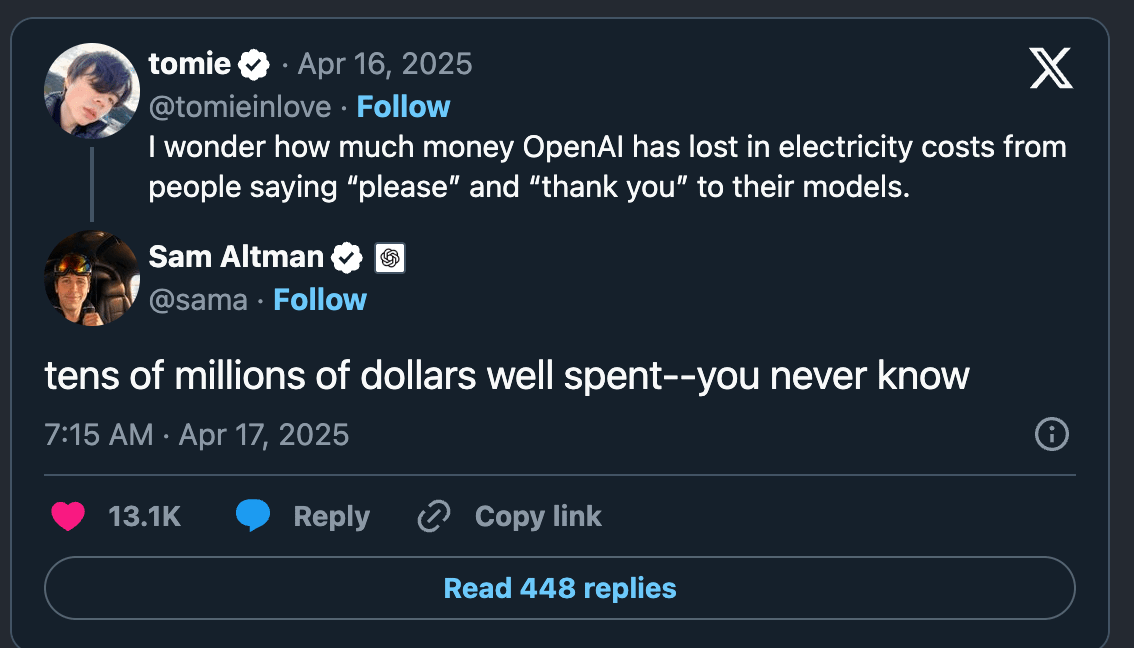
80% of people say "please" and "thank you" to ChatGPT.
It turns out the AI prefers being yelled at.
A new study just ran the test. The ruder the prompt, the smarter the answer.
Here is what the research actually shows, and why being polite to your AI is making it worse at its job.