neuroplasticity works faster under high emotional intensity. if you can resist a craving when it's at its peak, you get a bigger rewiring effect. this is why the hardest moments matter most, they're not setbacks, they're high-voltage opportunities to change.
your terminal in 4 upgrades:
1. ghostty — the terminal itself. fast, native, beautiful. finally one worth using.
2. tmux — sessions that survive anything. split panes, detach, come back later like nothing happened.
3. fish — autocomplete that actually works. syntax highlighting. no config needed.
4. starship — a prompt that shows you what matters (git branch, exit codes, env) without slowing you down.
use: brew install tmux fish starship + ghostty .org
your future self will thank you
if you can't connect with 99% of people, you're actually NOT the problem. they are.
in my junior year, i needed more friends. i googled every club at college and met ~180 new people. i made 1 friend.
so i moved to toronto for an internship. went to every event i could find and met ~200 people. i made 2 friends.
i thought something was wrong with me. even my therapist couldn't figure it out.
then i moved to sf in 2024. suddenly that 1/200 rate became 1/5. the same thing happened in 2025 when i moved to new york.
turns out there was never anything wrong with me. i was just in the wrong environment.
i wasn't truly opening up (which is required for meaningful relationships) b/c i bonded well with ambitious people (who were hard to find in canada).
if you're trying really hard and you know you're right, the limitation, paradoxically, is sometimes everyone else.
- Use multi-stage builds → separate build and runtime, copy
only final artifacts.
- Use smaller base image → e.g. alpine or slim variants.
- Leverage Docker layer caching → copy package.json/requirements.txt first, install deps, then copy code.
- Use .dockerignore → exclude node_modules, logs, tests, git, etc.
- Avoid rebuilding dependencies → only reinstall when lock files change.
- Minimize layers → combine RUN commands.
- Use build cache in CI/CD → enable Docker cache or remote cache.
Just found rsync and I can’t express how grateful I am. I spent close to 2 hours the other day using scp to move an app from my desktop to the vps. rsync did it in minutes! I was suffering for nothing ffs
Most "infrastructure as code" that I see in the wild is not really infrastructure as code.
Its usually a pile of Terraform files spread across folders, a remote state file everyone is slightly afraid to touch, and a system that only one person in the company truly understands. Everyone else just runs terraform apply carefully and hopes nothing breaks.
Real infrastructure as code is supposed to be treated like real software. It needs ownership, proper reviews, tests, versioning, clear modules, and people who actually understand what the code is doing before it touches production.
Just having Terraform files in a repository does not mean you are practicing IaC. It only means you moved the problem from clicking in the cloud console to committing YAML and HCL.
Most teams have the files. Very few have the engineering culture behind it.
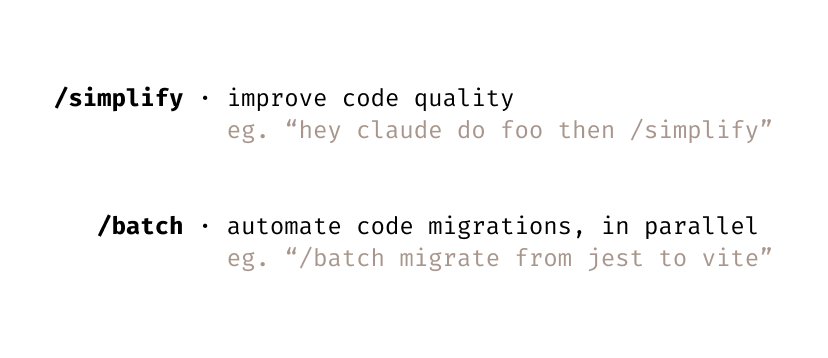
In the next version of Claude Code..
We're introducing two new Skills: /simplify and /batch. I have been using both daily, and am excited to share them with everyone.
Combined, these kills automate much of the work it used to take to (1) shepherd a pull request to production and (2) perform straightforward, parallelizable code migrations.