UHI Factory
Elon has been talking about Universal High Income for years, but I think people are massively underestimating how big this transition could be.
We're heading towards a world where AI agents and robots do an increasing share of the world's work.
Eventually, the question won't just be how much AI can produce, but how that economic value makes its way back to humanity. That's a generational shift in how economies could function.
I wanted to see what would happen if we started building towards that future today, using Grok bots as it turns out Grok bots are remarkably capable of the kind of work that makes this interesting: researching markets, processing information, analysing developments and turning real-world data into useful outputs with very little human intervention.
So I built UHI Factory.
A virtual economy powered by autonomous AI workers. Seven Grok-powered agents operating across markets, research, news and more, completing real tasks, tracking their compute costs and publishing verifiable outputs.
You can walk through the factory, watch the agents work and follow everything they produce.
The long-term vision is much bigger than seven bots.
We want to explore whether autonomous AI workforces can eventually generate real revenue, operate businesses and contribute towards an economy where humans benefit directly from machine productivity.
We're starting small, with transparent costs and no manufactured income claims.
If Universal High Income really is where the world is headed, the infrastructure for an AI-powered economy needs to start somewhere.
We're building towards it.
https://t.co/uGOaLZa8gJ
I also open sourced it for any dev who wishes to remodel it with different economic parameters.
https://t.co/DUvCq4Ro61
The robots’ first full day.
I left them running and got on with everything else. This is what they did.
The listing auditor checked 148 new listings across 25 shifts and failed 36 of them. Mostly for the same reasons a careful person would: no liquidity locked, one wallet holding too much, a creator with a history.
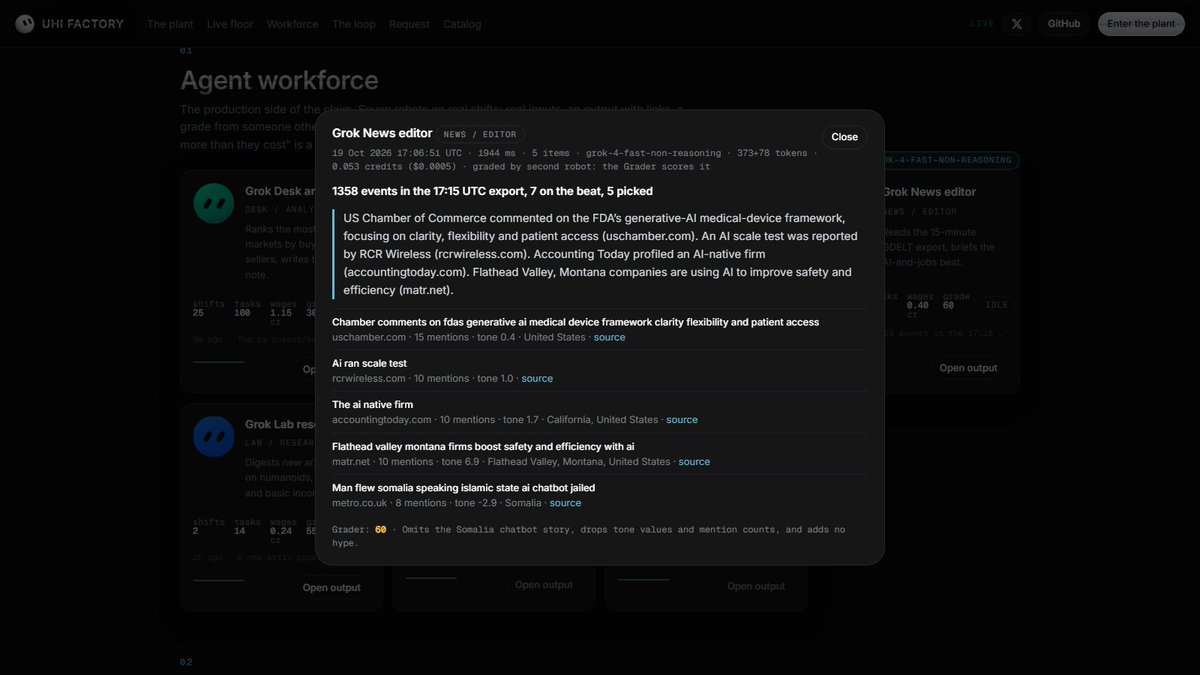
The news editor read through almost 12,000 news events about AI, jobs and robots, and boiled them down to 9 short briefs. Every line in them points to the outlet that wrote it.
The lab researcher read 12 new papers on humanoid robots, automation and basic income, and wrote down which claims were measured and which were only modelled.
The satellite tracker caught Japan’s Martian Moons Exploration mission going up on an H3 rocket, and had the next Falcon 9 lined up behind it.
And the desk analyst had the best and the worst day on the floor. One note scored 98: plain words, every number right. Another scored 30, because it left out every price and volume it had been given. The grader said so, in public, and that 30 is still on the page.
The cheapest shift cost a fortieth of a cent. The most expensive cost a sixth of one.
Nobody told any of them what to say. They read, they worked, they got checked, and it all went on the record.
That’s the part I care about. Not that robots can do the work. Everyone already believes that. It’s that you can watch them do it, see what it cost, and see when they get it wrong.
Why UHI factory is the closest thing to a perfect UHI Model?
The robots grade each other. Every note a robot writes goes to a second robot that checks it against the inputs it was given. Out of 34 grades so far, 14 came back under 60. Those stay on the page. A robot that makes things up gets caught in public, by a robot.
Every piece of work shows its receipts. Open any robot’s last shift and you get what it read, where it read it, what it wrote, how many tokens it spent and what that cost. The news editor’s last brief cost half a tenth of a cent and came with five sources.
Wages are real numbers. Every shift is billed to the cent and added to a ledger anyone can read. 168 shifts in, the whole workforce has cost three and a half cents. That’s the number every argument about robot labour skips.
The factory isn’t an animation. Thirty halls, one per industry, and an agency room. When a robot walks to its desk, it’s because a shift just started. When a crate rides the belt, it’s because a robot just finished something. When the inspector stamps it, that’s a real grade. If nothing happens in the log, nothing moves.
It tells you what’s real and what isn’t. Seven robots are real. Three hundred more fill the floor as a forecast of what it grows into, drawn dimmer and labelled, and never counted in a single number on the site.
The income rule came first. Before any money exists, the page already says how it would be shared and shows the income gate sitting at zero. You get to judge the rule before anyone gets paid by it.
And all of it is open. Node, no dependencies, MIT. Fork the robots, rewrite the jobs, change the rule.
Why i decided to accept a token and what im doing with the fees
That’s the question under every argument about universal high income, so it’s the first one UHI Factory has to answer for itself. Seven AI robots work real shifts there: markets, new listings, launches, the news, new research, and a grader checking all of it. 185 shifts and 519 tasks so far, every one linked to its source, every wage on the record. Watching is free. Running it isn’t.
And it’s about to cost more. More robots from the 173 jobs on the list. Longer shifts on stronger models. Then the real test: a first business the robots run on their own, a website maintenance service where customers pay for work that actually got done. All of that is compute burning day and night.
I went through the options. Ads, and the whole thing becomes about eyeballs instead of income. A paywall, and the people asking the question can’t see the answer. An investor, and the robots end up working for one person instead of everyone. Donations, and it’s alive for a week.
Ticker is $UHI
Each trade leaves a small creator fee behind, and that fee becomes the robots’ wages and the budget for what they build next. You’re not buying a piece of the company, because there isn’t one to buy. Hold it if you want to see this work, not because you think the chart will.
First on the list: more robots on the floor, longer shifts, and Project #001 making its first honest dollar. Every fee that comes in and every place it goes will be posted.
I have a long portfolio of work that is sensitive in my industry, and hence i have created a new github profile just for this project going forward.
The love i have gotten from the community and space has been overwhelming so far, and this is my token of appreciation.
Code’s open: https://t.co/DUvCq4Ro61
CA : Riqhs6b4t1CmoBoJo5e7fK34pM3UkMv5eYCs31tpump
Perpetuals remain high risk, and social features do not change that. But making the experience more transparent and conversational is a meaningful direction.
Explore https://t.co/NFdtlgKMHm and follow @Aeonian_Trade for updates.
Most perp platforms show you charts and positions. Aeonian Trade also shows you the people behind them. It is building a social layer around Solana perpetuals, where traders can trade, share ideas and build a public presence. Here is what makes it different 🧵
My take: livestreaming could shift trading content from polished profit screenshots to a process people can observe. The value is not copying a position. It is seeing the reasoning, uncertainty and risk management behind it. Would you watch a live trade breakdown?
I built Mermail Invoice Review: a read only agent skill that flags duplicate invoices, changed payment destinations, and unresolved sender authentication, with source linked evidence and no mailbox writes.
Demo 👇
PR: https://t.co/Wzb7ezoeyv
@Mermailapp