Skyroot is Ready to Launch, and i got exclusive access to checkout the Vikram 1 rocket before launch, with ofcourse a nerdy discussion with founders @PawanKChandana and @bharathdaka , link to full video below, @SkyrootA FACTORY TOUURRR in 4K
Pre-orders for Grand Theft Auto VI will officially begin on June 25 on digital storefronts and at other select retailers.
Check out the official cover art, also available as downloadable artwork at https://t.co/XPwC8URCQ4
The first pictures from the spaceport of India’s first privately built orbital rocket.
For those following closely: Vikram-1's Stage 2, Kalam-250, is now fully integrated inside SHAR, Sriharikota. Flex nozzle, actuators, and Interstages 1_2L & 1_2U mounted and assembled. Our first complete integration. Final assembly of remaining components and stages is underway—we're steadily progressing toward launch.
#Vikram1 #SkyrootAerospace
Ahmedabad is a hopelessly boring Tier 2 city. Please don’t move here.
Living here is an absolute nightmare:
• Zero Adrenaline: Women are just casually roaming around at 2 AM eating ice cream without fearing for their lives or dodging intense police naka bandis. Where is the survival thrill?
• No Linguistic Pride: If you don't speak Gujarati, nobody even threatens to beat you up or smash your shop's signboards. They just awkwardly reply in broken Hindi. Absolutely no passion!
• No Traffic Trauma: The roads are so wide and well planned that you actually reach your destination in 20 minutes. How am I supposed to finish my audiobooks or rethink my life choices during a 3 hour bumper to bumper commute?
• Missing Action: Someone bumps into your vehicle, and they just say sorry and pay you instead of pulling out a hockey stick. No street fights, no "Tu jaanta nahi mera baap kaun hai." So dull.
• Zero Aesthetic Culture: No underground drug or Udta Punjab vibes. Just boring, safe, sober families existing everywhere.
Honestly, it’s unbearable. Please stay in your happening metro cities, enjoy spending half your life in traffic and keep breathing that sweet AQI 1000 air.
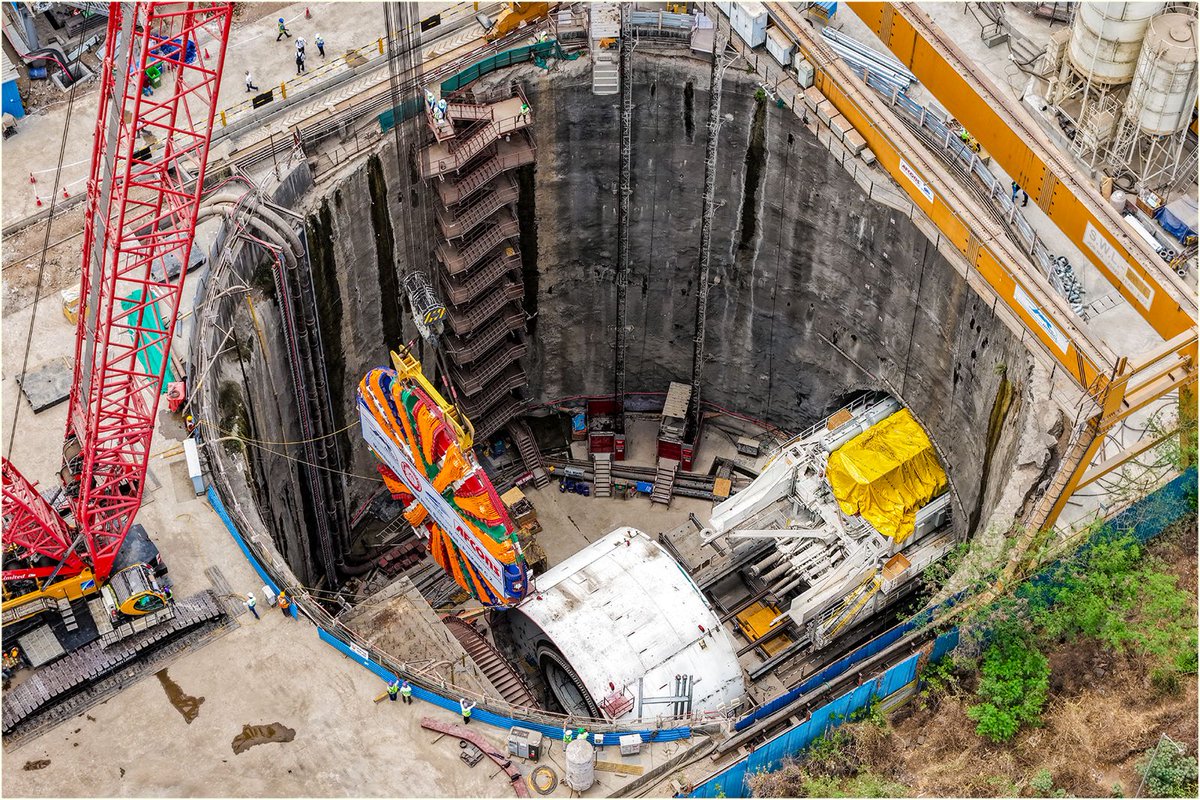
The cutterhead of the second Tunnel Boring Machine (TBM) has been successfully lowered at Sawli (Ghansoli) near Mumbai, Maharashtra. Measuring 13.6 metres in diameter and weighing 350 tonnes, the cutterhead marks the final step in the primary assembly of the TBM’s main shield.
This second TBM will start its journey from Sawli (Ghansoli) towards Vikhroli for the construction of the 21-km underground tunnel section of the project.
Equipped with 84 cutter discs, 124 scrapers and 16 bucket lips, the TBM is designed for efficient excavation and muck removal during tunnelling operations.
Big update from the Mumbai–Ahmedabad Bullet Train project 🚄
The cutterhead of the 2nd TBM for the 21 km tunnel has been lowered at Sawli, Ghansoli near Mumbai.
13.6 m diameter. 350 tonnes.
This TBM will tunnel towards Vikhroli, with initial drive expected in July 2026.
This is the story of building Vikram-1 and the preparations for its maiden flight. Every system built, every test run, every major decision until the final countdown at the launchpad, documented.
#SkyrootAerospace#Vikram1#JourneyToOrbit
A step towards Development of Efficient Semi-Cryogenic Engine
Recently a project focused on semi-cryogenic engines was concluded at Department of Mechanical Engineering, IIT Bombay in collaboration with LPSC, ISRO, Trivandrum. Cryogenic engines are used in upper stages of the launch vehicles due to their higher specific impulse. The liquid-vapor two-phase flow is a major concern due to extreme temperature limits in cryogenic engines. Efficient operation of cryogenic rocket engines depends on a clear understanding of how vapor and liquid interact during rapid heat transfer processes.
One such liquid-vapor interaction occurs in the semi-cryogenic engine where the high temperature gaseous oxygen comes into direct contact with liquid oxygen and condenses before entering the main pump. For proper operation, the gas must condense completely; otherwise, the remaining gas can seriously affect the performance of the pump. Measurement of heat transfer rates in such flows through conventional intrusive methods is difficult as it disturbs the flow itself and also does not capture the fast transients associated with the phenomena. This has been a challenge in studying cryogenic propulsion systems.
To address this challenge, ISRO funded a 3-year research project at IIT Bombay. Prof. Atul Srivastava and Prof. Milind Atrey were involved in this project from IIT Bombay side while scientists Dr. Deepak Agrawal and Anant Singhal worked from LPSC side. A novel optical method called Rainbow Schlieren Deflectometry was developed right from its first principles and applied to directly measure the thermal gradients around condensing steam cavity in a pool of water. The technique works without inserting any probes into the fluid and allows researchers to capture the entire temperature gradients field around the vapor cavity, and determine the variation of heat transfer rates during the vapor-liquid interaction. The application of the optical method on steam-water system is the proof-of-concept that such a technique can be successfully used to quantify the heat transfer rates in liquid-vapor two-phase systems.
The developed technology has been then applied in the cryogenic environment for condensing gaseous nitrogen in flowing liquid nitrogen. The initial results demonstrate the applicability of the RSD technique for visualizing the spatio-temporally resolved thermal gradients in two-phase cryogenic flows. As part of the project, the know-how of the RSD technique was transferred to LPSC.
The knowledge gained from the study will help improve the understanding of two-phase heat transfer processes relevant to cryogenic propellants such as liquid hydrogen and liquid oxygen used in launch vehicles. For ISRO’s future launch vehicles, this improved understanding can support the design of more reliable and efficient cryogenic systems.
@EduMinOfIndia
A 130‑metre‑long steel bridge span has been successfully launched for the Mumbai–Amdavad Bullet Train Project near Tralsi village, Bharuch, Gujarat, crossing the busy Surat–Vadodara railway section.
Standing 18 metres tall and 15.5 metres wide, this span weighs nearly 2900 metric tonnes.
#BharatKaGarv
Two twin tunnels have been constructed by cutting through the Mukundara Hills kota on India's longest expressway, the #Delhi#Mumbai Expressway.
These tunnels are the most critical section of the expressway—which passes through Rajasthan. this is expected to be finished within the next one to two months. Click on Link to view full details. https://t.co/WkAmTM3HJb
Jai Hind.