TRS (Total Return Swap) provides economic exposure of an underlying asset without needing to own it.
It is widely used by hedge funds, credit funds and other institutions in traditional finance, with more than $3.3 trillion in equity TRS gross notional outstanding reported at the end of 2025.
Flying Tulip finally brings TRS onchain through its integrated stack:
— ftUSD provides settlement
— Lend provides financing
— Trade provides execution
The key difference from conventional perps is the financing model. TRS financing is based on collateral yield and the actual cost of borrowing the assets in Flying Tulip's Lend to construct the position.
TRS also has no orderbook fees. Execution uses RFQ (Request for Quote) across onchain liquidity to find the best price. The difference is similar to swapping through an aggregator instead of a single DEX pool.
▸ All this makes TRS materially cheaper than a comparable perp.
TRS is also designed without auto-deleveraging (ADL). Liquidation can still occur if account equity falls below the required maintenance level. In that case, Flying Tulip issues an RFQ and uses the best available bid to sell only what is needed to repay debt and restore account health, rather than automatically transferring collateral at a predetermined discount.
Links in reply 👇
Indices are back and better than ever.
Treasuries and rewards are now optimized, with more stock pairings and balanced gas costs to accommodate the rapid growth of Robinhood Chain.
This maintenance was unrelated to our new product. Baskets are undergoing final smart contract audits and are nearing release.
Trade is now live on Ethereum and Sonic.
▸ Swap supported assets
▸ Place market or limit orders
▸ Go long or short with leverage
Spot and leveraged spot use the same non-custodial margin account and collateral system as Lend.
👉 Start trading:
https://t.co/3dv0v12RIQ
🚨 IF YOU HOLD $INDEX , YOU NEED TO SEE THIS.
Before the market realizes what something can become, the numbers usually look insignificant.
That is precisely why I want you to understand the math now before the future makes it obvious.
Let’s take a snapshot of INDEX today and then imagine what those exact same mechanics could look like deeper into the bull market.
Over the last 24 hours, @TheIndexFi has generated approximately $642,000 in trading volume.
At approximately $0.033 per INDEX, that represents roughly:
$642,000 ÷ $0.033 = ~19.45 MILLION INDEX traded.
Now pay attention to what happens next.
L INDEX utilizes a 3% ETH fee hook that feeds into the stock-buying mechanism.
So:
$642,000 × 3% = $19,260
That means approximately $19,260 worth of stocks enters the distribution pool from that 24-hour trading activity.
Now imagine you own 0.01% of the entire 1 BILLION $INDEX supply.
0.01% × 1,000,000,000 = 100,000 $INDEX
Your proportional share of that $19,260 stock pool would theoretically be:
• 100K $INDEX → $1.93 in stocks
• 200K → $3.85
• 300K → $5.78
• 400K → $7.70
• 500K → $9.63
• 1M → $19.26
At today’s price and volume, those numbers may not look revolutionary.
But this is where the asymmetry becomes interesting.
The number of $INDEX tokens traded doesn’t necessarily have to change for the dollar value of the trading activity to change dramatically.
Let’s take the same ~19.45 MILLION $
INDEX tokens and imagine INDEX reaches $1.00.
19.45M $INDEX × $1 = approximately:
$19.45 MILLION in daily trading volume.
Now apply the same 3% fee hook:
$19,454,545 × 3% = ~$583,636
Suddenly, the stock distribution pool looks very different.
Using the exact same ownership percentages:
• 100K $INDEX → $58.36 in stocks
• 200K → $116.73
• 300K → $175.09
• 400K → $233.45
• 500K → $291.82
• 1M → $583.64
And this is the part I want you to understand.
This isn’t a price prediction.
It is simply an illustration of the mathematical relationship between:
TOKEN PRICE × TRADING VOLUME × 3% FEE × YOUR OWNERSHIP
As the price increases, the exact same amount of token activity represents substantially more dollar volume.
And if price AND volume increase together?
The stock-buying flywheel becomes even more significant.
Today, $19.26 in daily stock distribution from 1M $INDEX might not seem extraordinary.
But markets have a fascinating way of making today’s numbers look microscopic when compared with tomorrow’s.
The question isn’t simply:
“What is $INDEX worth today?”
The better question is:
“What happens when today’s volume meets tomorrow’s price?”
Because if $INDEX eventually trades at $1, while maintaining approximately the same number of tokens traded as today’s example, the mathematical difference is enormous.
And if the trading volume itself expands as the ecosystem grows?
The equation changes again.
That is the philosophical lesson behind all of this:
Markets don’t always reward the person who arrives when the opportunity is obvious.
Sometimes they reward the person who understood the mathematics before the crowd understood the narrative.
THE MORAL OF THE LESSON:
1 MILLION INDEX today = 0.1% of the entire 1 BILLION supply.
At today’s hypothetical volume:
≈ $19.26 in stocks / 24H
At the $1 scenario using the same ~19.45M tokens traded:
≈ $583.64 in stocks / 24H
And that’s before assuming any additional growth in trading volume.
So don’t just look at the token.
Look at the machine behind the token.
Look at the volume.
Look at the fee mechanism.
Look at your ownership percentage.
Then look forward.
Because sometimes…
the future isn’t hidden.
It’s sitting there in the math.
Do the math.
Then decide what you believe.
Bookmark this tweet.
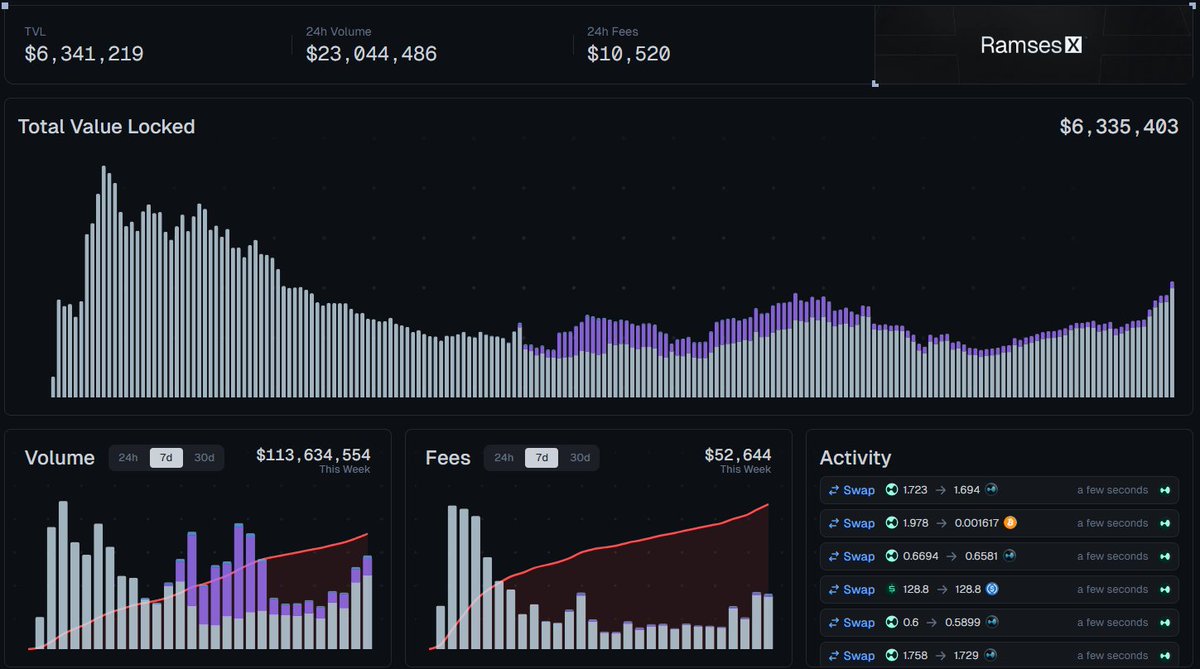
I believe $RAM can eventually cross a $50-$100M market cap.
Ramses is one of the active DEXs on HyperEVM.
RAM plays a similar role within #Ramses to $UNI for Uniswap and $CAKE for PancakeSwap, although it is still much smaller.
Current market cap: ~$824K
Current FDV: ~$3.85M
A future Hyperliquid spot listing could be a major catalyst, but no listing has been officially announced.

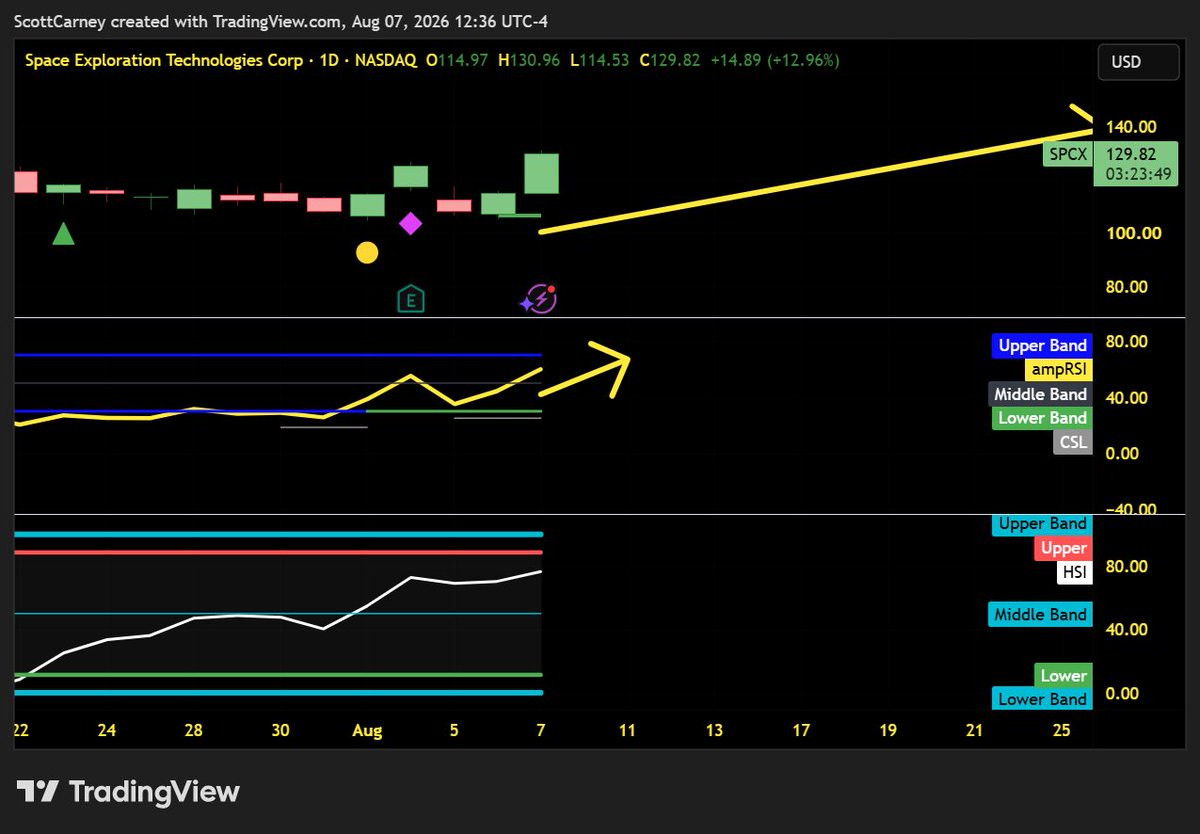
$SPCX we are now up 20 points from the 106.40 trigger. Just as a sidenote, I am not always an active poster, but when I do, it will be the clearest signals from my Harmonic Pattern Collection software. I recommend that you set your notifications for this feed and I strongly encourage everyone to take a free trial to get to know what #HarmonicPatterns are all about. 
9bn FT burned. No mint ability. These tokens could never become circulating, so it was a non-event. However, since originally 10bn FT was minted, this created "$1bn FDV" numbers, even though it never was, it was always only what was in the Options, since no other ways for FT to become circulating. But burning seems easier than explaining that.
FDV currently $44k (assuming all remaining PUT's exercise) or $52.47m if all PUT's withdraw FT.
Sometimes the simple answer is the correct one.
RamsesX Next Expansion: Robinhood Chain
Ramses has launched DLMM style pools to Robinhood in a fee-only model, so no $RAM emissions. Provide liquidity anyway you please with our intuitive UI, large selection of RWA stock pools, and dynamic fee model.
We were asked a very good question;
"Why was rebuilding the entire stack the only real option? What breaks if you stitch existing protocols together?"
I really liked this question.
To answer, let's start with what you can do today using existing protocols.
You could deposit USDC & BTC into Aave, this would give you aUSDC and aBTC. You could then take the aUSDC and aBTC and create a Uniswap LP for aUSDC/aBTC. On paper, this looks like capital efficiency. In reality a normal trade routed through Uniswap does not see USDC/BTC it sees aUSDC/aBTC, which it considers completely different assets. A third party aggregator could then optionally fill in that final leg of swap BTC > aBTC > aUSDC > USDC, however given this requires HF checks on every leg, the gas fees alone make this an unfeasible trade. The reality is onchain doesn't consider aUSDC/aBTC as USDC/BTC. (This also ignores edge cases like 100% utilization or when trades are required for liquidations).
This is a simple example, but it already shows where the system begins to break. We didn't even touch on cross protocol risk, independent systems that can't trust each other for purposes of HF calculation, or the overall bad user experience of needing to jump through multiple UI's.
The only real solution for capital efficiency is a single entry point margin account and all other systems feeding from it.
This is only one of many innovations already available in @flyingtulip_
Holding stable with ~13% on USDC/USDT on Ethereum. 8% on USDC/USSD on Sonic.
No offchain exposure, no external debt, no lockups. DN leverage less than 1.160x currently. HF over 13.
Pure defi yield @flyingtulip_
Delta Neutral on Ethereum activated for ftUSD. ~$4m in current TVL, forward projection puts APY around ~9%. Should only drop to ~6% post $20m tvl. Scaling safely.
Ramses (@RamsesExchange) is one of the most audited Dexes of all time. $2,000,000+ securing our contracts.
Not a single other DEX on HyperEVM comes close to our rigor or experience.
Position accordingly with all the recent hacks.
Would you invest in these charts?
Ramses is:
1⃣ The most audited DEX on HyperEVM
2⃣ Consistently the highest return to holders on HyperEVM (per DeFiLlama 1 year Holder Revenue)
3⃣ Most responsive team and active community
Did we miss something? Let us know in the comments:
5.11% on USDC on Sonic
5.27% on USDT and USDT on Ethereum
- No token incentives
- No subsidies
- No "points"
- No looping
- No leverage
- No "unstaking period"
- No "exit queue"
- Instant redemptions & liquidity
Defi hasn't reached its peak yet, there is so much more to explore and build onchain.
Still personally most exited about Total Return Swaps coming out, but so incredibly happy and proud of the team for shipping all this in under 60 days.
The PUT system is working even in these stressed environments, exactly what it was built for, great to see it align long term supporters and provide easy exit for short term flippers without impacting the secondary.
Secondary NAV system managed to absorb all exits as well, making sure there isn't a dragging tail, already bought and burned $1.22m worth of tokens.
PUT marketplace trading has generated over $1m in trade volume with over 200 active sales, all without impacting the secondary market while trading PUTs at premium.
Flying Tulip USD I believe is the only pure activity based stablecoin yield system, and even in these markets has outperformed base lending and even "managed vaults", and that's with only 14.5% allocation to the delta neutral staking yield positions.
Our Lending is the first onchain margin based (not LTV) system, and has already shown higher capital efficiency (we needed to build it to facilitate onchain delta neutral staking trade [not possible elsewhere]).
All this in 71 days, for only $475.77k spent to date. Still an exciting road ahead with spot, leverage, TRS, perps, options, binary options, and insurance, but already massive milestones accomplished.