We were taught that Earth orbits the Sun in a closed circle. In reality, Earth has never returned to the same point in space once in 4.5 billion years.
Right now, the Sun is carrying Earth and every planet around the center of the Milky Way at 230 km/s (828,000 km/h), more than 18,000 kilometers every 80 seconds.
Because the Solar System is tilted 60.2° to the galactic plane and bobs up and down through the galactic disc roughly every 30 million years, the planets trace open 3D corkscrew helices across deep space rather than flat loops.
The last time the Sun stood where it stands today, one Galactic Year (230 million years) ago, the very first dinosaurs were only beginning to appear on Earth. Since forming 4.6 billion years ago, our Sun has completed only 20 laps.
We were taught to picture planetary orbits as separate ellipses around the Sun. But when we examine the relative motions of Earth and Venus, something remarkable emerges, an almost perfect mathematical symmetry hidden within the Solar System.
Every 8 Earth years (2,922.0 days), Venus completes almost exactly 13 orbits around the Sun (2,921.1 days), an 8:13 orbital commensurability that matches to approximately 99.968% precision.
This near 8:13 Fibonacci ratio means Venus passes between Earth and the Sun at inferior conjunction approximately every 583.92 days (1.599 years). Over eight years, five successive conjunctions form an almost symmetrical fivefold pattern, resembling a five-petalled rose. The alignment is not perfectly fixed but gradually shifts over time.
Even at the center of this pattern, the Sun itself is not stationary. It moves around the Solar System's barycenter, sometimes traveling beyond its own radius from that common center of mass under the gravitational influence of the planets, especially the outer giants.
A ball can move along a straight path, yet someone watching from a rotating platform may see it follow a curve. The difference is not in the ball's motion, but in the reference frame used to observe it.
In this visualization, the red trajectory represents motion in an inertial frame, while the blue curve illustrates how that same motion appears to an observer rotating with the platform. In the rotating frame, the apparent acceleration includes Coriolis and centrifugal effects. The Coriolis acceleration depends on both the platform's angular velocity and the object's velocity relative to it.
The same principle operates on Earth. Because our planet rotates, moving air and ocean currents experience Coriolis deflection, helping shape large-scale atmospheric circulation. What appears to be a sideways acceleration can arise simply because the observer is rotating.
We were taught that Earth orbits the Sun in a closed circle. In reality, Earth has never returned to the same point in space once in 4.5 billion years.
Right now, the Sun is carrying Earth and every planet around the center of the Milky Way at 230 km/s (828,000 km/h), more than 18,000 kilometers every 80 seconds.
Because the Solar System is tilted 60.2° to the galactic plane and bobs up and down through the galactic disc roughly every 30 million years, the planets trace open 3D corkscrew helices across deep space rather than flat loops.
The last time the Sun stood where it stands today, one Galactic Year (230 million years) ago, the very first dinosaurs were only beginning to appear on Earth. Since forming 4.6 billion years ago, our Sun has completed only 20 laps.
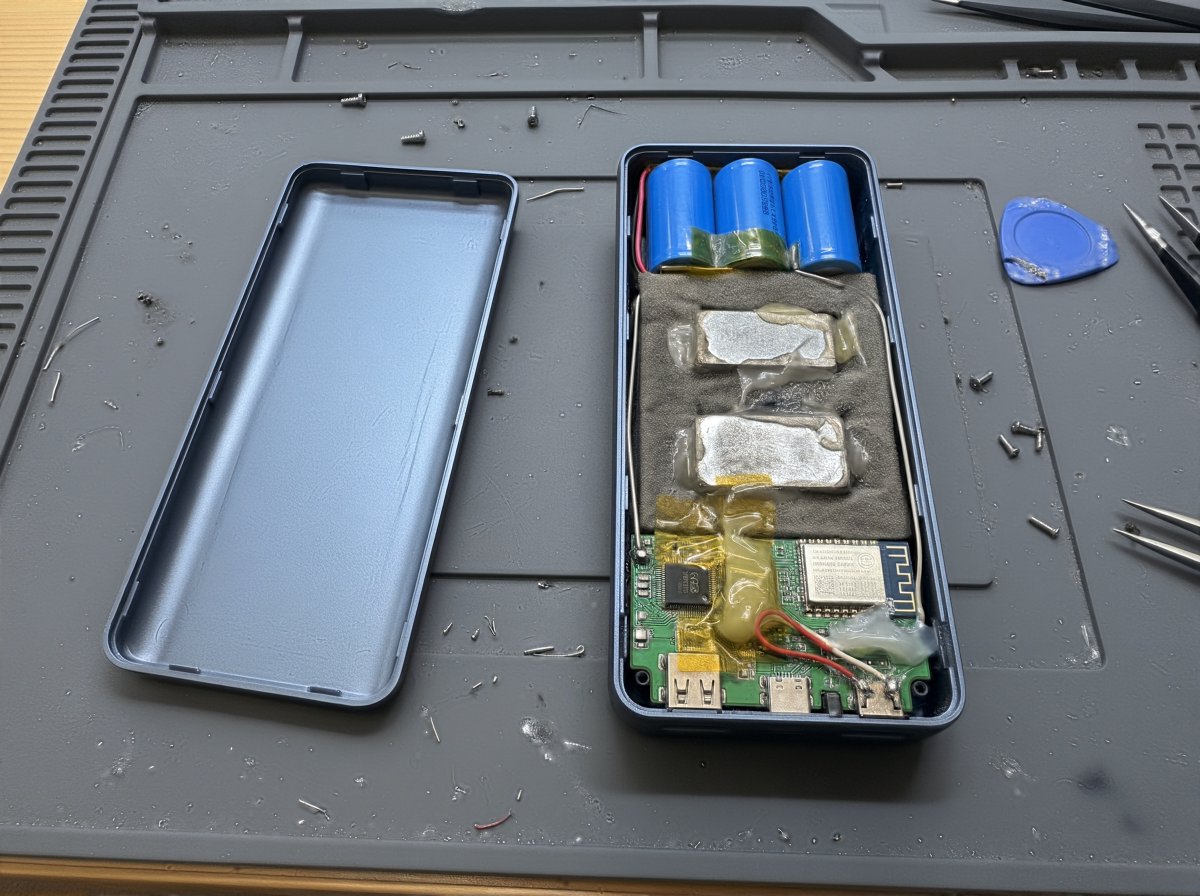
The repair guy opened it and found a tiny computer with its own Wi-Fi inside. The battery is less than a third of what the label says…
Here is everything inside the case:
→ 3 batteries → about 9,100 mAh, not 30,000
→ gray foam → fills the empty space
→ 2 metal weights → glued in, so it feels like a real battery
→ green board → a 64 GB memory chip
→ Wi-Fi module + antenna → how it got online
→ 2 thin wires → from that board to the USB port
He said it's the third one like this he has opened this month.
How to check your own in 30 seconds is in the next comment ↓