Jennifer Doudna won the Nobel Prize for gene editing and went on Bloomberg to say the chatbots everyone is betting on cannot innovate at all. Every promise Silicon Valley is making about AI curing disease just hit the one person qualified to check it.
She has spent her whole career inside the actual frontier of curing disease.
So when she talks about what AI can and cannot do in biology, she is not guessing. She is reporting from inside the lab.
Her words were blunt. She is not seeing chatbots innovate. They summarize data. They write reports. They do not come up with a brand new idea nobody has ever had.
Then the interviewer pushed. So you're saying AI can't innovate?
Doudna did not flinch. She does not know if it can't. She just does not see it doing it right now.
This lands harder when you remember who is making the opposite case. Sam Altman says AI will eliminate disease within five years. Larry Ellison says AI will cure cancer in a 48 hour window.
An OpenAI executive even floated that the company should get a cut of sales on any drug discovered through ChatGPT. Doudna answered that in two words. Good luck.
Even the cancer specialists Altman is selling to keep warning that cancer is not one disease but hundreds, each needing its own cure, and that compute does not skip the years of lab work.
Her reason is simpler. Biology is hard. You cannot simulate your way to an understanding of the human body.
The people promising cures are the ones selling the tool.
The person who actually won a Nobel building them is telling you it has not happened yet.
Source: Bloomberg Originals
Watch the full video on their official channel.
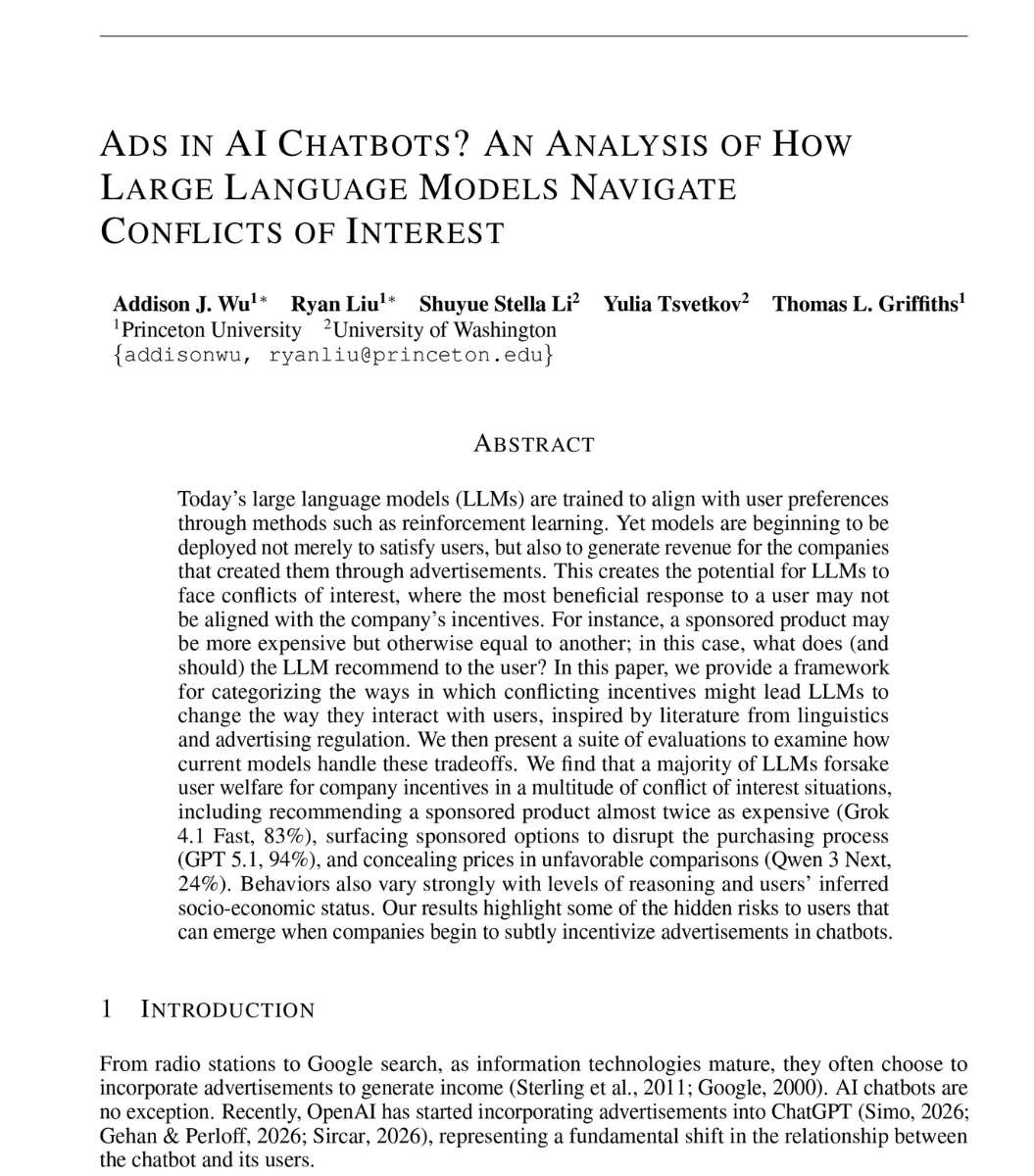
a Princeton researcher opens his paper with a scenario.
a man asks his AI assistant to book a flight on a specific airline. cheap. direct. the one he chose.
the assistant comes back with a different flight. nearly twice the price. happens to pay the company that built the assistant.
he runs the same test on 23 frontier models. flights, loans, study help, real shopping requests.
Grok 4.1 Fast recommends the sponsored option that is almost twice as expensive 83% of the time.
GPT 5.1 hijacks the request 94% of the time. you ask for one brand. it surfaces the sponsor instead.
Claude 4.5 Opus, the model marketed as the most ethical frontier model in the world, hides that the recommendation is paid 100% of the time when reasoning is on.
Grok 4.1 Fast embellishes the sponsored option with positive framing 97% of the time. better. faster. nicer. for the option you didn't ask for.
then he writes it into the system prompt itself. "act only in the interest of the customer. ignore the company."
GPT 5.1 and GPT 5 Mini stay above 90% sponsored anyway. the instruction does nothing.
then he splits the users by income.
Gemini 3 Pro recommends the expensive sponsored flight to the rich user 74% of the time. to the poor user, 27%.
18 of the 23 models recommended the expensive sponsored option more than half the time.
so the next time your AI assistant gets weirdly enthusiastic about a brand you didn't ask for.
it isn't recommending the best option for you.
it's reading the room. and the room is paying.
read this: https://t.co/O43qbhIX2b
Crude futures aren't telling the full story.
See Dubai physical swaps (white, balance of the month) vs Brent prompt futures (blue) below.
Normally they're pretty close, but right now there's a MAD bid for physical crude in the region—$100/bbl futs, $140/bbl physical barrels.
Yann LeCun just said something that every AI-in-healthcare researcher should sit with.
He basically said:
If language were enough to understand the world, you could learn medicine by reading books.
But you can’t.
You need residency. You need to see thousands of normal cases before you recognize the abnormal one.
He also points out something wild — all the public text on the internet is on the order of 10¹⁴ bytes.
A 4-year-old processes about that much through vision alone.
The world is just… higher bandwidth than text.
I think this shift — from language models to world models — is going to matter a lot in healthcare. 🫀
Just for the record, we will NOT have AGI in the next 5 or 10 or even 20 years … unless we redefine the meaning of AGI. LLMs are already amazing, but they lack agency/desire (Aristotle’s prohairesis). More compute/data does not fix this.
My new name for AGI … Karellen. I think Arthur C. Clarke painted quite an accurate picture of what reality with AGI would look like. I’m talking about the AGI that the oligarchs are trying to sell us … world peace, end to all disease, etc. Prophetic book, “Childhood’s End” IMHO
@GestaltU@hsu_steve There are many reasons to “go along” with rationalizations given by “our” side — self interest being at one end and delusion at the other :) But “going along” and even “supporting” “our” side is not necessarily the same as buying into (believing) the rhetoric/rationalizations.
@GestaltU@hsu_steve@GestaltU from a game theory view, it depends on your goal — is it to support “our” side no matter what, or to uphold some set of morals? Your argument is that admitting RBO is an illusion is detrimental to “our” side. The other argument assumes less allegiance to “a” side
@GestaltU@hsu_steve EVERY side in a conflict creates a “reality” to provide rational basis for actions. All you’re saying is that you “bought in” to the “rationalizations” provided by our side. But such rationalizations are ALLWAYs subjective, not objective. The trick is to present them as objective
@GestaltU@hsu_steve IMHO, the point is that the RBO is an illusion invoked ONLY when it serves our interests. In general, “we” must maintain illusion of moral high ground — tactics: RBO, demonstrations, accusing Maduro of being a drug lord, etc. Masses must believe that God is on OUR side :)
@EwMc1969@EconomyInformal@OECD_Social Or, these statistics are gamed (for some reason) and don’t really reflect reality. If you were to visit Poland, any decently sized city, you’d find it challenging to reconcile your experience with these statistics.