Or maybe for a worse reason: books on Marx & philosophy (I think they're at least 3 of them last year) are being considered fell off in academia's trend or don't generate enough hype commercially, so they don't make into the shortlist.
and just to say: clearly a hostility toward philosophy in general. attempts like michael’s to systematically rethink what marxism requires to have a consistent normative foundation simply fail to register as a contribution because of certain prejudices re: what it must be. lame.
Now, there is the controversy about how much Communist Party of Thailand had an effectual relationship to the trajectory of this massacre: Is this a part of "civil war" or "political repression," esp. from the perspective of Thai authoritarian state?
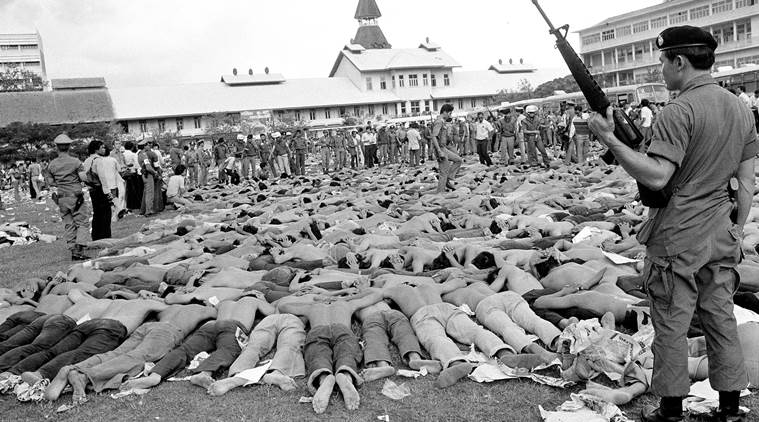
#OtD 6 Oct 1976 the Thammasat University massacre took place in Thailand when state forces and far-right royalist mobs murdered dozens of student demonstrators who were protesting against the return of military dictator Thanom Kittikachorn https://t.co/PqOrg2Rjbd
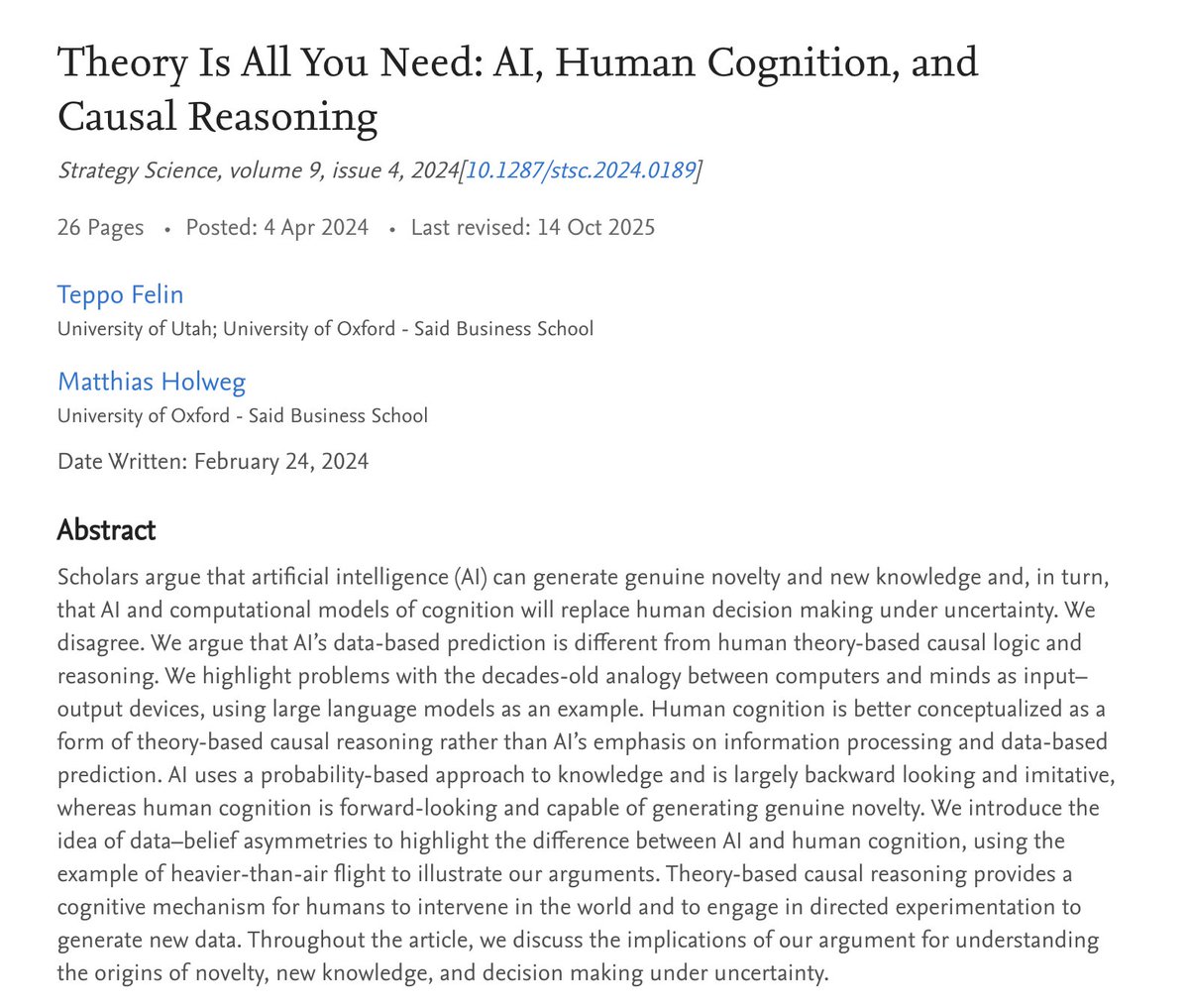
Oxford researchers argue that LLMs can never invent anything.
It is mathematically impossible.
They published a paper called “Theory Is All You Need" and it argues against the claim that computational models can generate genuine novelty or new knowledge.
They analyzed the limits of generative ai, and the results are a brutal reality check for the idea that ai will replace human decision making under uncertainty.
Here is why AI is stuck and human cognition wins:
backward-looking vs forward-looking.. llms are probability machines that look backward at existing data. human cognition is forward-looking and capable of generating genuine novelty. human cognition operates theoretically "top-down" rather than "bottom-up" from data.
the "data-belief asymmetry".. the researchers use the invention of "heavier-than-air flight" to illustrate this concept. an ai relies on data-based prediction, which is largely imitative. humans, however, use theory-based causal logic that allows them to hold beliefs that go beyond existing data.
the intervention gap.. humans don't just process information; we use theory to practically "intervene" in the world. we engage in directed experimentation to generate entirely new data. ai-based models are theory-free and place primacy on existing data and prediction.
tldr?
AI uses a probability-based approach to knowledge and ia largely imitative. It can process data and make predictions, but human cognition relies on theory-based causal reasoning.
The decades-old analogy comparing human minds and computers to mere "input-output" devices is fundamentally flawed.
@drumm_colin Then, I should ask how you view "rhetorics" as an intellectual subject. There are some people who take it seriously when reading philosophical text after all, notably the Straussians.
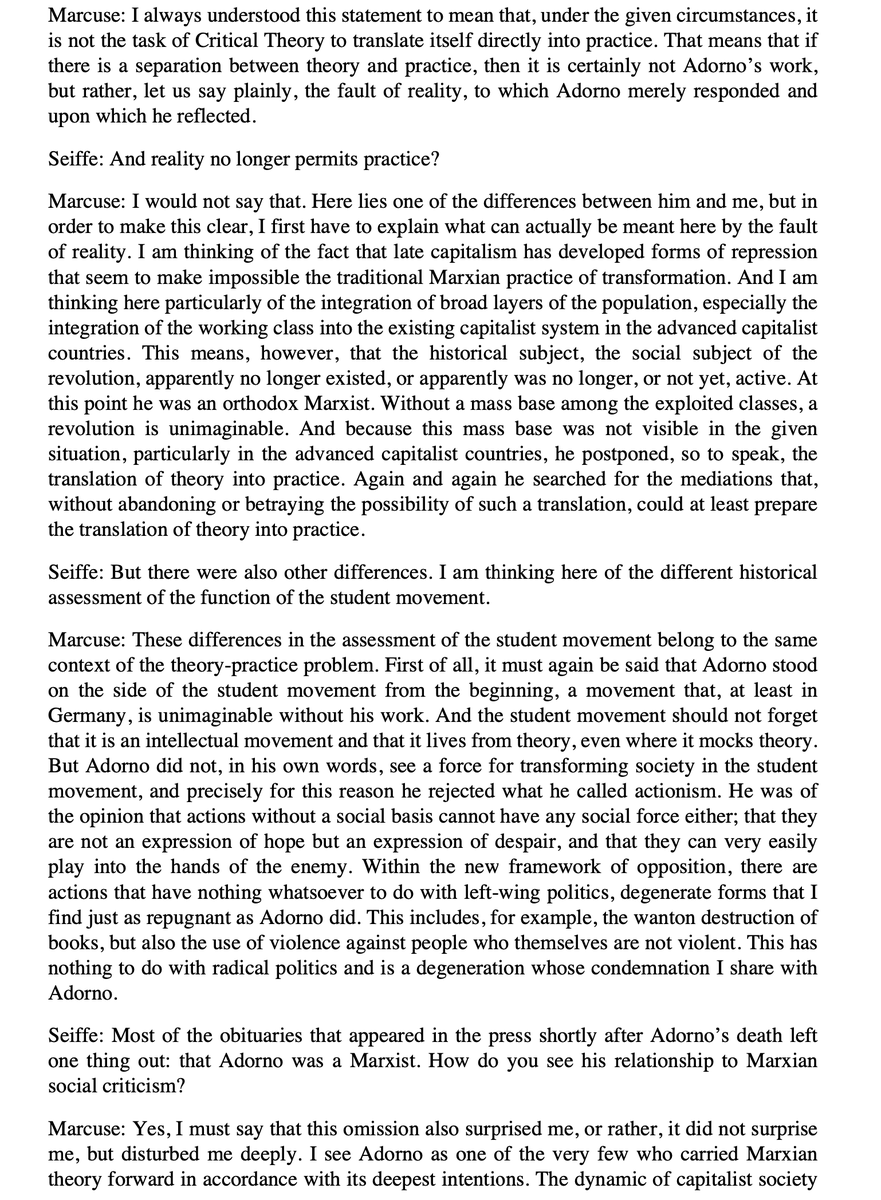
Coming across the controversies of Phil Magness and Colin Drumm on reading Marx and German Idealism, respectively. Makes me curious how we define "reading". Or, to put it differently, can we view "reading" as purely intuitive practice?
Saying Capital contains no ethical or normative claims is much too strong. Marx doesn’t construct a systematic moral philosophy or derive socialism from abstract principles of justice. But that’s a very different claim.
@Gattungswesen25 I think we have to be careful claiming that many great thinkers in the past never cared about ethics/politics/ontology, etc. This rigid demarcation is more or less our reification of contemporary philosophical categories. We should consider their philosophies as the whole first.
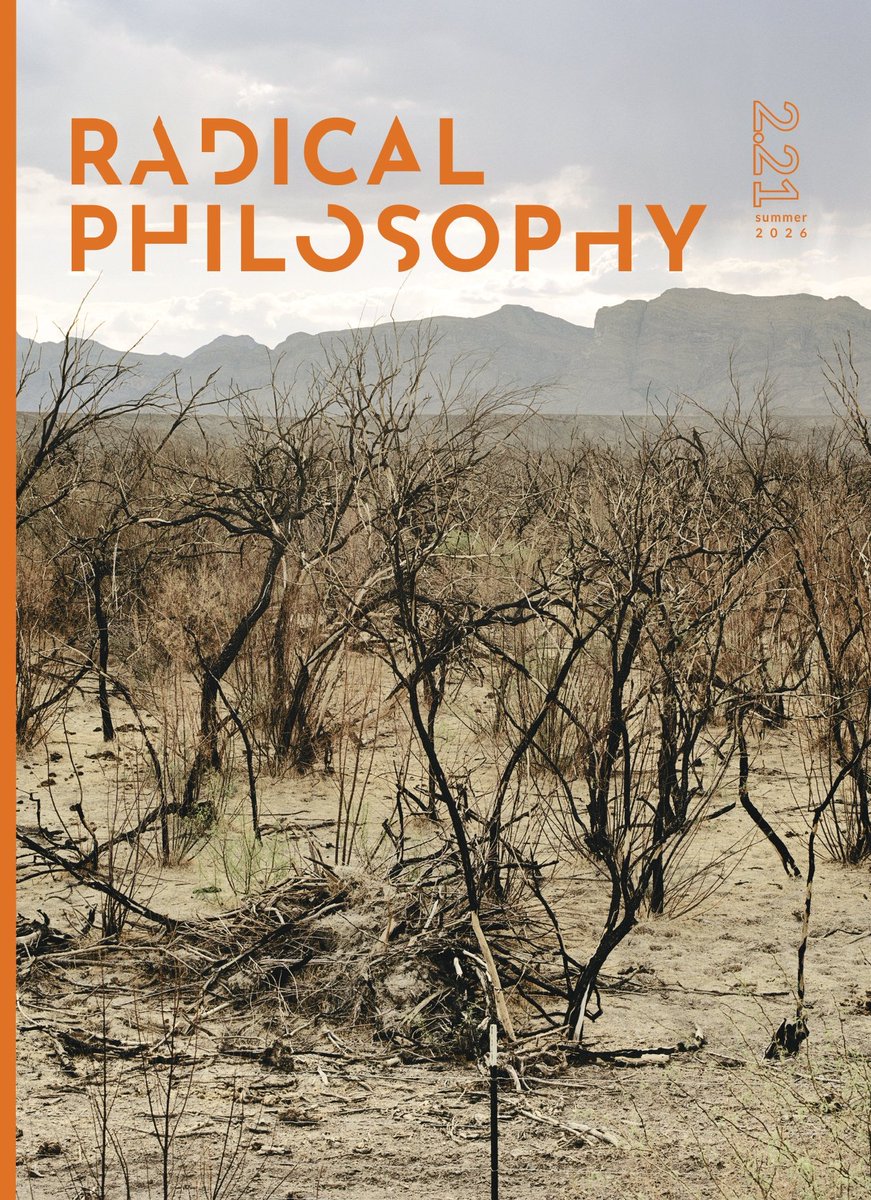
RP2.21 is out now!
Rebecca Comay on The 18th Brumaire 🎭
Grégoire Chamayou on data centres 💻
Danny Hayward on Peter Weiss’s Aesthetics of Resistance 🏛️
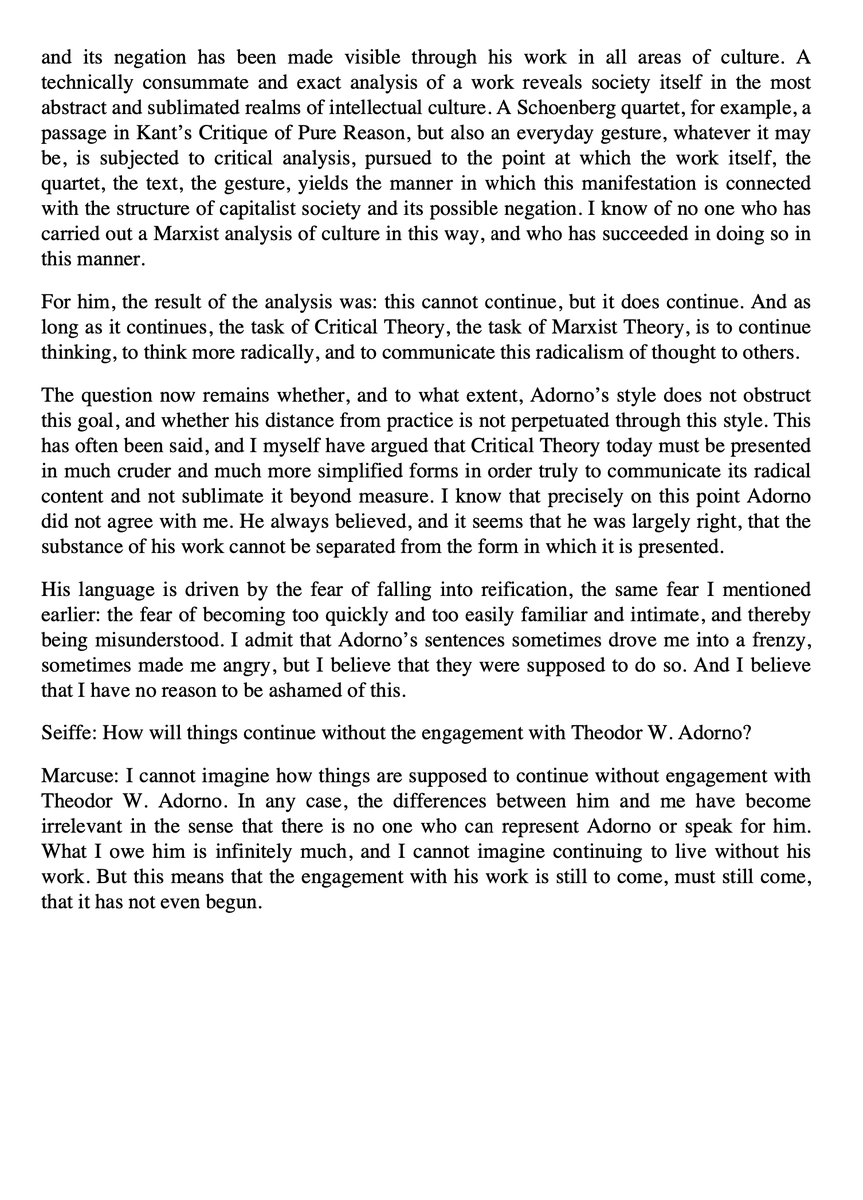
Werner Bonefeld on Adorno, plus a newly translated Adorno lecture with intro by Jake Orbison 📕
And more…
@chrisokane_nyc I quite favour "Open Marxism" as a theoretical current and research paradigm, but Patrick Murray and Frank Engster are the authors that occupy special places in my heart.
@chrisokane_nyc I think the whole approach is based on the conviction that "the economic" is not to be blindly accepted, but to be explained. And potential explanation lies in Marx's way of explication in Capital (which for some it is "Hegelian").
@sean_obee and I have edited a special issue of @web_clc called “Keywords for Value and Culture”. Across 34 essays, it explores the shared conceptual terrain between value-form theory and aesthetic theory. The full issue is available open access here: https://t.co/5LK1AIveRa
@chrisokane_nyc I would like to approach it from the problematics of hospitality, which is bound to the mobility/security relationship with state power. It seems I need to read Derrida through the Marxist lens at some point!
Hope I find someone to supervise me and a sufficient fund/scholarship!
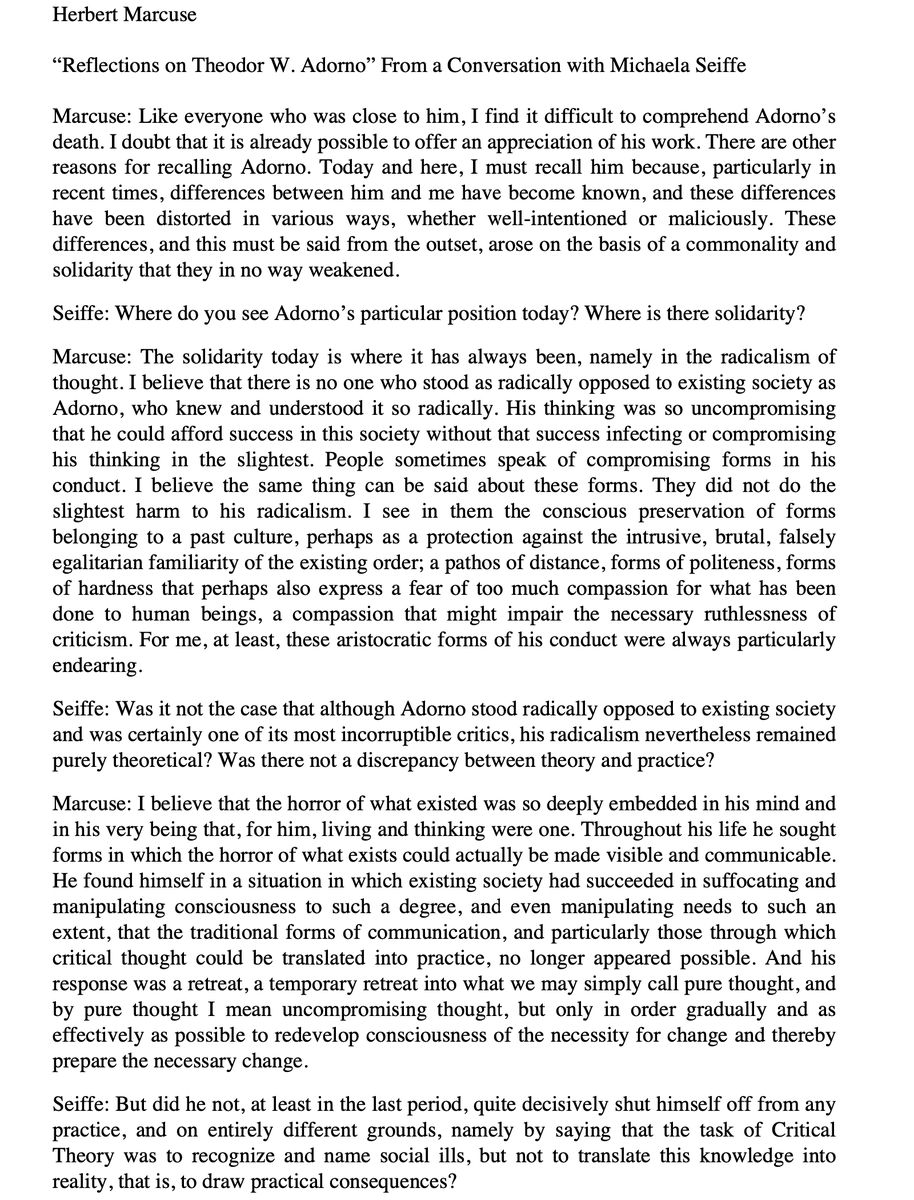
Chris O'Kane presents the latest edition of Marx’s Capital as another attempt by translators to crystallize a particular political interpretation of Marx—this time, the novel synthesis misapprehended as a straightforward “Marx revival.” @chrisokane_nyc
https://t.co/z4HYeptQQk
Actually, these are not Hegelian terms, but Aristotelian ones, although Marx uses several Hegelian terms.
1) Commodity (in its immediate form as a thing that satisfies a need) → thing (Ding) and its properties (Eigenschaften)
2) Value (as the common element) → universal
3) Use-value → matter (Materie) or “thinghood thereness”
4) Exchange-value (immediately) → ratio
5) Exchange-value (as value-form) → form or appearance (Erscheinung)
6) Commodity as the unity of use-value and value → concrete universal, contradictory or negative unity
7) Relative form of value → something
8) Equivalent form → other
9) Expanded form of value → bad infinity
10) Universal equivalent → being-for-itself
11) Substance of value (abstract labor) → substance
12) Capital (automatic subject) → subject or concept (Begriff)
13) Money-form → ser-aí of being-for-itself
14) Socially necessary labor time → measure
15) Capitalist circulation of commodities → quantitative bad infinite
16) Surplus-value and profit (as explained in Volume 3) → Essence (Wesen) and semblance (Schein)
17) Labor-power and labor → Force (Kraft) and externalization (Äusserung), but also act and potency.
Etc.
Hence, for example, value that valorizes itself, or capital, as the vampire that consumes living labor, is a reconstruction of the transition from substance (labor) to subject (concept) in Hegel.
Moreover, in Capital, the Grundrisse, and The German Ideology, Marx uses the terms related to ser-aí and existence in the same way as Hegel.
A) Existenz / Existence → being or facticity with a mediated relation, or the relation of an essence that realizes itself within a world of interdependencies.
A1) Existenzbedingung – condition of existence
A2) Existenzform – form of existence
A3) Existenzweise – mode of existence
A4) materiellen Existenzbedingungen – material conditions of existence
A5) symbolische Existenz – symbolic existence
Etc.
B) Being (Sein) and Being-there (Dasein) → the factual or the immediately present
B1) Daseinsweise – mode of being-there
B2) gesellschaftliches Dasein – social being-there
B3) funktionelles Dasein – functional being-there
B4) materielles Dasein – material being-there
B5) Metalldasein – metallic being-there
Especially the pair that explains what economic categories are: categories are expressions of forms-of-being-there (Daseinsformen), that is, determinations-of-existence (Existenzbestimmungen), a critical reconstruction of the Hegelian notion of determinations-of-thought (Gedankenformen).
And there's a lot more