@ECISVEEP, clarify the discrepancy of 125512 voters b/w 1."Assembly Constituency-wise Elector data (https://t.co/GnUajM5slV)" & 2."ELECTORS DATA SUMMARY (https://t.co/M5cFybw8ax)". While 1 shows 68251008, 2 shows 68125496. They must be same. Where are these 125512 voters gone?
This has been very engaging for the last five months in the first half of my sabbatical leave since December 2025. In the first half of my sabbatical, this is my last Econometrics workshop. Thanks to Professor Bibek Ray Chaudhuri of IIFT for organising this 2-day workshop
Great faculty, good students, fabulous time spent at IGIDR. I thoroughly enjoyed presenting my work at IGIDR, Mumbai, at Indira Gandhi Institute of Development Research (IGIDR). @EconTwitter @warwickecon@cage_warwick
not migration patterns, not demographic composition. WB is also one of India's most densely populated, highly urbanised, and historically industrialised states — factors that independently suppress consumption growth rates relative to catching-up agrarian states.
The tweet asks "What is holding West Bengal back?" — implying state-level governance or policy failure. But the chart controls for nothing: not initial income levels (richer states may mechanically grow slower — convergence effect), not industrial structure, (continue...see next)
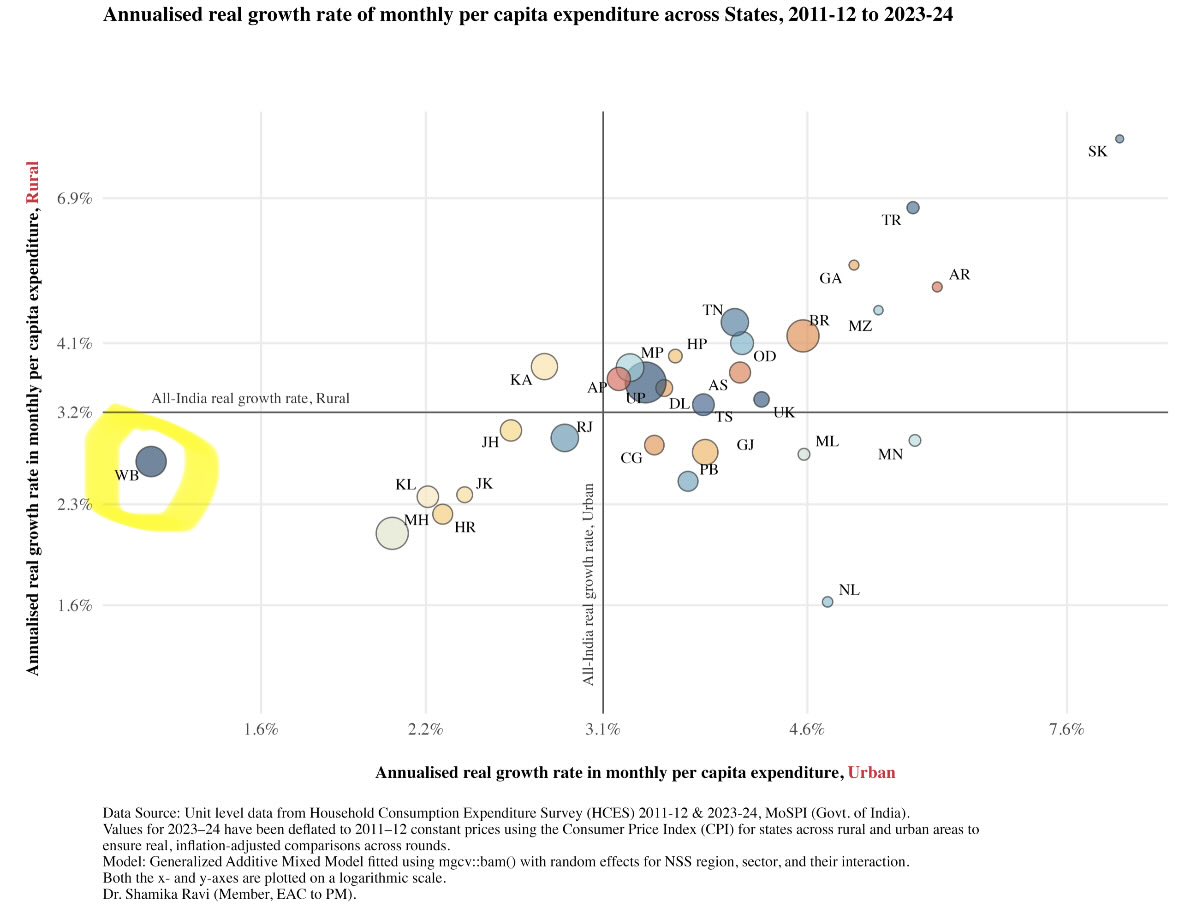
@ShamikaRavi A log of a negative number is undefined. Tweet itself cites a –0.4% CAGR for the top urban quintile of WB. This value cannot even exist on this chart's axis. The graph is structurally incapable of displaying the very data point the tweet weaponises as its most alarming finding.
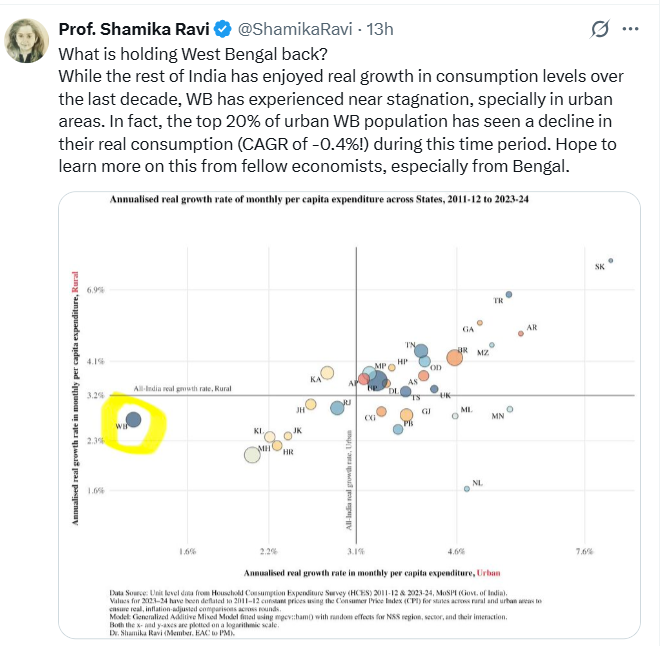
What is holding West Bengal back?
While the rest of India has enjoyed real growth in consumption levels over the last decade, WB has experienced near stagnation, specially in urban areas. In fact, the top 20% of urban WB population has seen a decline in their real consumption (CAGR of -0.4%!) during this time period. Hope to learn more on this from fellow economists, especially from Bengal.
@ShamikaRavi "Both the x- and y-axes are plotted on a log scale." This is statistically problematic. Growth rates are already a ratio/proportional measure derived from log-differencing of the underlying data. Applying a second log transformation visually distorts the distances between states.