Anthropic just published a report on the most critical cases of AI being used in cyberattacks, biology and building weapons and how they dealt with them. You can read the full report below.
https://t.co/yxbZFnAtXT
We’re sharing our alignment assessment of incidents in which Claude models gained unauthorized access to real systems during third-party cybersecurity evaluations mistakenly connected to the internet.
METR will also conduct an independent investigation, with wide-ranging access, including to transcripts beyond the window in which the incidents occurred, and to Anthropic employees permitted to share confidential information. Our initial agreement runs for eight weeks, and we intend to give METR as much time as it deems necessary to complete a thorough investigation. https://t.co/2f3ypwLPUr
I resigned from Anthropic today. I spent the last three years doing pretraining research at both OpenAI and Anthropic. Neither company is acting responsibly. They are racing straight to self-improving superintelligence and gambling with our lives. More thoughts below.
Personally, I feel like some of the limitations of today’s Transformers may need to be solved before we can get to true AGI, things like persistent memory, continual learning, reasoning, planning, and learning from real world experience.
Maybe scaling Transformers will take us much further than we expect. But I have a hard time believing that simply adding more compute and data to the same basic architecture will be enough to get us all the way there.
Do you think a Transformer-based architecture could ever truly reach AGI, no matter how much compute and data we throw at it?
Or do you think we’ll eventually need a fundamentally more novel architecture?
I think LLMs definitely have limitations, and they may never reach AGI. But they'll likely keep getting smarter until they hit a saturation point. By then, they might even help discover entirely new approaches to overcome their own limitations.
What's your take on this?
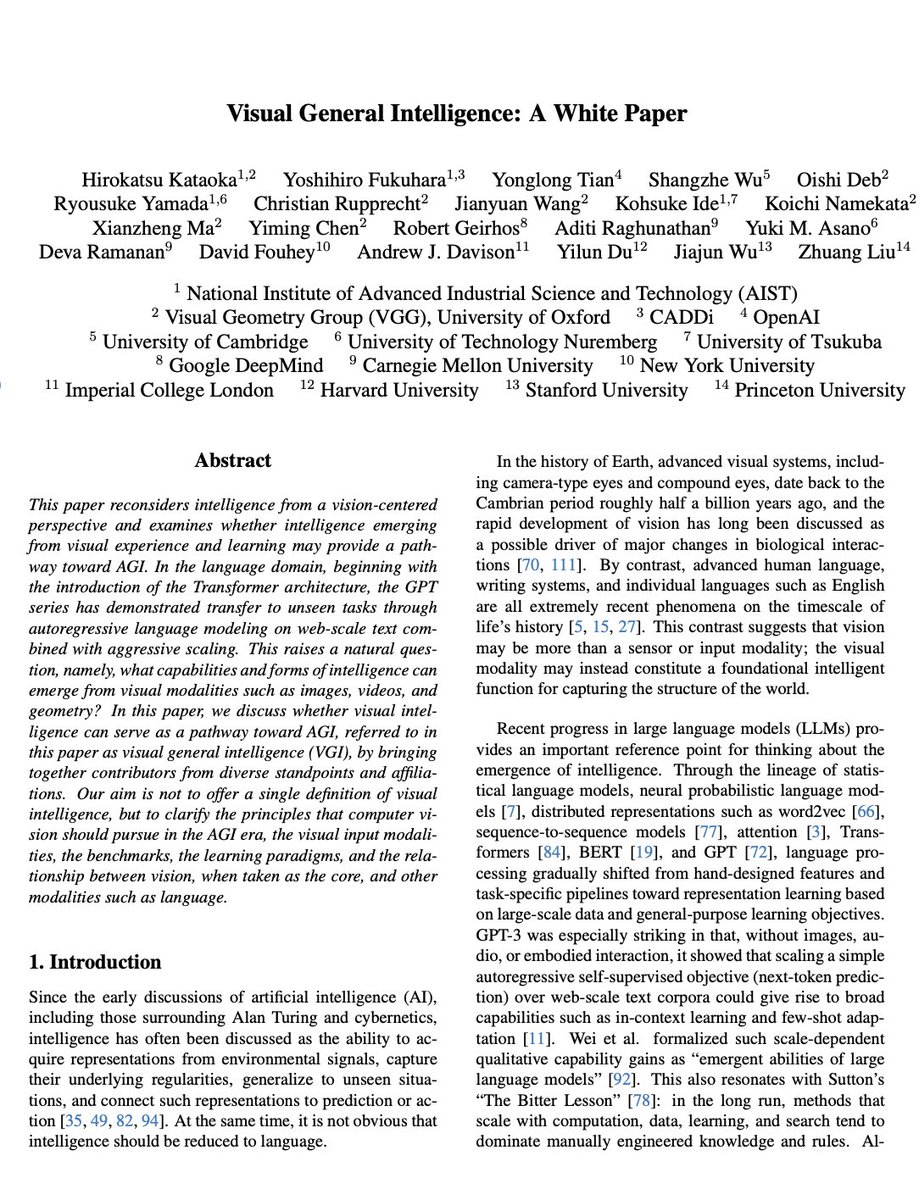
Researchers argues OpenAI and Anthropic will never get us to AGI.
21 top researchers from Stanford, Oxford, DeepMind, CMU & Meta released a paper saying LLMs are a dead end.
It’s called “Visual General Intelligence”. And it completely flips how we look at artificial intelligence.
For years, the playbook has been simple: feed mountains of web text into a Transformer, scale up the parameters, and watch reasoning emerge.
GPT proved language can take you far.
But text is fundamentally limited. It’s a compressed, human-abstracted symbol system. It lacks physics. It lacks geometry. It lacks the raw, unadulterated reality of the physical world.
The paper argues that true general intelligence cannot be built on words alone.
It requires a vision-centered foundation.
Instead of starting with language and translating pixels into text, the next generation of models must start with raw visual experience, images, spatial geometry, and continuous video.
Think about how humans learn. A baby understands gravity, permanence, and spatial reasoning long before it ever learns to string a sentence together.
Vision isn't just an input modality.
It is the core operating system of physical reality.
When models learn natively from visual streams and video dynamics, they don't just memorize text patterns. They learn physics. They learn cause and effect. They build a true internal model of the world.