Starting fresh on X. I’ll share weekly build-in-public notes on scaling backends: diagrams, failure drills, SLO math, and code that ships. Expect threads on queues vs streams, idempotency, backpressure, and autoscaling. What’s the messiest reliability problem to tackle first? 👇
@RamuCodes @iwantMBAm4 I share what I’m reading, thinking, and learning, like a day-by-day record. If it doesn’t get traction, that’s okay. It’s a public journal. This mindset helps me avoid disappointment. Eventually, if I am adding value to people's life, things will fall in place
@Vijay_Tyagi_@arpit_bhayani I understand the frustration and here is my advise :
Personal projects help you master the language and learn the stack, great starting point. But you should not stop there. If you’re a fresher, contribute to OSS to get real ‘production’ experience.
Starting fresh on X. I’ll share weekly build-in-public notes on scaling backends: diagrams, failure drills, SLO math, and code that ships. Expect threads on queues vs streams, idempotency, backpressure, and autoscaling. What’s the messiest reliability problem to tackle first? 👇
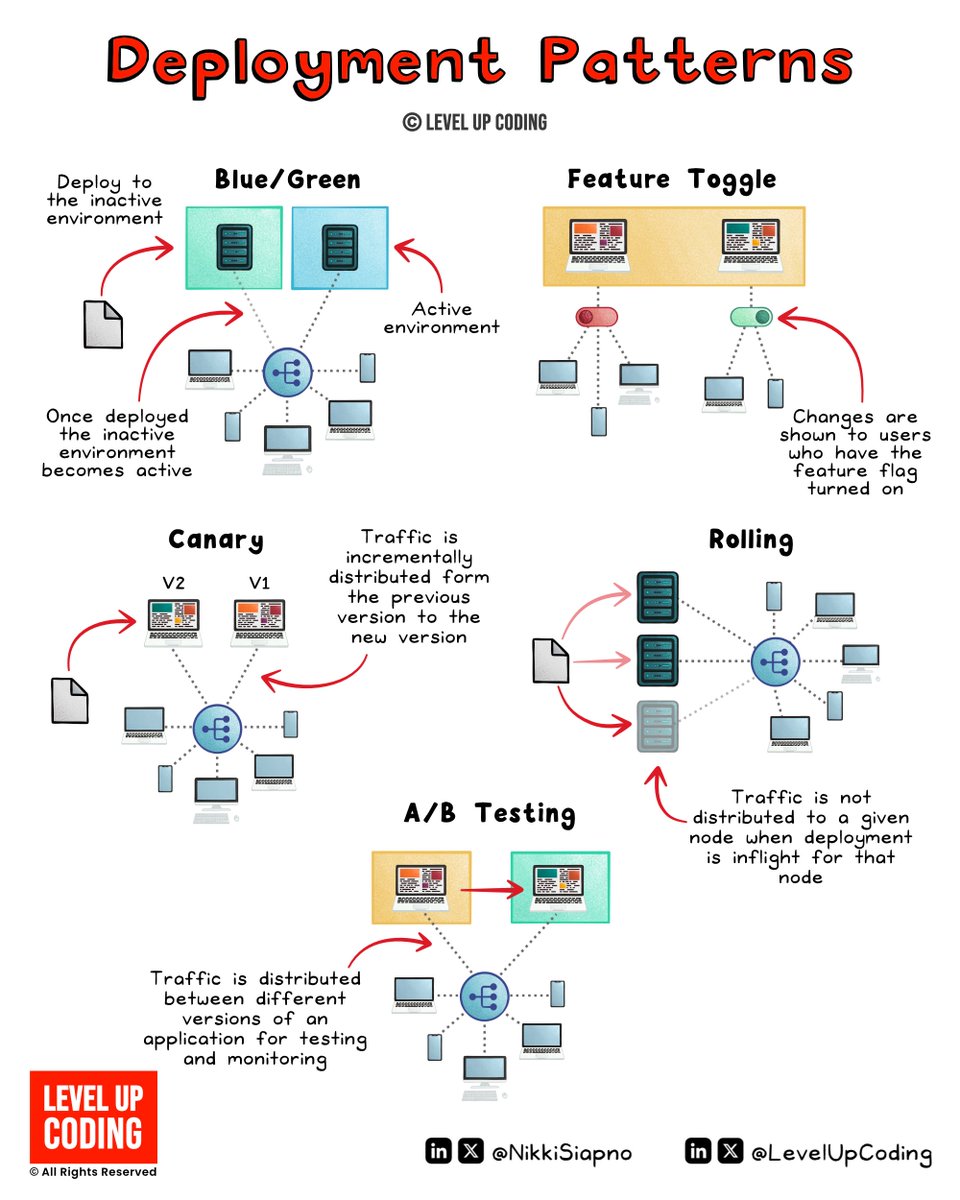
The most popular deployment strategies explained.
There are many possible approaches.
Here's a breakdown of five of the most popular.
Each stands out for specific strengths.
• Blue/Green for safety and zero downtime.
• Canary for controlled, low-risk rollouts.
• Rolling for maintaining continuous operations.
• Feature Toggles for flexible feature management.
• A/B Testing for data-driven user insights.
𝗕𝗹𝘂𝗲/𝗚𝗿𝗲𝗲𝗻 𝗗𝗲𝗽𝗹𝗼𝘆𝗺𝗲𝗻𝘁
↳ Renowned for zero downtime, this method uses two environments, Blue and Green. One hosts the live version while the other tests the new version.
↳ After comprehensive testing without affecting live traffic, users are transitioned to the updated environment.
↳ If an issue is discovered after switching environments, it is relatively easy to switch back.
↳ The main challenge is the cost and complexity of managing two environments.
𝗖𝗮𝗻𝗮𝗿𝘆 𝗗𝗲𝗽𝗹𝗼𝘆𝗺𝗲𝗻𝘁
↳ Named after canary birds in mines, it starts by rolling out changes to a small subset of users.
↳ This allows for monitoring performance and gathering feedback.
↳ If successful, you gradually extend the update to more users.
↳ Excels in minimizing user impact during updates due to isolation of a small set of users.
𝗥𝗼𝗹𝗹𝗶𝗻𝗴 𝗗𝗲𝗽𝗹𝗼𝘆𝗺𝗲𝗻𝘁
↳ Updates software in phases, rather than all at once.
↳ Incrementally upgrades different segments of the system, ensuring most of it remains operational during the deployment.
↳ Can be ideal for critical systems that require continuous operation.
↳ However, it extends the total update time and might introduce temporary inconsistencies.
𝗙𝗲𝗮𝘁𝘂𝗿𝗲 𝗧𝗼𝗴𝗴𝗹𝗲𝘀
↳ Think of feature toggles as on-off switches for new features.
↳ They allow teams to deploy features quietly, turning them on for specific users when it makes sense.
↳ Feature toggles support strategies like canary releases and A/B testing.
↳ The challenge lies in managing numerous toggles, which can become complex and risk feature conflicts.
𝗔/𝗕 𝗧𝗲𝘀𝘁𝗶𝗻𝗴
↳ Comparable to a scientific experiment, A/B testing offers two variations of a feature to different user groups to gauge which performs better.
↳ It's a go-to for validating user preference and effectiveness of new features, based on concrete data like user engagement or ease of use.
Remember, the right deployment strategy varies depending on the project's needs and objectives.
--
Thanks to our partner CodeRabbit who keeps our content free to the community.
𝗗𝗶𝗱 𝘆𝗼𝘂 𝗵𝗲𝗮𝗿 about CodeRabbit releasing their 𝗖𝗟𝗜 and providing 𝗳𝗿𝗲𝗲 𝗰𝗼𝗱𝗲 𝗿𝗲𝘃𝗶𝗲𝘄𝘀?
Check it out: https://t.co/2HlvbMoSQF
5 books I can't recommend enough:
1. Clean Architecture ( Robert Martin )
2. Building Microservices ( Sam Newman )
3. Unit Testing ( Vladimir Khorikov )
4. Domain Driven Design ( Eric Evans )
5. Head First Design Patterns ( Eric Freeman, Ph.D. & Elisabeth Robson )
For more like these, check out my list of top 20 Engineering books for .NET Developers 👇
https://t.co/8gGxVovrrl
Do you know there exist a "2080 Problem" in ways X generates unique Ids for its posts, user etc?
X uses a 64-bit ID format known as Snowflake for tweets, users, DMs, pretty much everything.
Each ID packs three things: Time (41 bits), Machine/worker (10 bits) and Sequence (12 bits)
That 41-bit time field can represent about 69.7 years of milliseconds and X uses custom epoch which starts from Nov 4, 2010. So that means after July 10, 2080,
the clock portion would overflow if nothing changed.
The risk is future ID generation.
If you were an engineer tasked to solve this problem, how would you solve it ?
If you would like to read about Snowflake, here it is : https://t.co/sebUQLFWnl
Postgres 18 has been released, with Async I/O support.
Previously, all read requests were blocking, but with this update, they are no longer, delivering massive performance gains for read-heavy applications!
It's enabled by default on Postgres 18!
Designing a global, read-heavy content platform (images + static assets), millions of DAU, strict p95 < 150 ms from India to US. Here’s the stack—but one obvious edge component is missing ...
What would you add first?
**Software Design Pattern - Adapter**
The Adapter pattern acts as a translator between two incompatible pieces of code, enabling them to work together.
It allows integration of third-party SDKs or legacy code into your application without modifying the original code or rewriting your own. A small "adapter" connects them.
This makes it an unsung hero, solving a complex problem simply and cleanly.
Example Code :
https://t.co/jmpzP4kFYV
I have been playing with AI models and tools for quite some time and now having understood its strength and limitations, I think it is the best time to be Software Engineer. Emphasis is on the term 'Engineer'.
Hello Engineers, How do you handle event deduplication in your event-driven architecture ? Suggest strategies for dealing with different kinds of systems