Folks on X please listen to my appeal
It's going to save humans BILLIONS of minutes of typing if @WisprFlow launched an API for apps, and you could integrate it as a default way to give an input in ALL your apps.
While on laptop the typing experience of Wispr is legendary across apps. The same is not true on phones.
And unfortunately, it won't be true as iPhone has such a restrictive ecosystem.
1000s of B2C apps can replace typing as their default way to input, to speak-to-text being the default.
Nobody is better than Wispr in getting that done. Please amplify this so that they put out an API soon!
P.S. I am making a legit appeal, and I mean this 100%. Its best for all of us and for Wispr too, that they go B2B.
Thank you for your attention to this matter.
Added 1000 more users in ~1.5 days, btw.
The idea came when Nepal's prime minister was "chosen" from a Discord call; we figured there would be more instances where people would want to come to a consensus for public issues.
And it required a non-partisan platform, which meant it needed to be decentralized and transparent by design, sounds familliar right? blockchain.
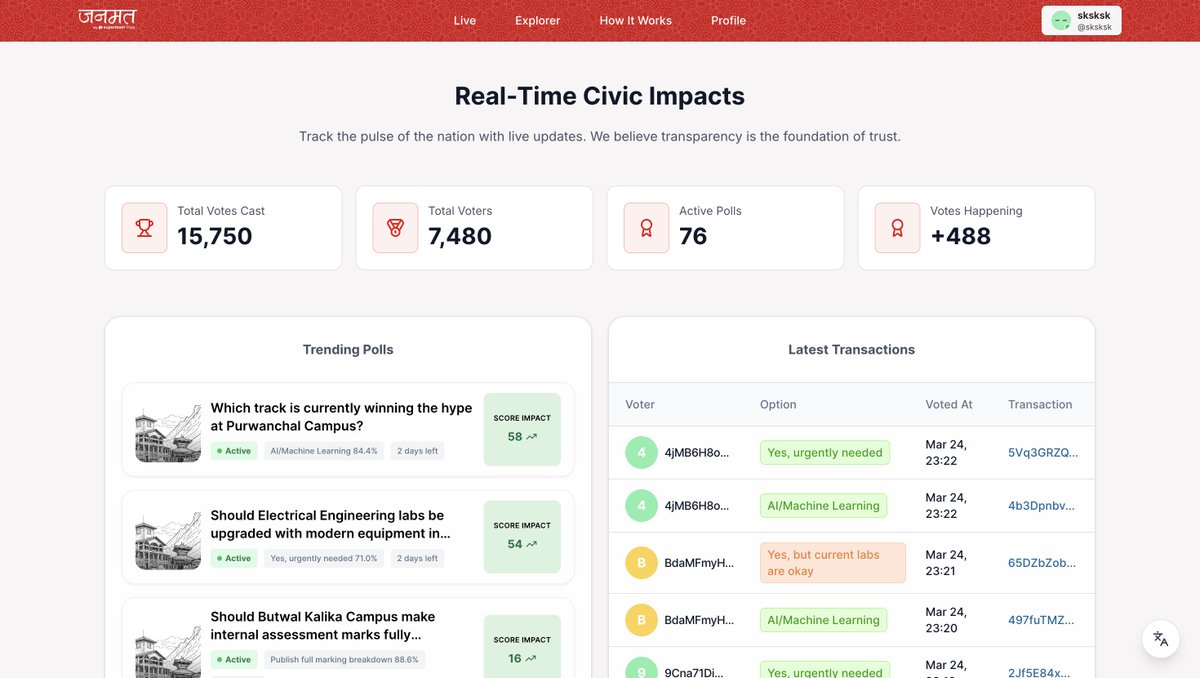
So we built @janamatnp, where verified Nepalis can privately voice opinions on public polls, or geo-locked for their local areas, all on @solana
We hosted a mock election on the platform, with polls running across all electoral constituencies, and surprisingly, the results were pretty similar to actual elections.
Next, we're establishing a direct communication channel between electoral voters and their MPs (Members of Parliament) by inviting MPs to run polls, forums, and discussions of bills on the platform.
This makes democracy continuous, transparent, and accountable, all on Solana Rails.
So much more planned for Janamat. Can't wait to share more about what we've done so far and what's next.
.@janamatnp crossed 7k users today, and its only growing.
Nepal's biggest civic tech platform on @solana where democracy is being practiced on blokchain rails.
hi, i’m aditya.
i’m joining the marketing team at @SuperteamNPL
met @Ronak0010 in oct ‘24 at Kathmandu buildstation.
he had an idea: build the home for @solana in Nepal.
time to make it real now, upwards only!
I watched the trailer for Christopher Nolan's The Odyssey and went down a rabbit hole I wasn't expecting.
Got obsessed with Greek mythology. The gods, the heroes, the battles.
The more I learned, the more I noticed a pattern that shows up everywhere humans have created religions.
The pattern:
Greek mythology isn't made-up fantasy. Troy was a real city. Athens, Sparta, Mycenae - all real places you can visit today. The Trojan War probably happened around 1180 BCE. Agamemnon might've been a real king.
But then the stories got wild.
Zeus throwing lightning bolts. Athena being born from someone's head. Poseidon controlling seas with a trident.
The supernatural stuff got added over time as people retold these stories for centuries.
This exact pattern shows up across every major religion.
Islam:
Muhammad was definitely real (570-632 CE). Solid historical records. Mecca and Medina are real cities. He founded a massive movement that changed the world.
But Gabriel appearing to him? The night journey to heaven? The Quran being literal word of God?
Claims of faith. Not things historians can verify.
Christianity:
Jesus was almost certainly a real Jewish preacher in 1st century Judea. Crucified under Pontius Pilate, a real Roman governor. Jerusalem, Nazareth, Bethlehem - all real places.
But virgin birth? Walking on water? Rising from the dead?
Theological claims written 40-70 years after his death, passed through oral tradition.
The historical person existed. The miracles? Can't be verified.
Hinduism:
Ramayana and Mahabharata mention real places - Ayodhya, Kurukshetra, Dwarka. The Kurukshetra War might be based on actual ancient conflict.
But flying aircraft? Divine weapons that destroy armies? Gods incarnating as humans with supernatural powers?
That's the mythological layer on top of possibly real events and definitely real cultural traditions.
The pattern is undeniable:
Real geographical locations
Possibly real historical figures (or at least real social movements)
Real historical contexts
Supernatural elements that cannot be verified
Ancient peoples used supernatural explanations for natural phenomena they couldn't understand.
So why do religions persist?
tbh religions exist because humans need them.
Not for the miracles or magic, but for what they provide:
Community (shared beliefs bond people together)
Values (stories teach morality)
Meaning (they answer "why are we here?" when science can't)
Comfort (help us deal with death, suffering, uncertainty)
Social order (common rules make societies function)
Religions aren't just about whether gods are real.
They're systems that help billions of people navigate life, build communities, and find purpose.
That's incredibly powerful, regardless of whether the supernatural claims are true.
What I've concluded:
From a purely empirical perspective - the supernatural claims of religions can't be verified through historical or scientific methods.
What we can verify: religions emerged around real places, often real people, and real historical events. But the metaphysical elements were added through theological interpretation, oral tradition, and the human need to explain the unexplained.
Religions persist not because their supernatural claims are scientifically provable, but because they fulfill deep social, psychological, and philosophical needs.
Does this mean I think all religions are "fake"?
Not exactly.
I think they're human. Created by us to make sense of our world, to bind us together, and to give life meaning.
And maybe that's more beautiful than any miracle.
The gods might've been exaggerated kings and teachers, but the values they taught and the communities they built? Those are very real.
I am genuinely surprised why more people in India aren’t talking about this openly.
If you want clean drinking water, you have to buy a water purifier and then pay 18% GST on it.
If you want clean air, buy an air purifier again, 18% GST.
If you want 24×7 electricity, don’t rely on the grid buy an inverter.
If you want quality education for your child, forget government schools, you have to go private, where fees run into lakhs.
Government schools are not even a serious option for most middle-class families.
If you want good healthcare, you go to a private hospital and once you step inside, your bank balance starts bleeding. Many families literally take loans to survive medical emergencies.
Now leave all this aside.
Even pure food is hard to get.
Paneer is adulterated.
Dal is artificially coloured.
Street food?
Nobody knows what’s being mixed dirty hands, sweat, sometimes worse. We just hope nothing happens.
Try walking outside:
• Footpaths barely exist.
• Vehicles come from all directions.
• People don’t follow lanes.
• Potholes everywhere.
One wrong step and:
you might get hit by a vehicle, or
you might fall and injure yourself
And who takes responsibility?
No one.
Ask questions and suddenly you’re:
• called deshdrohi
• told to “go to Pakistan”
Why should expectations from my own country be compared with Pakistan?
When India plays cricket, do we compare ourselves with Kenya or Zimbabwe?
No.
We compare ourselves with Australia, England, big teams.
Then why, as a country, shouldn’t we compare ourselves with: China, the USA, Japan, Australia other large economies?
People say “India is Vishwaguru.”
If that were true:
• why are so many millionaires leaving India?
• why are top celebrities and athletes settling abroad?
• why do people with money still choose foreign education, healthcare, and passports?
Loving your country doesn’t mean staying silent.
Asking questions is not anti-national.
Expecting clean air, safe roads, honest food, affordable healthcare, and quality education is not a crime.
Patriotism is not blind worship.
Patriotism is demanding better because we believe India deserves better.
If this made you uncomfortable, maybe it needed to be said.
Share it.
Talk about it.
Silence won’t fix anything.