Excited to share a new paper, Employment Relationships, Wage Setting, and Labor Market Power (with Francesco Agostinelli, Giuseppe Sorrenti, and Leonard Treuren). 1/
We do not assume the tax is annual. We estimate the revenue of the measure as written: a one-time wealth tax that could generate long-term income tax losses. We see 30% of the wealth tax base already eliminated pre-2026 and apply litigation-survival probability to the rest. 1/2 https://t.co/iRRxDv0YW1
@joefrancis505 Even under the assumptions of the china shock, cause it mean cheap imports it was still welfare improving for most regions (and as a whole for the country) though those are averages it might be diff for skilled vs non skilled workers.
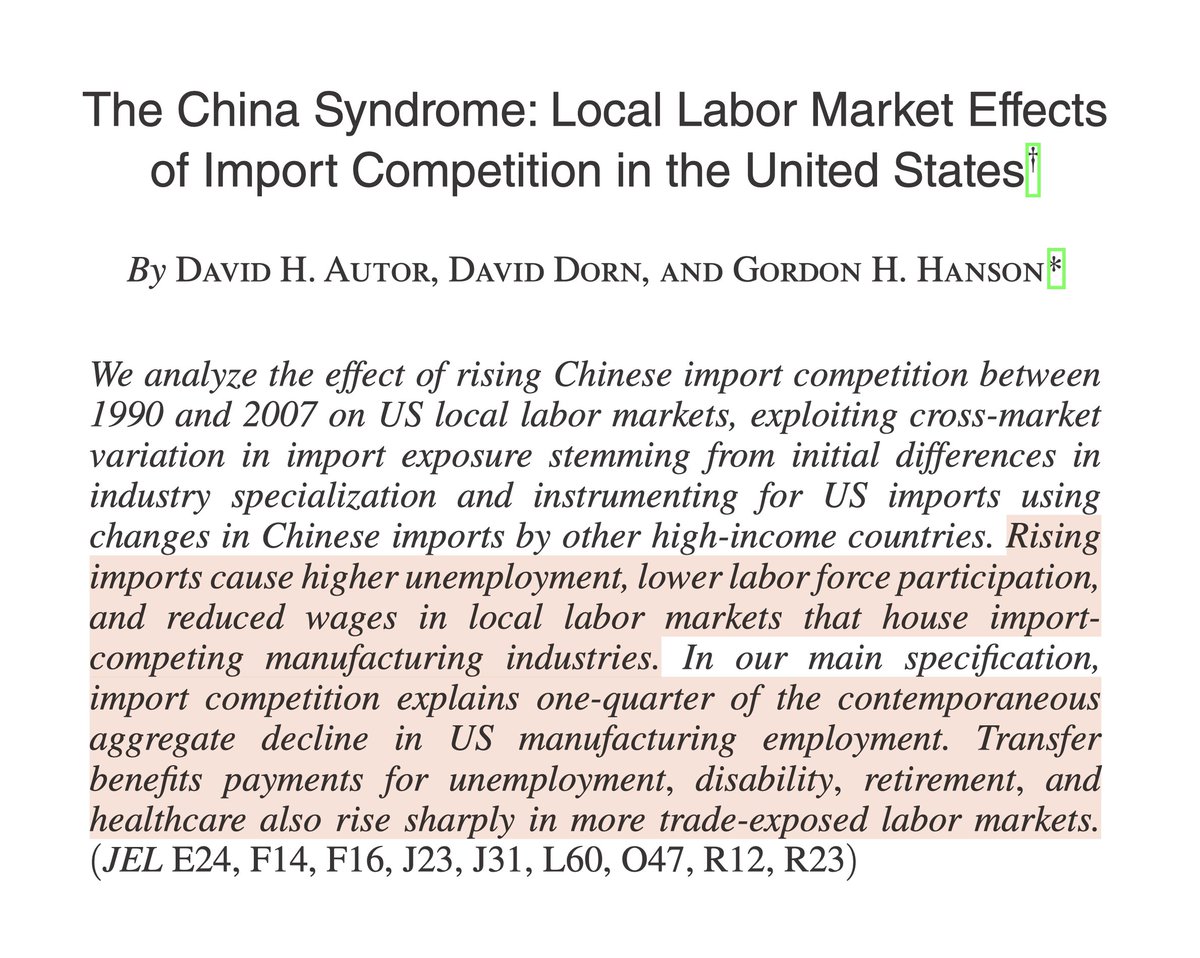
The "central message" of Autor et al. (2013) was found in the article's abstract: Chinese imports "cause higher unemployment, lower labor force participation, and reduced wages in local labor markets that house import competing manufacturing industries"; also "import competition explains one-quarter of the contemporaneous aggregate decline in US manufacturing employment. Transfer benefits payments for unemployment, disability, retirement, and healthcare also rise sharply in more trade-exposed labor markets."
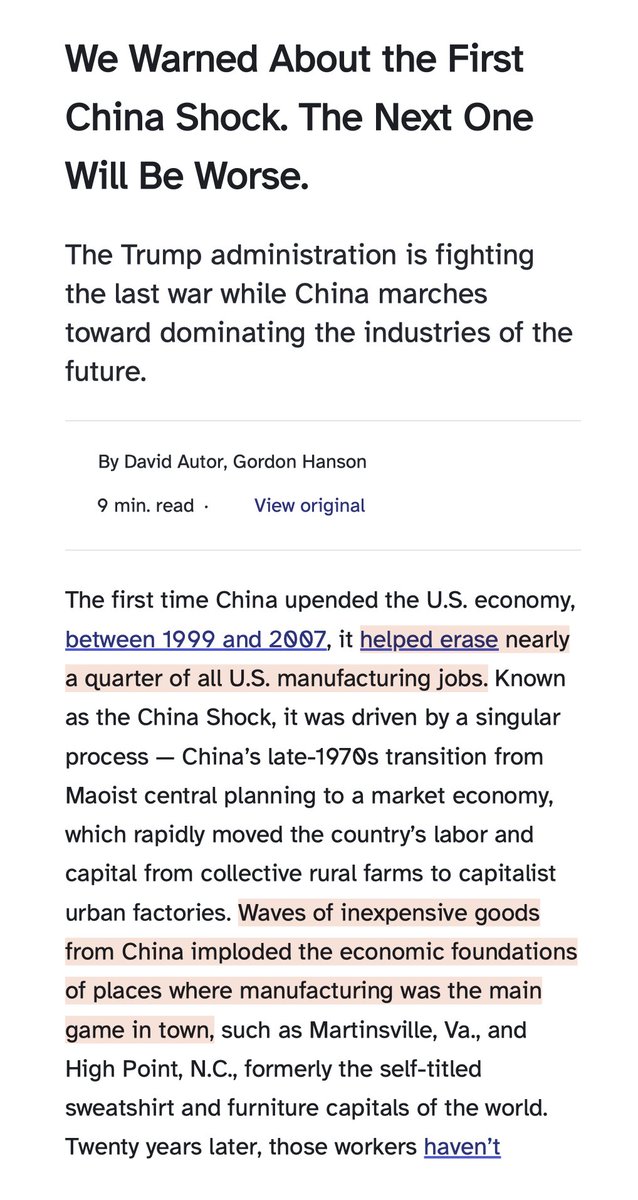
Autor and Hanson reiterated their "central message" in even simpler terms in their 2025 op-ed in the New York Times: China "helped erase nearly a quarter of all U.S. manufacturing jobs... Waves of inexpensive goods from China imploded the economic foundations of places where manufacturing was the main game in town."
If you want, then, you can respond to my EJW article by rewriting their "central message." Yet the historical record persists...
He's baaack! @GeorgeSelgintakes time off from living the good life in Spain to weigh in on lessons learned from the Fed's Main Street lending facilities, emergency lending facilities, and the Fed's balance sheet task force. https://t.co/JPi8tdARuc
I think it's very clear that ADH and its follow-ups have led many people to believe that trade with China was a net negative for American jobs in the aggregate, when it's not at all obvious that was the case. If you read their abstract & intro, and those of many other similar papers, there are no caveats whatsoever about relative vs absolute effects. In ADH, it's relegated to a footnote. And their extrapolation to aggregate effects is totally inappropriate---a practice they have continued through all their work and propagated to the broader set of papers building on their work.
@TradeDiversion@dix_rafael If I am not mistaken, the written critiques to that paper go beyond the missing intercept argument. But they also extend to the basic empirical results, let alone the statement about the aggregate implications.
@dix_rafael Rafael, you are telling me that the subsequent quantitative GE analysis motivated by the results in that paper were in no way "biased" in finding the same result? I know of many papers that used those elasticities to discipline models.
@dix_rafael I have no stake in denying trade’s negative employment effects. But if such an influential paper is shown to be incorrect, that matters; saying it inspired more research does little to restore public trust.
@dix_rafael Rafael, I am afraid this not the way the paper is written though. The idea that trade has distributional consequences is as old as economics, that paper made a precise statement about the negative employment effects of trading with China.
When industrial customers have to wait a decade to get electric service from a regulated utility, the least we can do in a free country is open up a permissionless option so they can move quickly
NEW REPORT: Millions of Americans already struggle to access pharmacies and the benefits they provide. But new policies could make the problem even worse.
A new @GoldwaterInst report warns that sweeping prohibitions on pharmacy ownership could disrupt care in communities with the fewest alternatives, and it urges lawmakers to address abusive business practices without making it harder for patients to obtain their medications.
Fed day! Rate hike likely, but very little dicussion about the elephant in the room. Fiscal policy is still expansionary, and this creates issues for the Fed. Higher rates contribute to debt accumulation, adding inflationary pressure if no fiscal correction occurs