@justalexoki This gets at the core philosophical issues discussed in "Identity and Necessity", though - contingent vs. necessary truths, rigid designators, etc.
It's not true that "I" could have been born to different parents, in a deep sense. That doesn't negate that we're fortunate though.
@justalexoki This gets at the core philosophical issues discussed in "Identity and Necessity", though - contingent vs. necessary truths, rigid designators, etc.
It's not true that "I" could have been born to different parents, in a deep sense. That doesn't negate that we're fortunate though.
New essay on the economics of structural change and the post-commodity future of work.
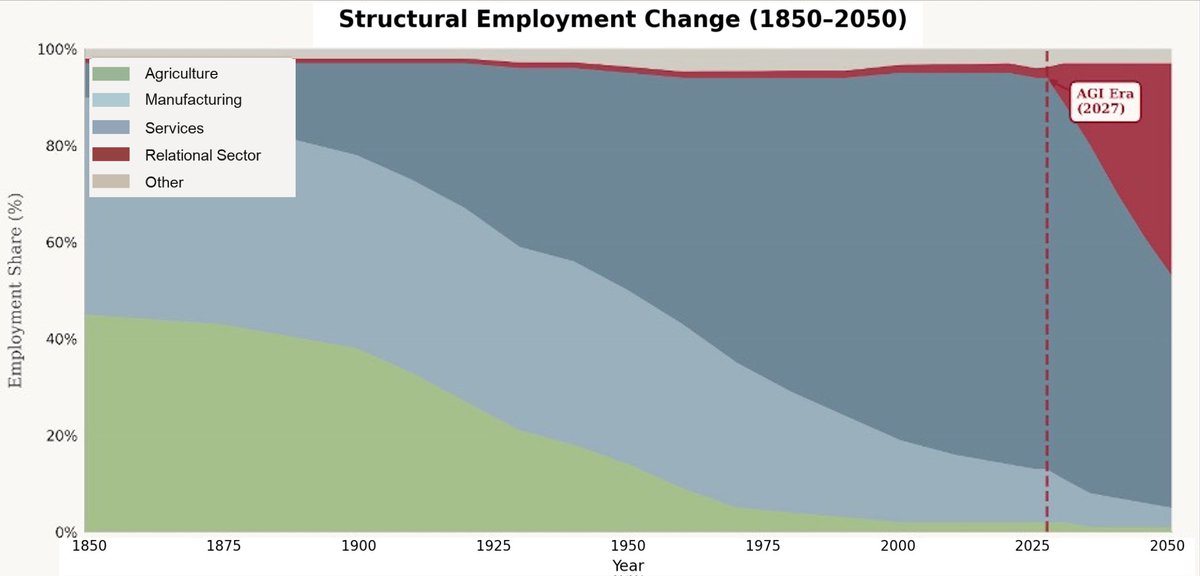
1. Almost any question about the impact of advanced AI on the economy needs to start at the same place: what is still scarce? Answer that, and the analysis becomes pretty straightforward. This essay explores what becomes scarce if AI really can replicate most of what humans do in production, and what this mean for the future of jobs.
2. My conjecture, working through the economics: labor reallocates across sectors, and the sector it reallocates to has properties that keep labor a meaningful share of the economy. Ultimately this is about the structure of demand itself. For this, we have to go back to Girard, Augustine and Rousseau: once people's base needs are met, their preferences shift to comparative motives (e.g., status, exclusivity, social desirability). This motive is inherently non-satiated.
4. The key paper is Comin, Lashkari, and Mestieri (Econometrica 2021). As people get richer, they don't buy proportionally more of everything. They shift spending toward sectors with higher income elasticity. They estimate income effects account for 75%+ of observed structural change.
5. The ironic consequence: the sector that gets automated becomes a smaller share of the economy, not a larger one. Agriculture got massively more productive and its share of employment collapsed. Manufacturing too. The "stagnant" sectors absorb the spending and the jobs.
6. So the question is: which sectors have high income elasticity in a post-AGI world? I argue it's what I call the relational sector. Categories where the human isn't just an input into production, it is part of the value.
7. Why does the relational sector have high income elasticity? Because human desire has a mimetic, relational dimension. We don't just want things for their intrinsic properties. We want what others want, and we want it more when others can't have it. Girard, Rousseau, Augustine, and Hobbes all saw this.
8. In work with Kristóf Madarász, we showed this experimentally: WTP roughly doubles when a random subset of others is excluded from the good. And in new work with Graelin Mandel, AI involvement kills the premium. Human-made art gains 44% from exclusivity; AI-made art only 21%.
9. This all comes together for the core argument. The sector that absorbs spending as AI makes commodity production cheap is one where human provenance is part of the value, and demand for it grows faster than income. Exactly the profile that keeps labor meaningful.
10. To be clear about the claim: I'm NOT saying aggregate labor share must rise. It may fall. The claim is about sectoral composition, i.e., where expenditure and employment go once commodities get cheap, and the fact that the sector that will absorb reallocated labor maps to a substantial component of human preferences and desire.
11. If you're interested in the formal model, a linked companion technical note works out all the economics.
Read the essay here: https://t.co/NcjVgn2o8g
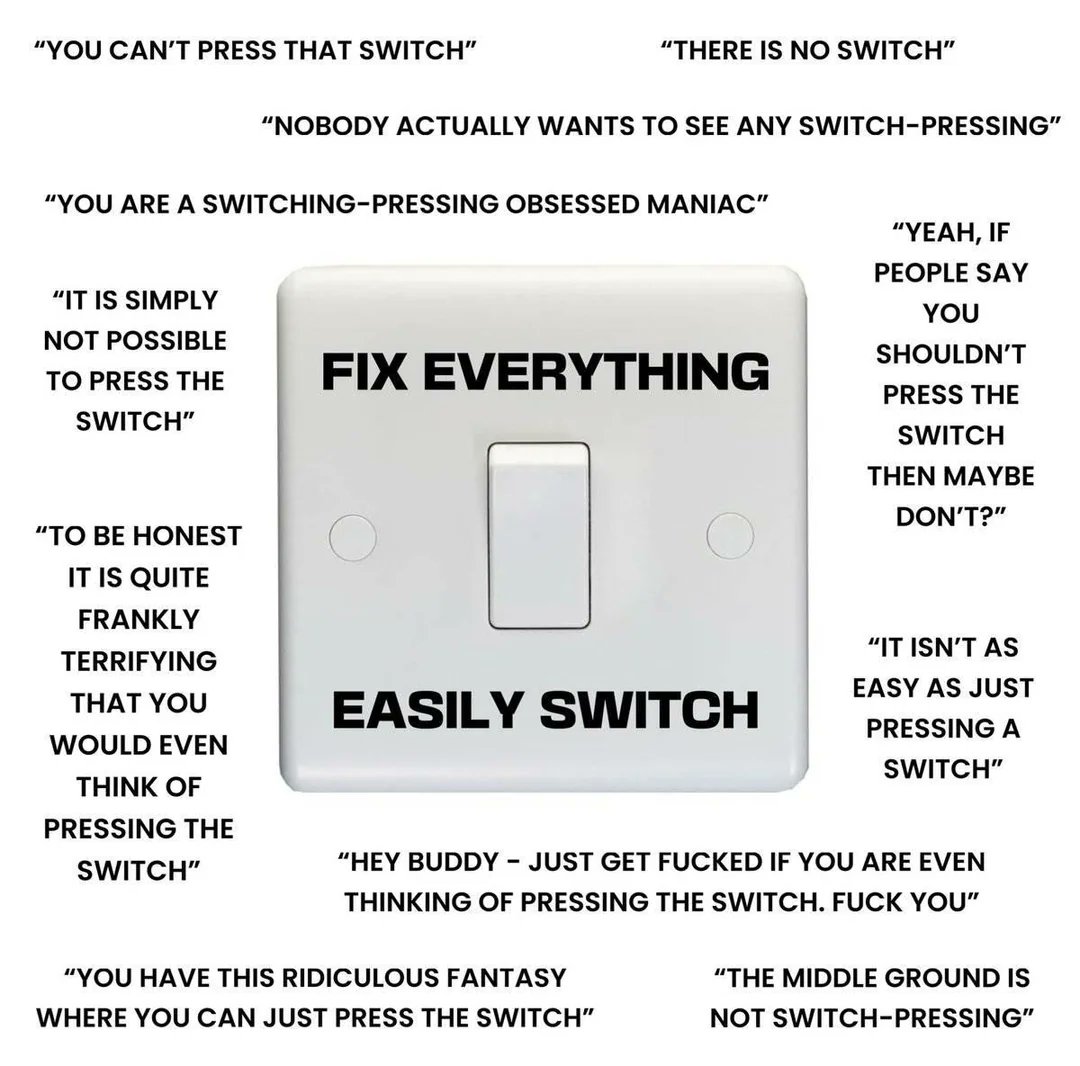
Asked Claude:
'There's a meme called the "fix everything easily switch". What policies do you think are the best candidates for being a real fix everything switch in the US? Give me your top ten, your confidence, your reasoning, and why a given policy has not been implemented.'
Dario is wrong.
He knows absolutely nothing about the effects of technological revolutions on the labor market.
Don't listen to him, Sam, Yoshua, Geoff, or me on this topic.
Listen to economists who have spent their career studying this, like @Ph_Aghion , @erikbryn , @DAcemogluMIT , @amcafee , @davidautor
Introducing Gemini on Mac.
It’s the first time we’re bringing the @Geminiapp to desktop. The team built this initial release with @Antigravity, and it went from an idea to a native Swift app prototype in a few days.
More features on the way!
OMG, I *love* this ad. Vote for Patrick in the primary in less than 2 months for insurance commissioner.
Please do not vote for Jane, whose election would be existential for even the very availability of insurance in the state. You WILL NOT be able to get homeowners' insurance if she wins and it will REVERSE the progress we've made in the last 1-2 years in getting companies to issue policies again here amid wildfire risk.
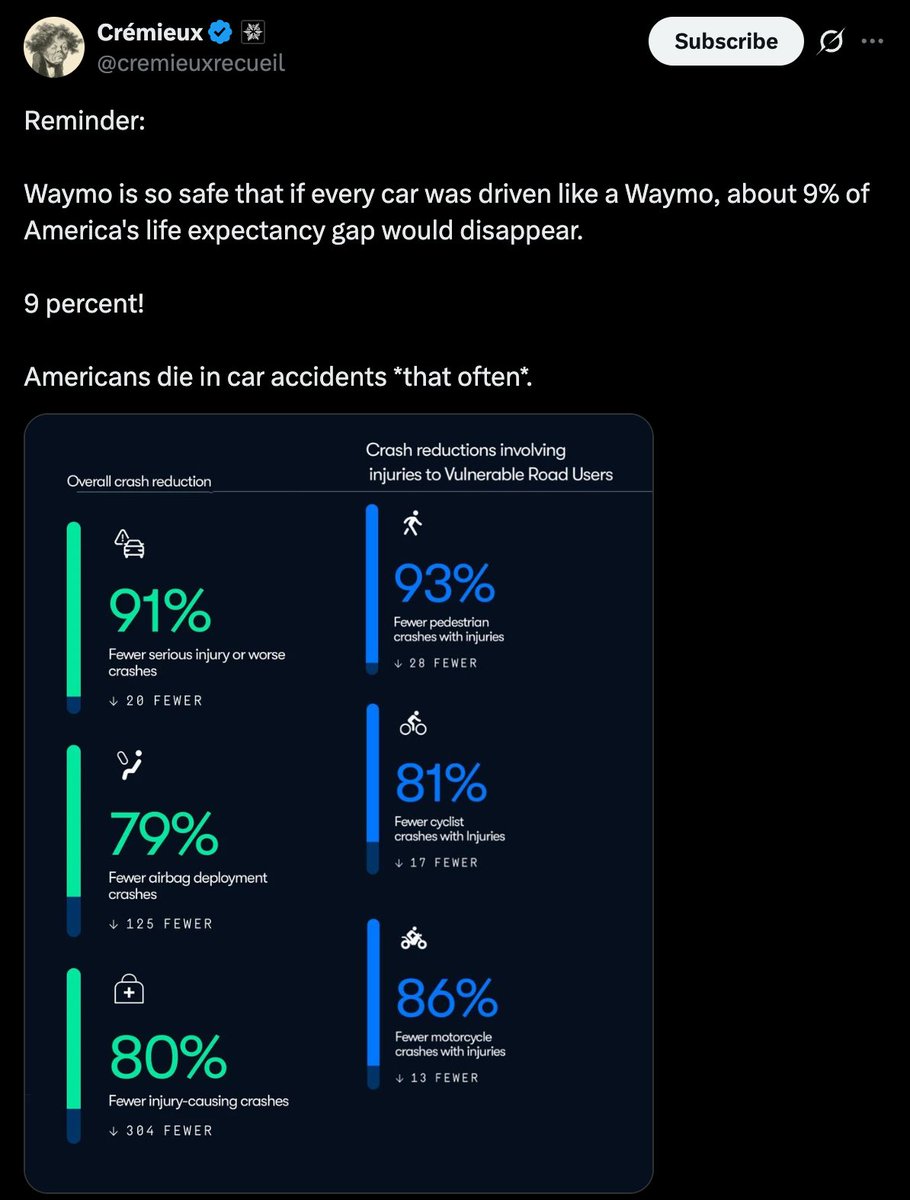
Waymo is so good at saving lives that if it were a new drug in trial, it would hit the bar for being unblinded and made immediately available to the control group for ethical reasons.
@MorePerfectUS would prefer to keep killing pedestrians.
No one created the land they live on. And yet they've been granted the ability to exclude others from it, backed by state force. All we ask is they pay the rest of society for the privilege to use this scarce resource, which itself derives much of its value from society around it
If you are seeing the news in the CA governors race and it as sickening and infuriating as it is to me, I would like to suggest you take a look at Mayor Matt Mahan.
He is the real deal
@MattMahanSJ
Meet Gemma 4: our new family of open models you can run on your own hardware.
Built for advanced reasoning and agentic workflows, we’re releasing them under an Apache 2.0 license. Here’s what’s new 🧵