When a court distinguishes a precedent by facts the original court never relied on, is that distinguishing or rule-modification? Rob Mullins (Queensland) takes on this 'restrictive reinterpretation' challenge to the reason model of precedent. Highly recommended! https://t.co/eXnBCsoHYF
Empirical SCOTUS research has leaned on the Spaeth database's thirteen issue areas for decades. Arthur Hellman (Pitt) proposes a structure-based replacement grounded in four macro categories tied to the Court's constitutional functions — complete category codes in the appendix. Recommended. https://t.co/0KkuhEbxuf
DotW: Marco Basile, "Old Textualism, New Juristocracy," 101 NYU L. Rev. (forthcoming). New textualism aims to constrain judges; old textualism (1830s-1850s) treated law as technical expertise—and laid the groundwork for judicial supremacy. https://t.co/jOalYP3pPs
Susan Tanner argues that AI challenges our understanding of legal reasoning. In hard cases, legal reasoning is part reasoning and part public justification—not prediction. Explores the boundary between enthymematic vs syllogistic reasoning. https://t.co/PL8mMRVHvO
People's philosophical intuitions often clash. Is this due to conflicts between underlying beliefs? Three studies validate a new belief inventory and show laypeople collectively and individually hold conflicting beliefs about vision: https://t.co/liZhDBpxdB
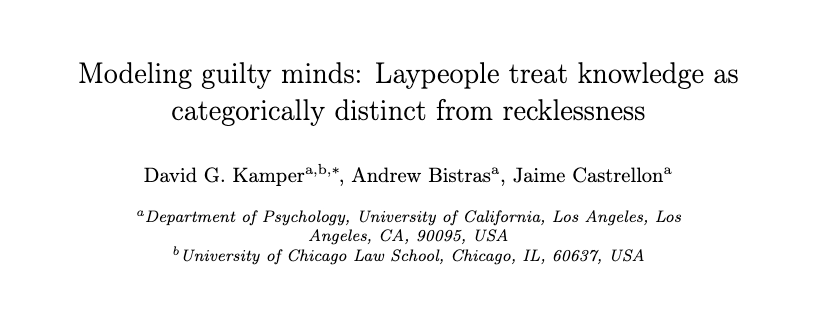
New preprint w/ Andrew Bistras & Jaime Castrellon: we asked whether ordinary people can tell apart the mental state categories criminal law cares about — knowing, reckless, negligent, blameless — when they have to infer them from behavior, the way actual jurors do.
If that generalizes, jury instructions that frame the knowledge/recklessness line in probabilistic terms ("practically certain" vs. "substantial risk") may not match how jurors actually reason. A circumstantial framing might be closer to the native inference.
🚨 New Paper Alert 🚨
Perhaps the most pressing question facing the legal community is how AI affects human legal reasoning. Our new co-authored draft provides the first empirical evidence directly addressing that question. https://t.co/7X4OKp7uMW
Psychologist George Newman has a new book out about creativity, but it’s about something very different from what people usually mean by “being creative”
Usual topic: ideas that are zany or original
Newman’s topic: ideas that actually work
https://t.co/kWqhDmyF67
My article with Thomas Chittum at UNLV Law, "Not Frozen in Amber: The Second Amendment and the Right to Innovation," has been accepted for publication in Volume 51 of the Vermont Law Review. 🧵
The article engages post-Bruen and post-Cargill doctrine, the intersection of the IP Clause and the Second Amendment, the One Big Beautiful Bill Act's NFA tax elimination, and structural features of ATF regulation that chill firearms innovation.