@curryja I tinkered a lot with fitting causal models to the AAM, its budget and MJO. While plenty of causality exists, none of these relationships appear to aid in developing good predictive models for subseasonal behavior.
@liftbyIron Those are 55 lb each. The vast majority of ordinary people won’t even get them to the start position because they have no idea how to clean. And that’s what you’re observing. Watching this, I’m concerned that someone out there is going to get hurt!
Yes but with a caveat: it can get and stay cold in the south even with only occasional discharges of modified polar/arctic air. For example here in Texas, cold air damming accelerates these air masses’ southward progression and then days of isentropic lift can lock in clouds/rain and slow or prevent airmass modification. That mechanism is quite operative in most El Niño years, which helps produce the seasonal below normal anomaly on seasonal timescales.
@jaycordeira Yes. The atmospheric angular momentum has really surged in response to El Niño and powerful extended jet streams with connections to high TPW source regions are a common manifestation of that.
@BigJoeBastardi Even if the oceanic component were to completely “collapse” immediately, the atmosphere has only gotten started with simply massive injections of atmospheric angular momentum and corresponding highly juiced westerly wind flows that will persist for months if not longer.
@rynelancer@webberweather One helluva lot of westerly flow in the subtropical and mid-latitude atmosphere, including likely strong consolidated jet streams spanning the oceans and parades of shortwave troughs hammering the southern tier of North America and Europe
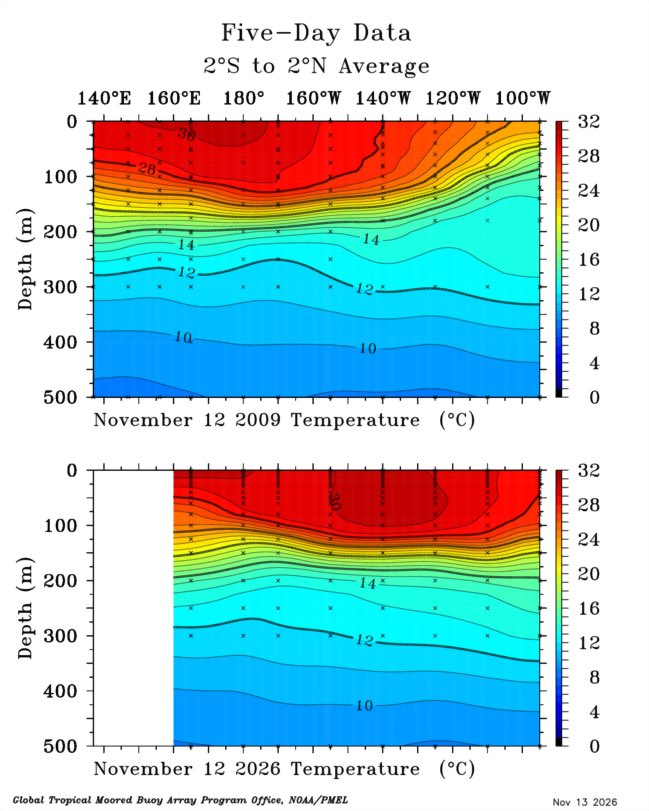
The atmosphere is fully participating in this El Niño to an extreme degree. After the record mountain torque spike, the GWO ran off the right edge of its phase diagram as angular momentum surged. Now some forecast members approach the top of the chart (+4σ in AAM). Quite an orbit in the “El Niño attractor”!
Coding harnesses endowed me with the ability to bring to life a vision I had about what a proper web service for doing weekly to subseasonal diagnosis should look and feel like. Instead of pouring enormous energy and time into manually building yet another complex code base, I could completely own the creative and scientific process and outsource the scripting, testing and validation to skillful - albeit fallible - AI agents. This tech has also allowed me to fail fast. Many ideas don’t pan out and with the ability to prototype so quickly, this process operates at hyper speed and you can much more quickly get to things that DO work. I’m grateful to have this amazing technology in my hands!
It has been interesting watching the new weather apps and websites pop up over the past year, largely driven by AI coding agents.
In my opinion, it is more important than ever to go with sites built by experienced meteorologists and engineers.
@webberweather In fact, even hypsometric arguments fall apart when you remember that a modest thickness change consistent with a warmer/cooler boundary layer doesn’t necessarily equate to higher/lower mid-tropospheric heights.
Global mountain torque just smashed the old record in my CORe analysis going back to 1968, exceeding it by a full standard deviation! East Asia and the Andes supplied most of the positive torque, transferring angular momentum from the solid Earth to the atmosphere as the AAM tendency carried the GWO trace off the right edge of the phase diagram. Twin upper-level anticyclones over the eastern tropical Pacific are consistent with persistent El Niño heating, while strong Pacific westerlies in both hemispheres help guide vigorous downstream Rossby wave dispersion.
Synoptic dynamics appear to be driving the next round of ridge growth. Around Nov. 19–21, ECMWF and its ensembles predict higher-θ air extending poleward along the dynamic tropopause on the eastern flank of a Pacific trough as the ridge amplifies over western Canada. Some guidance extends the ridge into Alaska. An active Pacific storm track could continue beneath the ridge, and the reach/intensity of any cold surge will depend on the downstream trough and the quality of the cold air it can tap. If the stratospheric disturbance couples more strongly to the troposphere, it could favor more persistent high-latitude ridging later in November and into December.