In the winter of 1927, inside Niels Bohr’s Institute for Theoretical Physics in Copenhagen, a 25-year-old German prodigy named Werner Heisenberg was losing sleep. Classical language simply couldn’t describe what the new quantum mechanics was showing.
To prove the point, Heisenberg invented his famous “ideal experiment”: imagine trying to watch a single electron with a gamma-ray microscope. The shorter the wavelength you use for razor-sharp position measurement, the harder the photons slam into the electron instantly changing its momentum. The very act of looking destroys what you’re trying to see.
That same year (February 1927), Heisenberg turned the thought experiment into hard math: the uncertainty principle Δx · Δp ≥ ħ/2 (where ħ is the reduced Planck’s constant, ≈ 1.0545718 × 10⁻³⁴ J·s).
You can never know both exact position and exact momentum at the same time.
His mentor, Niels Bohr, took it one step further. In September 1927 at a conference in Como, Italy, Bohr unveiled the principle of complementarity: an electron (or photon) can behave as a particle or as a wave, but never both in the same experiment. Which face you see depends entirely on how you set up the apparatus.
The perfect real-world demonstration is the double-slit experiment. Fire electrons one by one at two slits. Leave them alone and they build a classic wave interference pattern on the screen, even when sent individually (confirmed dramatically in 1989 by Akira Tonomura’s single-electron experiments). But install detectors to check “which slit did it go through?” and the interference vanishes; the electrons suddenly act like little bullets. Both descriptions of wave and particle are true, yet mutually exclusive.
In the Copenhagen Interpretation that emerged from these conversations, the wavefunction (ψ) isn’t a description of physical reality. It is a mathematical catalog of possibilities.
Max Born’s 1926 rule tells us |ψ|² gives the probability of each outcome. Only when you measure does the wavefunction “collapse” into one definite result. And here’s the radical part: the observer and the measuring device cannot be separated from the system. The act of measurement is part of the phenomenon itself.
This view shook physics to its core. At the legendary 1927 and 1930 Solvay Conferences, Einstein pushed back hard, declaring, “God does not play dice with the universe.” Bohr calmly replied that quantum theory forces us to accept a new kind of reality, one that exists as potential rather than fixed fact until observed.
So the unsettling questions remain;
> Is the world truly “real” when no one is looking?
> Does physics now include subjectivity at its foundation?
> And can science ever again claim complete objectivity when the observer is inescapably part of the story?
That is the Copenhagen Interpretation, not just a set of rules, but the moment when physics discovered that reality itself might be participatory.
“Young man, in mathematics you don’t understand things. You just get used to them.”
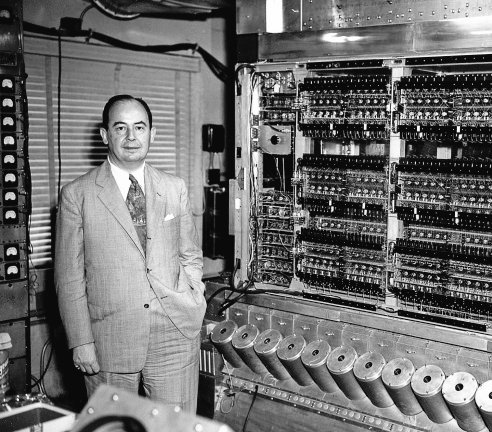
This famous reply is attributed to John von Neumann. The best-known version comes from Gary Zukav’s 1979 book The Dancing Wu Li Masters. After World War II, a physicist at Los Alamos was struggling with a tough problem and asked von Neumann for help. “Simple,” von Neumann said. “Solve it using the method of characteristics.” When the physicist admitted he still didn’t understand, von Neumann smiled and gave his classic answer.
A shorter version appears in David Wells’ 1997 book The Penguin Book of Curious and Interesting Mathematics: after a lecture, a confused student told von Neumann he hadn’t followed the final argument. Von Neumann looked at him and said, “Young man, in mathematics you don’t understand things. You just get used to them.”
"If people do not believe that mathematics is simple, it is only because they do not realize how complicated life is."
-- John von Neumann (1903 - 1957)