10/ #Result 5: Can scaling data, models, or compute fundementaly solve this? We don't think so! #OpenAI's #o1-series is performing better but still suffers from slight performance variations. #o1_preview shows significant improvements, but...
“I'd also like to acknowledge my students (…) they've gone on to do many great things.
I'm particularly proud of the fact that one of my students fired Sam Altman.“
😳🫡
Everyone's talking about Sakana's AI scientist. But no-one's answering the big question: is its output good?
I spent hours reading its generated papers and research logs. Read on to find out
https://t.co/2c6TyE9zPQ
Announcing new paper from our lab published yesterday in @NatureComms , led by the amazing @YuanhaoWu.
"Network mechanisms of ongoing brain activity’s influence on conscious visual perception".
Summary picture below. 1/5
https://t.co/5iEdFNjxJ6
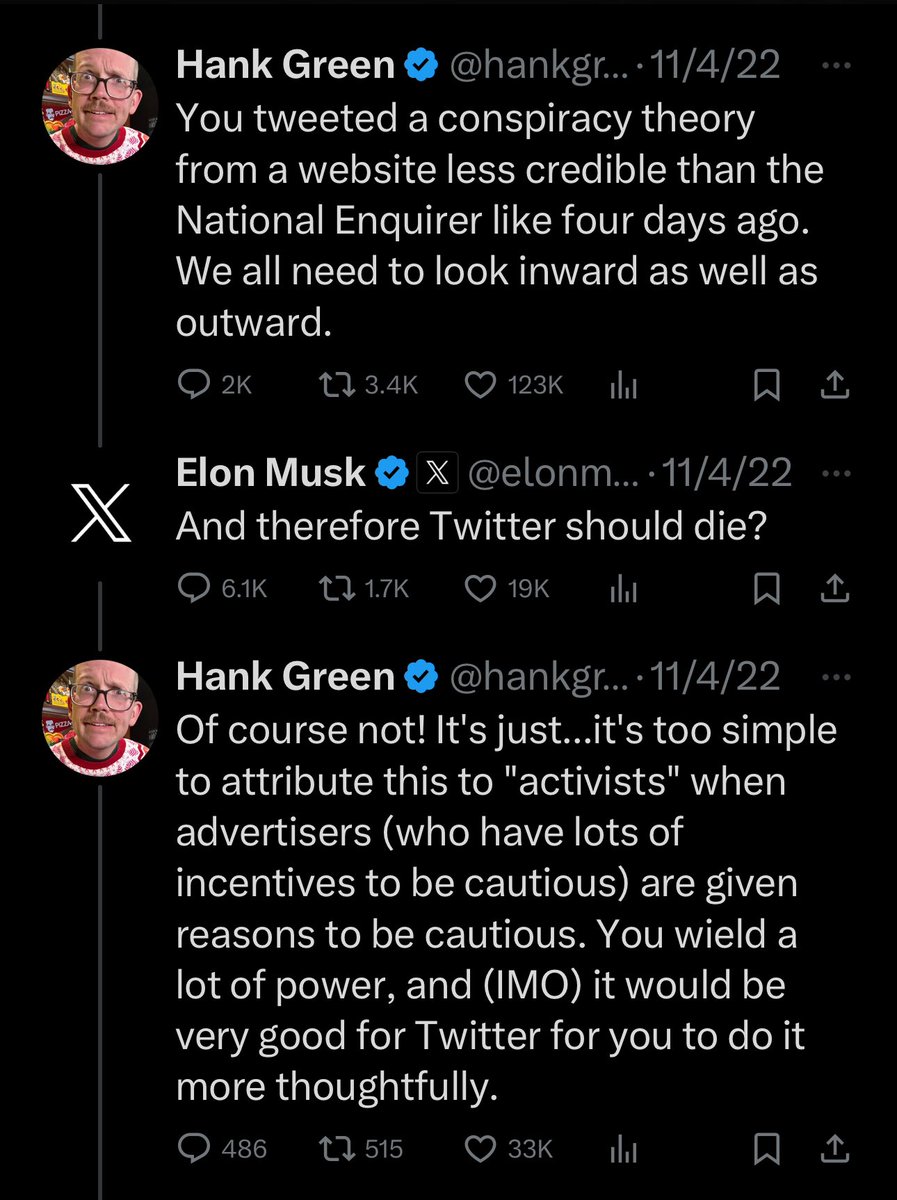
I had this exchange with Elon here on Twitter over a year ago and we are still having the same conversation so I guess…let’s do this.
Fortune 500 companies aren’t overly moral actors. They make decisions based on whether they think they will make more or less money.
Advertisers are not leaving Twitter because they are trying to make a statement or achieve some goal (which would be a boycott). They are leaving Twitter because they aren’t sure whether advertising on the platform is delivering negative or positive value, and why spend a bunch of money doing something that might actually be /hurting/ you.
The reason it might be hurting them is fuzzier. But, in my opinion, it’s not mostly to do with their ads showing up next to bigoted content. I think it’s that this platform is increasingly all about one guy in a lot of people’s minds. That one guy is both the most influential power use of the platform, and the owner of the platform.
And that guy has trained everyone to expect that he is going to say increasingly inflammatory and unhinged stuff.
That means employees and customers of those companies (who /are/ moral actors) don’t get good vibes from the company they like advertising with a company they don’t like. This is a symptom of the culture war that Elon Musk desperately wants to inflame because he is stuck inside of a really tight “you are always right” feedback loop of fans and friends who feel incapable of questioning him.
He has attained a kind of moral certainty that he is fighting a war against an existential threat to humanity. That inevitably results in either an intervention of good friends or a complete crash (often times a violent one). But that’s when the person isn’t the richest person in the world. I don’t know what happens when it’s the richest person in the world, but I’m trying not to watch it like it’s a train wreck, because, just like with train wrecks, real people are getting hurt.
That moral certainty is allowing him to do things that are very clearly bad for the economics of the platform (but good for keeping people talking about Elon Musk, which (as a person who has fallen into that trap before) is important to keep an eye on as an underlying motivation for all of this behavior.)
It is not at all surprising that large advertisers, who advertise specifically to ensure their brands are perceived positively, are leaving (at least for the moment) a platform whose biggest brand ambassador is tweeting Great Replacement theories and Pizzagate memes.
It is not an attempt to change Twitter or Elon’s behavior. It is an effort to not lose money.
Excited to announce the Center for Neural Science (CNS) at NYU is searching for a new tenure-track faculty member — applications are due January 1 — Please RT!
https://t.co/IdHygs9ZsA
My article summarizing our recent workshop on consciousness at the NIH (June 2023) is now out in @NeuroCellPress!
50 d free-access link:
https://t.co/1NOuChSQ1M
This article presents a vision for consciousness research ahead that is more empirically grounded & broader in scope.
Wild—just by flickering some colors you can make your brain hallucinate a triangle that doesn’t actually exist, moving in any direction you want, even though it doesn’t actually move.
@meoweleanna I agree, but at that point in my life I was involved more in computer science and machine learning and doing a deep dive of a new field would not be an easy task. So I started with cursory readings of many field.
I read about IIT in 2018 when I was preparing for some career changes. As an outsider, I thought that IIT is a leading theory of consciousness but I was not satisfied after reading Koch's and Tononi's books. Hence I decided it's not for me and I could use my skills elsewhere 1/n
As a member of ASSC and part of two TWCF-funded initiatives, I signed the IIT letter. I have some further thoughts on why I signed that I think are worth reading (apologies that this is long!) and worthy of further discussion:
https://t.co/FWeW7a0KKk
While I am not fully convinced of labeling IIT as pseudoscience, the leading-theory label put me back a few years where I could have done research. 3/3
Without neuroscience background, it was hard to gauge the science of C while IIT was portrayed as the leading theory. Nowadays, I find myself in the consciousness field anyway, thanks to outreach from scientists like @meganakpeters . 2/n