Business in Plastic raw materials Import..Warehousing services in Kasez...exports of Used and worn clothing to Africa.. Office operational from Kandla Sez-India
जीव को भगवान ने बुद्धि और मन दिये हैं। बुद्धि के अन्दर "विवेक" होता है और मन के अन्दर "भाव" की उत्पत्ति होती है। जब बुद्धि के द्वारा जानकर,मन में जो भाव उत्पन्न होता है उसे ही "स्वभाव=स्व+भाव" कहते हैं, यही भाव ही व्यक्ति का अपना होता है। इस स्वभाव के अनुसार ही कर्म होता है।
✋🏻
How to make your Rahu positive and survive Rahu Mahadasha ?
How to turn lord Rahu into your biggest asset ?
A thread on remedies, behavior, and what the scriptures actually say - 1/N 🧵
The SUN placed in your house reveals where you're meant to shine.
Your Sun placement is not just about your personality
- It shows the area of life where your purpose, confidence, and life force naturally radiate... if you embody your true self.
SUN IN ALL 12 HOUSES – 🧵
This is Thomas Seyfried.
He's a professor of biology who has studied cancer for over 30 years.
His message? Cancer isn't bad genes or bad luck. It's damaged mitochondria.
This flips everything you've been told about how to treat and prevent cancer: 🧵
✨ The Ultimate Wealth House ✨
💰 The Ultimate Wealth Configuration
Discover the single most powerful and significant combination for massive wealth accumulation (Dhan Yoga) in a birth chart. This is the real secret key to unlimited financial abundance! 🌟💎🪙
💸 The Secret to Your Highest Earnings
If you want to unlock the code to your maximum lifetime revenue and your absolute biggest financial breakthroughs, you must analyze one specific planet — the ultimate game-changer in your horoscope! 🔑🚀💰
🏆 The Power of the 11th Lord
The planetary ruler of your 11th House (Ekadash Bhav) holds the master key to massive wealth! 🔐
Its placement, strength, and aspects reveal exactly:
• 🌟 Where your highest income will come from
• 💵 Sources of major financial gains & sudden profits
• ✨ How your desires and ambitions will manifest into reality
Strong 11th Lord = Massive Gains 🔥
When the 11th Lord is well-placed (in own sign, exalted, in kendra/trikona, or receiving benefic aspects), it creates powerful Dhan Yoga — leading to consistent profits, huge networks, luxury, and fulfillment of all material desires! 🏦📈💸
#nifty #crude #Pmmodi #astrology #vedicastrology #operationsindoor
Consider the scale of expected NRI deposits due to the RBI's move. At an estimated $40–50 billion, or roughly ₹4 lakh crore, these inflows would amount to around 15–20% of the banking system's annual deposit growth of ₹20–25 lakh crore. If banks can source these NRI deposits in the 5–6% range, this could soften their overall cost of funds even if policy rates rise later.
Read the full analysis: https://t.co/dC2vmLccJ6
The war has stopped but situation will get worse from here
This war has disturbed the old Israel-Iran-SA-Turkey equilibrium in West Asia region, Turkey looks clear gainer here
I can see a new emerging Sunni alliance and Israel and India will be on the target
#SameTerrorPlaybook
Planetary Combination & Suitable Profession
1. Engineering : Mars & Saturn, Saturn & Rahu
Mars is machines, Saturn is structure, Rahu is technology , good for engineering fields.
2. Defense or Sports : Sun & Mars, Mars & Rahu, Mars & Ketu
Mars gives courage, Sun gives honor, Rahu/Ketu add risk taking and fearless attitude.
3. Business : Sun & Mercury, Mercury & Jupiter, Mercury & Rahu
Mercury is trade, Sun gives leadership, Jupiter gives wisdom, Rahu adds clever strategy.
4. Govt. Job : Sun & Moon
Authority, stability, and respect from public service.
5. Industrial Business : Mars & Jupiter, Saturn & Mars, Saturn & Jupiter
Mars gives energy, Saturn gives discipline, Jupiter gives expansion
6. Consulting Career : Jupiter & Mercury, Mercury & Ketu
Mercury is communication, Jupiter is guidance, Ketu gives deep research
7. Real Estate : Mars & Sun, Saturn & Mars
Mars rules land, Sun gives authority, Saturn gives long-lasting property gains.
8. Medical Profession : Moon & Sun, Moon & Jupiter, Sun & Jupiter
Moon - Healing , Sun- vitality, Jupiter- wisdom .
9. Law & Justice : Jupiter & Sun, Saturn & Jupiter
Jupiter is law, Sun is authority, Saturn is justice & discipline.
10. Teaching / Education : Jupiter & Mercury, Jupiter & Moon
Jupiter is teacher, Mercury is knowledge, Moon is nurturing mind.
11. Media / Communication : Mercury & Moon, Mercury & Venus
Mercury is speech, Moon is emotions, Venus is arts & creativity.
12. Finance / Banking : Jupiter & Venus, Mercury & Saturn
Jupiter is wealth, Venus is luxury, Saturn is calculation, Mercury is trade.
13.Politics : Sun & Jupiter, Rahu & Sun, Saturn & Sun
Sun is power, Jupiter is guidance, Rahu is mass appeal, Saturn is public
14. IT / Technology : Mercury & Rahu, Saturn & Rahu
Mercury is intellect, Rahu is technology/digital/modern tools, Saturn is machines/innovation.
15. Film / Arts / Acting : Venus & Rahu, Moon & Venus
Venus is glamour, Rahu is illusion/mass popularity, Moon is imagination.
16. Writing : Mercury & Moon, Mercury & Ketu
Moon is creativity, Mercury is expression, Ketu is deep thought.
17. Travel/ Import-Export : Rahu & Moon, Rahu & Sun, Mercury & Rahu
Rahu is foreign links, Moon is movement, Mercury is trade, Sun is authority abroad.
WhatsApp @ &91-9251032661
#Astrology
Once the lesson is learnt, the interest fades.
That’s how Ketu works.
Ketu gives depth without noise, quietly, internally, almost invisibly.
So when Ketu sits in the 5th house (speculation*),the native may withdraw from trading or gambling at some point in life when they kind of think they've mastered it, even if other planets show success and money from it.
It doesn’t deny results rather the attachment to the activity is cut off
More like mastering a game so well that you simply stop wanting to play.
Which ristrict growth & if this industry is not environment friendly why old units in SEZ renewal timely by SEZ BOARD. pls look into if possible which helps india to open recycling industries to save an environment as well contribute some percentage in economic for earn USD.
@narendramodi Sir atleast look some policy for SEZ where rule 18(4)(a)(b) restried plastic and worn clothing recycling industries new industries permission not allowed in SEZ & many industries want to come in india for save cost of labor and operational cost compared to North
America, EU & UAE where the cost of production is very high if it will allow in SEZ with same condition of Export rules, many industries will come which earn foreign exchange after export and hire indian labour which helps indian economy in such time. This is only license raj
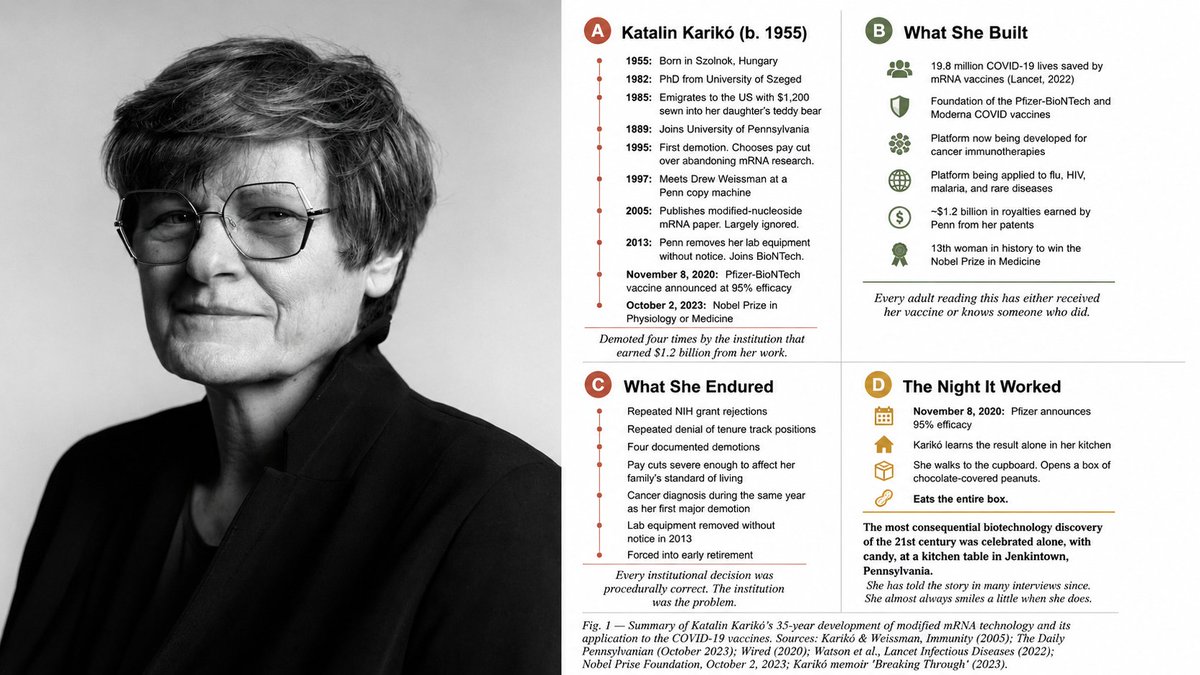
A Hungarian immigrant arrived in the United States in 1985 with her four-year-old daughter, her husband, $1,200 in cash sewn inside her daughter's teddy bear because that was the maximum the communist government allowed her to take out of the country, and a research interest in a molecule the rest of biology had given up on. Thirty-five years later, the molecule she refused to abandon would become the foundation of the COVID-19 vaccines that saved roughly 19.8 million lives.
The American university that employed her demoted her four times during that 30-year stretch. Cut her pay. Refused her grant applications. Pulled her lab equipment out of her office without telling her. Forced her into early retirement in 2013.
Her own institution earned 1.2 billion dollars in royalties from her work after she was gone.
She found out the vaccine had worked in 2020, sitting alone in her kitchen in suburban Philadelphia, and celebrated by eating an entire box of chocolate-covered peanuts.
She won the Nobel Prize three years later.
I read her actual story last night and could not stop thinking about it.
Her name is Katalin Karikó.
The textbook story of the COVID-19 vaccines names Pfizer, Moderna, BioNTech, and Operation Warp Speed. Names the companies. Names the executives. Names the speed of the rollout. That story is true. It is also missing the part where the underlying technology took 35 years to develop, and the woman who developed it spent most of that time being told by the academic establishment that her work was a waste of time, then being demoted for refusing to stop, then being pushed out of her job at the exact moment her discovery was about to change the world.
Here is the story almost nobody tells you.
Katalin Karikó was born in 1955 in Szolnok, a small town in central Hungary. Her father was a butcher. The family lived in a one-room house with no running water and no refrigerator. She watched her father work and developed an early fascination with biology, with how living cells took apart and rebuilt themselves. She studied biochemistry at the University of Szeged. She earned her PhD there in 1982. She got married. She had a daughter, Susan, in 1982 as well.
By 1985, her university's research budget had collapsed. There was no funding for the molecule she had become obsessed with. She and her husband applied for an immigrant visa to the United States. Hungary was still behind the Iron Curtain. The communist government allowed citizens to leave with no more than $100 per person in foreign currency. The Karikó family had sold their car and managed to convert the proceeds to $1,200. They sewed the cash inside Susan's teddy bear. They flew to Philadelphia in 1985 with their daughter, three suitcases, and a smuggled stuffed animal.
The molecule was called messenger RNA. mRNA.
In 1985, the entire field of molecular biology considered mRNA to be a dead-end research topic. mRNA is the chemical messenger your cells use to translate the instructions in your DNA into the proteins that build everything you are. The biologists of the era understood roughly how it worked. They did not see how it could ever be useful as a medicine. mRNA is fragile. It breaks down within minutes inside the body. The immune system attacks it on sight. Any attempt to use it as a drug would be destroyed before it could do anything useful.
The serious money in molecular biology was going to DNA-based therapies, gene editing, and traditional protein-based drugs. mRNA was considered a curiosity.
Karikó refused to accept this. She believed that if you could solve the stability and immune-rejection problems, you could use mRNA to program living cells to manufacture their own medicine. You could give a person an injection of mRNA carrying the instructions for any therapeutic protein you wanted, and their own cells would produce the medicine. No tablets. No infusions. Just the body running the recipe you handed it.
She joined the University of Pennsylvania in 1989 as a research assistant professor.
The detail that should disturb every reader is what happened over the next 24 years.
She could not get her grant applications funded. The National Institutes of Health rejected her proposals year after year. The reviewing committees considered mRNA therapy a fantasy. Her department chair told her, repeatedly, that she needed to switch to a more fundable research area. She refused. She cobbled together small amounts of money from any source she could find. She borrowed equipment. She did her own technical work because she could not afford a research assistant. She often spent her evenings doing the lab work herself, with her daughter Susan reading homework on a bench in the corner.
In 1995, the same year she was diagnosed with cancer and her husband was stranded in Hungary because of a visa technicality, Penn told her she could choose between abandoning her mRNA research or accepting a demotion and a pay cut.
She chose the demotion.
She kept working on mRNA.
She underwent cancer surgery. She recovered. She kept working on mRNA.
The pay cut was severe enough that she sometimes had to ask her daughter to forgo activities her classmates were doing. Susan grew up watching her mother do research that nobody else believed in, on a salary that barely qualified as middle class for the city they lived in, for a university that would not give her a tenure-track position no matter how long she worked there.
Susan grew up to become an Olympic gold medal rower for the United States, twice. She has said in interviews that her mother taught her everything she needed to know about not quitting on things that mattered.
In 1997, Karikó met an immunologist named Drew Weissman at a Penn copy machine. They started talking. He was working on HIV vaccines. She was working on mRNA. They realized their problems were related. They became collaborators.
It took them eight more years to crack the central problem. They figured out that you could modify one of the four chemical building blocks of mRNA — replacing the uridine nucleoside with pseudouridine — and the modified mRNA would slip past the immune system's defenses without triggering the inflammatory response that had killed every previous attempt to use mRNA as a drug.
They published the result in 2005, in a small immunology journal.
The paper was largely ignored.
A few small biotech companies noticed. A new startup in Germany called BioNTech, founded by another husband-and-wife scientific team, Uğur Şahin and Özlem Türeci, took the work seriously and started building on it. An American startup called Moderna picked up the same thread a few years later. Both companies began to develop mRNA platforms based on the Karikó-Weissman discovery.
The University of Pennsylvania did not. The institution where the discovery had been made considered mRNA research too risky and too commercially uncertain to invest in seriously.
In 2013, Penn went further. The university's neurosurgery department, where Karikó had been allowed to work, removed her lab equipment from her office while she was traveling. She was not informed in advance. She returned to find her workspace stripped. She was effectively pushed into early retirement.
She accepted a senior vice president position at BioNTech in Germany the same year.
Penn lost her. The institution that had spent 24 years trying to redirect her research finally succeeded in losing the researcher.
The most uncomfortable line in the entire historical record is what Penn did with her work after she left.
The patents on the modified-nucleoside mRNA technology that she and Weissman had developed at Penn remained the property of the university. When Pfizer-BioNTech and Moderna began producing their COVID-19 vaccines in 2020 using that technology, the University of Pennsylvania began collecting royalty payments. By the time the Nobel Prize was awarded in 2023, Penn had earned an estimated 1.2 billion dollars in royalties from the work of the researcher it had spent decades demoting, underfunding, and eventually pushing out.
She received some compensation from BioNTech, where she had been working since 2013. She has never publicly disclosed how much. She has said in interviews that money has never been the point.
The detail that should be carved into the wall of every research university on Earth is what happened on the night of November 8, 2020.
Pfizer announced the preliminary results of its Phase 3 clinical trial for the BNT162b2 mRNA vaccine. The vaccine, built on Karikó and Weissman's modified mRNA technology, had achieved a 95 percent efficacy rate against symptomatic COVID-19. The result was so far beyond what anyone in the vaccine industry had expected that several senior scientists at Pfizer reportedly cried when they saw the data.
Karikó learned about the result alone in her kitchen in Jenkintown, Pennsylvania. She was 65 years old. Her husband was upstairs. She did not call him. She did not call her daughter. She did not call anyone.
She walked to the cupboard. She opened a box of chocolate-covered peanuts. She sat at her kitchen table. She ate the entire box.
She has told this story in multiple interviews since, almost always with a small embarrassed smile. The most consequential biotechnology discovery in modern medical history was confirmed in a clinical trial, and the woman who had spent 35 years building the underlying technology against every institutional headwind celebrated by herself, with a box of candy, in a suburban kitchen, because there was no one in her life who fully understood what had just happened.
On October 2, 2023, the Royal Swedish Academy of Sciences announced that the Nobel Prize in Physiology or Medicine had been awarded jointly to Katalin Karikó and Drew Weissman. She was the 13th woman in history to receive the prize. She had spent more than three decades being told by senior colleagues that her work was unfundable and her career was a dead end. She was now standing on the highest podium in science.
When asked, repeatedly, in interviews after the Nobel was announced, whether she felt vindicated, she has consistently refused the question. She has said vindication was never the point. She has said the work was the point. She has said she did not pursue mRNA research to prove anyone wrong. She pursued it because she believed it could one day save lives, and because the alternative was to stop doing the work she loved, which she was not willing to do.
Roughly 19.8 million lives have now been saved by the mRNA vaccines built on her technology, according to the most-cited global estimate, published in The Lancet Infectious Diseases in 2022.
The University of Pennsylvania has earned 1.2 billion dollars in royalties.
Penn has erected a banner outside the Perelman School of Medicine featuring her face. The same school that demoted her four times now uses her image in its recruitment materials.
She has said, in interviews, that she does not think about Penn very much.
The most uncomfortable line in the entire historical record is the one her former colleagues at Penn have repeated, on background, to multiple journalists in the years since the Nobel announcement.
They said the system had been working perfectly. The grants she could not get were the grants the field had collectively decided were unfundable. The demotion was procedurally correct. The lab equipment removal was within department policy. Every individual decision that pushed her further down had been reasonable at the time, according to the standards of the institution.
The institution was the problem. The standards were the problem. The reasonableness was the problem.
The work that was unfundable for 24 years saved 19.8 million lives the moment the world needed it.
The career that the academic system considered a failure was the most consequential biomedical research career of the 21st century so far.
Walk into any major research university today. Ask the senior faculty how they decide which research directions to fund.
Most of them will describe a process that is almost identical to the one Penn used on Karikó. Peer review. Track record. Publication history. Grant productivity. The same process that demoted her four times and pushed her out in 2013 is still the dominant filter for what counts as legitimate research in 2026.
The young scientists working today on ideas that the rest of the field considers dead ends are largely operating under the same system. Some of them will turn out to be wrong. Some of them will turn out to be the next Karikó. The current academic system has no reliable way to distinguish between the two until decades after the fact.
She was right. The system was 30 years late.
And the next vaccine, the next cancer therapy, the next breakthrough that saves tens of millions of lives is probably being developed right now by another quiet, stubborn researcher, in a lab somewhere, on a salary that barely qualifies as middle class, while her department chair tells her she should pick a more fundable research area.
You can bet on the system catching up to her in time.
You can also bet on it taking 30 years.
Most of us will be alive to see it. Some of us will not.
The chocolate-covered peanuts will be eaten alone, in a kitchen we have never visited, by a person whose name we have not yet learned.
That is how this always works.