Great game of football..DR Congo dominate Portugal. What was supposed to be a cake walk for Portugal turned out to be a disaster..Ronaldo was non existent throughout the game #FifaWorldCup
Writers & actors built careers on propaganda, and the industry stayed quiet like cats. Now the same clan mock Dhurandhar. You don’t get to call yourself liberal if your first instinct is to Mock.
Don’t know when truth started getting labeled as propaganda...... strange times.
COMING TO THE POINT.....
I want to tell @AdityaDharFilms & @RanveerOfficial yeh kaala drishti aise nahi jaayega... Muthi bhar ke laal mirch se kaam nahi chalega.... poora khet jalana padega 🔥
Watched #Dhurandhar2TheRevenge last night.... Outstanding film 🙏
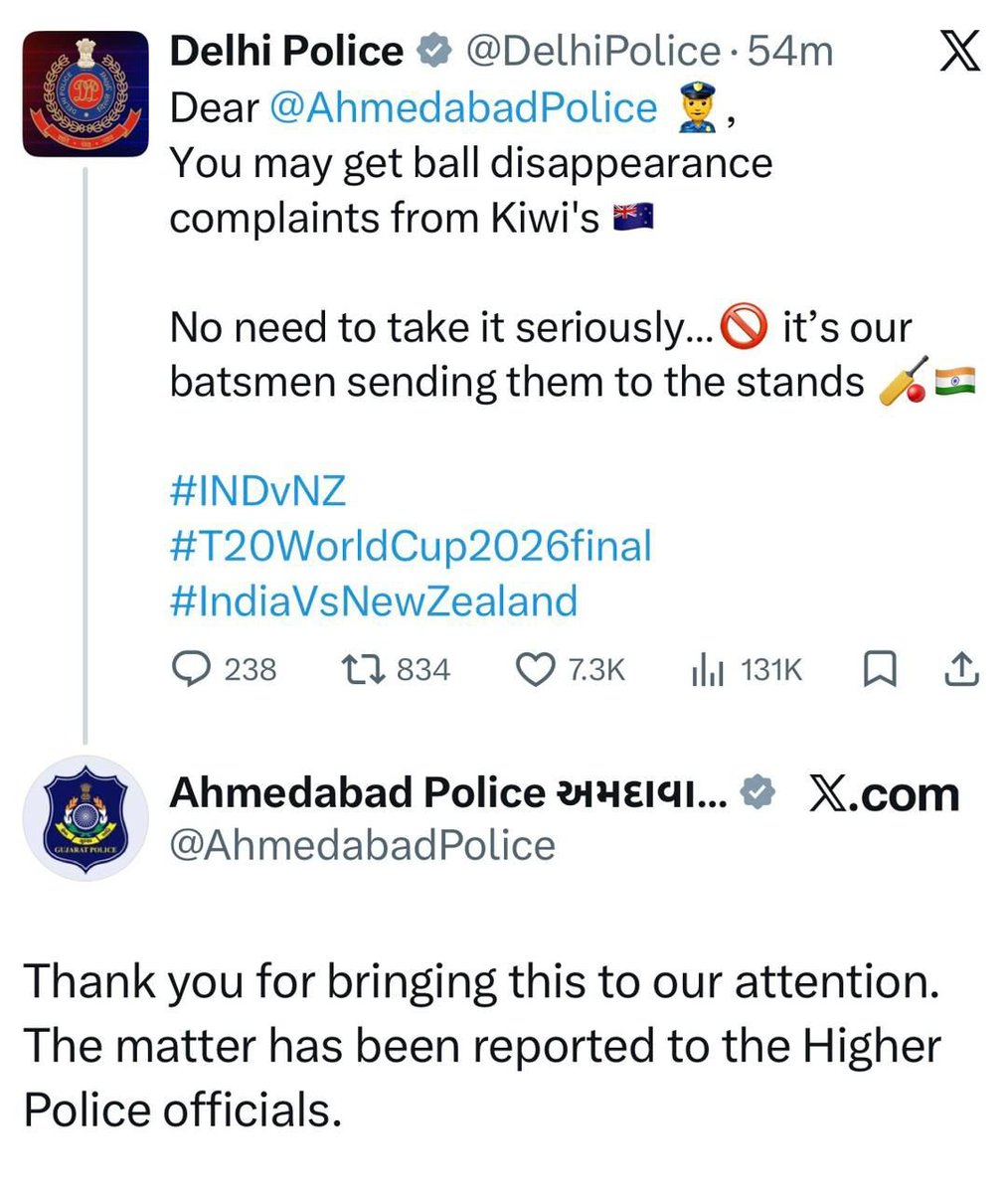
CASE STATUS UPDATE 🚔
Earlier complaint: Ball going missing.
New complaint: Entire batting lineup going missing.
Our assessment: This is not a law & order problem.
This is Bumrah. 🎯🇮🇳
#INDvNZ#T20WorldCup2026Final
Facts below (1/5):
In 2025, average earnings per hour (EPH), excluding tips, for a delivery partner on Zomato were ₹102.
In 2024, this number was ₹92. That’s a ~10.9% year-on-year increase. Over a longer horizon also, EPH has shown steady growth.
Most delivery partners work for a few hours and only a few days in a month. But if someone were to work for 10 hours/day, 26 days/month, this translates to ~₹26,500/month in gross earnings. After accounting for fuel and maintenance (~20%), the net earnings for the partner are ~₹21,000/month.
Note: Earnings per hour are calculated on total hours logged in, including the time when the partner might be waiting to receive an order. Earnings per “busy hour” will be higher but that’s not the right metric to look at.
On top of this - delivery partners earn 100% of tips given by customers. The average tip per hour in 2025 on Zomato was INR 2.6 and in 2024 was INR 2.4 per hour. Tips are transferred instantly, with zero deductions. We absorb the payment gateway processing cost ourselves. About 5% of the orders get tipped on Zomato; 2.5% on Blinkit.
Surprisingly on the same day when the Gig workers had called "no-work" day, I placed an order on Blinkit...
After placing the order and tracked the delivery, it was showing as normal as 9 minutes, which would show on any other regular day....
Sanjay, the delivery partner arrived with the order, I asked him "Aaj toh band thaa na?"... "Uncle, jisko takleef hai wo band karein, hum log toh sincerely kaam karte hain, humko kya?"....
Gig workers GET welfare benefits AND long term support. (4/5)
In 2025, Zomato and Blinkit spent over ₹100 crore on insurance coverage for delivery partners. These premiums are borne entirely by us, and the benefits are administered with record speed without any fuss.
Coverage includes:
1. Accident insurance with coverage of up to INR 10 lakh:
2. Medical insurance with coverage of INR 1 lakh plus OPD coverage of INR 5,000
3. Loss of pay insurance of up to INR 50,000
4. Maternity insurance with coverage of up to INR 40,000
Beyond insurance, we’ve added other forms of support where gaps are most visible. (5/5)
1. Period rest days of 2 days per month for women delivery partner
2. Support in filing income tax returns (95,000 delivery partners leveraged this)
3. Access to a gig-variant of National Pension Scheme (54,000 delivery partners enrolled in PRAN under NPS, enabling long-term retirement savings)
4. SOS Service for immediate support in case of emergencies, including accidents, vehicle breakdown, theft etc.
Quick commerce’s 10-minute promise DOES NOT put pressure on gig workers, and it DOESN’T lead to unsafe driving. Why? (3/5)
The most common concern is that faster delivery promises translate into pressure on delivery partners to drive unsafely. That isn’t how the system operates.
Firstly, delivery partners are not shown customer-facing time promises. There is no “10-minute timer” or countdown in the delivery app.
10 mins or faster deliveries are primarily due to our stores being closer to customers and not by higher speeds on the road.
In 2025, the average distance travelled per order on Blinkit was 2.03 km. Average driving time was ~8 minutes, which implies an average speed of ~16 km/h.
On Zomato, where delivery times are longer, average driving speeds in 2025 were ~21 km/h.
As you can see, average driving speeds are broadly similar across Zomato and Blinkit: 10 vs 30 min delivery time is not affected by driving speed.
Road safety, I agree, remains one of the hardest challenges in any logistics ecosystem. Which needs to be solved with shared responsibility across road builders, rule enforcers, customers and delivery partners alike, regardless of the platform they work with.
Delivery partners are not overworked on our platforms. (2/5)
In 2025, the average delivery partner on Zomato worked 38 days in the year and 7 hours per working day, reflecting true gig style participation rather than fixed schedules. Only 2.3% of partners worked more than 250 days in the year. Demanding full-time employee benefits like PF, or guaranteed salaries for gig roles doesn’t align with what the model is built for.
Delivery partners are not assigned shifts or geographies. They determine when to log in and log out, and their area of work in a specific city. Partners also have the freedom to add or remove a desired work area based on their preferences. Once a partner opts into a gig, the only expectation is availability for the duration of that gig; beyond this, there are no participation requirements.
This shows that gig work is a reliable source of secondary income for delivery partners which is available to them all 365 days of the year. It is used as a flexible, stop-gap earning option, not a long-term lock-in.
Flexibility isn't incidental to the gig model, it is the whole point.
One more thing. Our 10 minute delivery promise is enabled by the density of stores around your homes. It’s not enabled by asking delivery partners to drive fast. Delivery partners don’t even have a timer on their app to indicate what was the original time promised to the customer.
After you place your order on Blinkit, it is picked and packed within 2.5 minutes. And then the rider drives an average of under 2kms in about 8 minutes. That's an average of 15kmph.
I understand why everybody thinks why 10 minutes must be risking lives, because it is indeed hard to imagine the sheer complexity of the system design which enables quick deliveries.
Also, if you've ever wanted to know why millions of Indians voluntarily take up platform work and sometimes even prefer it to regular jobs, JUST ASK any rider partner when you get your next food or grocery order.
You will be humbled by how rational and honest they will be with you.
Having said that, no system is perfect, and we are all for making it better than today. However, it is far from what it is being portrayed on social media by people who don't understand how our system works and why.
If I were outside the system, I would also believe that gig workers are being exploited, but that's not true.