Longevity = Inner Longevity + Outer Longevity
Outer Longevity (skin and scalp care) is part of longevity practices. Full stop.
US life expectancy has increased 11+ years since 1950.
In that context, wanting to look younger for longer isn't vanity - it's sanity.
Today, we're open sourcing the first computer-use dataset for design.
We captured 200+ hours and 3400+ trajectories of real design work in Figma, recording step by step how designers execute complex, long-horizon tasks.
FigmaTrace dataset, paper, and blog below :)
@PatronusAI
The models are improving the models.
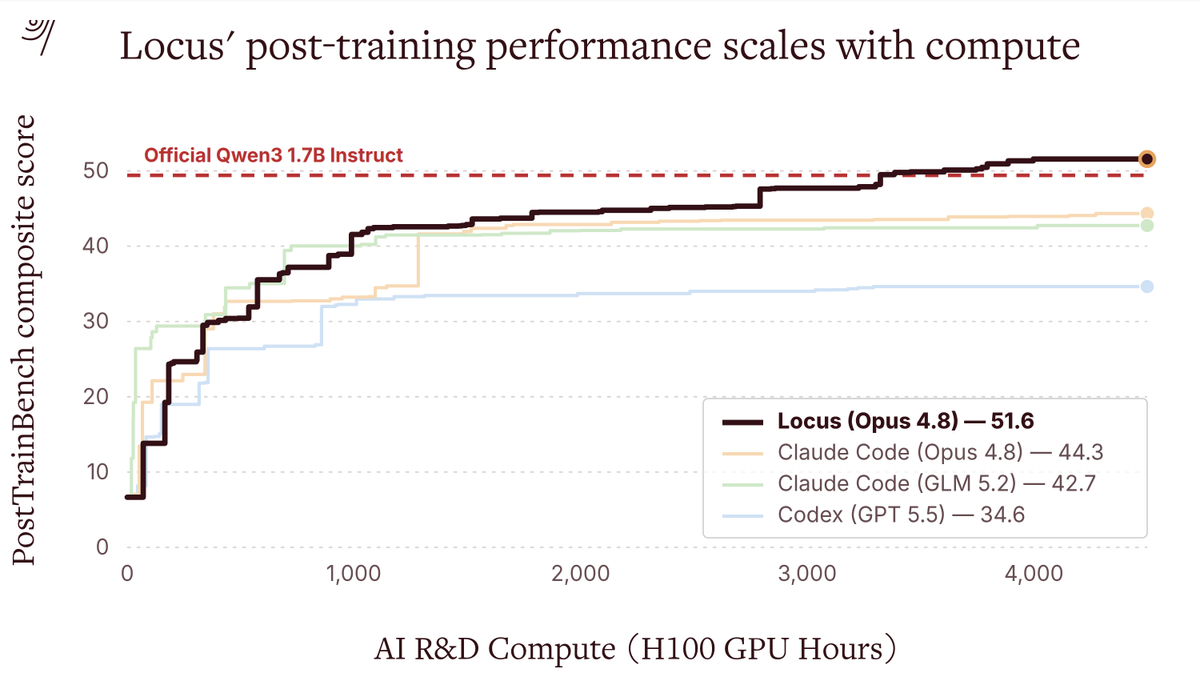
Locus, our automated AI research system, is SOTA on PostTrainBench and post-trains Qwen3 base models that surpass the human post-trained Qwen3 model.
Today, LLMs post-trained end-to-end by Locus are in production to millions. 🧵👇
PostTrainBench evaluates agents' ability to post-train models on various domains given 10 H100 hours.
We extend PostTrainBench via PostTrainBench+, which has a greatly expanded compute budget that provides clearer signal on automated post-training capabilities. We find that thousands of H100 hours help distinguish methods' performance post-training Qwen3 1.7B-Base models, and that Locus scales best. In this setting, modes trained by Locus collectively surpass the perforamce of the offical human post-trained Qwen3 1.7B model.
In a test of generalization, we ran Locus on all live Kaggle competitions with prize money and public leaderboards. After 16 days, Locus achieved the 4th highest average rank among all participants.
We just solved the biggest UX problem in AI.
Today, we're releasing AI Autocomplete, a SDK that gives every text box a brain.
It boosts your conversions by 50%+ by guiding your users as they type with what your product can do, and 500+ companies have already signed up.
So check it out if you have a search box or assistant.
Add it in under 5 mins ↓
https://t.co/NLgwtQTgoh
(or comment your product name, and we'll reply with a demo of it working on your product)
In Machines of Loving Grace, Dario Amodei predicts AI will give us "the next 50-100 years of biological progress in 5-10 years."
Last week at ICML 2026 I went looking for the one thing standing in the way.
It's not the models. It's not even necessarily the data.
Today we're releasing Synthefy Nori: a tabular foundation model for structured data.
→ Ranks #1 on aggregate across 96 datasets, ahead of TabPFN-3
> Beats tuned XGBoost & LightGBM on ~80% benchmark datasets, with zero training or tuning
→ 6M parameters, ~1/10 the size of its nearest peers
→ Fully open source: weights, inference, training code
Pass your labeled rows as context, get predictions back in seconds. No training. No tuning.
Built for the predictions businesses run on (demand planning, risk, pricing, churn, conversion)
Details to full release below. 👇
We want to make AI accessible for everyone, so we're reducing our API prices by ~50%.
Consumer AI growth is still blocked by model costs. 97% of consumer AI users will never pay. But every session still consumes tokens.
This is the math we've found every consumer AI developer is stuck with. The model pricing they're forced to use, was built for $300/mo enterprise seats, not $10/month consumer subscriptions.
So we're taking a step to solve this with reduced pricing across TTS, STT and LLMs.
Teams like Wishroll, Biblechat, Talkpal, and Luvu are already seeing 40-95% reductions in their AI costs.
Full breakdown on our blog: https://t.co/iHorIMMzk9
Pricing details in bio link.
Genetic engineering in human embryos is here.
Today, in a world first, @Columbia and @nucleusgenomics announce high-efficiency editing of human embryos.
The study, led by Dr. Dieter Egli's lab at Columbia University, with Nucleus Genomics’ Dr. Nathan Treff as a senior co-author, achieved editing efficiencies of up to 100% at targeted loci. Simultaneously, we showed no detectable editing-induced chromosomal abnormalities and low off-target activity.
In other words, this is the closest we've come to practical, high-precision gene editing in human embryos.
We are also excited to announce we will be funding and participating in the next phase of this research, alongside Columbia and Dr. Egli.
We see ourselves as a natural pathway for eventually bringing technologies like this into clinical care as part of a broader genetics platform — a full "Genetic Optimization" stack.
@nytimes broke the news in what is a historic moment for Genetic Optimization. See story in thread.
Can coding agents do research?
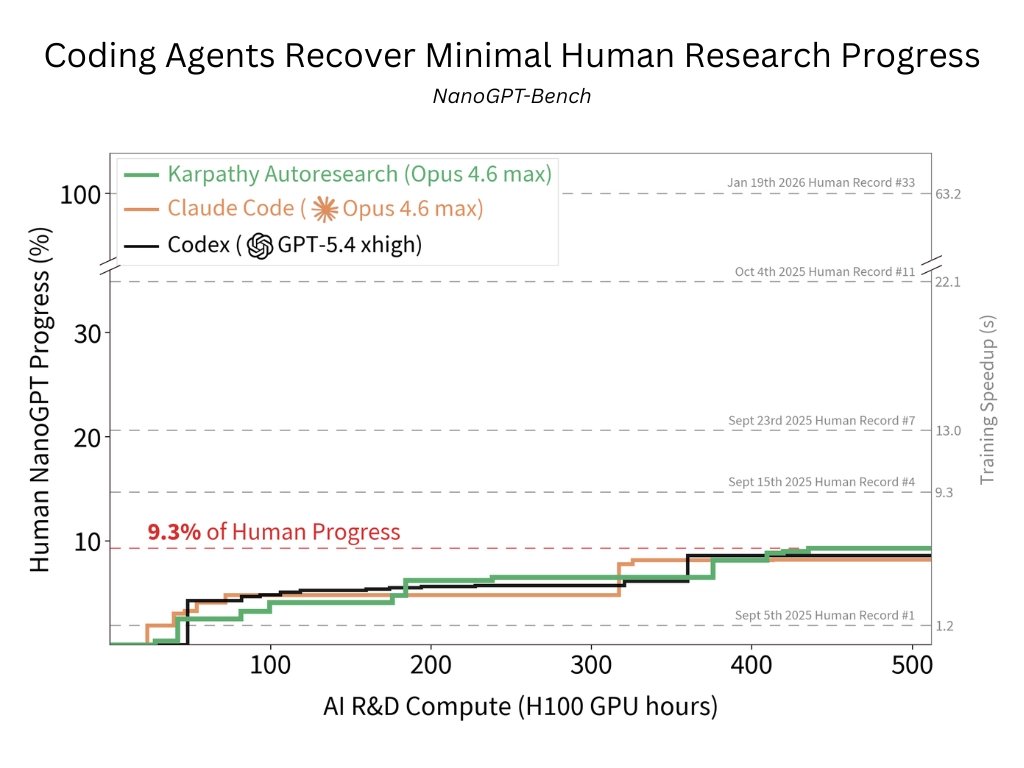
We release NanoGPT-Bench, an internal eval we’ve used to test agents on an AI R&D problem with months of human progress
Codex, Claude Code, Autoresearch recover only 9.3% of human progress, mostly tuning hyperparams & ignoring algorithmic research
NanoGPT-Bench is built on the NanoGPT Speedrun, a popular LLM pretraining competition to minimize the training time of a GPT-2 style model. Existing human submissions constitute nearly 2 years of work. To control for dependencies and contamination in frontier models, we standardize evaluation to a 5-month window of world records. Evaluation is fully autonomous and end-to-end, with no human intervention or internet access. 🧵
The most exciting thing about wearables is that we’re just scratching the surface rn. So many more biometrics to track - to get ever more accurate in measuring every patient’s personal baseline. Still so much work to be done
Thrilled that I got to brainstorm on stage at Women’s Health Week USA
Hollywood isn't dead. It's evolving. And we're leading that evolution.
We just shipped Koyal v2.5: The best Agentic AI filmmaking platform. It goes from your script or music to full video with consistent characters, settings & storylines.
Large Production houses, music labels & ad agencies use @KoyalAI for storyboarding & pre-viz.
Smaller studios use it for making content they never had the time, budget or resources to create.
Write a scene. Direct the camera. Build a world. @KoyalAI brings it to life.
Here's what's new:
- Go from script to video:
Write a scene with dialogue, pacing, emotion. Koyal fully realizes it. Using the best voice models on the planet.
- Direct the camera:
Push in. Pull back. Drift through a scene. Real 3D camera blocking. Shape the shot the way you see it in your head.
- Build a world that stays:Lock in a location and return to it. Your scenes stay consistent from the first frame to the last.
Plus: dialogue, SFX, annotations for editing, and more control over every shot.
Under the hood, we benchmark 40+ models weekly with real humans so Koyal always uses the best available (more on that next week!)
Our agents pick the best models for each scene in run-time so you focus on the story, we handle the complexity.
You don't need to prompt a film, you can direct it.
With Koyal, we're looking to replace the camera, not the filmmaker behind it.
Try it now at beta [dot] koyal [dot] ai
DM me for credits!
My slightly cynical answer is that the freedom should be structural and not philosophical. In other words, there shouldn't be anyone else in the org who WANTS to define your role for you. Your manager talking about a philosophical commitment to self-defined roles isn't enough, because they are still operating within a hierarchical org structure.
But a lot of the time self-defined opportunities arise in chaotic companies. So you need to decide how much chaos you are willing to deal with!
At NeurIPS I talked to a bunch of 20 year old researchers debating whether to found a startup, but waiting for conviction.
The problem is that "waiting for conviction" ignores both the disadvantages and advantages of being a young researcher.
Thread below:
6. TL;DR Conviction comes from action, not reflection. It is structurally impossible to have conviction at 20.
Don't waste your superpower - cognitive porosity.
Learn how to define your own success.
Learn how to live through failure.
If you miss the boat on this, you may never learn.
5. The one exception:
If you have the rare job offer that lets you define your role, build and fail in public, and grow your personal brand ➡️ take it.