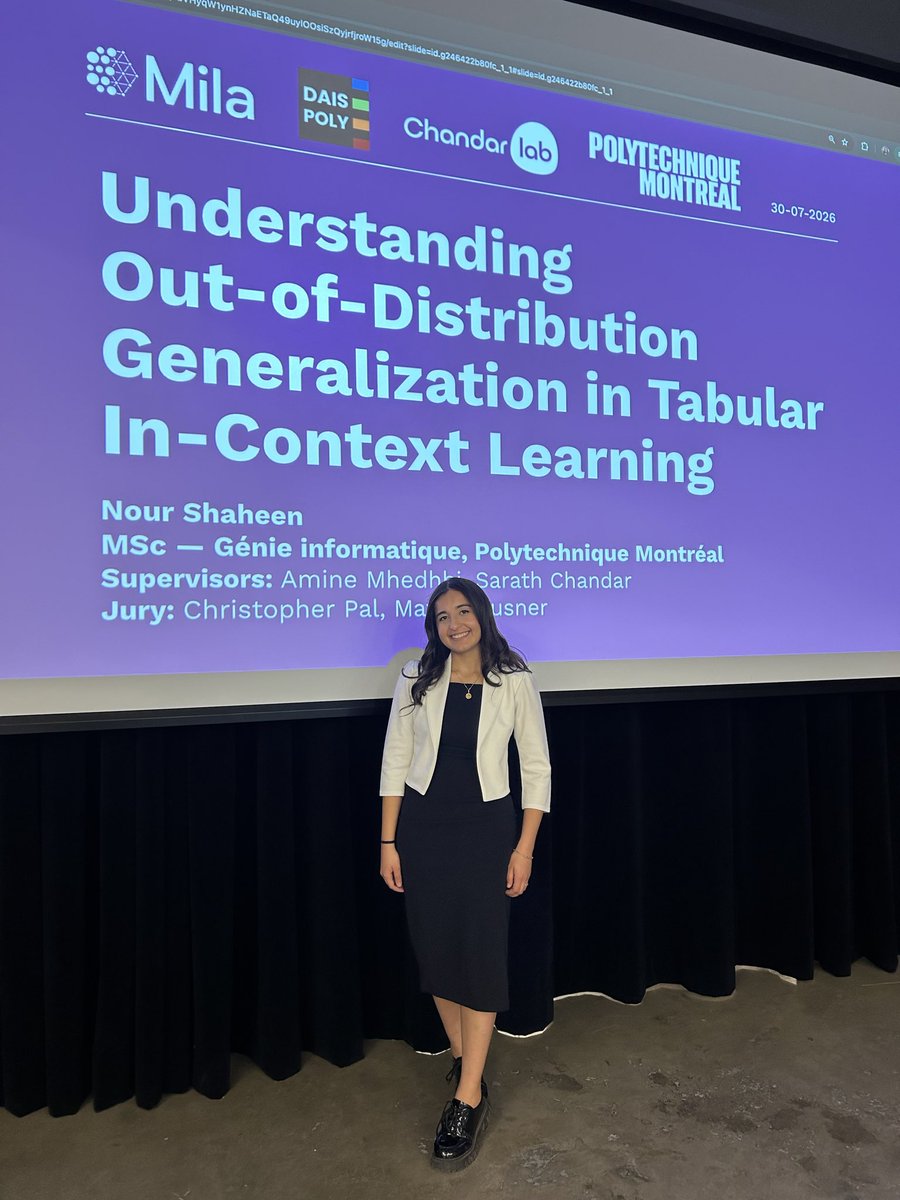
I am pleased to share that I successfully defended my master's thesis at @polymtl and @Mila_Quebec , titled: "Understanding Out-of-Distribution Generalization in Tabular In-Context Learning".
I passed with distinction and was nominated for the best Msc thesis award.
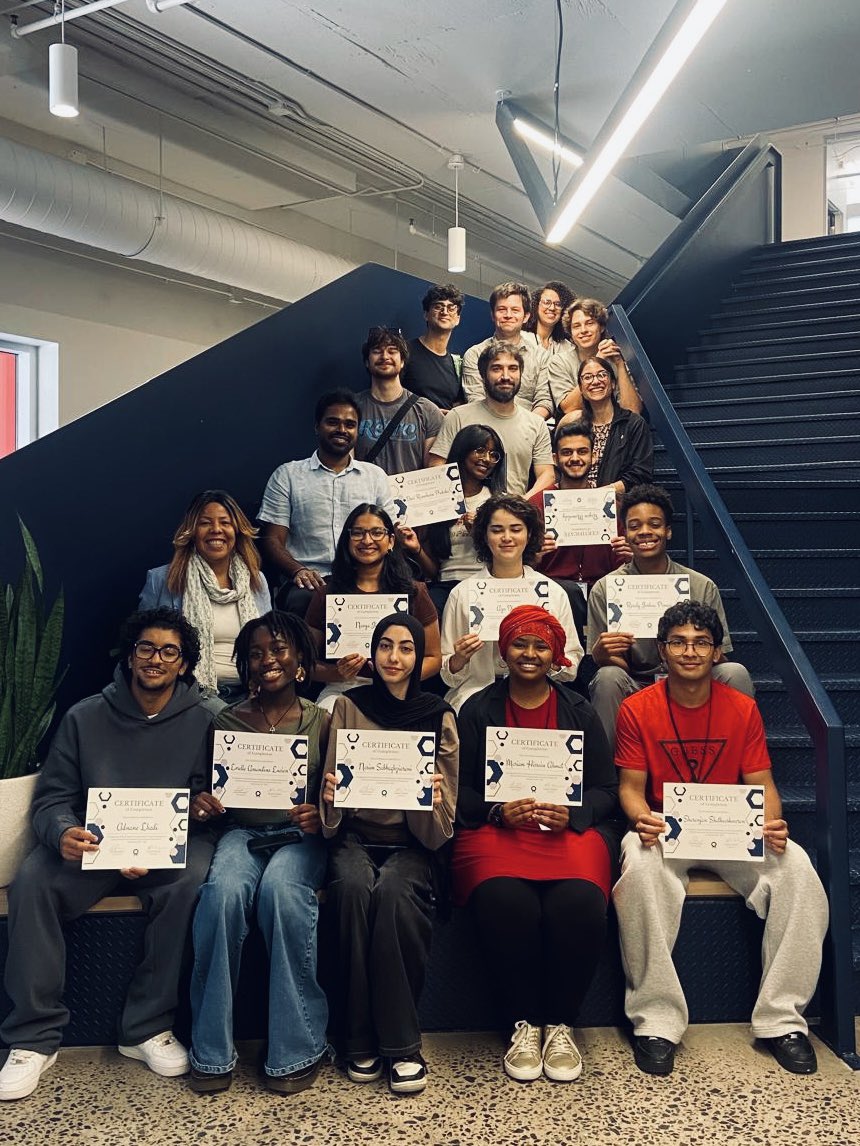
For the third year in a row, we held our annual Highschool Internship for recent graduates from across Montreal! 🎓🎉💻
Ten bright students underwent a month-long summer school and got introduced & coached on the basics of computer science and programming!
I will be attending @icmlconf and am looking to hire 2 postdocs: one in foundation models for biology (proteins/small molecules/genomics data/drug discovery) and another in RL (including continual RL, world models, and RL training for LLMs). Please do reach out to me if you are interested in these positions and attending ICML too!
We are super excited to announce @ChandarLab 7th Annual Research Symposium! 🔥
Join us on July 23–24 for two days of talks on deep learning, NLP, reinforcement learning, continual learning, and AI for science, plus a keynote by @mengyer from NYU!
Event is hybrid!
been messing around with the Unreal 5.8 MCP these past few hours lol and honestly? really into it
made a BP that generates a wall with whatever params I want — size, damage, rubble, all editable live 🧵 #UE5#gamedev
We’re excited to see the Research on Agent Language Models (REALM) Workshop returning to #EMNLP2026!
Huge shoutout to our PhD student @MaryamHashemzadeh for co-organizing. We’re looking forward to the conversations this workshop will bring to the agent language model community!
New paper from the lab:
Ask a base LLM to pick a random weekday, and it might output "Wednesday" 80% of the time. We show that this can be fixed and that probabilistic calibration is actually a trainable capability.
Diffusion world models can help test and improve robot policies before running them on real robots.
But can the choice of latent space make the WM more faithful?
We show that semantic spaces beat reconstruction spaces on task relevant metrics.
https://t.co/BwHZk7ciUQ
📣 Announcing the CoLLAs Seminars
A year-long exploration of one of the central challenges in AI: building systems that can learn continually, adapt in real time, and improve over their lifetime.
Join us on May 13th at 11 am ET as we kick off the series with Pulkit Agrawal speaking on “Rethinking Post training”.
ℹ️ Learn more: https://t.co/Xs7slVeIYK
✉️ Join our mailing list: https://t.co/m3WvA3EO2E
🔗 Zoom link for the talk: https://t.co/tqRtIEeSf6
We're thrilled to see the Workshop on Weight-Space Symmetries coming to #ICML2026! Huge shoutout to our postdoc @KateLobacheva for co-organizing it. We're excited for the ideas and discussions this workshop will bring to the community!
📢Excited to announce the Workshop on Weight-Space Symmetries @icmlconf! We welcome 4-page submissions analysing symmetries, their effects on training and model structure, and practical methods to utilize them.
Submission Deadline: April 24 (23:59 AoE)
#ICML2026
Quoting this from Aidan, who presented this as a talk to the lab last Friday.
If you think LLMs are unreliable for coding, this is the missing piece: reliability comes from how you structure the work around the model.
The article lays this out very concretely.
🧵↓
I wrote an article on agentic coding for beginners after my talk at @apsarathchandar@ChandarLab group. We cover history of AI coding tools, the importance of model harnesses, and general principles in simple research workflows.
Feedback is very welcome!
https://t.co/1G3B7Xyidk
In lifelong learning, continuously learning new tasks can cause ML models to forget previously acquired knowledge.
For this, our lab introduced TAG (Task-based Accumulated Gradients): a general wrapper on top of adaptive gradient optimizers. 📈
This week, as we celebrated International Women’s Right Day for the 115th time on Sunday, the Chandar Lab wanted to pay tribute to all the amazing women doing research👩🎓, and to highlight the cutting-edge work they do at our lab everyday...🧵
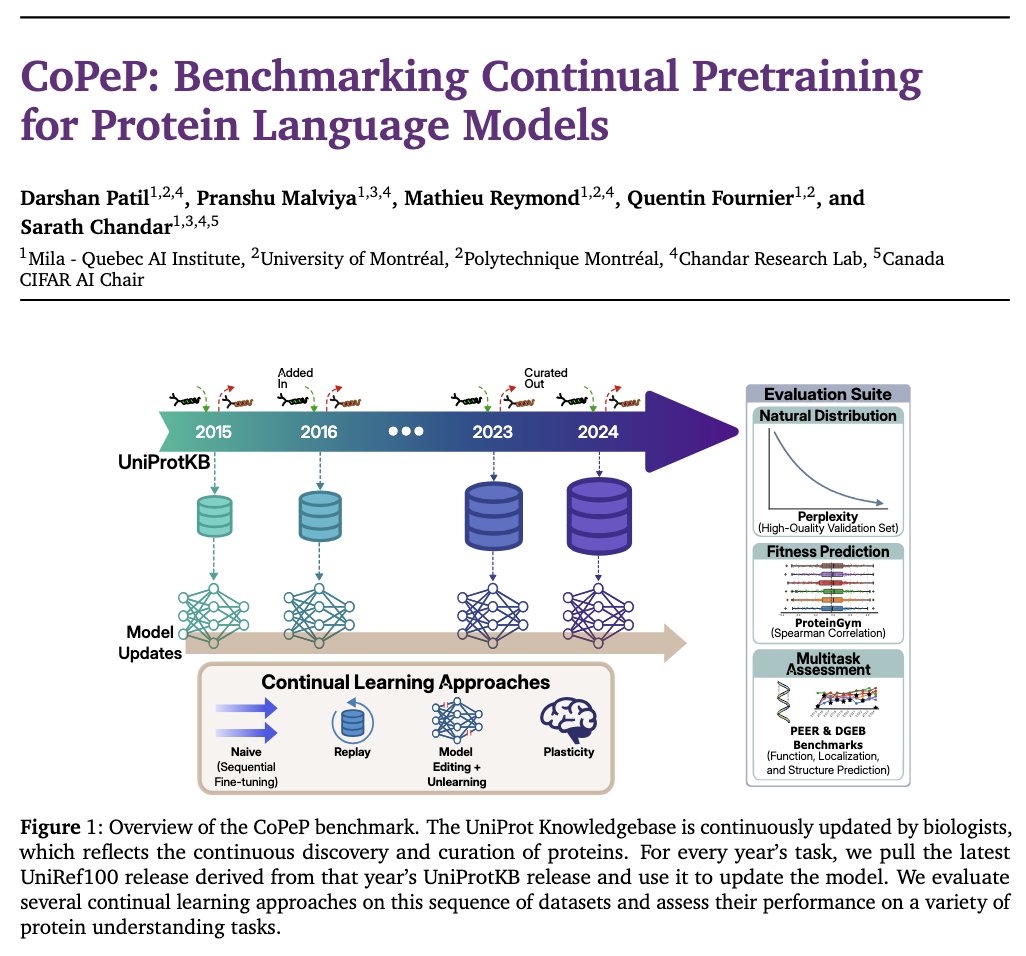
🧬 New paper
Scientific datasets evolve as science evolves. With proteins, new sequences get added, annotations get corrected, and noisy entries get curated out.
Introducing CoPeP, a continual-pretraining benchmark for protein LMs.
Details 🧵
1/n
Today, we’re celebrating Gabriele Prato as they reached a major milestone in their PhD journey and defended their thesis. 🎉
It tackles an underexplored limitation of large language models: knowledge consolidation.
The thread below explains what this means and why it matters👇