New paper from the lab:
Ask a base LLM to pick a random weekday, and it might output "Wednesday" 80% of the time. We show that this can be fixed and that probabilistic calibration is actually a trainable capability.
Overall, our results demonstrate that language models can be explicitly trained to behave as better probabilistic samplers, with gains extending well beyond the synthetic distributions used for supervision.
Extremely excited to share our recent work on diffusion world models. We ask a simple question - what space supports diffusion world modeling the most and how do we evaluate that?Turns out representation is the answer with JEPA space yielding the strongest diffusion world models!
Diffusion world models can help test and improve robot policies before running them on real robots.
But can the choice of latent space make the WM more faithful?
We show that semantic spaces beat reconstruction spaces on task relevant metrics.
https://t.co/BwHZk7ciUQ
Checkout the recent work on diffusion world models from our lab! The work studies a simple but important design choice: should the world model think in pixels reconstruction space or in semantic feature space?
Diffusion world models can help test and improve robot policies before running them on real robots.
But can the choice of latent space make the WM more faithful?
We show that semantic spaces beat reconstruction spaces on task relevant metrics.
https://t.co/BwHZk7ciUQ
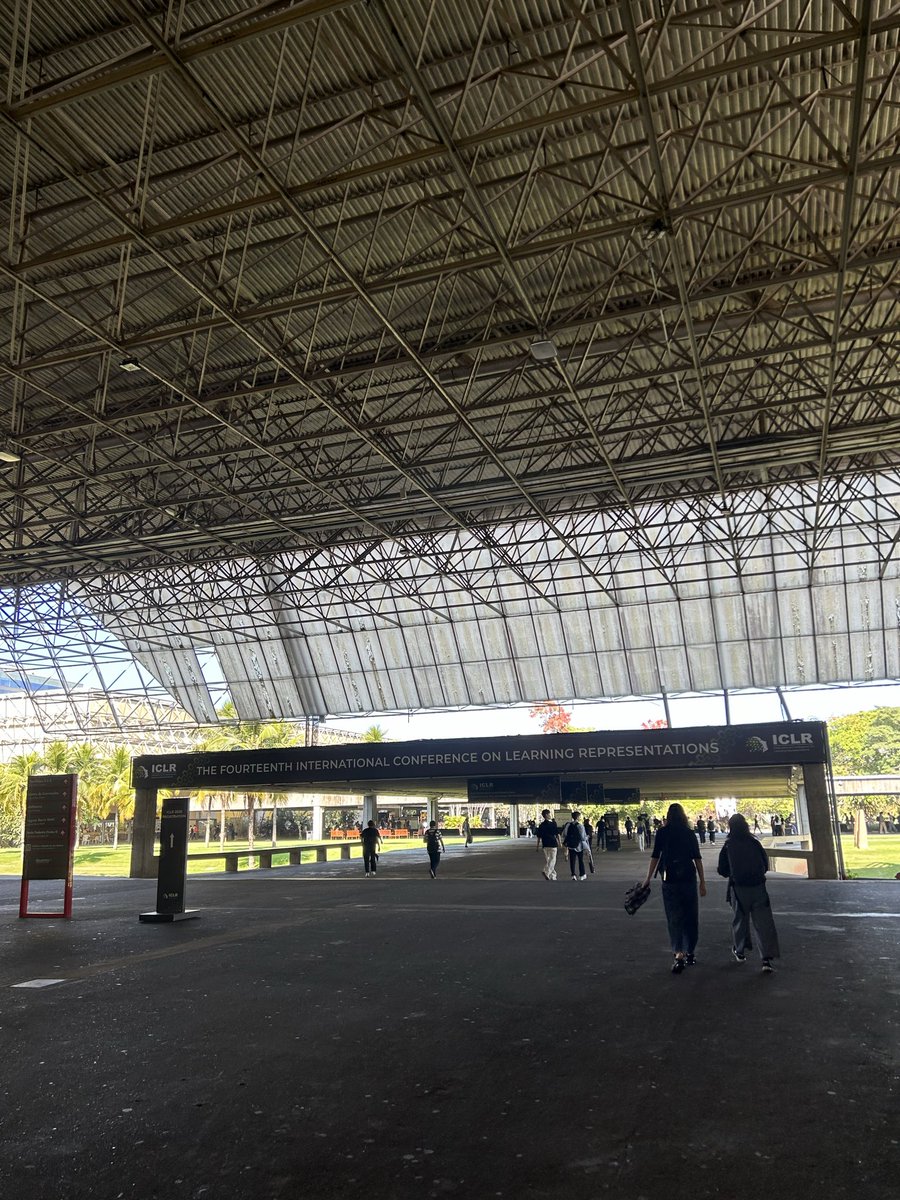
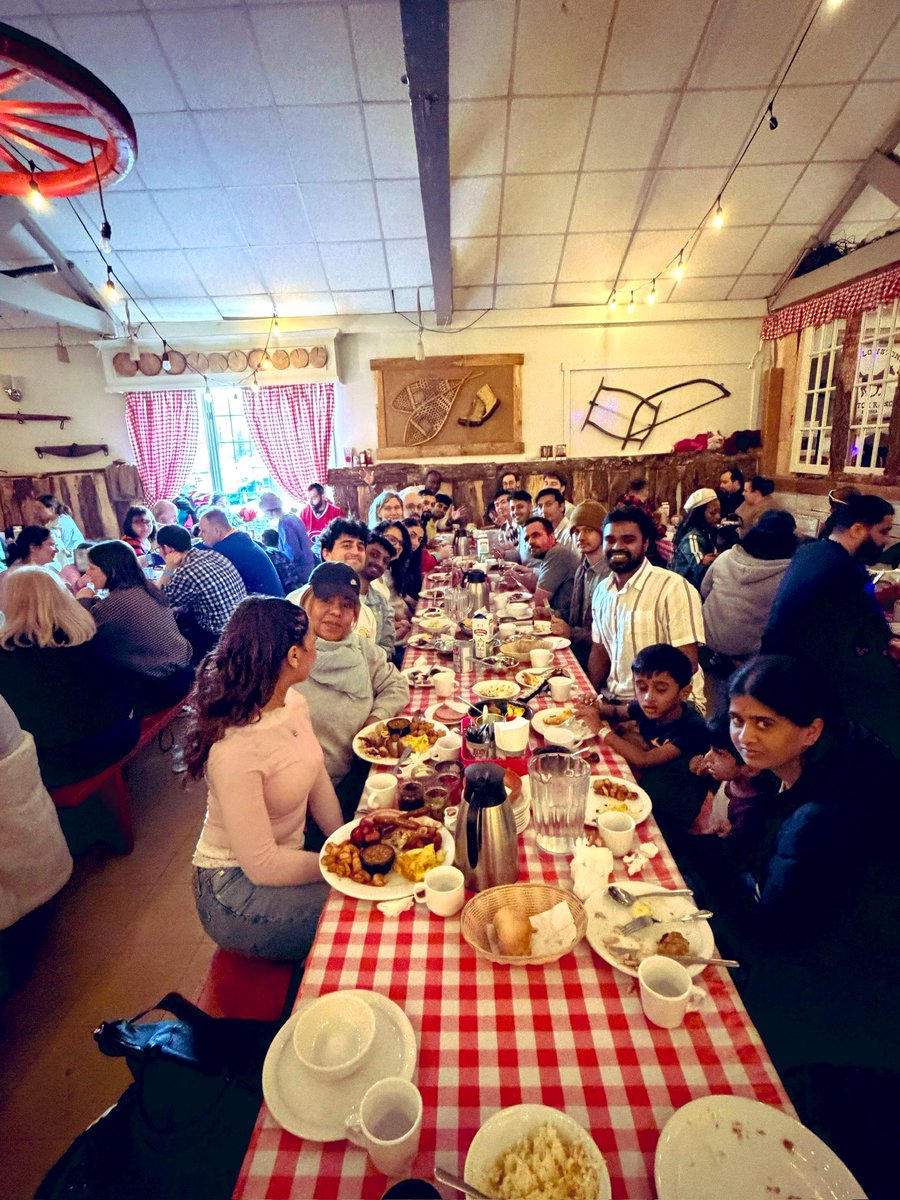
Still at #ICLR2026 and interested in training dynamics, simplicity bias, training under data distribution shift, and model merging? Come to our workshop posters to see what we are working on! 🧵👇
Want to know the expressivity of Mamba 3?
Come by our ICLR poster!
Sat, Apr 25 • 3:15 PM – 5:45 PM
Pavilion 4 P4-#4409
The Expressive Limits of Diagonal SSMs for State-Tracking
Joint work with Behnoush Khavari, Siamak Ravanbakhsh, and @apsarathchandar.
I'm in Rio de Janeiro for ICLR 2026! 🇧🇷
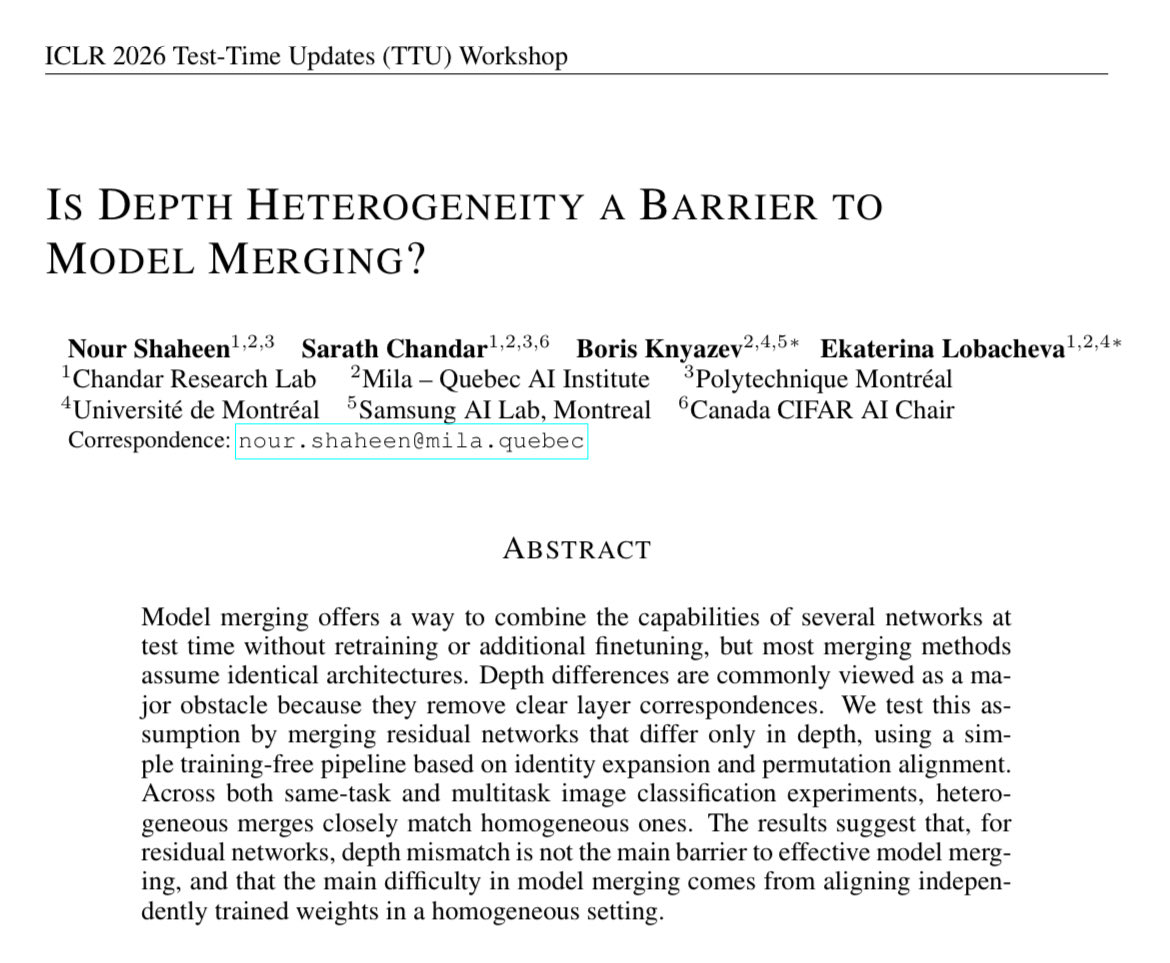
I will be presenting our paper "Is Depth Heterogeneity a Barrier to Model Merging?" (spoiler: not really) at the Workshop for Test-time Updates on Monday April 27th!
Please dm if you're there and you'd like to geek out about... (1/2)
📣 Announcing the CoLLAs Seminars
A year-long exploration of one of the central challenges in AI: building systems that can learn continually, adapt in real time, and improve over their lifetime.
Join us on May 13th at 11 am ET as we kick off the series with Pulkit Agrawal speaking on “Rethinking Post training”.
ℹ️ Learn more: https://t.co/Xs7slVeIYK
✉️ Join our mailing list: https://t.co/m3WvA3EO2E
🔗 Zoom link for the talk: https://t.co/tqRtIEeSf6
If you work in continual learning, adaptation, online learning, updatable ML, unlearning, model editing and any other form of non-stationary/non-iid learning settings, consider joining the @CoLLAs_Conf mailing list here: https://t.co/RkRNuAdt2A!
We're thrilled to see the Workshop on Weight-Space Symmetries coming to #ICML2026! Huge shoutout to our postdoc @KateLobacheva for co-organizing it. We're excited for the ideas and discussions this workshop will bring to the community!
📢Excited to announce the Workshop on Weight-Space Symmetries @icmlconf! We welcome 4-page submissions analysing symmetries, their effects on training and model structure, and practical methods to utilize them.
Submission Deadline: April 24 (23:59 AoE)
#ICML2026