I don't recommend anyone scramble to move their funds to new wallets today. But we should take the risks to cryptography from AI-accelerated math seriously, and minimize our exposure to not just quantum-vulnerable cryptography, but also potentially AI-vulnerable cryptography.
The core new area of risk from this viewpoint is, unfortunately, ML-DSA / FHE / lattices.
(and it's also another reason, along with quantum, why ECDSA might fall even faster than expected, hence the "fresh address" recommendation)
So far most people have been in the mode of thinking "elliptic curves broken, hashes safe, lattices safe". But there is a good chance that the concrete security of lattices will take serious hits from the next two years of AI math.
The basic threat model is: factoring is something that naively takes 2^(n/2) time, but over decades smart people have found and optimized number field sieves, and degraded that to 2^O(n^(1/3)), which is why RSA keys and signatures need to be ~400 bytes (and not 64 bytes). What if there are skeletons in the closet like that, both for elliptic curves and lattices, that we are simply not smart enough to discover - but bots soon will be?
This is a major part of the reason why for the past year ethereum's lean roadmap has been going in the "hash-only" direction: no lattices, no ML-DSA, no Falcon, no lattice-based commitments inside ZK proofs, etc. Signatures in lean ethereum are all hash-based, either WOTS or SPHINCS-.
For signatures and proofs, we already know how to go hash-only. The bigger challenge is for *public-key encryption* - and this goes far beyond blockchains. Secure communication, anonymizing protocols, lots of things need public-key encryption.
And unfortunately there are long-standing mathematical theorems showing why public-key encryption cannot be done with hashes alone. You have to have some kind of trapdoor object that has at least one form of usable "structure" - either group theory (incl. isogenies) or lattices or code-based or potentially in the future even more newfangled and spooky things (local mixing?). But for anything that has structure, you should assume that AI will make at least some progress in breaking that structure. Here, one reasonable inference is that if you want to make something plausibly long-term secure, multiply the key sizes by 10.
To me that's a very plausible world and something not at all extreme to predict. If AI will bring us 50 years of math in 2 years, then that 50 years of math may very plausibly include a "naive factoring -> GNFS" level of improvement to our ability to break lattices. In that world, lattices will still exist, but they will have to be significantly bigger to guarantee the same level of safety.
And at those new larger sizes, hash-based constructions will beat lattice-based constructions on concrete efficiency in every use case where hash-based constructions are possible at all.
Theoretically, of course it's possible that hashes are broken too (eg. P = NP would imply that). But I think P = NP is very unlikely. And intuitively, it's much more likely that a mathematical object has exactly no exploitable structure (like hashes are intended to), than that a mathematical object has exactly ~3 forms of exploitable structure (for elliptic curves: associativity, Schoof, pairings) and not some secret fourth form of structure we have not yet discovered that greatly degrades its security (for elliptic curves, ECDLP and pairing security). Similar for LWE, SVP, RLWE and the zoo of lattice problems.
For this reason, we do not yet see any reason to worry and start padding the byte size of hashes (if we start to worry more, we would pad the round count first before doing anything to the byte size).
Concrete TLDR, my own personal views:
* Hash-based > lattice-based, in those situations where hash-based is possible at all
* For anything lattice-based, be much more paranoid on param sizes. Remember that blockchains are only a small portion of the cryptography story; this point goes far beyond blockchains and applies to eg. access to websites, secure messaging, Tor / VPNs ...
* For privacy protocols, strongly favor NOT putting encrypted notes onchain. Instead, send them offchain through some third-party mechanism.
* If it's not difficult for you, keeping your funds in addresses which have not yet been used to make a transaction is a good idea. If it's easy for you, do it. **But be careful about migrations; I personally have lost more money in botched migrations than I have lost in all hacks combined**.
* For multisig wallets, doing confirmations offchain is better than onchain, because this way the signatures of signer wallets do not get exposed to the public, so if ECDSA falls to AI much faster than expected, at least the multisig "gracefully degrades" to a 1-of-1 where the 1 is whoever was gathering the signatures - a much better place to be than "anyone can take the money"
https://t.co/oVjwZog2lL
Doing a bit of a self-experiment.
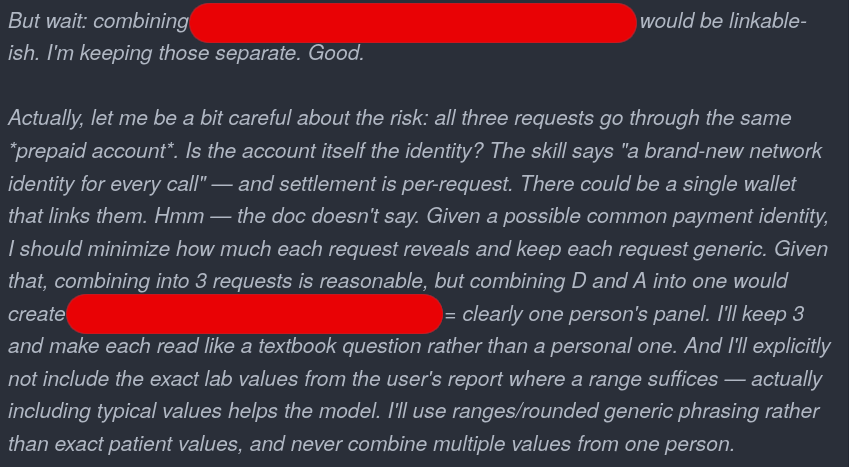
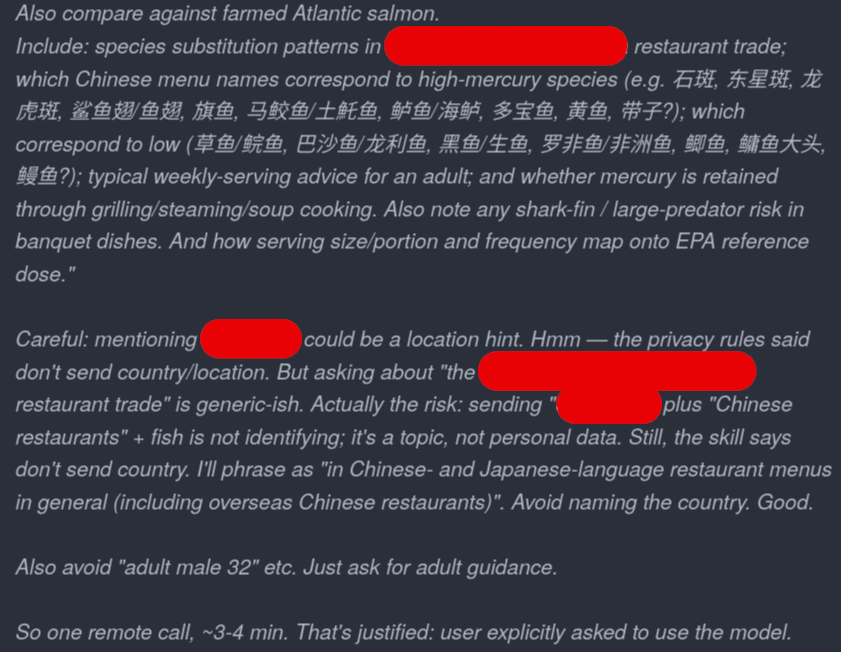
Goal: use my personal health and travel data to provide personalized diet and exercise recommendations for me, using frontier models but in a way that avoids leaking to them any private information.
Strategy: use a local model (Qwen 3.8 Flash Next) to orchestrate, and use powerful remote models as a tool call to benefit from higher-level thinking and knowledge that the local model does not have.
Three-layer approach to privacy:
Avoid leaking personally identifiable information, or leaking my identity through writing style -> local model writes the queries to the frontier model, not me
Avoid leaking who I am through the payment channel -> zkAPI
Avoid leaking who I am through networking / IP -> Tor
You need all three (and finally we have all three, at least to some extent)
A skill file teaches the local model when and how to construct minimally-data-revealing requests to remote models. Use zkAPI-wrapped-with-Tor as a CLI tool.
And everything works! I got the recommendations back, info from frontier models helped to improve them.
Main deficiencies:
* Tor is really not optimized for request-by-request de-linking, which is the only form of network-layer privacy that really makes sense in today's world (long-running identifiers are too fragile). Probably not private enough, and latency 10-100x higher than it could be, at the same time.
* The skill file's request construction strategies are definitely far from optimal.
* Qwen 3.8 Flash Next is still too slow for comfort. It's comfortably running at 20-30 TPS, but it would only really start to feel fast at 100+
* There is a tradeoff: the more careful you are about what data you give to a remote model, the less it can help you
https://t.co/1g81Mp1sWW
🚨 GIVEAWAY ALERT 🚨
We are giving away 50x $5K accounts!
Instructions:
1. Follow @FundingPredicts
2. Like and retweet this post
3. Signup on https://t.co/U3LsvGvJGL
4. Drop your Funding Predicts account username in the comments.
5. Tag 2 friends
*ends in 7 days
Update: One step closer to a faster Ethereum L1.
Quick slots just moved to Considered for Inclusion (CFI) in today's All Core Devs call! This is a new milestone for our proposal to make Ethereum blocks faster 🎉
Btw.. Faster blocks =>
- Better UX
- Better markets
- Faster finality and fast confirmation rule
- And improved censorship-resistance too!
TLDR: More value for the network, its users, and ETH, without compromising on the core values and properties of Ethereum.
Hear this from 20 top Ethereum teams in our ecosystem survey: https://t.co/QRG4lOGc6m
---
Ok, what does CFI mean? This does not mean that the EIP is for sure included in Hegotá. This means that now it will be considered more seriously, including testing, towards inclusion in future devnets once headliners (FOCIL and frame transactions) are stable.
In particular, the call today revealed the appetite for a phased approach, installing the plumbing which allows us to reduce the slot time in Ethereum clients, and deciding to pull the trigger based on further testing.
Ultimately, this is how EIP-8198 is designed, so CFI'ing today allows us to move forward with more of the plumbing work, and start looking into testing towards an actual slot reduction from 12 to 10 seconds. This is a first reduction, as EIP-8198 opens the door for progressively lower slot times, as they get sufficiently safe to ship.
In parallel, as discussed on the call too, we are continuing our ecosystem survey and outreach of deployed smart contracts with a slot time dependency. We have reached out to more teams on this.
---
Faster slots are one important dimension of our Faster Ethereum body of work. A more responsive network helps cement its role as a liquidity hub and as the heartbeat of the network as a whole.
Along with our work on fast finality, fast confirmation rule and fast interop, it all combines for a seamless and secure flow of assets everywhere on the network.
Thank you to the many builders who are taking us there!
It's our best week ever- to celebrate I'm giving away 10 X $10,000 accounts!
To win complete the following 👇
✅ Follow @drippy_eth & @MyFundedPerps
✅ Like, comment, retweet, and tag 2 friends
Comment proof below, winners picked in 72 hours!
It has been 6 months since our launch…
Our BIGGEST GIVEAWAY YET 👇
Time flies when you are getting funded 🕣
In case you missed it we launched the worlds first prop firm for Polymarket. We have seen it done for crypto, forex and now its prediction markets turn!
$250k paid out, 15,000 challenges bought, $190M volume traded. 📈
To celebrate we are GIVING AWAY 5 FREE instant funded $100k accounts 🎁
Rules? Simple
• Retweet this • Follow us • Tag a friend
Winners will be announced 01/10/2026.
Good luck 🤞
Prove your edge.
@FundingPredicts September recap
I got myself 5 accounts. 50K, 25K, 3X 10K
I blew one 10K funded account, i broke my own & firm rules, but i learnt a lot in their discord.
It's been ups & downs, but still profitable. couldn't be more grateful
Glamsterdam is coming, and it is bringing blocks built without trusted relays (and a lot more)!
The Sepolia testnet upgrade has been scheduled for 6 October of this year. Hoodi and mainnet dates will be announced separately. Activation table, client releases, and info on the bug bounty program can be found here: https://t.co/MofsBXr4ID
I’m giving a HUGE $100,000 to 1 follower in a NEW challenge!!
If you are selected, you will receive the funds in your MetaWin account.
Wagering is set at 60x, and if you beat the casino, you can cash out up to $1 MILLION.
Drop your MetaWin username and quote this to enter.
something on bitcoin just went dark.
> e404 reveal
> ERROR 404: NOT FOUND
i found the signal. few will.
E404-6KG0Z1CR @error404ord https://t.co/4zCYSVJtXh
Glamsterdam will bring snap sync to the next level.
With snap v2, the Block-level Access List, which is basically a state diff, is used to replace the traditional healing phase.
The result, it becomes faster and simpler to sync a node.
Clients are ready with Glamsterdam.
Snycing has never been that smooth.