Conspiracy theories are, very often, illogical. If AI companies were worried by open weight models (they probably are btw) the logical response would be to *not* slow down the development of frontier AI, to try locking the advantage. Stop with nonsense.
ARC-AGI-4 will be a benchmark for autonomous open-ended innovation. It will continue our commitment to open-source, giving the research community a shared target for progress that benefits all of humanity.
Despite rapid model progress, humans still significantly outperform AI at open-ended invention. This is the meta-skill that unlocks progress across every field of technology.
Advanced AI capable of scientific innovation will lead to tremendous new technology, knowledge, and understanding. This is a positive-sum future. We are deeply committed to advancing it.
Open source is the foundation for that progress.
The knowledge behind frontier AI, not just the technology itself, should be broadly distributed among researchers, academics, and organizations. Any coordinated effort by the AI industry to reduce openness or concentrate access to frontier AI would undermine that positive-sum future. We are committed to advancing a future where everyone can contribute to and benefit from AI progress.
AI makes it so easy to polish rough edges and smooth out your product experience. Yet pretty much every piece of software is falling apart.
Why? The devs building them don't care.
Software built by people detached from the users has never felt worse.
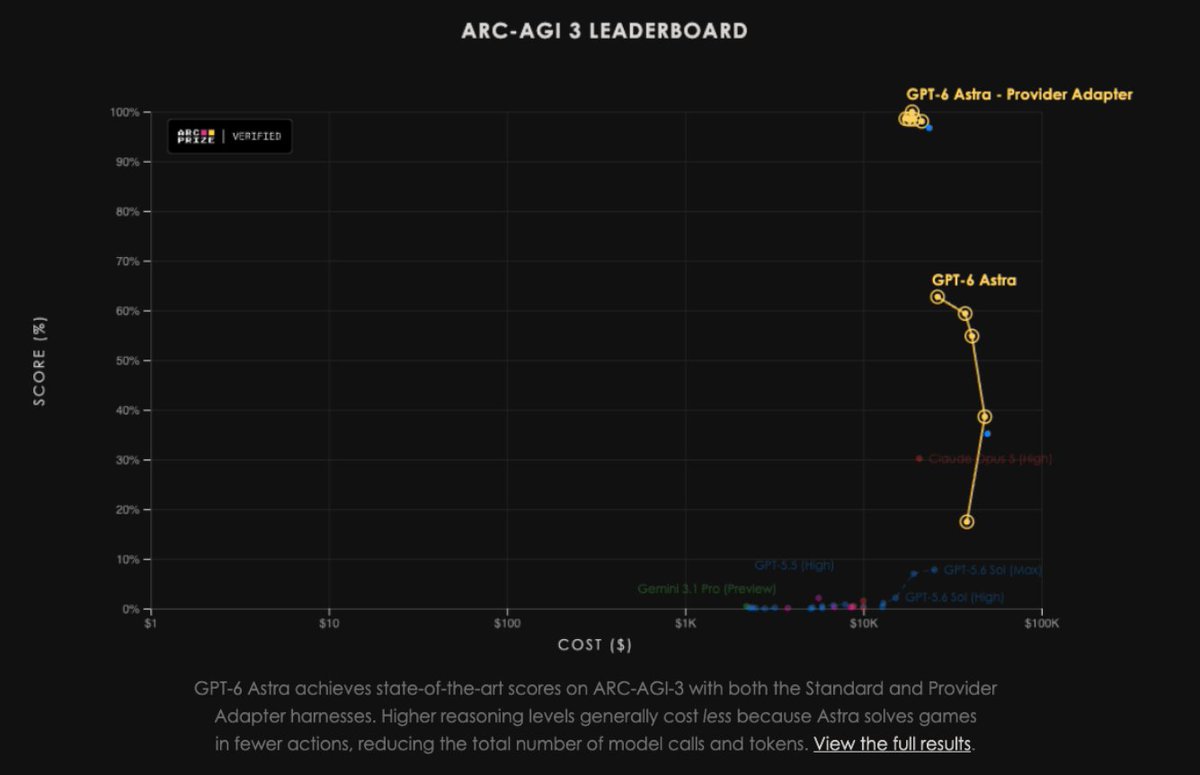
GPT-6 Astra represents a step-function change in model capability for interactive reasoning problems. It scores 66% on ARC-AGI-3 using our standard harness, and nearly 100% with a continuous conversation harness and custom compaction, at a cost of roughly $360 per game.
In fact, the continuous harness version significantly outperforms our human baseline in action efficiency across almost all levels. When we examined the reasoning chains to understand how the model operates, we found it performing highly efficient, on-the-fly symbolic world modeling for each game and level. It goes as far as developing its own shorthand DSL to represent in-game situations -- essentially a game-specific algebraic notation.
Overall, Astra exhibits symbolic modeling behaviors we had previously only seen with sophisticated harnesses -- so harness capabilities are increasingly shifting into the model itself.
We see Astra as a major breakthrough in model intelligence.
Read our post on Astra and what these results mean: https://t.co/wJnYxEqYNI
GPT-6 Astra by @OpenAI achieves SOTA on ARC-AGI:
- Astra scores 63% on ARC-AGI-3, 99% via a new provider adapter harness
- It surpasses human performance on 96% of ARC-AGI-3 levels
- It builds the most precise symbolic model of novel environments we've seen
Our analysis:
Omarchy is blowing up. I've never been involved with anything in my career that has grown this fast. With Ruby on Rails, we had years to build solid institutions, teams, and relationships. With Omarchy, we've been forced to figure it all out in twelve days. It's exhausting, but also incredibly exciting.
It was never sustainable with just Ryan and me running everything. That's how it was, more or less, up until Quattro. Lots of other contributors, but all the responsibility was on us to make sure the ship stayed afloat, the servers didn't crash, and fixes got pushed out quickly.
Now it's time to build a proper institution. Durable, resilient, and competent. That's what we're doing here on Basecamp now. I'm spinning up teams for every facet of responsible distro management, and I'm getting an absolute outpouring of interest for all of them. Everyone wants to be part of this. We're winning hearts, minds, and volunteers at an astounding rate. Great! We need all of it to succeed.
Because make no mistake: There are many people who'd love to see this rocket blow up before it reaches the moon. Aggrieved Linux users who don't like the sudden attention their exclusive hobby has received. Competing Linux distributions that are seeing our numbers explode. Mac stans who've sunk their identity into an apple. And, of course, any of the haters I've picked up in my quarter-century career speaking bluntly on the internet.
They're not going to succeed. Because we've already become unstoppable. There's too much momentum, too much money, and too much support now backing this effort. We're living the Mandate From Heaven meme at the moment. And we are here to fulfill the prophecy: The Year of Linux on the Desktop!
That has been a joke for two decades. But by the end of the year, nobody at Apple or Microsoft is going to be laughing. They're going to be scrambling. Because neither of these proud organizations currently has any method to counter the speed, vision, or ambition with which we're going to accelerate into the future of personal computing.
This is the moment. This is the opening. This is our chance.
For thirty years, we've been subject to one OS overlord or another. Dictating how we compute. Choking off competitors through platform malfeasance. Tollboothing the distribution. That ends now. Because Linux is going to win. And Linux is free. As in beer, speech, and source.
But just because it's inevitable doesn't mean it's going to be easy. We have a lot of work in front of us if we actually want to make our mark. But there's never been a better time for this kind of delusional ambition. The age of agents is the unlocking factor. It sounds like a LinkedIn slogan, but it's true. Where the application of tokens goes, the innovation follows.
We can fix everything.
Let's do it together.
Let's go.
---
This is what I sent to the dozens of new volunteers who've signed up for teams within the new Omarchy organization yesterday. But we might as well broadcast our mission and intentions to the world too.
@pamelafox Interesting! I was doing sth similar but much less structured on my own:
- docs/requirements/ with customer requests and external info
- docs/plans/ and ../completed/
- docs/handoffs/ for human artifacts.
I'm missing a way to manage many plans. I'm definitely going to try this!
For a non-software engineer this announcement won’t mean all that much.
For software engineers: he’s building a core primitive necessary for human/agent work.
Pretty sure @mitchellh + team will be building an AI-native “agentic operating system” that sits a level above OSes
Claude and codex have gotten to the point where they invent their own project specific vocab. I use the Simplified Technical English prompt often when it gets out of hand.
That seems to reasonate, the community put together skills and guides based on that idea
Claude skill:
https://t.co/vFecMjo9MQ
STE skill kit:
https://t.co/Qi8rxXWXPD
Writing styles:
https://t.co/xXjkp6Jv8A
Runbook skill:
https://t.co/j5MHAaz3Kz
STE checker:
https://t.co/XnUmPLuvCG
Enjoy! Happy slop combat
Something I have been thinking about: in the past, the best engineers I knew spent a lot of time automating their work in various ways. Better vim/emacs automations, writing lint rules to catch repeat code issues, building up a suite of e2e tests so they don't need to smoke test the app manually. These kinds of things were the highest leverage activities an engineer could do, because it multiplied their own output, which in turn meant they could build more things.
I think many of these automations have become even more important now. This is true for a number of reasons.
First, infra and DevX automation speeds you up. And if you are running an army of agents, each of those agents will be sped up also. More automation == more output per unit of time.
Second, moving things to code improves efficiency. Your agent could fix an issue every time it sees that issue happen, but that uses tokens and might miss cases. If Claude instead writes a lint rule, CI step, or routine, that class of issue can be fully automated forever. This is really what people are talking about when they talk about loops -- it's about automating entire types of busywork rather than solving them one off. This isn't a new idea at all. Engineers have been doing this for a long time!
Third and most importantly, automation makes it possible for others to contribute to the codebase more easily. Increasingly what I am seeing is engineers are contributing to codebases on day one because Claude can navigate the codebase for them, and that non-engineers are able to contribute to a codebase as effectively as engineers can. What gets in the way of both of these is domain knowledge that lives in peoples' heads rather than in automation -- the stuff you used to have to learn when ramping up. What has changed thanks to agents is the domain knowledge that can be encoded as infrastructure is no longer limited to what is expressible in lint rules and types and tests; it can now capture nearly all domain knowledge, encoded as code comments and skills and CLAUDE.md rules and memories. If I put up a PR for an iOS codebase I don't know and a code reviewer rejects it because it doesn't use the right framework, or if a designer builds a new feature and it gets rejected because it doesn't follow the right architectural patterns, these are failures of automation.
Every team should be writing the CLAUDE.md's, REVIEW.md's, skills, and docs that enable agents to productively work in their codebase with zero additional context from the prompter. This sounds crazy, and at the same time is a natural extension of the stuff engineers have always done: automate, and encode domain knowledge as infrastructure. As the model gets smarter and as the harness matures, this task becomes easier. In the meantime, it is on every team to look for ways to convert their domain knowledge to infra so that Claude can write code better, so that code review catches issues automatically, and so the next person working on your codebase can contribute more easily.
@thsottiaux Banked reset!! You could make a counter of millions of users somewhere on the website, or the app. Maybe a sort of funny/gamified progress line that pre announces all the gifts at every milestone
actually, it appears recent new contract Codex MultiAgent V2 does not allow selecting a different model anymore... I guess I had an old version of Codex app? I hope it's temporary and getting implemented
gpt 5.6 Sol is much better at delegating work intelligently to cheaper subagents
Before I was doing the opposite: asking the model to write an email to a senior dev for advice
Task delegation has a lot of potential, it's clear that it should be done flexibly by the model itself
"An agent-first Internet with Internet-scale settlement built in..."
"...x402 is an open protocol that makes it possible to pay over HTTP ... the buyer needs no account with the seller, because the payment itself is the credential..."
We're opening the waitlist for our Monetization Gateway, which will allow you to charge for any web page, dataset, API, or MCP tool behind Cloudflare. The charges will settle in stablecoins over the x402 open protocol. https://t.co/pvICtEIixj