The National Digital Masterplan (NDMP) for the country will be approved by the National Digital Commission, which includes representation from each province. Indeed, provinces are the most critical stakeholders in its success and the flame keepers of Pakistan's digital future.
In relation to this, the Pakistan Digital Authority (PDA) held a meeting at PDA Headquarters with Agha Suhail Ahmed, Secretary, Science & Information Technology Department, Government of Sindh, and Ayaz Ahmed Uqaili, Member IT Industry Development.
The meeting was chaired by @sohailmunir, Chairperson, Pakistan Digital Authority, and brought together senior leadership and technical experts to discuss the following:
🔹 National Digital Masterplan (NDMP): the proposed national framework, covering 14 priority sectors, and collaborative development with the provinces.
🔹 Cybersecurity & Digital Resilience: national cybersecurity capabilities, AI-enabled threat detection and institutional readiness against cyber threats.
🔹 AI Governance: responsible AI adoption through human oversight, transparent governance, AI observatories and auditable AI systems.
🔹 Data Governance & Protection: consent-based data sharing, interoperability and alignment with the National Data Governance Policy.
🔹 Digital Transformation in the Public Sector: reforms in public procurement and development planning, and the integration of digital transformation components into government projects and policies.
@ShazaFK, Federal Minister for Information Technology and Telecommunication, has made provincial ownership and meaningful participation in shaping the National Digital Masterplan a key part of her ministry’s agenda and has recently visited Sindh, Balochistan and KP related to this. She has impressed upon PDA to work with the principle “those who work together go further”, and that the federal government and provinces can combine different skills, perspectives, and accountability to solve harder prob
The Government of Sindh's engagement will be instrumental in identifying provincial priorities and ensuring alignment with the NDMP. The meeting reaffirmed the importance of sustained institutional collaboration to build a digitally empowered Pakistan.
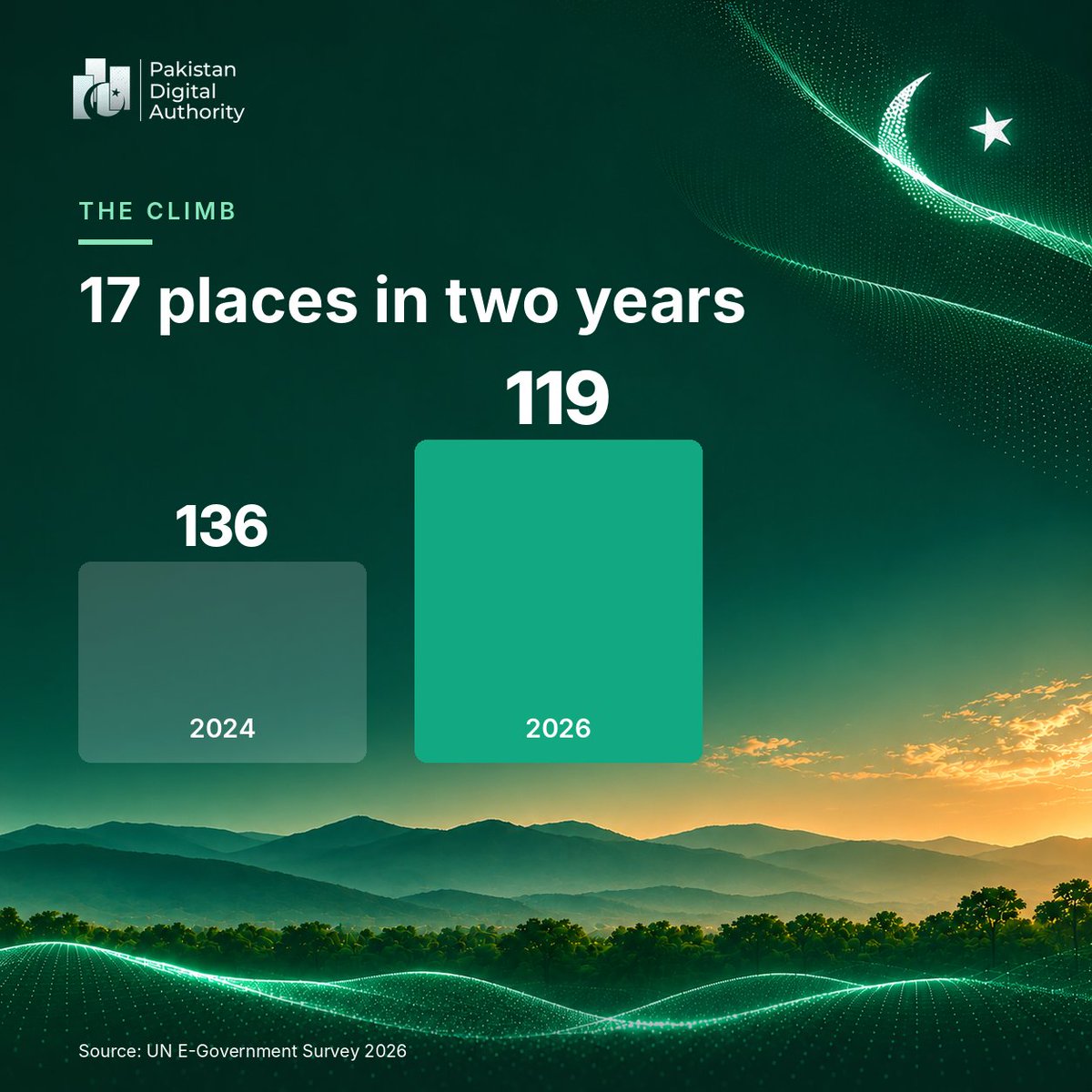
Congrats! Pakistan ⬆️17 places in #UNEGDI 2026
EGDI +23%
Online Services +20%
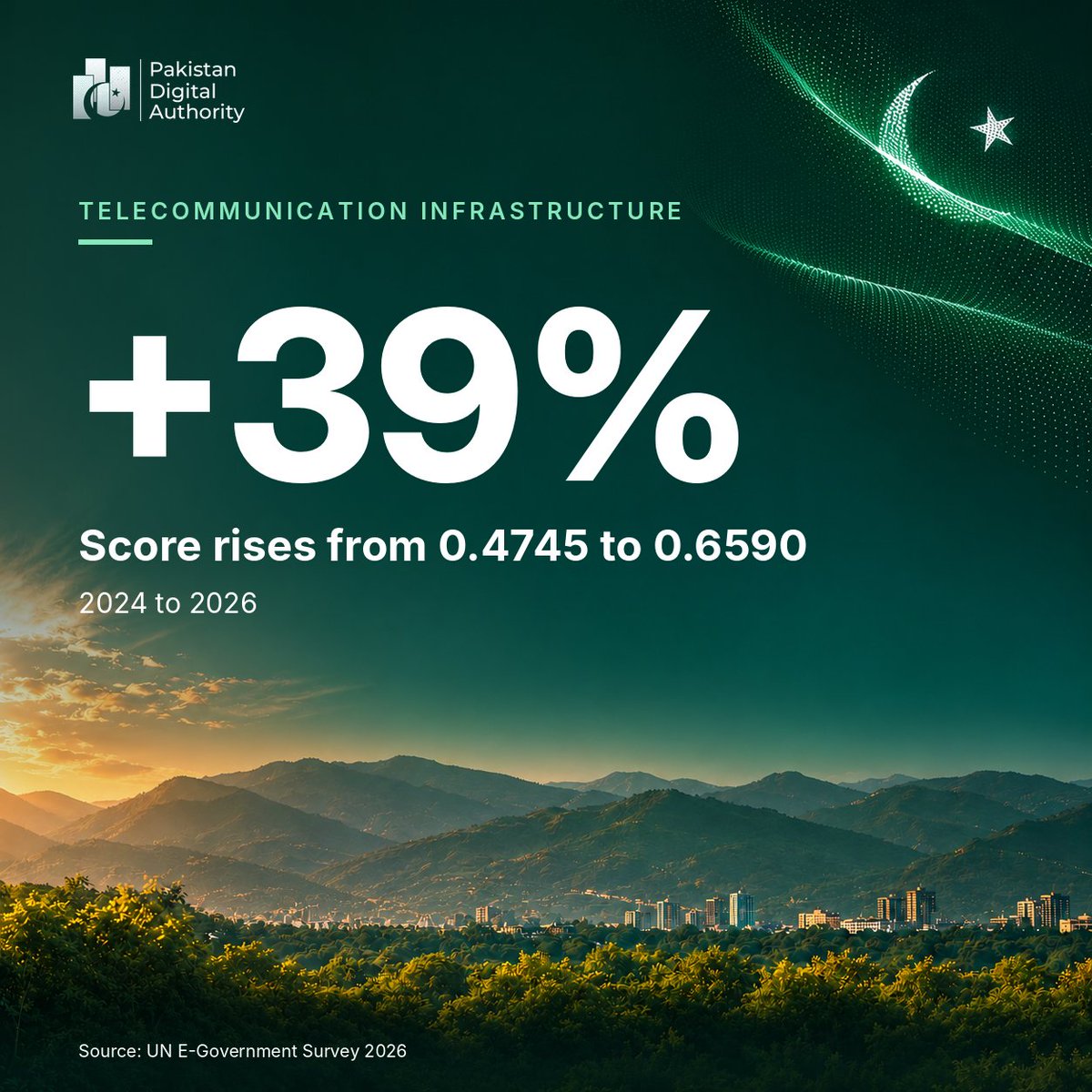
Tel Infrastr +39%
Human Capital +8%
Thank u @CMShehbaz for ur leadership n to my teams for all the support!
ہمارامشن:ڈیجیٹل پاکستان،جہاں ٹیکنالوجی ہرشہری کی زندگی کوبہتربنائے۔
#DigitalNationPakistan
Every child deserves a digital world that protects them as much as it empowers them. This Children’s Day, under the Prime Minister’s Digital Nation Pakistan vision, PDA reaffirms its commitment to building safer digital spaces for Pakistan’s youngest citizens.
The Federal Minister of IT & Telecom @ShazaFK has given Pakistan Digital Authority one guiding principle, all public services need be built with the citizen at center. For the merchant’s journey, that means speaking to merchants and researching the sector around them before deciding how to optimize his value chain.
With that in mind, the PDA Citizen Experience team and the Commerce Sector team carried out fieldwork and ran a workshop with participants from banks, payment providers, government bodies, distributors and merchant representatives. The ultimate goal is to digitize their core workflows to remove friction and improve related economic outcomes.
During the fieldwork, shopkeepers, distributors and small manufacturers told us how they raise money when stock runs low or a bill falls due, who they approach first, what happens when they go to a bank, how registration actually went, and what they make of digital lending and the formal schemes meant for them.
The workshop on digitising lending and merchant registration, held on 11 November 2026, followed the fieldwork. It was facilitated by Moazzam Kamran, Executive Director, Digital Innovation Lab (SME and Industries); Osman Nasir, Advisor, National Digital Masterplan Governance; Saadullah Javed, Head of NDLS and Coordination; and Kishwer Ali, Innovation Analyst.
The room worked through three activities. First, mapping where merchants get stuck: registering a business, opening an account, taking payment, buying stock, borrowing and staying compliant. Participants then voted on the problems that hurt merchants and lenders at the same time. Second, proposing fixes for the problems that scored highest. Third, ranking those fixes by impact and effort.
Running through all three was the question we kept returning to: what should be digitised, what should be left alone, and how anything built has to work for the merchant and for the bank or provider on the other side.
As we work on building the digital transformation plan for the SME and Commerce sector, what gets built next should be intuitive to the people living the problem.
Our thanks to @easypaisa, @KarandaazPK, Digital Miles, Tasdeeq, SMEDA, the Ministry of Commerce and the @PakBanksAssoc for their participation in the workshop.
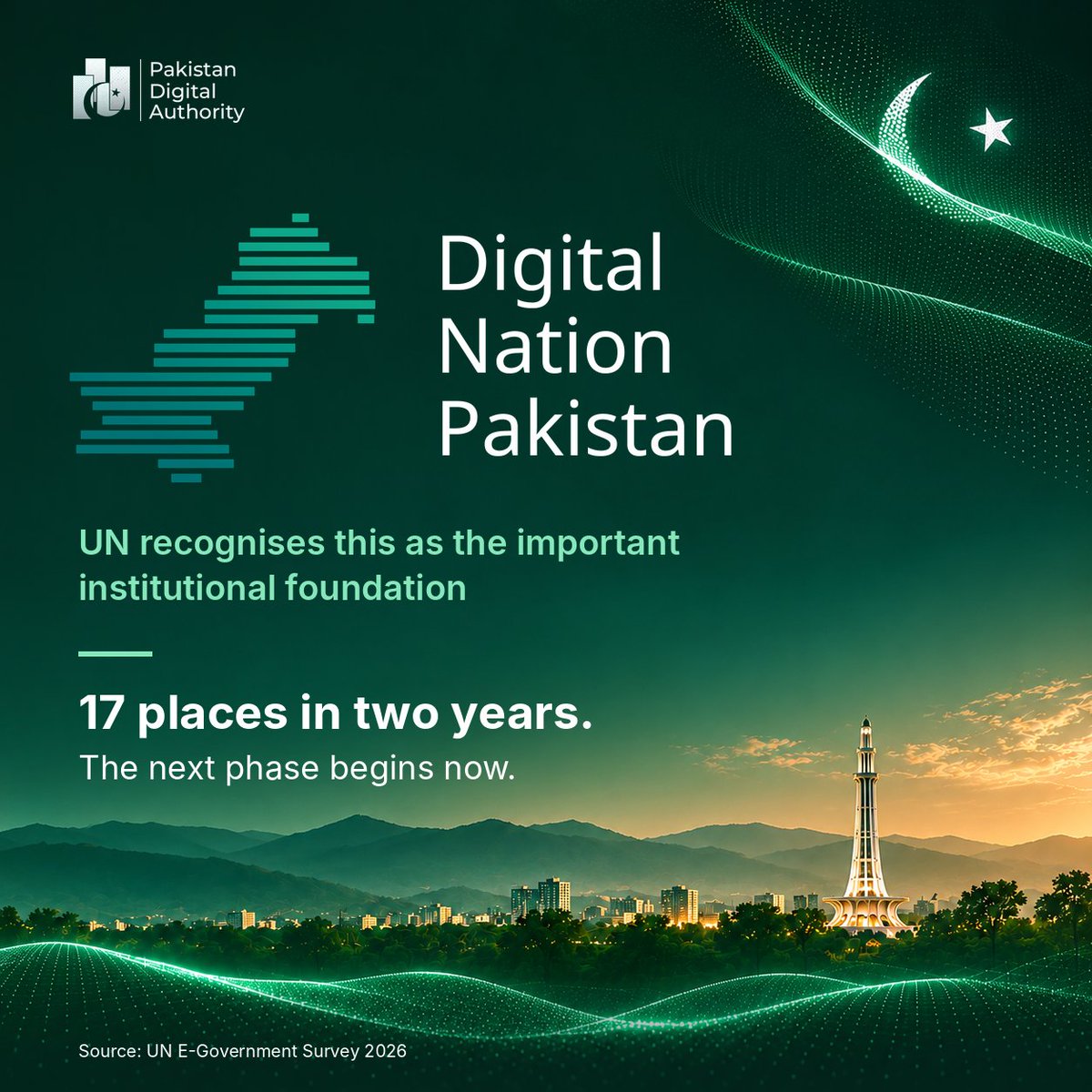
The @UN E-Government Survey 2026 was just published. Pakistan is up 17 places from 2024 and 31 places since 2022. Pakistan is improving, and the world is taking note of what has been built and whether citizens can reach it.
Congratulations to the Prime Minister, @CMShehbaz , whose Digital Nation Pakistan vision put that architecture in place and is now showing numbers no one can argue with. And to @ShazaFK Federal Minister for Information Technology and Telecommunication, who has carried the mandate through the machinery of government ever since.
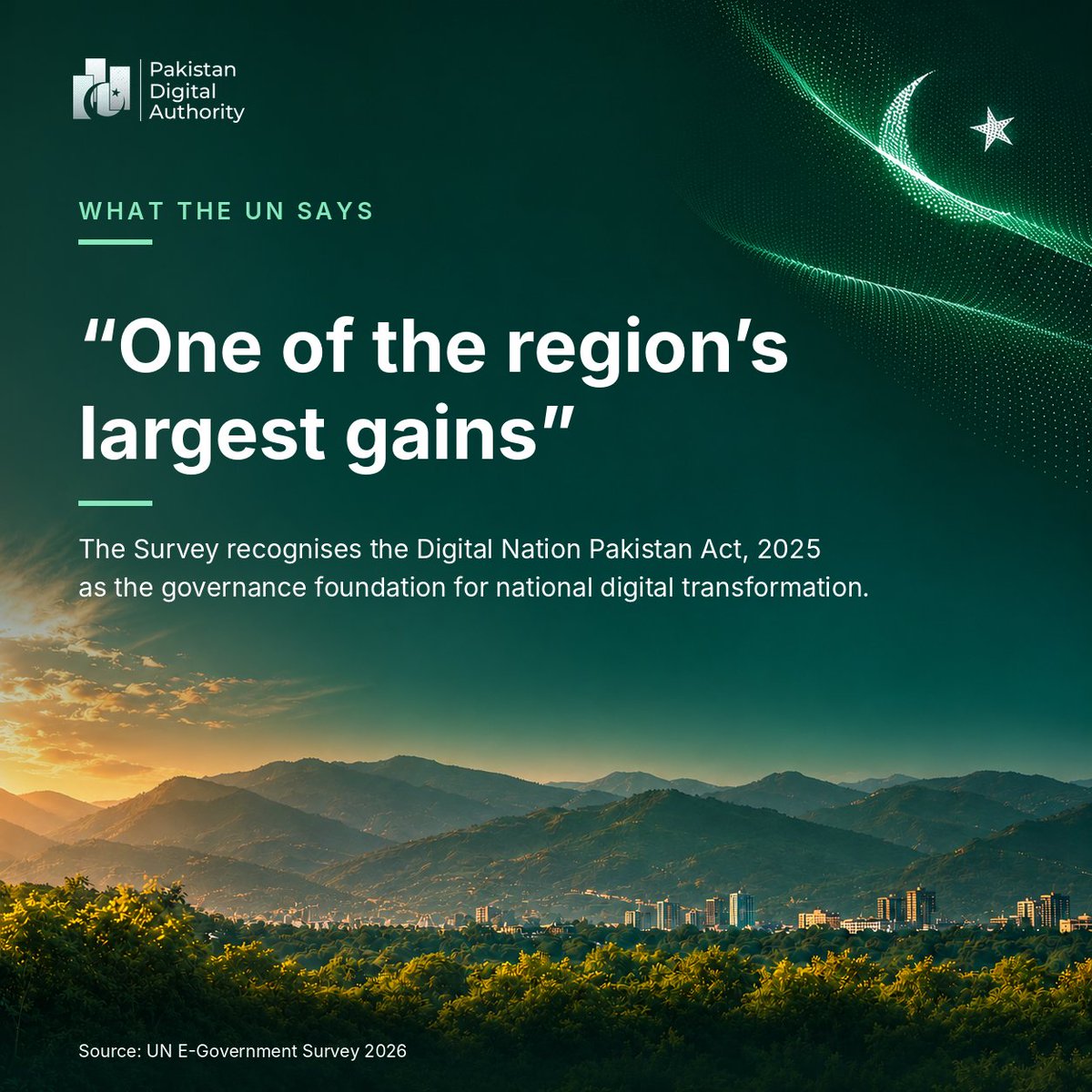
The Survey records that Pakistan “posts one of the region’s largest gains”. It then names the reason. Pakistan’s improvement, is through "the enactment of the Digital Nation Pakistan Act, 2025, which establishes a more formal governance architecture for national digital transformation.”
That Act created the Pakistan Digital Authority. Under it, PDA is mandated to deliver the National Digital Masterplan, build and operate the country’s shared digital public infrastructure, govern how public data is classified and exchanged, and hold federal and provincial institutions to one set of standards.
What these numbers show is a starting position. The next phase of the Digital Nation agenda is connectivity, skills and services reaching every part of the country.
@MoitOfficial@sohailmunir
A delegation from the Pakistan Digital Authority’s Strategy, Product and Delivery Wings visited @ministry_law for a Process and Requirements Discovery Session under the Machine Readable Legislation (MRL) initiative.
A child’s life online does not stay inside one institution’s mandate. The response to the harm they face cannot either.
The Pakistan Digital Authority (PDA) joined the Seminar on Mental Health of Children and Adolescents in the Digital Environment at @OfficialAIOU, organised by AIOU and the @RFInterventions in collaboration with the Mental Health Strategic Planning and Coordination Unit (MHSPCU), @PlanComPakistan. The discussion built on a recent report by @UNESCO's International Bioethics Committee.
Dr. Reham Baig, Senior Analyst, Digital Innovation Lab (Health), represented PDA on a panel that brought together @MoitOfficial, @NCRC_Pakistan, @PTAofficialpk, @PKCERT_official and @UNICEF_Pakistan.
Each of these bodies holds part of the picture. Schools notice changes in behaviour. Health facilities see the distress. Regulators deal with the platforms. Child protection agencies handle the cases. Today these systems rarely talk to each other, so a child at risk can be seen in pieces by several of them and fully by none.
PDA’s point was that this fragmentation has to give way to interoperability. Right now, a family often has to raise an issue with several offices separately, retelling their story each time and waiting on each one. In a connected setup, a warning sign picked up in one place would reach every relevant department at once, securely and with the child’s privacy protected. A single alert instead of many complaints, with identification, referral and psychosocial support working as one pathway.
For the child, it should not matter which door the concern came through. The response should be the same.
Coordination between institutions is a good start. What children need is coordination between the systems those institutions run.
Digital transformation of the public sector is a governance question before it is a technology question.
@sohailmunir, Chairperson, Pakistan Digital Authority (PDA), delivered a special address on “Transforming Pakistan into a Digital Nation” at the 5th Pakistan Public Sector Conference (PPSC) 2026, organised by @ACCA_PK.
In his address, he highlighted the growing importance of digital transformation in shaping Pakistan’s institutional landscape, strengthening public-sector governance and building a more efficient, transparent and technology-enabled state.
Dr. Sohail emphasised the significance of embracing emerging technologies and digital innovation, and underscored the need for a forward-looking national approach to harnessing technology as a catalyst for public-sector reform, institutional resilience and sustainable development.
While advancing the case for digital governance, the address also set the context for a discussion on “Government Finance in the Age of AI”, which explored the transformative role of artificial intelligence and related technologies in the future of public financial management.
Through platforms such as PPSC 2026, ACCA Pakistan continues to facilitate meaningful policy dialogue, encourage cross-sector collaboration and champion innovative approaches to strengthening Pakistan’s public institutions.
Digital capability is what makes a resilient, transparent and future-ready state possible.
The Pakistan Digital Authority (PDA) joined the delegation led by the Federal Minister for Information Technology and Telecommunication, @ShazaFK, for a meeting with the Honourable Governor of Khyber Pakhtunkhwa, @fkkundi.
@sohailmunir, Chairperson, PDA, presented the national digital transformation framework and PDA’s mandate: coordinating the National Digital Masterplan (NDMP), advancing shared digital public infrastructure, and strengthening data and Artificial Intelligence (AI) governance.
The Governor endorsed the NDMP concept and PDA’s mandate, and welcomed the work PDA is already doing with Khyber Pakhtunkhwa’s departments on their own digital transformation.
Dr. Akif Khan, Managing Director of @kpitbgov, set out how KPITB’s existing initiatives already align with the NDMP and with the whole-of-nation approach PDA leads. Alignment of that kind means the province has something to build on, and the task now is to connect it to the national rails.
The discussions focused on several priority areas for Khyber Pakhtunkhwa, including:
• Digital Skills and Human Capital Development: Expanding access to AI, advanced IT, e-commerce, entrepreneurship and emerging technology skills to enhance youth employability and economic participation.
• Women’s Digital Inclusion: Promoting flexible digital skills development, home-based entrepreneurship and opportunities for women to participate in the digital economy.
• Technology Infrastructure and Innovation: Strengthening technology parks, co-working facilities, incubation ecosystems and industry linkages.
• Digital Education: Exploring smart classrooms, curriculum digitisation, and capacity building for teachers and trainers.
• Digital Public Services: Identifying opportunities to improve citizen experience and access to government services through digital solutions.
• Data and AI Readiness: Strengthening provincial data capabilities and promoting evidence-based, locally relevant digital interventions.
The Federal Minister asked that provincial priorities be consolidated into a single actionable proposal, with defined objectives, implementation timelines, resource requirements, institutional responsibilities and measurable outcomes.
Dr. Sohail thanked KPITB and the Khyber Pakhtunkhwa departments for their support, and for work that was already aligned with national efforts.
Progress in Pakistan’s digital transformation will be measured in the provinces, and on this evidence Khyber Pakhtunkhwa is already building.
The gaps in a health service show up at the registration counter and the referral desk. Mapping a citizen’s journey through healthcare has to start where the service is being delivered.
PDA’s Citizen Experience (CX) team has been out in the field for the Health Sector Journey Mapping initiative, visiting primary, secondary and tertiary health facilities across Islamabad and the surrounding areas.
Reham Baig, Senior Analyst, Digital Innovation Lab (Health); Sara Obaid ul Islam, Senior Analyst, Citizen Experience; and Imaara Zulfiqar, Senior UX Designer, have been speaking to the people who use these facilities and the people who run them: patients and their attendants, nurses, Lady Health Visitors (LHVs) and doctors.
The exercise focuses on understanding the patient journey, engaging with healthcare staff and citizens, and identifying critical gaps and pain points in the use cases identified for the health sector. The team discussed current issues and spoke about digitising parts of health services. They put concepts in front of people, showing what these services could look like if they were digitised, and asked whether that would actually help or simply add another step.
We spoke to men and women across a range of literacy levels, because a service that only works for a few is not a national service.
What came back is perception and preference, which is what decides whether a digital service gets used at all. It feeds directly into the use cases for the health sector.
Designing for people you have never met produces services that fit no one. That is why the PDA team is in the field, checking ground realities first, then designing services around what people actually need.
Healthcare delivery needs reimagining, and digital health should produce a citizen journey that holds together from the first symptom to the last follow-up.
The @nhsrcofficial and the Pakistan Digital Authority (PDA) are delivering work mandated by the Digital Nation Pakistan Act 2025 to close the gap between the care a citizen is entitled to and the care they can actually reach.
We recently hosted key institutional leaders and healthcare stakeholders from @DRA_Pakistan, the @NIH_Pakistan, PIMS, the Sehat Sahulat Program, the @HealthSAcademy, @WHOPakistan and our clinical partners at PDA Headquarters for a Design Thinking Workshop on Digital Health Services and Citizen Journey Mapping.
Key highlights:
• Citizen insights: integrating direct patient and citizen feedback on hospital interactions, referrals and complaint mechanisms.
• Journey mapping: visually mapping complete citizen experiences alongside backstage operational and institutional bottlenecks.
• Actionable solutions: prioritising high-impact digital interventions to feed directly into the National Digital Masterplan and December use case pipeline.
Our thanks to the participants who brought the operational detail needed for the health sector’s digital transformation. Every such workshop narrows the distance between what a plan says and what a patient feels.
A national education reform has to work in one classroom before it can work in thousands. Daanish School Kuri is where that gets tested.
@sohailmunir, Chairperson, Pakistan Digital Authority (PDA), led a delegation to Daanish School Kuri, Islamabad, to assess the institution’s digital readiness, review educational facilities and explore opportunities for integrating emerging technologies into teaching, learning and school management.
The delegation included Dr. Henna Karamat, Executive Director, National Digital Innovation Lab (Education) and Education Sector Lead; Muhammad Salman Iqbal, Head of Citizen Experience; and Sara Obaid Ul Islam, Senior Analyst, Citizen Experience. They were joined by Shahab Siddiqi, Director, Tabadlab; Shah Jehan, Deputy Secretary, Ministry of Federal Education and Professional Training (MoFEPT); and Asghar Awan, Principal, Daanish School Kuri.
The visit followed the high-level consultative meeting chaired by Dr. Sohail Munir on 4 November 2026, to finalise the design and implementation framework for an AI-based personalised curriculum module, with Daanish School Kuri serving as the initial pilot campus for nationwide rollout.
The delegation reviewed the school’s existing digital infrastructure, classrooms, laboratories, technology-enabled learning facilities and teacher training arrangements, including the proposed Training of Trainers (ToT) programme. Particular emphasis was placed on AI-based personalised learning, integrated Learning Management Systems (LMS), AI-enabled smart classrooms, digital teacher development, future skills and innovation laboratories, integrated school management systems, and comprehensive digital student profiles.
The visit identified areas requiring further technical facilitation and implementation planning. @EduMinistryPK and Daanish Schools Authority will lead the initiative, with PDA facilitating technical expertise and digital architecture guidance to support a practical, sustainable and scalable implementation framework.
The initiative reflects PDA’s broader mandate under the National Digital Master Plan to catalyse sector-led digital transformation through technology, innovation and institutional collaboration. The students at Daanish Schools have had the least access to AI-based personalised learning and stand to gain the most from it. Getting this pilot right is how that gap begins to close.
While honouring Shair-e-Mashriq, Allama Muhammad Iqbal, for giving the idea of Pakistan its political voice, we also remember how clearly he saw the way dreams become real. He taught us that a nation takes shape in the mind, through vision and resolve, long before it takes shape on the ground. In his words, new worlds arise from fresh thinking; worlds are not born of stone and brick.
It is tempting to measure digital transformation by fibre-optic cables, mobile towers, and data centres. While all of it matters, none of it is enough on its own.
Real transformation asks more of us.
That a young Pakistani with an idea finds in the State a partner, not a gatekeeper.
That we build institutions humble enough to be corrected by the generation after us.
Iqbal knew where the struggle would lie.
آئینِ نو سے ڈرنا، طرزِ کہن پہ اڑنا
منزل یہی کٹھن ہے قوموں کی زندگی میں
To fear the new and cling to the old: this is the hardest stage in the life of a nation.
Pakistan stands at that threshold now. The tools are within reach. What remains is the will to think afresh, and to keep doing so long after the ribbon is cut.
That is the work of a digital nation. One hundred and forty-nine years after his birth, it is also the truest way to honour him.
یومِ اقبال مبارک
#IqbalDay #AllamaIqbal
PDA is advancing federal–provincial collaboration on Pakistan’s digital transformation.
The Pakistan Digital Authority (PDA) held a series of stakeholder consultations with @GovernmentKP, including the Advisor ST&IT, Secretary @PnDKPGovt, @AgricultureKP, Department of Science & Technology and Information Technology, and @kpitbgov, as part of the ongoing development of the National Digital Masterplan (NDMP) and its sectoral plans.
Representing PDA, Aamer Rana, Member; Sophia Hasnain, Chief of Staff; Dr. Sahibzada Ali Mahmud, Chief DPI Officer; Fouad Bajwa, Principal Digital Systems and AI Consultant; Aalishan Akhtar, Executive Director, DPI; Moazzam Kamran, Executive Director, Digital Innovation Lab; and Kashif Ahmad, Project Manager, engaged with their KP counterparts to advance this shared national agenda.
The consultations focused on strengthening provincial ownership and participation in shaping Pakistan’s national digital transformation agenda, aligning provincial priorities with the NDMP, and identifying opportunities for coordinated action across digital governance, public service delivery, digital infrastructure, and sectoral transformation.
These engagements reflect PDA’s commitment to a collaborative, whole-of-government approach that builds on provincial experience, respects constitutional and institutional mandates, and translates national digital ambitions into actionable, context-specific priorities.
PDA appreciates the support of KPITB and the ST&IT Department, as well as the constructive engagement and valuable insights shared by all participating provincial stakeholders.
Pakistan’s digital transformation will be strongest when national direction and provincial ownership move forward together.
At the Pakistan Digital Authority, our Culture Charter shapes how we work: from the decisions we make and our commitment to the citizens we serve, to the way we treat each other every day.
It sets out the values we hold ourselves to:
Public Purpose First
Respect & Accountability
Ownership & Collaboration
Performance with Empathy
Responsible Innovation
Transparency & Trust
Long-Term Institution Building
It now hangs on our wall, with every signature beside it, as a daily reminder of the organisation we are shaping and the standard we live by.
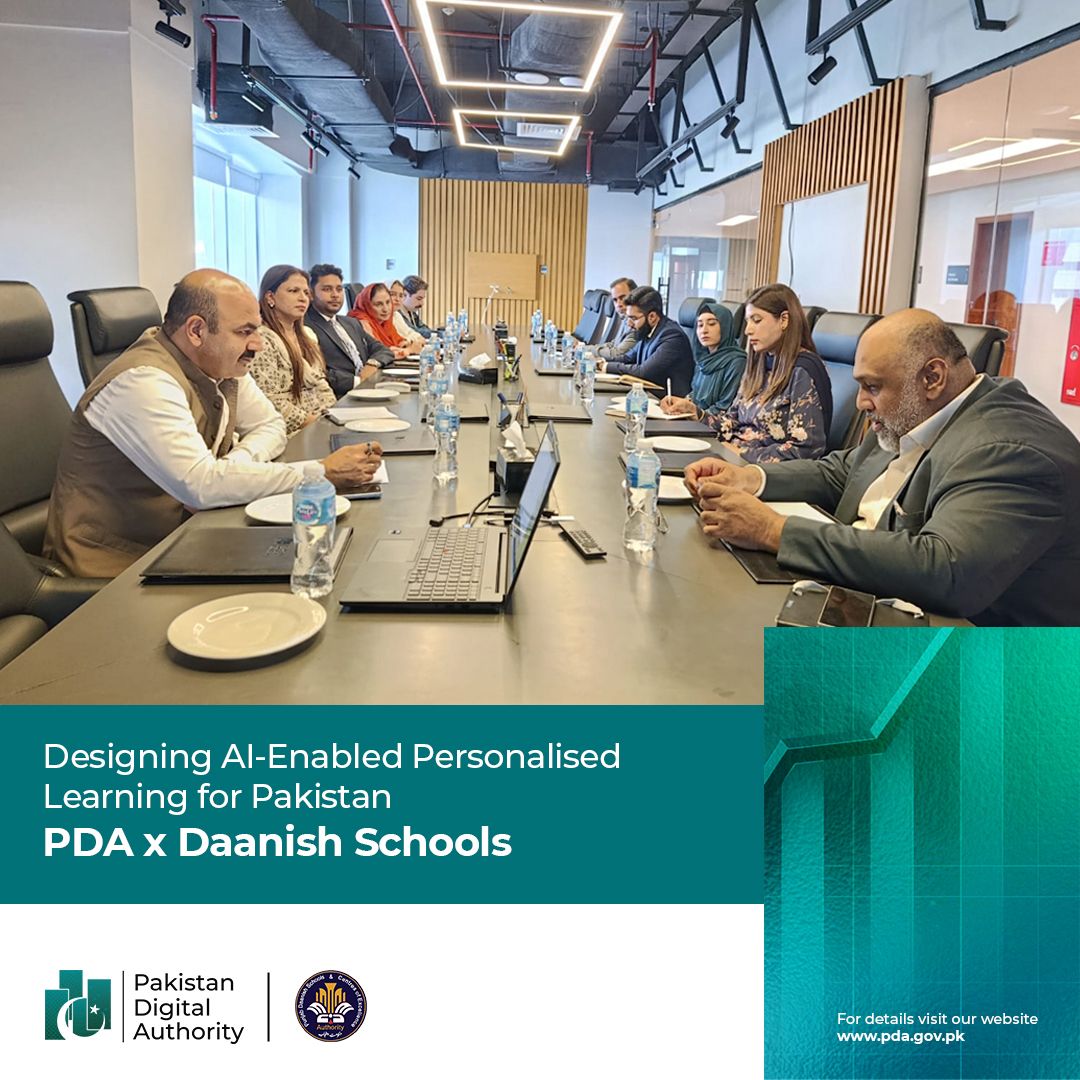
@sohailmunir, Chairperson, Pakistan Digital Authority (PDA), chaired a high-level consultative meeting with representatives of the Ministry of Federal Education and Professional Training (@EduMinistryPK), Daanish Schools and education and artificial intelligence (AI) experts to explore the integration of AI and advanced digital technologies into Pakistan’s education system.
The meeting was attended by Sophia Hasnain, Chief of Staff, PDA; Dr. Henna Karamat, Executive Director, National Digital Innovation Lab (Education) and Education Sector Lead, PDA; Shah Jehan, Deputy Secretary, MoFEPT; Asghar Awan, Principal, Daanish School Kuri; Dr. Tabassum, Director Curriculum; and AI experts.
The meeting focused on advancing the Prime Minister’s directive for an AI-based personalised curriculum and adaptive learning system, with Daanish School Kuri, Islamabad, serving as the initial pilot campus. MoFEPT and Daanish Schools will lead the initiative, with PDA providing technical facilitation, expert support and guidance.
Daanish Schools, the Prime Minister’s flagship initiative for talented students from underserved backgrounds, will help demonstrate how innovation narrows inequality and helps students compete globally.
Discussions centred on digital student profiles that go beyond grades to cover personalised learning, well-being, aptitude and growth. They also explored AI-assisted teaching, learning platforms, teacher training and integrated learning management systems, as well as how international education models such as Singapore’s can be adapted to Pakistan.
Through the National Digital Masterplan, PDA is committed to catalysing sector-led digital transformation that delivers meaningful improvements in the lives of ordinary citizens. By facilitating innovation in initiatives such as Daanish Schools, PDA aims to support a future where every child, regardless of socioeconomic background, has the opportunity to benefit from quality, technology-enabled education.