I am working on Bringing awareness about Cybersafety, Cyberpsychology, and Ethical AI to ordinary people in India (Tamilnadu). Follow @digitaldiet4all for writings in English and @thiruvinod4u for writings in Tamil.
📚 [AI BOOK CLUB] "Code Dependent: Living in the Shadow of AI" by @madhumita29 is a must-read for everyone interested in AI, and it's our 🎉 10th selected book:
📖 About the book:
"On the surface, a British poet, an UberEats courier in Pittsburgh, an Indian doctor, and a Chinese activist in exile have nothing in common. But they are in fact linked by a profound common experience―unexpected encounters with artificial intelligence. In Code Dependent, Murgia shows how automated systems are reshaping our lives all over the world, from technology that marks children as future criminals, to an app that is helping to give diagnoses to a remote tribal community.
AI has already infiltrated our day-to-day, through language-generating chatbots like ChatGPT and social media. But it’s also affecting us in more insidious ways. It touches everything from our interpersonal relationships, to our kids’ education, work, finances, public services, and even our human rights.
By highlighting the voices of ordinary people in places far removed from the cozy enclave of Silicon Valley, Code Dependent explores the impact of a set of powerful, flawed, and often-exploitative technologies on individuals, communities, and our wider society. Murgia exposes how AI can strip away our collective and individual sense of agency, and shatter our illusion of free will.
The ways in which algorithms and their effects are governed over the coming years will profoundly impact us all. Yet we can’t agree on a common path forward. We cannot decide what preferences and morals we want to encode in these entities―or what controls we may want to impose on them. And thus, we are collectively relinquishing our moral authority to machines.
In Code Dependent, Murgia not only sheds light on this chilling phenomenon, but also charts a path of resistance. AI is already changing what it means to be human, in ways large and small, and Murgia reveals what could happen if we fail to reclaim our humanity."
📖 Why read:
Many have heard about algorithmic bias, the black box, AI-powered privacy invasion, and so on, but they don't understand how AI works in practice (both from technical and social perspectives), how harm might materialize, and how they are probably already being affected by it in unexpected ways. Madhumita's book is an eye-opener, which helps reflect on the human and social consequences of AI-powered technology.
📖 Go beyond:
In February 2023, Madhumita was appointed as the first AI Editor of the Financial Times, so make sure to follow her coverage there. I also recommend watching her TEDx Talk "The business of biometrics" (relevant links below).
📖 Join the AI Book Club
Our AI Book Club already has 1,400+ members. Join it at the AI, Tech & Privacy Academy's website and NEVER MISS our book recommendations (link below).
Happy reading!
For thousands of years prophets, poets and politicians have used language to manipulate and reshape society. Now computers are learning how to do it. And they won't need to send killer robots to shoot us. They could manipulate human beings to pull the trigger.
Yuval Noah Harari, who has spent a lot of time worrying about #Al over the past decade, the threat is less fantastical and more insidious. "In order to manipulate humans, there is no need to physically hook brains to computers," he writes in his engrossing new book Nexus. "
���Can #ArtificialInteligence apps understand the world behind words? New experiment with @GaryMarcus, @ElliotMurphy91 & Fritz Günther. We tested humans & LLMs in a new domain: the ability to read leet code. Results: HUM4NS C4N UNDERST4ND THIS BUT LLMs 4PP4RENTLY C4N'T! Why? 1/2
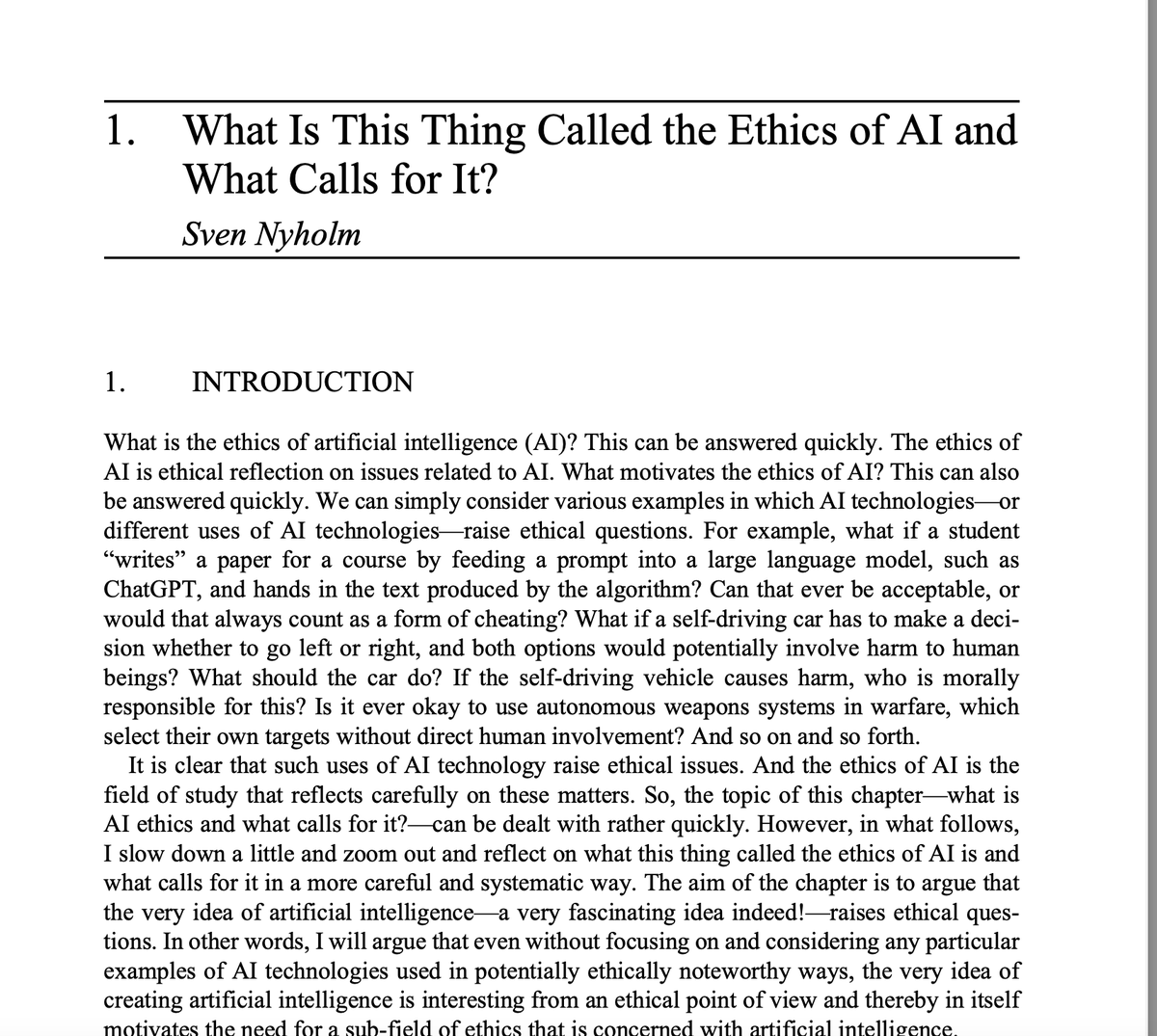
My article "What Is This Thing Called the Ethics of AI and What Calls for It?", from @David_Gunkel's (ed.) Handbook on the Ethics of AI @ElgarPublishing, is available in open access here:
https://t.co/bd0Y4BCaC5 #aiethics
🚨 [AI RESEARCH] "The Environmental Impacts of AI - Primer," by @SashaMTL, @TrevelinBruna & @mmitchell_ai, is a MUST-READ for everyone in AI. Quotes:
"It can be hard to understand the extent of AI’s impacts on the environment given the separation between where you interact with an AI system, and how that interaction has come to be – most AI models run on data centers that are physically located far away from their users, who only interact with their outputs. But the reality is that AI’s impressive capabilities come with a substantial cost in terms of natural resources, including energy, water and minerals, and non-negligible quantities of greenhouse gas emissions."
-
"For a full picture of AI’s environmental impact, we need both consensus on what to consider as part of “AI”, and much more transparency and disclosures from the companies involved in creating it. AI refers to a broad set of techniques, including machine learning, but also rule-based systems. A common point of contention is the scoping of what constitutes AI and what to include when estimating its environmental impacts. Core to this challenge is the fact that AI is often a part of, as opposed to the entirety of, any given system – e.g. smart devices, autonomous vehicles, recommender systems, Web search, etc. How to delineate and quantify the environmental impacts of AI as a field is therefore a topic of much debate, and there is currently no agreed-upon definition of the scope of AI."
-
"Environmental protection is also stated as being one of the core values put forward by the EU AI Act, and appears several times in its text. As provided in the AI Act, the energy consumption of AI models is at the core of this topic, and is stated as one of the criteria that must be taken into consideration when training and deploying them. The AI Act stipulates that the providers of general-purpose AI models (GPAIs) specifically should share the known or estimated energy consumption of their models. It also provides that high-risk AI systems should report on resource performance, such as consumption of energy and of 'other resources' during the AI systems’ life cycle, which could include water and minerals depending on the level of detail of the standards that will guide compliance to this reporting obligation."
👉 Read the full paper below.
🔥 To stay up to date with the latest developments in AI policy, compliance & regulation, including excellent research, join 34,000+ people who subscribe to my weekly newsletter (link below).
Our paper just got covered by @Nature. We went under cover and contacted a "citation boosting" service. We managed to buy citations that appeared in a Scopus-indexed journal, providing conclusive evidence that citations can be bought in bulk!! https://t.co/clqQVVrSRL
If Elon was a true centrist, as he has claimed, he would spread no more misinformation about the left than he does about the right.
If he genuinely cared about democracy, he wouldn’t spread misinformation at all.
Actions speak louder than words.






![LuizaJarovsky's tweet photo. 📚 [AI BOOK CLUB] "Code Dependent: Living in the Shadow of AI" by @madhumita29 is a must-read for everyone interested in AI, and it's our 🎉 10th selected book:
📖 About the book:
"On the surface, a British poet, an UberEats courier in Pittsburgh, an Indian doctor, and a Chinese activist in exile have nothing in common. But they are in fact linked by a profound common experience―unexpected encounters with artificial intelligence. In Code Dependent, Murgia shows how automated systems are reshaping our lives all over the world, from technology that marks children as future criminals, to an app that is helping to give diagnoses to a remote tribal community.
AI has already infiltrated our day-to-day, through language-generating chatbots like ChatGPT and social media. But it’s also affecting us in more insidious ways. It touches everything from our interpersonal relationships, to our kids’ education, work, finances, public services, and even our human rights.
By highlighting the voices of ordinary people in places far removed from the cozy enclave of Silicon Valley, Code Dependent explores the impact of a set of powerful, flawed, and often-exploitative technologies on individuals, communities, and our wider society. Murgia exposes how AI can strip away our collective and individual sense of agency, and shatter our illusion of free will.
The ways in which algorithms and their effects are governed over the coming years will profoundly impact us all. Yet we can’t agree on a common path forward. We cannot decide what preferences and morals we want to encode in these entities―or what controls we may want to impose on them. And thus, we are collectively relinquishing our moral authority to machines.
In Code Dependent, Murgia not only sheds light on this chilling phenomenon, but also charts a path of resistance. AI is already changing what it means to be human, in ways large and small, and Murgia reveals what could happen if we fail to reclaim our humanity."
📖 Why read:
Many have heard about algorithmic bias, the black box, AI-powered privacy invasion, and so on, but they don't understand how AI works in practice (both from technical and social perspectives), how harm might materialize, and how they are probably already being affected by it in unexpected ways. Madhumita's book is an eye-opener, which helps reflect on the human and social consequences of AI-powered technology.
📖 Go beyond:
In February 2023, Madhumita was appointed as the first AI Editor of the Financial Times, so make sure to follow her coverage there. I also recommend watching her TEDx Talk "The business of biometrics" (relevant links below).
📖 Join the AI Book Club
Our AI Book Club already has 1,400+ members. Join it at the AI, Tech & Privacy Academy's website and NEVER MISS our book recommendations (link below).
Happy reading!](https://pbs.twimg.com/media/GXWngPJXoAAkUk2.jpg)


![LuizaJarovsky's tweet photo. 🚨 [AI RESEARCH] "The Environmental Impacts of AI - Primer," by @SashaMTL, @TrevelinBruna & @mmitchell_ai, is a MUST-READ for everyone in AI. Quotes:
"It can be hard to understand the extent of AI’s impacts on the environment given the separation between where you interact with an AI system, and how that interaction has come to be – most AI models run on data centers that are physically located far away from their users, who only interact with their outputs. But the reality is that AI’s impressive capabilities come with a substantial cost in terms of natural resources, including energy, water and minerals, and non-negligible quantities of greenhouse gas emissions."
-
"For a full picture of AI’s environmental impact, we need both consensus on what to consider as part of “AI”, and much more transparency and disclosures from the companies involved in creating it. AI refers to a broad set of techniques, including machine learning, but also rule-based systems. A common point of contention is the scoping of what constitutes AI and what to include when estimating its environmental impacts. Core to this challenge is the fact that AI is often a part of, as opposed to the entirety of, any given system – e.g. smart devices, autonomous vehicles, recommender systems, Web search, etc. How to delineate and quantify the environmental impacts of AI as a field is therefore a topic of much debate, and there is currently no agreed-upon definition of the scope of AI."
-
"Environmental protection is also stated as being one of the core values put forward by the EU AI Act, and appears several times in its text. As provided in the AI Act, the energy consumption of AI models is at the core of this topic, and is stated as one of the criteria that must be taken into consideration when training and deploying them. The AI Act stipulates that the providers of general-purpose AI models (GPAIs) specifically should share the known or estimated energy consumption of their models. It also provides that high-risk AI systems should report on resource performance, such as consumption of energy and of 'other resources' during the AI systems’ life cycle, which could include water and minerals depending on the level of detail of the standards that will guide compliance to this reporting obligation."
👉 Read the full paper below.
🔥 To stay up to date with the latest developments in AI policy, compliance & regulation, including excellent research, join 34,000+ people who subscribe to my weekly newsletter (link below).](https://pbs.twimg.com/media/GWqEV_MWEAAvPMC.jpg)


