We highlight how computational methods using large-scale language data and open-source tools like DLATK can scale well-being measurement to entire populations. (5/5)
Thanks to the amazing team of @JonasP_Schoene Tiffany Hsu @SalGiorgi@HAndySchwartz@JEichstaedt 🙏
🎉 Excited to share my first preprint as first-author!
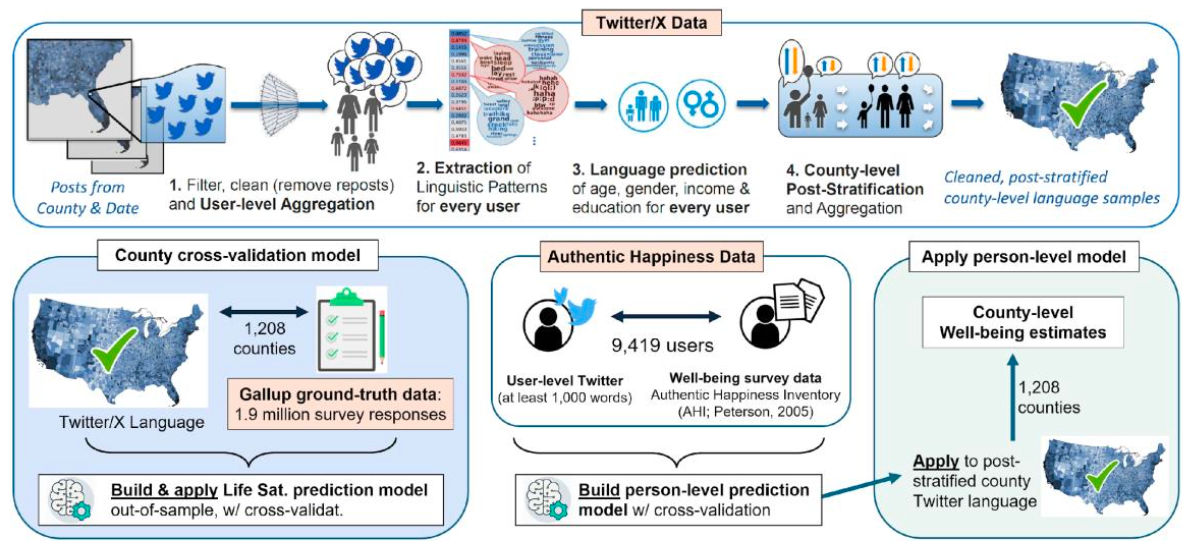
We show that population well-being estimation from social media language outperforms surveys and traditional proxies like household income.
Link - https://t.co/InAhSIy8We
(1/5) 🧵👇
🤖 Our Big Data (1.53B tweets from 5.25M users and 1.9M Gallup responses) analysis pipeline was powered by the Differential Language Analysis ToolKit. Underscoring our commitment to reproducibility, we release our code/artifacts on OSF soon - https://t.co/UltpTbDzTO
(4/5)
We're looking for a part-time front-end developer to join our lab! In this role, you'll work on AI-based mental health web applications and get training in NLP methods.
Click on the link below to learn more and apply!
https://t.co/cjW0CBP1Ct
Check out this fantastic commentary on our article (https://t.co/4vsy0lqWMC) by @ALCamerini, published today in @NatureHumBehav
🔗 https://t.co/D3muVM7dsC
Excited to share our new article w/@affectivebrain in @NatureHumBehav.
Key finding: consuming more negative content online is tied to poorer mental health—and vice versa. 💻🧠
Article link: https://t.co/OZ8W42exq0
🧵 Read on for more insights from the study
We're so proud of our postdoc @JonasP_Schoene for his presentation at the Psychology of Technology Conference in Boston last weekend! It was incredible to see industry, policy, and research minds come together to shape the future of tech and human psychology. 🧠#PsychTech2024
Our Lab is looking to hire 2 new members!
We are searching for an enthusiastic data scientist and project coordinator. This role will include training in key psychological natural language processing methods and is an excellent stepping stone for pursuing graduate studies!
https://t.co/JeSelgieoi
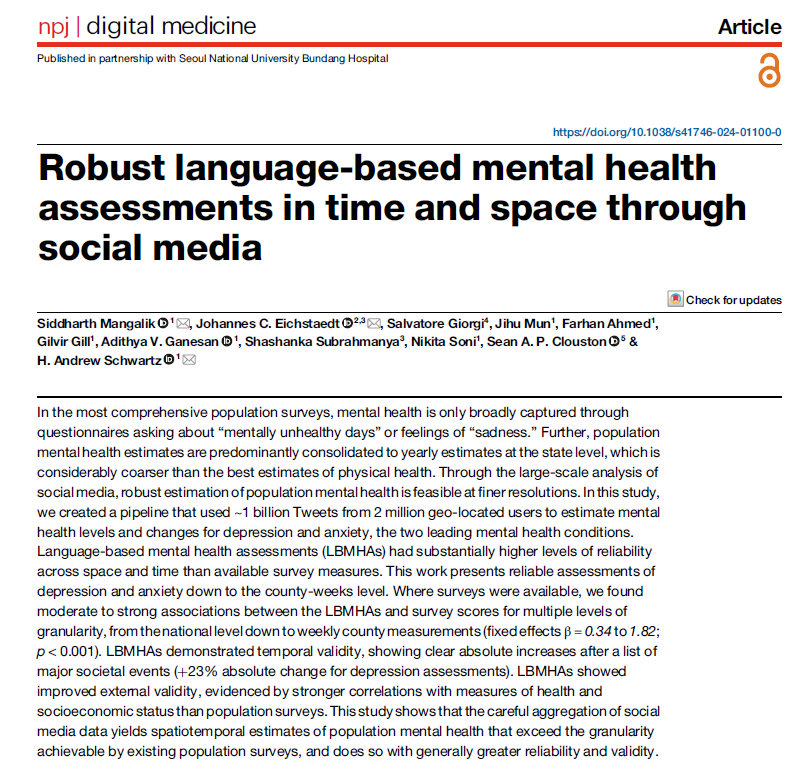
Putting together a decade of learnings on getting more accurate regional well-being assessments from social media into a single pipeline! Lead by @lemon_n_limes with @sal_giorgi @JEichstaedt@WWBProject
Using #socialmedia data can give us more detailed & accurate info about people's #mentalhealth compared to traditional surveys. The authors were able to estimate levels of depression & anxiety down to specific areas & weeks.
https://t.co/Gfzo6dSLoI
big news from
@HAndySchwartz
and the
@WWBProject
team: DLATK- a premier language analysis tool for social sciences and beyond - now available in an open and easy to use format!
Work led by
@digitalyonko w/ @sal_giorgi @adigan8@JEichstaedt
See 🧵:
I'm giving a talk tomorrow at Columbia-- Public Health (Thur 2/29, 1-2.30pm) -- NLP and LLMs for mental health.
“Using Digital Text and LLMs to Understand and Improve Individual and Community Mental Health”
If you happen to be around and free, please join!
https://t.co/uB8dt0mIcO
🚨 Announcement:
DLATK is now available as a colab notebook!
https://t.co/RtDdGRp9Je
DLATK is a suite for end-to-end human language analysis, used in 100+ AI/NLP/Psych papers. This was lead by @digitalyonko, joint with @sal_giorgi, @adigan8, @JEichstaedt, and @WWBProject 🧵1/4
Check out this Vox (@voxdotcom) article featuring one of CPWB’s postdocs @betsy_stade discussing AI and mental health outcomes in therapy, what to consider when integrating chatbots into therapy, and the importance of access to mental health care. https://t.co/9kI7NUQiHM
@divyayyy Totally! That said, I feel it (I use a MacBook Air M1) can be more efficient with resource usage and organization. I use https://t.co/0l21jH3VrY to do this for my research.