@iBhanuDahiya But you have to remember that the people who top iit are the best of the best. The people who get left behind due to silly mistakes eventually do catch up if they are at the same level. The rest of the pack is not in the same league.
If you’re so small minded that you take me talking about cultures and behaviors as “racist” that’s your own problem because I’ve not spoken about skin-color at all in regard.
All human life is equal.
All behaviors are not equal.
@Moonlight_myths The new wife would be perfectly happy for the husband to never ever interact with his ex wife and son. Which the husband would not accept. Which in turn would be a constant source of friction. Which may lead to a second divorce. Feel so sad for the children!
@kellabyte That is exactly what i struggle with. Have done some great work but still not able to answer the question - what can i build for which people will pay me. I guess i am not the only one struggling with this.
@lakshya_sen You make us all proud. Really proud. You were right up there. I wish you all the very best and that you attain the greatest heights and get the success you want. God bless you.
"i dont need engineers!" // "i can ship 1000x more code than before"
the amount of software rot is reaching escape velocity. even just using LLMs: the thing you did 3 months back no longer works the same.
but yes lets keep talking about how much slop we can ship.
I am as AI pilled as they come (someone even called me an AIfluencer the other day) but I have trouble agreeing with these recent attempts to ignore the value of code or code reviews (not just in this post but also in similar writings that have surfaced recently).
1. We seem to be conflating the cost of generating code with the value of generated code. These aren't the same. Just because the cost of generating code is nearly zero, does not make the code throwaway. The moment any code is deployed, it's sticky. You can't throw it away willy nilly. The baby is born and it's yours.
2. Code is still the only verifiable artifact. It's not fungible. A prompt is not a pure function to predictably regenerate the code from spec.
3. No validation method except working code is deterministic. You need a much higher level of trust in the spec to allow an agent to autonomously change the implementations. The truth is that the AI native teams are also writing the specs using agents, which means these are even harder to maintain.
4. It's nearly impossible to express a system in English. Toy examples look great. But try codifying all the "it depends" rules. The value of code is not the written lines but the system it describes.
5. Specs are a lot harder to review and detect bugs in. Our minds are trained to look at structured code and idnetify bugs. But given a sentence in English, it's very hard to understand what it means. And it's open to interpretations.
6. There is a long term effect of code rot that is being ignored here in the assumption that as long as the spec and interfaces are working, the implementation doesn't matter. But code rot over longer horizon actually makes agents less effective. There is a difference between a 10 line implementation and a 1000 line one, even if they confirm to the same interface.
I hate code reviews as much as anyone else but eliminating them completely sounds very premature. The best way to eliminate code reviews would be to NOT write code at all and make it a build/compilation step. But I don't think we are there yet.
@ClownWorld Both are at fault. The one moving away seems deliberate to crash the tail gator. Someone in the stopped car or in the tail gating car can get injured or die and this will be the result of a deliberate action.
I wanted to understand how GPT works, so I ported Karpathy's https://t.co/5FK9fuhDBF to C# from scratch. No frameworks and NuGet packages, just plain math in ~600 lines of code.
It builds a tiny GPT that learns from 32K human names and invents new ones. Every piece is there: autograd, attention, Adam optimizer, the works. Just at a scale you can actually sit down and read.
I also wrote a prerequisites guide that walks through all the math and ML you need, starting at a high school level. If you've ever wanted to peek under the hood of ChatGPT without drowning in linear algebra textbooks, this might help.
https://t.co/rwAB7pswzY
People without children often hear this line as judgment. It is not. It is simply truth, said softly.
You can live a full life without a child. You can travel, build, earn, heal, and enjoy freedom. All of that is real. But there is a dimension you will never touch until you become responsible for a life that exists because of you.
A child changes the axis of time.
Suddenly, the future is not abstract. It has a face, a voice, and tiny hands holding your finger.
You learn a kind of love that is not romantic, not transactional, not conditional. A love that shows up even when you are tired, broke, scared, or failing. A love that humbles you daily and strengthens you quietly.
You start measuring success differently.
Not by applause. Not by money.
But by whether you are becoming someone your child can feel safe with and proud of.
Children force growth. They expose your impatience, your selfishness, your unresolved wounds. And then they give you a reason to fix them. Not tomorrow. Today.
Legacy stops being a word and becomes a responsibility.
You realize you are not just living your life.
You are shaping a human who will walk the world long after you are gone.
People without children are not missing happiness.
They are missing this specific depth of meaning.
And you do not know it is missing
until it arrives.
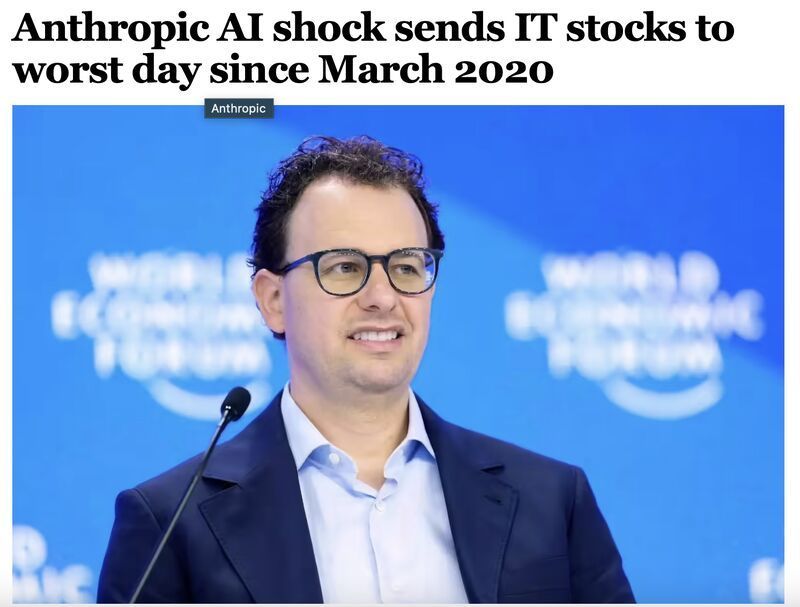
I'm pretty sure everyone at my company saw this article and now they all think we're in an AI crisis.
We're not in an AI crisis. We use Claude to summarize Slack threads.
But here's what's actually interesting: this whole panic reveals something nobody wants to admit.
Every company in America has been bullshitting about their "AI strategy" for two years.
We all saw the hype. We all knew we had to say something. So we rebranded our existing automation as "AI-powered" and called it a day.
My company isn't special. We're all doing the same thing.
The problem is now the executives actually believe their own bullshit. They think we have "significant AI exposure" because they've been telling investors we're "AI-first."
I just got pulled into an emergency meeting. Six executives asking me to explain our "AI dependency matrix."
There is no AI dependency matrix.
There's Claude for meeting summaries, there's some sentiment analysis in our support tickets that came free with Zendesk, and there's whatever Gmail is doing when it autocompletes my sentences.
But I can't say that in a room full of people who told their boards we're "transforming the business through AI."
So I said we have "distributed AI touchpoints across multiple vendors with no single point of failure."
Which is technically true. We use a bunch of different services that all have AI features we mostly ignore.
The CFO asked if we should "hedge our AI exposure."
I have no idea what that means. Neither does he.
What am I going to do: nothing. Because in three weeks, Anthropic will say something reassuring, the stocks will recover, and everyone will forget this happened.
But I'll have documentation showing I recommended a "risk assessment" that mysteriously never got prioritized.
The funniest part is that half these executives probably don't even know what Anthropic is. They just saw "AI" and "crash" in the same headline.
We're all pretending. The whole industry is pretending.
And articles like this just remind everyone how fragile the pretending is.
This is going to be a long one, but I think y’all need to hear this.
FSD is an incredible software, and it’s wild to see the progression Tesla has made. I’am glad many of you are extremely passionate about it, and I’m excited to see how Tesla pushes the industry along when it comes to autonomy.
I am not an autonomy expert but I am a car enthusiast, I have been since I was born. I grew up in a car family, and I’m grateful to be able to have a career and hobby based in the car industry detailing. I love cars.
FSD is an extremely cool product, but it’s not for everyone. We are in an insulated bubble here on Twitter (X) and I think less people actually care about FSD than you might think in the real world. Did you know out of the entire fleet only 12% of Tesla’s have FSD or are subscribed to it as of Q3 2025? I’ve attached the screenshot below. Now, this was before launch of v14, but has the needle moved that much? I guess we will see in the Q4 2025 metrics.
All this to say…
What I don’t understand is this push for people to call people idiots, morons, r*tards, dumbasses, etc, etc, the list goes on… Because they have a differing viewpoint of FSD. It’s bizarre to me how it have become if you don’t use FSD you are just dumb.
Again, I’m glad y’all enjoy it, it’s fricken cool… But just because you believe in something, why do you have to shove it down everyone’s throat. Every comment lately is “Tesla or nothing, FSD or nothing, everything else is trash”
There are some great offerings out there in the EV space, and I enjoy getting to drive my Tesla and other EVs in the industry.
I enjoy driving over sitting in a car letting the car make every single decision for me, hence why I don’t subscribe to FSD. Tesla removing autopilot(autosteer) from future cars is a huge miss in my opinion. I didn’t buy my Tesla for FSD, I bought my Tesla cause it’s awesome to drive, the software is leagues above others, and it just makes me smile. I enjoy driving my car hard on canyon roads, and running errands. When I’m on the interstate Autopilot was all I needed to sit back and relax a bit. I get to control the speed, the lane I’m in my following distance, and let the car center me in a lane. It’s all I needed. That’s why I’m so bummed to hear AP is gone.
All this to say, I love Tesla’s cars, I’ve owned 3 and I will own more. But just because someone decided to buy another EV or use/not use FSD doesn’t make them wrong.
Enjoy your car, enjoy your tech, but let people enjoy their car. The car community is awesome when you can respectfully agree and disagree and make a decision on what you want to spend your hard earned money on.
Thanks for coming to my TED talk.