"I don't want flying cars. I want raw nature and real human connection."
Brother…
YOU are CURRENTLY SELLING $50 worth of protein bars that were not foraged, not hunted, and not hand-pressed by a village elder at dawn but manufactured in a FACILITY on a production line powered by the electrical grid, sealed in plastic made from petroleum pumped out of the earth by giant drills, boxed, labeled, barcoded, and scanned into an inventory system running on servers cooled by industrial AC units humming 24/7, then loaded onto a DIESEL TRUCK that hauls them down an interstate bulldozed straight through the exact wilderness you want to get lost in (you will not get lost, there is a Buc-ee's), dumped into a sorting hub full of conveyor belts and robotic arms and lasers, thrown onto ANOTHER truck, handed to a mail carrier idling in a van in a cul-de-sac, and dropped on a porch in a cardboard box that gets ripped open in four seconds and tossed in the recycling, all so someone can eat a bar they bought on a phone with a credit card processed in 0.3 seconds by a bank mainframe and then YOU logged on to tell the rest of us technology doesn't make anyone happy, when it's clearly making YOU very happy, and the second someone figures out drone delivery you'll be first in line with your logo on the propellers, so no, you're not a troglodyte, because troglodytes never offered free shipping on orders over $75.
interpretability might be the most important scientific problem in the world right now, as I don't think we can solve alignment if we don't know what we're building. I think I have good news about it. I co-authored early work in mechanistic interpretability at OpenAI and came away pessimistic, because neural networks appeared to fold into arbitrary tangled knots. years later, I started openai's first large-scale automated interpretability project, finding about 2% of neurons legible with the primitive tools we had
with modern agentic tools and a much closer look, the picture looks totally different. the vast majority in models up to trillions of parameters are legible, and their circuits beautiful. many famous examples of tangled neurons turned out to be misunderstood. The roadblocks I expected mostly aren't there. I now think ambitious interpretability will be solved by the time we need it most, and possibly quite soon, as automated scientists keep improving. it may be a bitter lesson for interpretability: the simple thing, at absurd scale, works
https://t.co/zHij5zwKGT
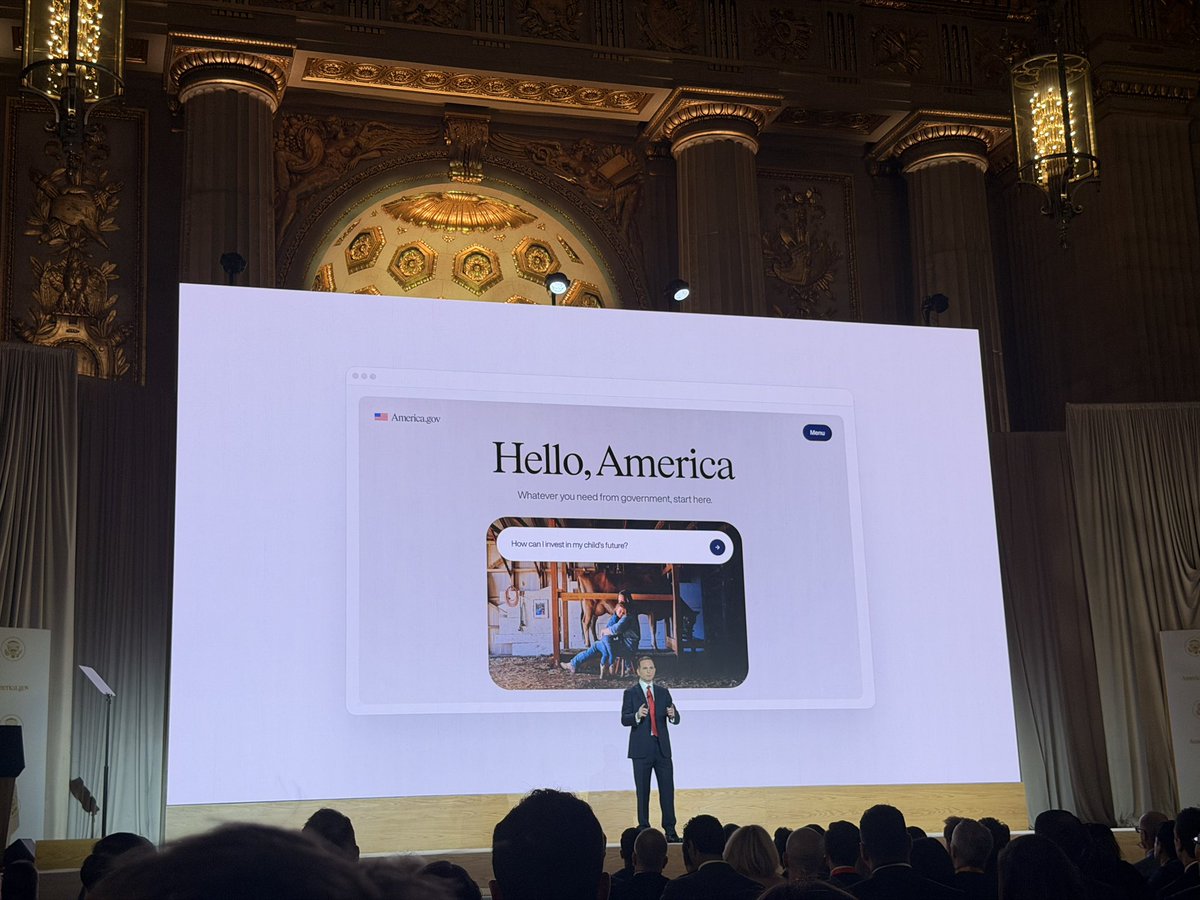
Today we’re launching https://t.co/3PmkMcWHNN, a single front door to the federal government.
Instead of opening a bunch of tabs across different agency sites and trying to figure out which information actually matters to you, you can ask America a question and get the relevant answer from across 29,000+ official government websites, with the source and what to do next.
@pitdesi Honestly, that'd have been far less controversial. Cos by popular definition, rich feels like a much wider spectrum. Like every tech worker is rich.
You seem sincere, but there’s something super irksome about “post economic”
Funny also how it’s casually tucked away there along with funny etc. People work their entire life to get there. Like that alone would be THE achievement.
Prob signals that you’ve been v lucky in life more than anything else :)
I'm not of fan of regulation for two reasons - 1) its hard to get right, and 2) its highly susceptible to regulatory capture. That said, if we insist on doing it, we should try to get it correct.
As "safety" seems is the primary goal of this AI regulation exercise, I wanted to share that I recently went deep on both the 737 Max (2 crashes) and Fukushima accidents. In both cases, the investigations led to a conclusion that "regulatory capture" was the EXACT failure that led to both safety incidents. Boeing/FAA and Tepco/NISA.
As a result, with safety as the #1 goal, the regulator MUST BE someone with authority and accountability "over" the regulated company. The idea that it could be a friendly third party with lots of cross-relationships is structurally broken idea. Ask Mr. Kiyoshi Kurokawa.
If we insist on doing this the regulator (1) needs to be 100% independent, 2) the "tests" and "procedures" need to come for the regulator not the company, and (3) the regulator needs to understand their responsibility is to the American people. They need to feel the authority over the regulated company and the responsibility to the nation.
It's imperative. Or it will fail.
1/ Today, we're launching @Mercury Books.
AI-powered accounting software, for your bookkeeper or you, that categorizes and reconciles your transactions the moment they happen.
@immad I got a smart pen and built an agent to sync all my writing.
I’ve been hand writing sooo much more!! My fav new gadget in years.
https://t.co/LiKmquIbxe