I feel sad seeing newly planted trees in London dying or dead. It doesn’t take much to come out with a watering can or bucket once or twice a week to keep them alive. Please share. Encourage people to look after what little nature we have.
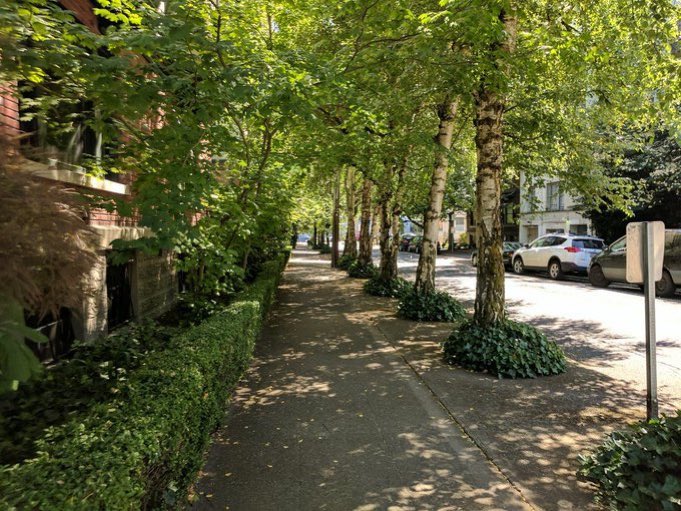
El efecto de un solo árbol en la calle es equivalente a cinco aires acondicionados del tamaño de una habitación funcionando 20 horas al día. Si nuestra ciudad se llenara de calles como esta la vida en verano sería mucho más agradable.
To understand why Keith is on the barn roof, you have to go back about eleven thousand years, to the Zagros Mountains, where a wild goat called the bezoar ibex spent its days on cliff faces so steep no other large mammal would attempt them. Keith, in Devon, in 2026, on a barn roof, is the direct inheritor of that animal. The roof, by every measurable indicator, is the closest thing to a cliff Keith has been able to find.
What that inheritance left him with, anatomically:
A hoof split into two flexible halves, with a soft rubbery pad in the middle that grips like climbing-shoe rubber.
A centre of gravity adjustable in real time, with a spine that flexes laterally in ways most ungulates simply cannot.
Eyes set wide on the head, with rectangular pupils that give close to 320 degrees of visual coverage. A goat on a roof can see what is happening behind it.
Inner-ear balance that is, in measurable terms, on par with cats.
A brain wired with the conviction that any vertical surface is a question deserving an answer.
Keith does not climb the barn roof because he wants to be on the barn roof. Keith climbs the barn roof because, in eleven thousand years of domestication, nobody has been able to switch off the part of him that thinks the roof is a smaller and less interesting version of the Caucasus.
The roof is, by his measurement, a four-metre cliff with moss on it.
Moss on a cliff, in goat terms, is breakfast.
There is, behaviourally, no version of Keith that is fine with the barn roof being unconquered. The roof is there. Keith is here. The arithmetic resolves itself.
The fence is the same problem on a smaller scale. The gate is the same problem at the wrong angle. The Land Rover, when parked too close to the shed, is, by Keith's working assessment, also the same problem.
Goats are not "escaping" when they climb. Goats are doing what eleven thousand years of selection has installed as their primary cognitive function.
The interesting question is not why Keith climbs.
The interesting question is why anyone, having met a goat, ever thought a four-foot fence would hold one.
Keith is on the barn roof.
He earned it.
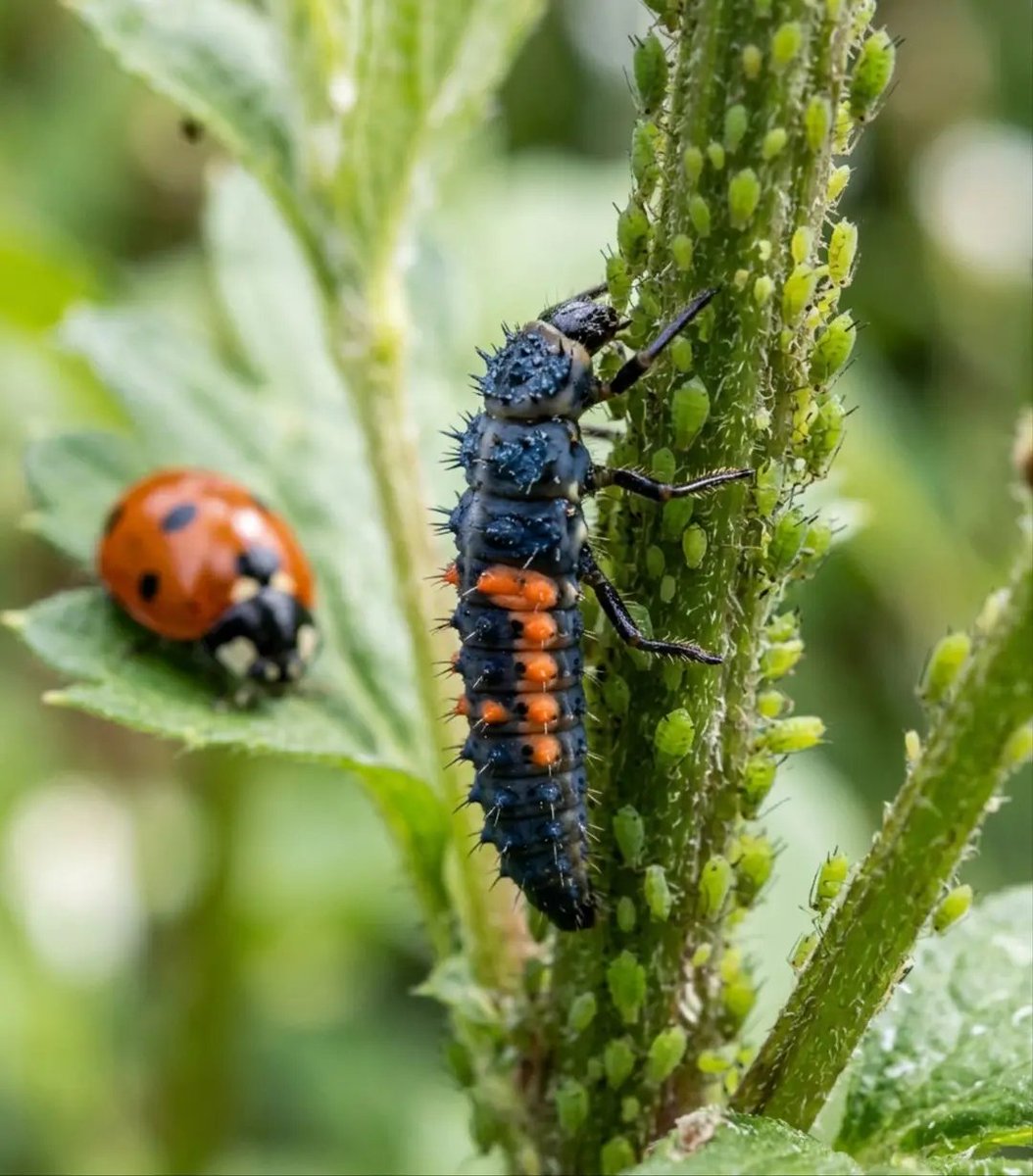
This is a ladybird larva. It looks nothing like a ladybird. It looks like a tiny black alligator with orange spots — and most gardeners crush it thinking it's a pest.
That mistake costs the garden dearly. An adult ladybird eats around 50 aphids a day. Its larva can devour up to 500 before it pupates. Ten times as many. That strange-looking creature working its way along your tomato stems is the most effective phase of a ladybird's entire life.
Once you know what to look for, the larva is unmistakable: an elongated blue-black body with six orange spots along the sides, six short legs, slow and methodical movement up and down stems. It doesn't fly, doesn't jump, doesn't hide. It moves from one aphid colony to the next and feeds continuously for two to three weeks before pupating.
The pupa looks like a small, still orange droplet fixed to a leaf — and it too gets removed during routine plant tidying. Inside it, the adult ladybird is forming.
If you find aphids on a plant and ladybird larvae among them, leave them alone. The biological control is already working.
🐞
May 15, 1963.
Astronaut Gordon Cooper climbed into a capsule barely larger than a phone booth and launched into space aboard Faith 7.
The mission was simple on paper:
Orbit Earth 22 times.
Stay in space for a full day.
Come home alive.
For most of the flight, everything worked perfectly.
Then, on the 19th orbit, the warning lights came on.
First, a faulty sensor falsely reported reentry.
Then the electrical system failed.
One by one, the automated controls died.
Guidance system: dead.
Orientation system: dead.
Reentry calculations: dead.
At 165 miles above Earth, Gordon Cooper suddenly had no functioning instruments to bring him home.
And reentry is unforgiving.
Too shallow, and the capsule skips off the atmosphere into space forever.
Too steep, and friction turns it into a fireball.
The difference between life and death was fractions of a degree.
Mission Control could only watch.
So Cooper became the computer.
He drew reference marks on the capsule window with a pen.
He stared at the stars he had memorized before launch and used them to orient the spacecraft by eye.
He strapped a wristwatch to his arm and timed everything manually.
Then he did the math in his head.
No autopilot.
No navigation system.
No backup computer.
Just a man, a watch, and the stars.
At exactly the right second, Cooper fired the retrorockets manually.
The capsule dropped into Earth’s atmosphere.
For several minutes, communication vanished as plasma wrapped the spacecraft in fire.
Nobody on Earth could contact him.
Then the parachutes opened.
Faith 7 splashed down just 4.4 miles from the recovery ship USS Kearsarge — the most accurate splashdown of the entire Mercury program.
Later, Cooper described it simply:
“I used my wristwatch for time, my eyeballs out the window for attitude.”
That’s it.
In one of the most dangerous moments in early spaceflight history, a human being outperformed the machines.
We live in a world obsessed with automation and software.
But Gordon Cooper’s flight is a reminder that when everything breaks, the final backup system is still the human mind.
Calm under pressure.
Thinking clearly.
Making the call when nobody else can.
It was true in 1963.
It still is.
The Wind-Woven Fence of Maesteg
Following the destructive path of Storm Arwen, a mundane wire fence on a hilltop above Maesteg, Wales, was transformed into an accidental masterpiece of environmental art. High-velocity winds stripped dry Molinia grass—commonly known as purple moor grass—from the surrounding landscape and drove it with such force that the blades became intricately interlaced within the wire mesh. The result is a dense, golden tapestry that mimics the deliberate work of a master basket weaver, stretching across the summit as a visual record of the storm’s intensity and direction.
This phenomenon, often referred to locally as a "molinia fence," occurs when the specific aerodynamic properties of dried grass meet a steady, powerful gale. The grass is not merely blown against the fence but is threaded through it, creating a windbreak so thick it can eventually act like a sail, putting immense structural pressure on the fence posts. For the residents of the Llynfi Valley, these golden walls serve as a fleeting reminder of the sheer power of the Welsh elements, standing as a natural installation that remains until the next shift in weather begins to unravel the weave.