told my girlfriend to give me the best birthday present and she did it @HyperliquidX
in addition, she said that if @chameleon_jeff likes this tweet, then she will have to make a big Hypurr carpet
so I ask you to make an activity so that it appears in his feed!
Hypurrliquid.
Unlike many investors in crypto, I did not pivot to AI in the last few years. However, since 2020, I built some of the deepest understanding in this industry on the intersection of AI and decentralized networks (crypto, web3).
From the start, it was very clear that AI models are a centralizing force and the biggest target for government control. That point became market fact last night, with @AnthropicAI’s export control compliance.
As an investor in decentralized AI, I know that d-networks are a counterbalance to this state of affairs. In particular, the starting point of sovereign, open, public, decentralized AI is the seemingly insurmountable compute problem.
How are people supposed to source more industrial compute for frontier training than these huge trillion dollar companies? The answer is simple: there is enough commodity GPU compute in the world to compete on the frontier, but to make use of it we need new algorithms for training.
That’s what a few companies like @gensynai@PrimeIntellect@bageldotcom@Pluralis@NousResearch@MacrocosmosAI@covenant_ai set out to research, while everyone on the planet told them it was impossible.
The result is that it is not only possible, but it can be cheaper and nearly as efficient as the alternative process.
The second major problem is economic sustainability. Open source models are great, however, they are not economically viable as they don’t have a business model. So far in decentralized AI, only @Pluralis has an answer — by breaking up the weights of the model among participants, we create a business model for tokenized AI models.
This is the moment of truth — will AI become fully centralized and fall under censorship and unilateral government control? Or will the AI world realize the importance of public AI on open decentralized networks?
MegaETH bull case was never about transaction speed.
It was a bet that the team understands crypto culture.
The mainnet launch was bumpy, but the pieces are starting to come together.
Mainnet incentives are around the corner, just as the market is slowly turning risk-on.
The app lineup is starting to look solid.
Timing looks good.
Now it all comes down to the incentive campaign.
Blast showed what a great campaign can do.
Abstract on the other hand completely fumbled it and felt like they were disincentivizing TVL.
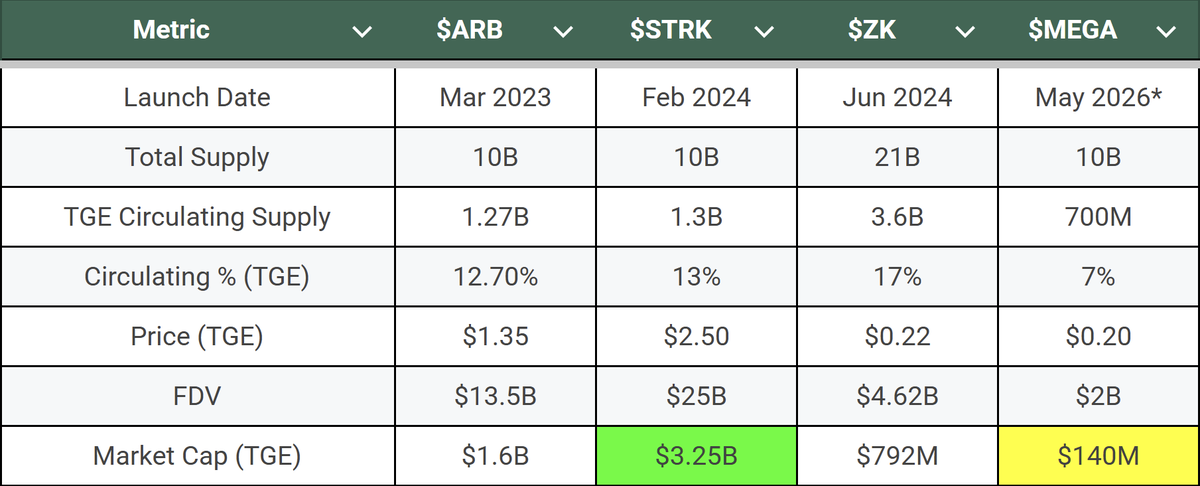
I did some math for the upcoming @megaeth token $MEGA launch.
Based on the data we have right now from:
- Pre-market price (Hyperliquid perps)
- Assumed TGE circulating supply
- Assumed TGE date
Then, comparing it with other L2 TGE statistics.
If this data happens to be correct, then all I can say is that $MEGA is mispriced. Extremely undervalued at the moment.
Note:
- It is a very different market condition
- We do not have any major L2 chain TGE this year to compare with
- I used data from the OG L2 chain Arbitrum, and recent major L2 launches like Starknet and ZKsync
Thoughts? 👇
HIPAA and GDPR without cloud. On iPhone.
OpenMedKit runs 200+ PII models. Now adding GLiNER: 90+ state-of-the-art zero-shot clinical NER. De-identify PII → extract medications, symptoms, diagnoses. All on device.
OpenMed's first production-ready iOS library for medical AI.