Kalau follow @farisrachman_1
kan sering baca artikel2nya tentang industrialisasi Indonesia.
Nah, cici2 mainland ini secara singkat dan jelas menjabarkan kenapa menurutnya Indonesia tidak akan bisa industrialisasi...
Semua ekonom wajib noton nih gaes
Synthetic data is turning into an optimization loop.
Instead of generating data once, Autodata trains an agent to write, critique, and rewrite its own training set.
Better models don't just learn from data. They learn how to create better data.
Highly relevant!
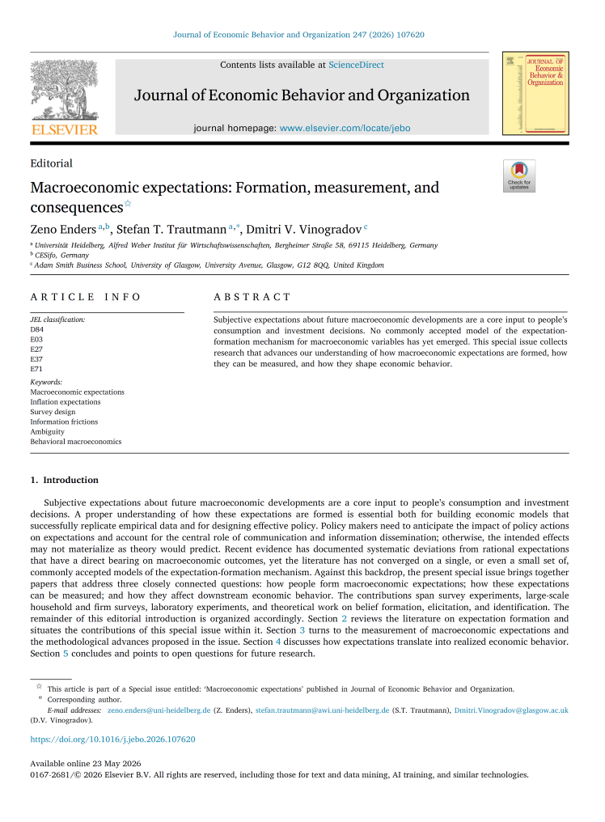
"Macroeconomic expectations: Formation, measurement, and consequences" by Zeno Enders, Stefan T. Trautmann, and Dmitri V. Vinogradov. An editorial for the "Macroeconomic expectations" special issue in the Journal of Economic Behavior and Organization.
"The contributions assembled in this special issue cut across the three thematic strands of formation, measurement, and consequences of expectations, but they speak to one another in ways that suggest a more integrated agenda. On the formation side, the new evidence reinforces the picture of expectations as the joint product of information frictions, cognitive limitations, social influences, and salient personal experiences, rather than the output of a single canonical mechanism. On the measurement side, the papers in the issue show that the apparent properties of expectations – their level, dispersion, and uncertainty – depend systematically on how questions are framed, on which response format is used, and on how the elicited distributions are summarized; methodological choices are not innocuous, and the comparability of results across surveys and over time hinges on them. On the consequences side, the evidence confirms that expectations influence behavior across households, firms, and asset markets, but also that detecting these effects depends on careful identification strategies, structural model integration, randomized information experiments, and laboratory designs, each with its own strengths and limitations."
https://t.co/G6L3vQKBP9
This looks like a must-read!
"Macro: The Economic Models That Shape Our World" by Greg Kaplan (available in November).
"In clear and engaging prose, Chicago economist Greg Kaplan demystifies how our everyday behavior, including how we spend and save, connects to the biggest questions in fiscal and monetary policy. Tracing the evolution of modern macroeconomics from Keynes to today, he guides readers through the models that are often used to explain our economy, uncovers their flaws, and reveals what cutting-edge research tells us about managing the economy in good times and bad. The journey culminates in HANK, a macroeconomic model co-created by Kaplan that is more consistent with reality. Macro offers a timely, new framework for understanding and shaping economics in the real world."
https://t.co/IxOWTajiak
Economics has never been, and never will be, a value-free science.
At its core, economics is shaped by ideologies, value judgements, competing interests, social norms, and political priorities.
Adam Smith and Karl Marx — two of the most important figures in the history of economics — both treated it as an inherently political subject. They didn't even call it "economics." They called it political economy.
For Smith, the study of wealth creation was inseparable from questions about the state, social class, and moral philosophy. For Marx, the economy was a system of power relations.
Yet most introductory economics textbooks relegate politics, power, and history to footnotes. Technical models fill the space instead, abstractions that describe an imaginary economy more than the real one.
My newsletter's most popular piece is on how economics became a discipline detached from politics — despite the fact that it is intrinsically and unavoidably political.
Link to the full piece in the comments.
We usually repeat that correlation doesn’t imply causation, which is true. But the reverse, causation doesn’t imply correlation, is ALSO true.
Let X~N(0,1) and Y=X^2. In this example, X causes Y.
But the correlation between X and Y is Corr(X,Y)=Corr(X,X^2)=Cov(X,X^2)/(σ_X*σ_(X^2))=(E[X*X^2]-E[X]*E[X^2])/(σ_X*σ_(X^2))=0. Why?👇
The function h(x)=x^3 is odd:
(-x)^3=-x^3
and the distribution is symmetric around 0, f is even:
f(x)=f(-x)
Thus (x^3)*f(x) is odd (odd*even=odd function) and the integral of an odd function over a symmetric interval is 0.
Thus E[X^3]=∫X^3*f(x)dx=0
(the integral is from -♾️ to ♾️)
The same occurs with the function g(x)=x because g(-x)=-x=-g(x) (it’s odd).
So E[X]=∫X*f(x)dx=0
(the integral is again from -♾️ to ♾️)
Thus Corr(X,Y)=0 because Cov(X,X^2)=0.
Thus we have proven that causation DOES NOT IMPLY correlation.
Q. E. D. ▪️
I have written a comprehensive primer on the theory of trade. My intent in writing is that, with half an hour’s reading, you will be able to understand what economists on the frontier are doing. Read it all below:
Let me clatify this problem for everyone.
MV = PY is an identity. It simply states that you need enough money to cover all transactions. The theory is about how you think money M, velocity V, prices P, and output Y interact.
The intuition behind monetarism is often conveyed to undergraduates by saying that if you hold V and Y constant, then changes in M will be reflected in changes in P. That is the simplest way to say that printing money causes inflation. The problem is that this isn't the actual theory and it glances over important nuances.
For starters, in the theory behind all of this, 1/V is money demand and that thing varies over time. The grown-up version of V is constant is V is covariance stationary meaning that it fluctuates around a stable mean. That is precisely what people debated in the 80s and 90s, and more recently in the 2010s using a different way to measure money in the US (specifically, the latter research used Divisia indexes).
One reason this matters is that if money demand and money supply both increase, M rises and V falls, so there need not be a rise in prices. Intuitively, people have to use the money to bid up prices. Nothing happens if everyone sits on it.
The other reason this is important is the nature of the signal you get from variations in M to predict variations in P. What theory gives you is a long-run relationship between M, P, and Y: if V fluctuates around a stable mean, then M, P, and Y have to "grow together" and, if they break apart too much, they get pulled back in. The technical term is that M, P, and Y share a stochastic trend -- they are cointegrated. So, what the theory buys you is what we call an "error correction" mechanism that keeps everything together over long periods of time. It's not nothing. To first order and with some assumptions, it says that 2% inflation and 2% real GDP growth requires 4% money growth over the long-run. But it's not clear that it's a great signal to forecast inflation -- other things besides monetary policy moves stuff in that equation.
Now, back to policy. Monetary policy in Canada only engaged in quantitative easing during the pandemic. Otherwise, the Bank of Canada usually works by setting a short term interest rate, not by targetting changes in the money supply. So, it's hard to measure those things just for Canada, but one can try.
To do it, you have to ask yourself what happened between March 2020 and the peak of inflation in June 2022 (healine CPI peaked there year-over-year). Can you really attribute all or even most of this to unconventional monetary policy? Because there were massive fiscal expansions in both Canada and the US, lockdowns and subsequent easing of punlic health policy, disruptions in shipping, energy and commodity markets, and the Canadian labor market was extraordinarily tight for a while... Where does any of this figure in your analysis?
I am working on a project specifically on that inflation episode for the US and Canada using a model estimated before the pandemic (partly to see if "old" explanations are enough). I don't explicitly treat unconventonal monetary policy like QE and FG, but it would probably show up as demand shocks in my model. And I also have some policy counterfactuals to think about the cost of moving to hike rates earlier when inflation started rising. I'll be sharing preliminary results in two weeks at the SCSE conference in Quebec City. Feel free to follow my work and take a look later this year when we have a full working paper ready.
🧵1/7) On the difference between dynamical systems in #physics vs #economics. Example 1.
The case of Ramsey-Cass-Koopmans (RCK).
Instability and learning the initial condition for c.
A point that is sometimes overlooked is that PDEs in physics and economics have a subtle but important difference.
When a physicist solves the Schrödinger equation (see my slide below), the potential is given. The coefficients of the equation are part of the problem statement. You pick your grid, refine your mesh, and the equation never changes on you. Better numerics give a better approximation to a fixed target.
In economics, this is not the case. Look at the Hamilton-Jacobi-Bellman equation for the neoclassical growth model (also slide below). The drift of capital depends on a derivative of the value function, the very object you are trying to solve for. The “coefficients” of the PDE are endogenous to the optimal choices of the agents. This is what @UncertainLars and Sargent referred to as the cross-equation restrictions implied by optimizing behavior.
This is what @MahdiKahou and I call the “equilibrium loop”: improving your approximation changes the policy, which changes the dynamics, which changes where in the state space the economy spends its time, which changes where your approximation needs to be accurate. You are not chasing a fixed target with a better net. Moving the net moves the target.
This has serious consequences for computation. You cannot just borrow neural network architectures from deep learning in the natural sciences. The loss function comes from equilibrium conditions, not from labeled data. The evaluation points are not given. Instead, they are regenerated each epoch from the current approximation. Ignoring it is why you often get solutions that look good on a training set but fall apart in simulation.
A slightly simplified version of Mankiw-Reis makes it trivial to compute analytic solutions, and solves one of the main problems of monetary economics, how higher interest rates lower inflation going forward
https://t.co/SmAZBHBBhR
Academic Economics Is a Degenerating Research Program
Far too many economists are comfortable making first order analysis and then issuing prescriptions and forecasts off of it. Single variable inference in a system that's inherently multi-causal. Their ex-post regressions routinely confuse not sufficient with doesn't matter. But if you can't explain how the entire system adjusts, those first order explanations are worthless. Any systems analyst would know that intuitively. But most economists aren't systems thinkers. Which is ironic, because they are studying a system.
The root of this goes back to Walras and Jevons. They began arbitrarily making up unrealistic assumptions about the world for the sole purpose of making their equilibrium math work. The profession followed to its demise. Most economists today aren't good enough mathematicians to recognize the folly in using equilibrium models to describe a complex adaptive system. The only time a complex adaptive system is ever in equilibrium is when it's dead.
Physicists use simplified models too, but they are extremely careful that their simplifications don't change the relationships so that the model no longer describes the real world. Does the map explain the territory? As Poincaré wrote to Walras, "If the arbitrary functions reappear in these consequences, the conclusions will be devoid of all interest". Most of academic economics today produces models that only describe a theoretical fantasy world. Because if they don't model it that way, they can't say anything at all.
Economists love making cause and effect statements but they only take the chain to the first order. They can't describe the feedback loops, so they just ignore them. Act like they don't exist. Or model them as exogenous variables. For them, all the interesting things happen outside the model. Systems are highly unintuitive, and if you can't describe how the system as a whole adjusts, then looking at first order effects alone will give you wrong predictions and descriptions. If you want to call yourself a science, you should be able to make predictions. The economists at the Fed are atrocious at predicting interest rates. We have the data.
They get away with it because they live in the ivory tower. They aren't forced to reckon with the uselessness of their models the way people in markets are brutally confronted with reality in the form of a daily P&L. A theory's scientific value depends on its capacity to generate testable, falsifiable predictions that prove useful in practice. Make a call, watch the tape, explain why it worked or didn't. That feedback forces you to confront unambiguous outcomes instead of arguing from priors. Markets give you a scoreboard. When you're forced to make predictions and live with the result, you quickly learn where your model is missing a channel. Macro arguments that aren't tied to falsifiable predictions drift into storytelling.
If their models truly captured how the economy works, investment firms would be aggressively bidding for economists' services. The fact that successful funds ignore academic economic research while employing their own analysts…people who think in terms of flows, sectoral balances, and system dynamics…tells you everything you need to know about the practical value of mainstream economic theory. Every Fortune 500 company used to employ a team of economists. They've almost all been fired because they added negative value. So economists have retreated into the last bastion where you don't have to be useful to keep your job…academia and think tanks.
Investment professionals can't afford the luxury of elegant but irrelevant models. They need frameworks that actually predict how markets and economies adjust to changing conditions, so they've naturally evolved toward real systems analysis like tracking cross border flows, understanding institutional constraints, following accounting identities through their full implications.
Accounting identities work like conservation laws in physics. Energy conservation doesn't tell you how a collision will unfold, but it absolutely constrains which outcomes are possible. Accounting identities reveal where adjustment mechanisms must be operating, even when you can't directly observe them. They're forcing functions for systems thinking, and they prevent you from making claims about one part of the system without accounting for how the whole system adjusts. Most academic economists don't subject their claims to that kind of discipline. They can make statements about one side of an identity without ever being forced to explain what has to adjust on the other side.
The economics profession has been rotted out by institutional capture. PhDs writing papers no one outside their silo reads or uses for any prediction with real money on the line. Just people writing back and forth and patting each other on the back. Their peer review system rewards mathematical sophistication rather than predictive accuracy. It's reminiscent of what Kuhn described about scientific paradigms in crisis, the practitioners become increasingly focused on solving puzzles within their framework rather than questioning whether the framework itself corresponds to reality. A degenerating research program that explains away its failures rather than adapting its methods.
The biggest travesty is that along the way they managed to fool themselves into thinking what they are doing benefits the world. Most of their analysis is relatively harmless because no one listens to it, let alone acts on it. The problem occurs when economists who have spent their entire career modeling a theoretical fantasy world, and have zero experience putting actual money behind their predictions, get put into positions where they are tasked with setting policy in the real world. That is a recipe for disaster, and we should have expected nothing less. It is insanity that we have FOMC members with zero real world experience in making predictions tasked with making the most important predictions in our economy. This skill isn't even considered a prerequisite for the job. But write a bunch of inconsequential papers whose only use is for people to cherry pick to justify preconceived positions...well, the job is yours.
To be clear, there are economists who produce highly useful analysis that I regularly use to trade markets. But their work looks nothing like what comes out of academia. Or the Fed.
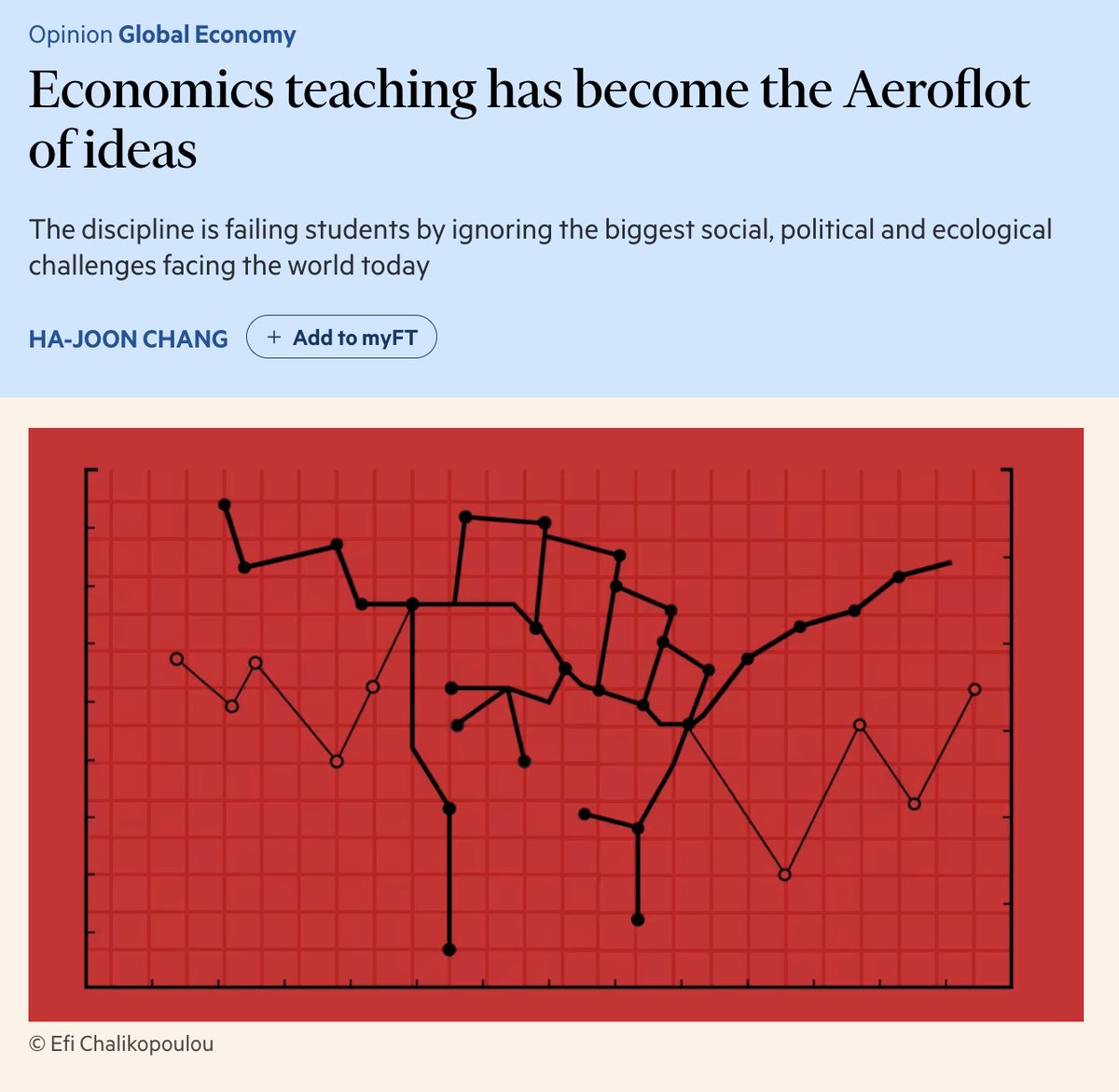
Ha-Joon Chang compares mainstream economics to Catholicism in the Middle Ages.
“Economics today resembles Catholic theology in medieval Europe: a rigid doctrine guarded by a modern priesthood who claim to possess the sole truth. Dissenters are shunned.”
Krisis itu pasti multikausal, dan pasti ada dampak dari sisi governance kita yang jelek. Tapi gue ngerasa ini penjelasan yang overrated terkait dampak Krisis 1998.
Ekonom mainstream-pun sangat kritis terhadap peran IMF (meskipun tentu bukan satu-satunya penyebab dan ga ada konspirasi sama sekali) dalam Krisis 1998
Kenapa? Karena ada contoh Malaysia yang governance-nya juga jelek, kapitalisme kroni di mana-mana...
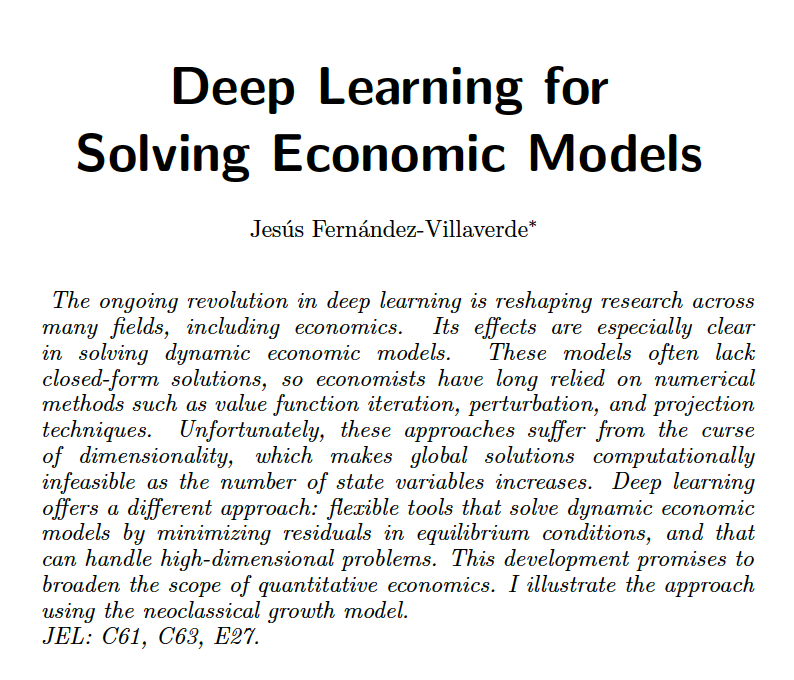
I am very happy that my survey paper, "Deep Learning for Solving Economic Models," is forthcoming in the Journal of Economic Literature (pending final replication checks, which should be quick).
The paper benefited greatly from the editor, David Romer, five referees, and many friends who read earlier versions. I believe the result is a solid introduction to the field, though in 48 pages, there is only so much one can do. So, I created a companion webpage:
https://t.co/zZpOLFXpDk
where you can find the paper, the code, and some slide decks with my teaching material. My plan is to expand the slides over time, adding new material and updating them as new results appear. I will probably do a thorough revision once the spring semester is over.
Those who follow my feed know that I think deep learning is the most fundamental change to computational economics in the last 40 years. I am by now convinced it is more important than the development of Markov chain Monte Carlo methods in the early 1990s or the introduction of projection and perturbation methods in the 1980s. To find a comparable shift, one would probably need to go back to Richard Bellman's invention of value function iteration in 1957.
More pointedly, we need to redesign the Ph.D. in economics. Not at the margin. From the ground up. Economists can either fully embrace the deep learning revolution or become irrelevant, as has already happened, I would dare say, to some fields in academia that refused to accept reality.
Finally, let me apologize to everyone working in this area whom I could not cite. Space was a binding constraint.
And yes, this post was written with the considerable help of AI. There is nothing I am prouder of than the fact that AI is now an integral part of every step I take in my professional life.
To say that empirical work would be different were it not for Christopher Sims is an understatement:
-Sargent and Sims (1977): introduced dynamic factor models
-Sims (1980):
introduced structural VARs
-Doan, Litterman, and Sims (1984): introduced reduced-form conditional forecasts in VARs
-Sims, Stock, and Watson (1990):
establish consistency and asymptotic normality of OLS under unit roots (he has several entries in the unit root debates of the late 80s and early 90s)
...
But my favorite Sims moments were his comments on methodology. When everyone obsesses over robustness, Christopher Sims comes out and tells people they ought to model that covariance instead of appending coma r in STATA (search for "sharp econometrics").
And he repeatedly argued that econometrics should be done in Bayesian terms. We'll see if he wins that debate one day.






![FranNunesEcon's tweet photo. We usually repeat that correlation doesn’t imply causation, which is true. But the reverse, causation doesn’t imply correlation, is ALSO true.
Let X~N(0,1) and Y=X^2. In this example, X causes Y.
But the correlation between X and Y is Corr(X,Y)=Corr(X,X^2)=Cov(X,X^2)/(σ_X*σ_(X^2))=(E[X*X^2]-E[X]*E[X^2])/(σ_X*σ_(X^2))=0. Why?👇
The function h(x)=x^3 is odd:
(-x)^3=-x^3
and the distribution is symmetric around 0, f is even:
f(x)=f(-x)
Thus (x^3)*f(x) is odd (odd*even=odd function) and the integral of an odd function over a symmetric interval is 0.
Thus E[X^3]=∫X^3*f(x)dx=0
(the integral is from -♾️ to ♾️)
The same occurs with the function g(x)=x because g(-x)=-x=-g(x) (it’s odd).
So E[X]=∫X*f(x)dx=0
(the integral is again from -♾️ to ♾️)
Thus Corr(X,Y)=0 because Cov(X,X^2)=0.
Thus we have proven that causation DOES NOT IMPLY correlation.
Q. E. D. ▪️](https://pbs.twimg.com/media/HIhXfFaWQAAHrru.jpg)